Topic: Friends - Bài mẫu IELTS Speaking Part 1 kèm audio & từ vựng
Trong bài viết này, tác giả sẽ đưa ra các từ vựng liên quan đến chủ đề Friends kèm theo cách áp dụng các từ vựng này vào phần thi IELTS Speaking Part 1.
Một số câu trả lời tham khảo cho các câu hỏi thường gặp trong IELTS Speaking Part 1 chủ đề “Friends”:
What do you do together with your friends?
Do you prefer to have a big or small group of friends?
What kinds of people do you like to have as friends?
Do you prefer to spend time alone or with friends?
Bài viết sau đây sẽ cung cấp các câu trả lời mẫu theo khung sườn tư duy cùng các thử thách nâng cấp về cả ý tưởng, từ vựng và ngữ pháp để người học lựa chọn được câu trả lời phù hợp với bản thân, sẵn sàng cho các tình huống trong phòng thi. Bài phân tích này sẽ dẫn dắt người học đi qua chủ đề Friends, từ những khoảnh khắc đi chơi giải tỏa áp lực (hang out) và chia sẻ về nhịp sống hằng ngày (chat about daily life) để nạp lại năng lượng, cho đến việc nhìn nhận sâu sắc giá trị cốt lõi của một tình bạn đích thực thiên về chất lượng hơn số lượng, giúp người học chinh phục giám khảo bằng sự mạch lạc và ngôn ngữ tự nhiên.
IELTS Speaking Part 1: Friends Sample Answers
Simple Answer
1. Do you spend a lot of time with your friends?
If yes:
Yes, I do. I often spend time with my friends after school or on weekends. We usually talk, eat out, or watch movies together.
If no:
Not really. I’m quite busy, so I don’t meet my friends very often. But we still text each other online.
Dịch nghĩa:
Có. Em thường dành thời gian với bạn bè sau giờ học hoặc vào cuối tuần. Tụi em thường nói chuyện, đi ăn hoặc xem phim cùng nhau.
Dịch nghĩa:
Không hẳn. Em khá bận nên không gặp bạn bè thường xuyên. Nhưng tụi em vẫn nhắn tin với nhau qua mạng.
2. Where do you usually meet your friends?
If you meet outside:
We usually meet at coffee shops or shopping malls. These places are comfortable, and we can talk for a long time.
If you meet at school / near home:
I usually meet my friends at school or near my house. It’s easy and convenient for all of us.
Dịch nghĩa:
Tụi em thường gặp nhau ở quán cà phê hoặc trung tâm thương mại. Những nơi này thoải mái và tụi em có thể nói chuyện lâu.
Dịch nghĩa:
Em thường gặp bạn ở trường hoặc gần nhà. Điều đó dễ dàng và thuận tiện cho tất cả tụi em.
3. Do you prefer having a few close friends or many friends? Why?
If you prefer a few close friends:
I prefer having a few close friends. I can trust them and share my problems with them. For me, quality is more important than quantity.
If you prefer many friends:
I prefer having many friends. It’s fun because I can meet different people and learn new things from them.
Dịch nghĩa:
Em thích có vài người bạn thân hơn. Em có thể tin tưởng họ và chia sẻ vấn đề của mình với họ. Với em, chất lượng quan trọng hơn số lượng.
Dịch nghĩa:
Em thích có nhiều bạn hơn. Điều đó vui vì em có thể gặp nhiều người khác nhau và học được những điều mới từ họ.
4. Have your friendships changed since you were younger?
If yes:
Yes, they have changed a lot. When I was younger, I made friends easily, but now I care more about trust and understanding.
If no / not much:
Not much. I’m still close to some old friends from school. We don’t meet every day, but we still keep in touch.
Dịch nghĩa:
Có, tình bạn của em đã thay đổi nhiều. Khi còn nhỏ, em kết bạn dễ dàng, nhưng bây giờ em quan tâm nhiều hơn đến sự tin tưởng và thấu hiểu.
Dịch nghĩa:
Không nhiều. Em vẫn thân với một vài người bạn cũ ở trường. Tụi em không gặp nhau mỗi ngày, nhưng vẫn giữ liên lạc.
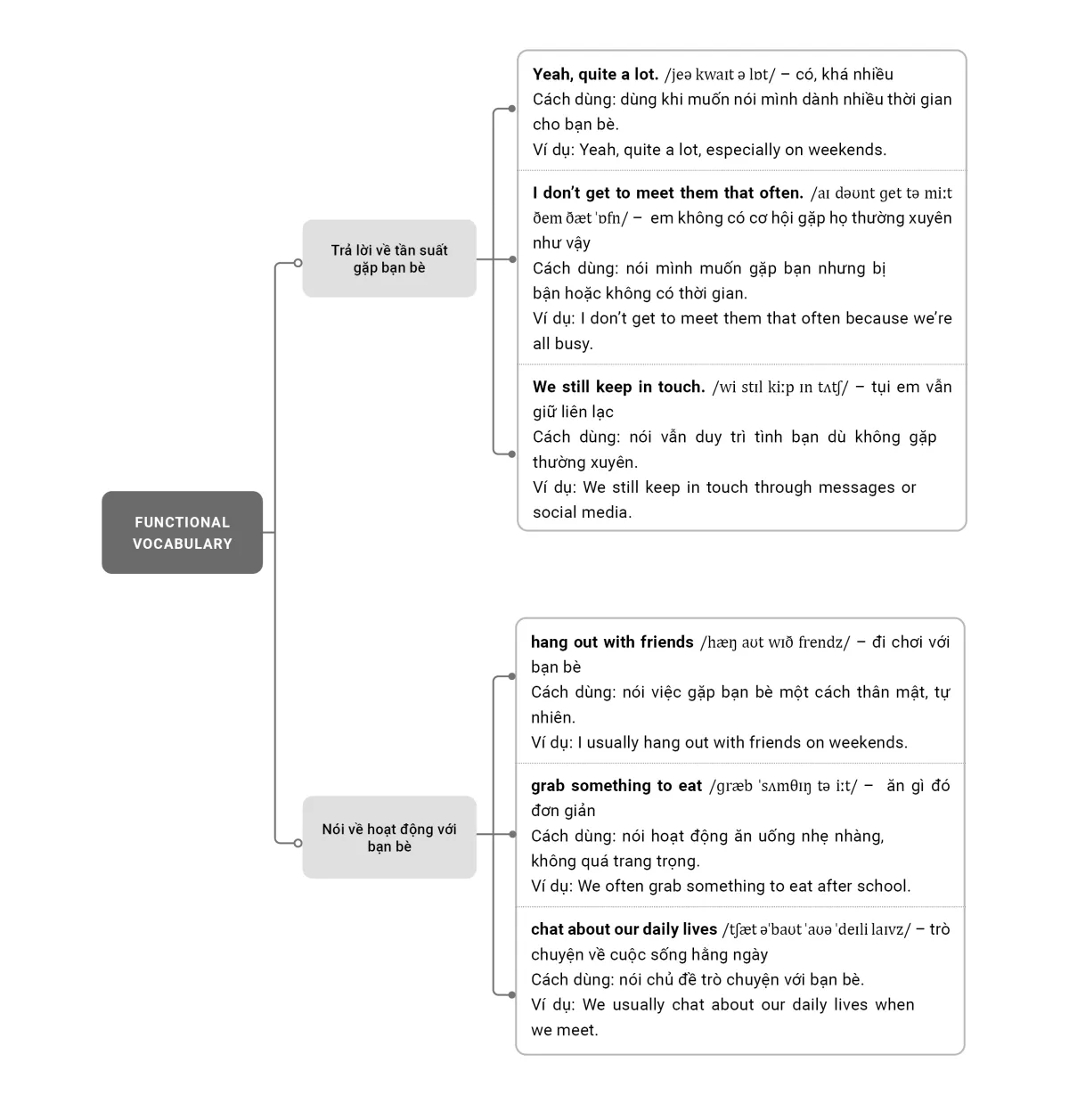
Yeah, quite a lot, especially on weekends. We usually hang out at coffee shops, grab something to eat, or just chat about our daily lives. To be honest, spending time with friends helps me recharge after a busy week.
If no:
Not really, to be honest. I’m usually tied up with school or work, so I don’t get to meet my friends that often. That said, we still keep in touch through messages or social media.
Dịch nghĩa:
Dạ có, khá nhiều, đặc biệt là vào cuối tuần. Tụi em thường đi chơi ở quán cà phê, ăn gì đó hoặc nói chuyện về cuộc sống hằng ngày. Thật lòng thì dành thời gian với bạn bè giúp em nạp lại năng lượng sau một tuần bận rộn.
Dịch nghĩa:
Thật ra thì không hẳn. Em thường bận học hoặc bận việc nên không gặp bạn bè thường xuyên được. Tuy vậy, tụi em vẫn giữ liên lạc qua tin nhắn hoặc mạng xã hội.
2. Where do you usually meet your friends?
If you meet outside:
We usually meet at coffee shops or shopping malls because they’re convenient and comfortable. These places give us enough space to talk for hours without feeling rushed. Sometimes, we also try new restaurants just for a change of scenery.
If you meet at school / near home:
I usually meet my friends at school or somewhere near my house. It’s much easier to arrange because everyone is familiar with the place. Plus, we don’t have to spend too much time travelling.
Dịch nghĩa:
Tụi em thường gặp nhau ở quán cà phê hoặc trung tâm thương mại vì những nơi đó tiện và thoải mái. Những nơi này cho tụi em đủ không gian để nói chuyện hàng giờ mà không thấy bị vội. Đôi khi tụi em cũng thử nhà hàng mới để đổi không khí.
Dịch nghĩa:
Em thường gặp bạn ở trường hoặc đâu đó gần nhà. Điều đó dễ sắp xếp hơn nhiều vì mọi người đều quen với địa điểm đó. Hơn nữa, tụi em không phải mất quá nhiều thời gian di chuyển.
3. Do you prefer having a few close friends or many friends? Why?
If you prefer a few close friends:
I’d definitely prefer having a few close friends. For me, friendship is more about quality than quantity. With close friends, I can be myself, share personal problems, and know that they’ll have my back.
If you prefer many friends:
I think having many friends also has its advantages. It allows me to meet different types of people and learn from different perspectives. Of course, not all of them will be close friends, but having a wide social circle can make life more interesting.
Dịch nghĩa:
Em chắc chắn thích có vài người bạn thân hơn. Với em, tình bạn thiên về chất lượng hơn là số lượng. Với bạn thân, em có thể là chính mình, chia sẻ vấn đề cá nhân và biết rằng họ sẽ luôn ủng hộ em.
Dịch nghĩa:
Em nghĩ có nhiều bạn cũng có lợi thế riêng. Điều đó giúp em gặp nhiều kiểu người khác nhau và học từ nhiều góc nhìn khác nhau. Dĩ nhiên không phải ai cũng là bạn thân, nhưng có một vòng quan hệ rộng có thể làm cuộc sống thú vị hơn.
4. Have your friendships changed since you were younger?
If yes:
Yes, definitely. When I was younger, I made friends quite easily, mostly because we studied or played together every day. But now, I’m more selective, and I value trust, loyalty, and emotional support much more.
If no / not much:
Not really, at least not with my closest friends. We may not meet as often as we used to, but we still keep in touch and support each other. I guess real friendship can stand the test of time.
Dịch nghĩa:
Dạ có, chắc chắn rồi. Khi còn nhỏ, em kết bạn khá dễ, chủ yếu vì tụi em học hoặc chơi cùng nhau mỗi ngày. Nhưng bây giờ em chọn lọc hơn và coi trọng sự tin tưởng, lòng trung thành và sự hỗ trợ tinh thần nhiều hơn.
Dịch nghĩa:
Không hẳn, ít nhất là với những người bạn thân nhất của em. Tụi em có thể không gặp nhau thường xuyên như trước, nhưng vẫn giữ liên lạc và hỗ trợ nhau. Em nghĩ tình bạn thật sự có thể vượt qua thử thách của thời gian.
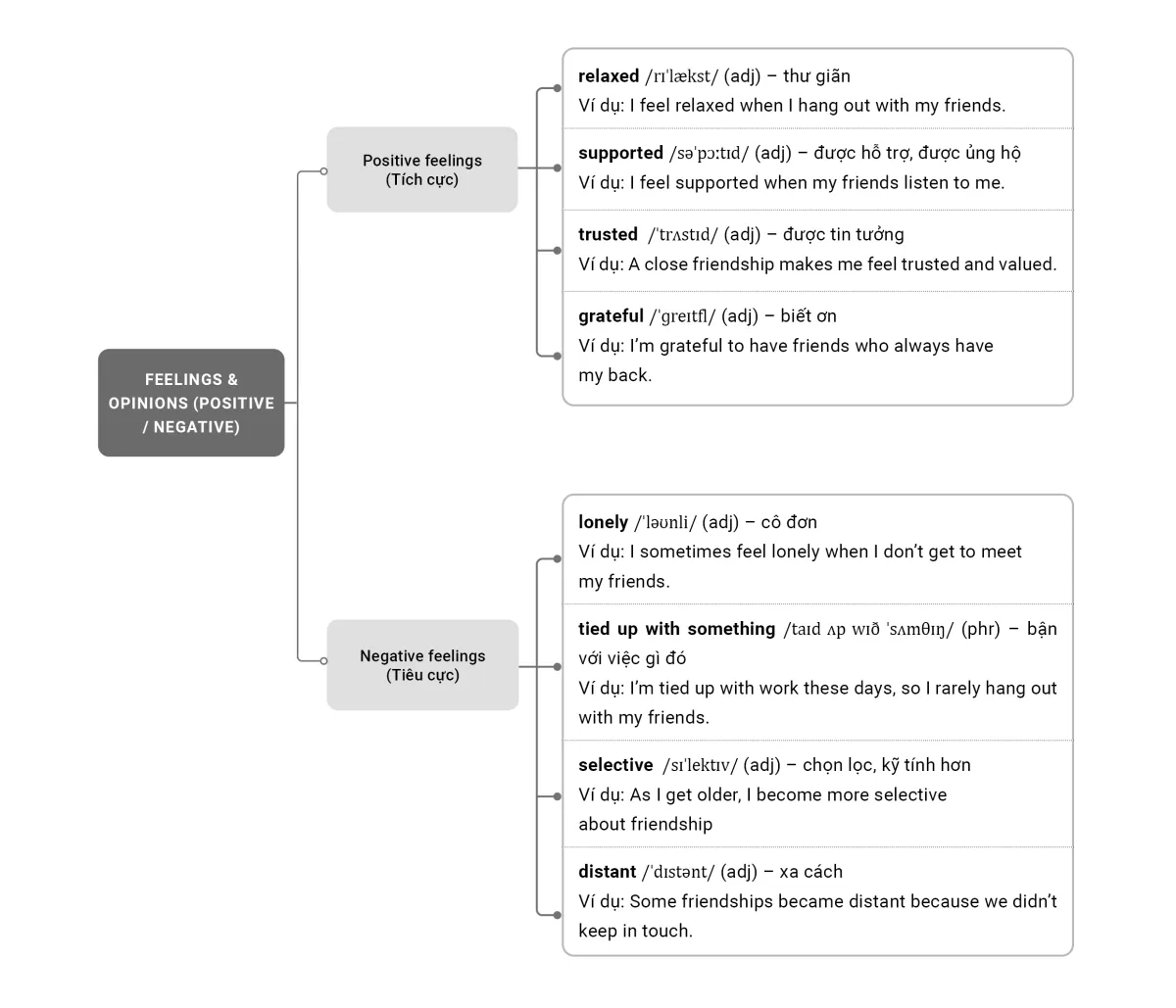
Phân tích từ vựng
Nhật ký Từ vựng & Ý tưởng
Ghi chú sau khi luyện tập nói về chủ đề trên
Từ vựng/Ý tưởng
(Chọn các từ vựng/ý tưởng mà bạn tâm đắc nhất)
Kỉ niệm cá nhân
(Gán các từ vựng/ý tưởng đã chọn với kỉ niệm của bản thân)
Ví dụ: Friendship is more about quality than quantity. /ˈfrendʃɪp ɪz mɔːr əˈbaʊt ˈkwɒləti ðən ˈkwɒntəti/ – tình bạn thiên về chất lượng hơn số lượng
Người đọc tự đặt các câu hỏi cho bản thân, ví dụ:
Do I spend a lot of time with my friends?
Where do I usually meet my friends?
Do I prefer a few close friends or many friends?
Have my friendships changed as I’ve grown older?
Who are the friends that always have my back?
→ I don’t get to meet my friends that often because we’re all busy with school or work. However, we still keep in touch through messages and sometimes hang out at coffee shops on weekends. Personally, I believe friendship is more about quality than quantity, so I’d rather have a few close friends than a large social circle. With my close friends, I can be myself, share personal problems, and know that they will always have my back. Some friendships may become distant over time, but real friendship can stand the test of time.
Khoảng trống diễn đạt
(Phần khiến bạn ngập ngừng khi nói về chủ đề trên)
Giải pháp
(Giải pháp cho các khoảng trống diễn đạt)
Ví dụ:
Mình muốn nói: “Em không gặp bạn thường xuyên như trước, nhưng tụi em vẫn giữ liên lạc,” hoặc “Em thích vài bạn thân hơn vì tình bạn quan trọng chất lượng hơn số lượng,” nhưng mình bí các từ vựng diễn đạt những điều này.
Ví dụ:
Dùng từ điển của ZIM để tìm cụm từ cần sử dụng tương ứng hoặc áp dụng từ vựng ở các câu trả lời mẫu trong bài này:
keep in touch /kiːp ɪn tʌtʃ/ – giữ liên lạc
Friendship is more about quality than quantity. /ˈfrendʃɪp ɪz mɔːr əˈbaʊt ˈkwɒləti ðən ˈkwɒntəti/ – tình bạn thiên về chất lượng hơn số lượng
be myself /bi maɪˈself/ – là chính mình
stand the test of time /stænd ðə test əv taɪm/ – vượt qua thử thách của thời gian
→ I don’t get to meet my friends as often as I used to, but we still keep in touch through messages. For me, friendship is more about quality than quantity. With my close friends, I can be myself and share my problems without feeling judged. I believe real friendship can stand the test of time.
Người đọc có thể tìm từ vựng bằng từ điển của ZIM: ZIM Dictionary
Các lỗi ngữ pháp thường gặp
1) spend time with friends
Lỗi thường gặp: “I spend a lot of time for my friends.”
Cách dùng đúng:
spend time with someone = dành thời gian với ai
spend time on something = dành thời gian cho việc gì
Không dùng spend time for someone trong ngữ cảnh này.
Câu đúng: I spend a lot of time with my friends on weekends. (hoặc) I spend a lot of time on schoolwork, so I don’t meet my friends often.
Lý do sai: Khi nói “dành thời gian ở cùng ai”, dùng with someone, không dùng for someone.
2) not as + adverb/adjective + as + S + used to
Lỗi thường gặp: “We don’t meet as often like before.”
Cách dùng đúng:
not as often as we used to = không thường xuyên như trước đây
not as close as we used to be = không thân như trước đây
Cấu trúc đầy đủ: not as + adj/adv + as + S + used to + V/be
Câu đúng: We don’t meet as often as we used to, but we still keep in touch. (hoặc) Some of my friendships are not as close as they used to be.
Lý do sai: Khi so sánh hiện tại với quá khứ, dùng as...as, không dùng like before sau as often. Cấu trúc as often as we used to giúp câu tự nhiên và đúng ngữ pháp hơn trong Speaking.
3) having + noun / V-ing as a subject
Lỗi thường gặp: “Have many friends can make life more interesting.”
Cách dùng đúng:
Khi một hành động làm chủ ngữ, dùng V-ing
Having many friends = việc có nhiều bạn
Having a few close friends = việc có vài người bạn thân
Câu đúng:Having many friends can make life more interesting. (hoặc) Having a few close friends is better than having a wide social circle.
Lý do sai: Động từ nguyên mẫu have không thể đứng một mình làm chủ ngữ trong câu. Khi muốn nói “việc có nhiều bạn”, cần đổi thành Having many friends.
Mini practice
Dùng đúng cấu trúc trong ngoặc
Hãy nói chung về việc bạn có dành nhiều thời gian với bạn bè không, và thường làm gì cùng họ. (Dùng: spend time with friends — không dùng spend time for friends)
Hãy nói về việc bạn và bạn bè có còn gặp nhau thường xuyên như trước không. (Dùng: not as often as we used to hoặc not as close as we used to be — không dùng as often like before)
Hãy nói chung về việc có nhiều bạn hay có vài bạn thân thì tốt hơn. (Dùng: Having many friends / Having a few close friends làm chủ ngữ — không dùng Have many friends can…)
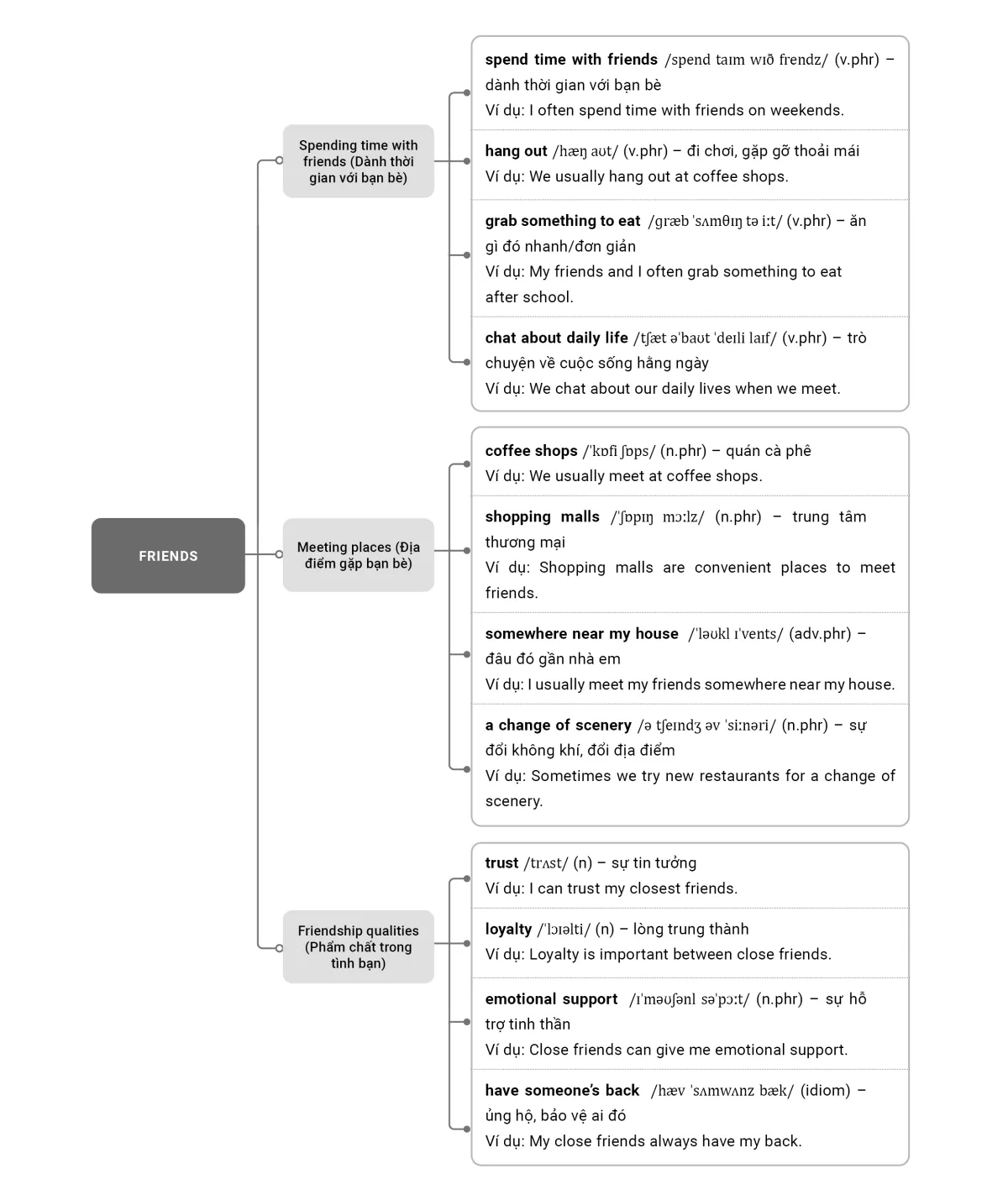
Từ vựng: spend time with friends, hang out, grab something to eat, chat about daily life, coffee shops, shopping malls, keep in touch, close friends, a wide social circle, different perspectives, trust, loyalty, emotional support, have my back, be myself, quality than quantity, not as often as we used to, stand the test of time ...
Ý tưởng:
Bạn bè thường gặp nhau ở coffee shops, trường học hoặc những nơi gần nhà vì thuận tiện và thoải mái.
Dành thời gian với bạn bè giúp mình recharge sau khi học tập hoặc làm việc căng thẳng.
Có nhiều bạn giúp mình gặp different types of people và học từ different perspectives.
Có vài close friends giúp mình cảm thấy an toàn hơn vì có thể be myself và chia sẻ vấn đề cá nhân.
Khi lớn lên, tình bạn có thể thay đổi vì mọi người bận hơn, nhưng bạn thật sự vẫn có thể stand the test of time.
Mini practice: Sử dụng từ vựng và ý tưởng ở trên để trả lời các câu hỏi sau
What do you usually do with your friends in your free time? (Gợi ý: hang out, grab something to eat, chat about daily life, recharge)
Do you prefer meeting friends in person or keeping in touch online? Why? (Gợi ý: keep in touch, social media, messages, not as often as we used to)
Do you think it is better to have a few close friends or many friends? (Gợi ý: quality than quantity, close friends, a wide social circle, different perspectives)
What qualities are important in a good friend? (Gợi ý: trust, loyalty, emotional support, have my back, be myself)
Bài mẫu mở rộng
1. What do you do together with your friends?
I love hanging out with my friends and we do all sorts of things together. We might hit up a restaurant or catch a movie, or if we're feeling active, we'll play some sports. We're always down to try something new too, like going to a concert or taking a class to learn a new skill.
hit up: đi đến một nơi nào đó
E.g: I'm going to hit up the grocery store on my way home.
catch a movie: đi xem phim
E.g: Let's catch a movie together tonight.
2. Do you prefer to have a big or small group of friends?
Personally, I'd rather have a small group of tight-knit friends that I can really connect with. Having a ton of friends sounds cool in theory, but it's hard to maintain those relationships and really get to know people on a deeper level.
Tight-knit: mối quan hệ thân thiết
E.g: Our family is very tight-knit and always supports each other.
in theory: trên lý thuyết
E.g: In theory, this plan sounds great, but in practice, it may not work out.
3. What kinds of people do you like to have as friends?
When it comes to friends, I'm all about kindness, authenticity, and support. I think it's important to have friends who are genuine and who will be there for you when you need them. Plus, a good sense of humor never hurts!
Authenticity: sự chân thật
a good sense of humor: khiếu hài hước
E.g: John has a good sense of humor and always makes us laugh.
4. Do you prefer to spend time alone or with friends?
Honestly, I'm pretty flexible when it comes to spending time alone or with friends. Sometimes I need some me-time to recharge and focus on my own thing, but other times I'm craving some company and good conversation. It really depends on my mood and what I have going on at the time.
Me-time: thời gian dành riêng cho bản thân và làm những thứ mình thích
E.g: I like to take some me-time on the weekends and read a book.
Crave: khao khát một thứ gì đó / rất muốn có được thứ gì đó
Company: sự bầu bạn (có người ở bên cạnh để tâm sự)
E.g: I enjoy the company of my friends when we hang out.
Tổng kết
Qua bài viết này, tác giả hy vọng người đọc sẽ trang bị được cho mình thêm kiến thức để có thể trả lời các câu hỏi liên quan đến chủ đề “Friends” IELTS Speaking Part 1 một cách tốt nhất dựa trên những từ vựng và cụm từ vựng đã được giới thiệu.
Tham khảo thêm khóa học IELTS cấp tốc tại ZIM Academy giúp học viên cải thiện kỹ năng Nói và biết thêm phương pháp tư duy nâng cao khả năng phân tích và phản biện trong các chủ đề thường gặp trong phần thi IELTS Speaking.



Bình luận - Hỏi đáp