Câu trả lời mẫu: Câu trả lời mẫu cho câu hỏi theo phương pháp IWHC.
Trả lời full IELTS Speaking Part 2 và 3 sample : Describe a prize that you received.
What rewards can children get from school?
Should parents push their children to get prizes?
What kinds of rewards can companies offer to their outstanding employees?
Chủ đề "Mô tả một phần thưởng mà bạn đã nhận" không chỉ mang đến cơ hội để người học thể hiện khả năng ngôn ngữ, mà còn giúp thí sinh thể hiện cảm xúc và những kỷ niệm đáng nhớ liên quan đến phần thưởng đó. Trong bối cảnh học tập và tham gia các kỳ thi, việc mô tả một phần thưởng không chỉ đơn thuần là việc liệt kê, mà còn đề cập đến giá trị của nó đối với quá trình phát triển cá nhân. Bài viết này sẽ gợi ý cho người học những ý tưởng và từ vựng phong phú để xây dựng bài mẫu hiệu quả, từ đó tạo ấn tượng trong mắt giám khảo. Hãy cùng khám phá cách mà một phần thưởng có thể mang lại ý nghĩa sâu sắc trong cuộc sống học đường và cách thức mô tả để đạt được kết quả tốt nhất trong các kỳ thi.
Đề bài
Describe a prize that you received
You should say:
what was it
when you received it
what did you do for it
And explain how you felt about it.
Phân tích đề bài
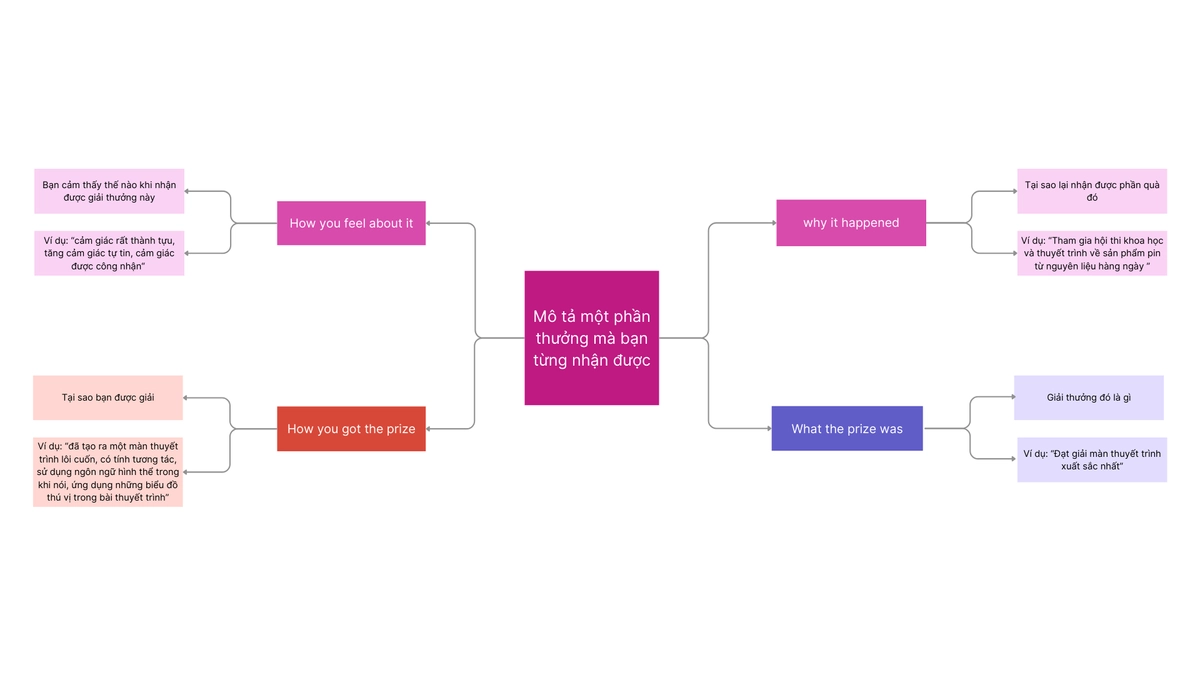
Áp dụng phương pháp “IWHC” để tạo phần ghi chú tóm tắt câu trả lời cho đề bài ở trên. Phần ghi chú này có thể áp dụng trong khoảng thời gian 1 phút chuẩn bị trước khi nói trong phòng thi, góp phần giúp thí sinh nhớ được những nội dung chính cần phải đưa ra trong 1 phút rưỡi tới 2 phút trả lời sau đó (thí sinh có thể lược bỏ phần “introduction” và “conclusion” nếu cần thiết). Dưới đây là sơ đồ tư duy bao gồm các khía cạnh của đề bài mà thí sinh cần giải quyết:
phân tích đề bài describe a prize that you received
“best presenter”, basic principles, sustainable energy solutions.
how you got the prize: engaging, easy to follow, use body language, interactive, live demonstration, colorful diagrams, simplify technical concepts.
how you felt about it:
incredible, validated, sense of accomplishment, boosted my confidence.
conclusion: inspiring, lasting impression.
Bài mẫu
Introduction + why it happened:
One of my proudest achievements was winning the "Best Presenter" award at a science fair back when I was in fourth grade. It was for a project where I demonstrated how everyday materials like potatoes and saltwater can be used to generate electricity.
demonstrate (giải thích, chứng minh): give a practical exhibition and explanation of (how a machine, skill, or craft works or is performed).
What the prize was:
The award was given for my presentation on building simple potato and saltwater batteries. These DIY experiments showcased how basic principles of chemistry and physics can be applied to create sustainable energy solutions. Besides, I got the chance to present about it in front of around 100 people, but it was nerve-wracking because I have never talked with such a large audience before.
nerve-wracking (căng thẳng): causing stress or anxiety.
sustainable (bền vững): able to be maintained at a certain rate or level.
How you got the prize:
I focused on making the presentation engaging and easy to follow as a huge part of the audience are students my age. I practiced my body language in front of mirrors and used it while I explained the science behind how potatoes and saltwater act as electrolytes to produce electricity. To keep it interactive, I also showed live demonstrations of the batteries powering small LEDs, which amazed the audience. I used colorful diagrams and fun analogies to simplify the more technical concepts. When questions arose, I made sure to answer them in a clear and approachable way, which helped me connect with the audience and judges and earned me a higher score.
easy to follow (dễ theo dõi)
body language (ngôn ngữ hình thế): a range of nonverbal signals that you can use to communicate your feelings and intentions
interactive (trực quan): (of two people or things) influencing or having an effect on each other.
analogy (phép liên tưởng): a comparison between two things, typically for the purpose of explanation or clarification.
simplify (đơn giản hóa): to make something less complicated and therefore easier to do or understand.
arise: to start to happen or exist.
approachable (dễ tiếp cận): friendly and easy to talk to.
How you felt about it
Winning the prize was an incredible feeling—it was a mix of excitement, pride, and gratitude. I felt validated for the hard work I put into preparing the presentation, and I was thrilled that my project resonated with both the judges and the audience. It also gave me a sense of accomplishment, as it proved that even a simple idea could make an impact if presented well. Beyond the prize, the recognition boosted my confidence and encouraged me to continue exploring creative ways to share science with others.
gratitude (biết ơn): the quality of being thankful; readiness to show appreciation for and to return kindness.
validated (được công nhận):recognize or affirm the validity or worth of (a person or their feelings or opinions); cause (a person) to feel valued or worthwhile.
resonated (đồng điệu, cộng hưởng) evoke or suggest images, memories, and emotions.
sense of accomplishment: cảm giác thành tựu
boosted sb’s confidence: tăng thêm sự tự tin
Conclusion
This experience was truly inspiring and has left a lasting impression on me. It reinforced the importance of effective communication and creativity in science, and it motivates me to take on new challenges with the same passion and dedication.
inspiring (truyền cảm hứng): having the effect of inspiring someone; giving someone positive or creative feelings.
lasting impression (ghi nhớ mãi): an idea or opinion that remains with someone long after an event has occurred.
reinforce (bồi đắp): to make something stronger.
IELTS Speaking Part 3 Sample: Describe a prize that you received
1. What rewards can children get from school?
“At schools, teachers often give out different types of rewards, from small rewards like candies or snacks when they answer questions correctly, to medals, certificates or prizes when they have done something well in their studies, sports or other activities. I think rewards are helpful to a child’s self-esteem as it validates their hard work and talents while also keeping them motivated. Whether big or small, I think it is a good idea that we give children something that can serve as an act of recognition to them”
self-esteem: belief and confidence in your own ability and value
Phiên âm IPA: /ˌself.ɪˈstiːm/
Dịch nghĩa: Lòng tự tôn.
act of recognition: An action or doing that implies a recognition to something (in this case somebody’s hard work)
Phiên âm IPA: /ækt əvˌrek.əɡˈnɪʃ.ən/
Dịch nghĩa: Hành động công nhận
2. Should parents push their children to get prizes?
“Parents should encourage their children to aim for prizes, but they should focus more on effort and learning rather than just the outcome. I think sometimes parents force their kids to bite off more than they can chew, which might lead to stress or fear of failure, and can discourage children in the long run. Instead, parents can support their kids by helping them set realistic goals, praising their progress, and fostering a love for learning. Prizes are great motivators, but the real reward lies in the skills, confidence, and resilience children develop through their efforts. In my opinion, a balanced approach is key to healthy growth.”
Bite off more than you can chew: to try to do something that is too difficult for you
Phiên âm: /baɪt ɔf mɔr ðæn ju kən tʃu/
Dịch nghĩa: cố gắng làm một việc gì đó nhiều hơn có thể hoặc cố gắng làm việc gì đó quá khó.
3. What kinds of rewards can companies offer to their outstanding employees?
“To reward top performers, companies might hand out bonuses or other financial perks—it’s a great way to show they value hard work. Career-focused rewards like mentorship programs or skill-based workshops can also help employees grow and stay motivated. Even small gestures, like a heartfelt thank-you or public acknowledgment, can really hit the nail on the head when it comes to boosting morale. Ultimately, it’s about finding the right balance between tangible benefits and genuine appreciation”
hand out: to give something to each person in a group or place.
Phiên âm IPA: /hænd aʊt/
Dịch nghĩa: Đưa cho ai cái gì đó.
heartfelt: to give something to each person in a group or place
Phiên âm IPA: /ˈhɑːrt.felt/
Dịch nghĩa: Cảm động
hit the nail on the head: to describe exactly what is causing a situation or problem
Phiên âm IPA: /hɪt ðə neɪl ɑn ðə hɛd/
Dịch nghĩa: Đánh đúng trọng tâm.
tangible: real and not imaginary; able to be shown, touched, or experienced
Bài viết trên đã chia sẻ bài mẫu IELTS Speaking chủ đề Describe a prize that you received. Người học có thể tham khảo những ý tưởng và từ vựng này để áp dụng cho bài nói của mình.
Triết lý giáo dục: "Không ai bị bỏ lại phía sau" (Leave no one behind). Mọi học viên đều cần có cơ hội học tập và phát triển phù hợp với mức độ tiếp thu và tốc độ học tập riêng của mình.



Bình luận - Hỏi đáp