Describe a time when you found something interesting on social media
Gợi ý bài mẫu IELTS Speaking Part 2 về chủ đề “Describe a time when you found something interesting on social media”, cung cấp từ vựng, audio hỗ trợ và các câu hỏi Part 3 hữu ích.
Useful because it showed Pomodoro & active recall clearly
Felt guilty but then motivated to study
Part 3 — Social media
In-person friendships feel more genuine
People know they overuse apps
Social media is addictive due to instant rewards
Too many ads harm user experience
People often show a filtered version of themselves
Trong bài thi IELTS Speaking Part 2, đề bài “Describe a time when you found something interesting on social media” yêu cầu thí sinh kể về một trải nghiệm cụ thể khi phát hiện nội dung thú vị trên mạng xã hội. Đây là chủ đề quen thuộc với đời sống hiện đại, tuy nhiên nhiều thí sinh gặp khó khăn trong việc triển khai ý tưởng mạch lạc và sử dụng từ vựng phù hợp. Bài viết này cung cấp bài mẫu chi tiết kèm phân tích từ vựng theo chủ đề và các câu hỏi Part 3 thường gặp, giúp người học chuẩn bị tốt hơn cho phần thi này.
Bài mẫu chủ đề “Describe a time when you found something interesting on social”
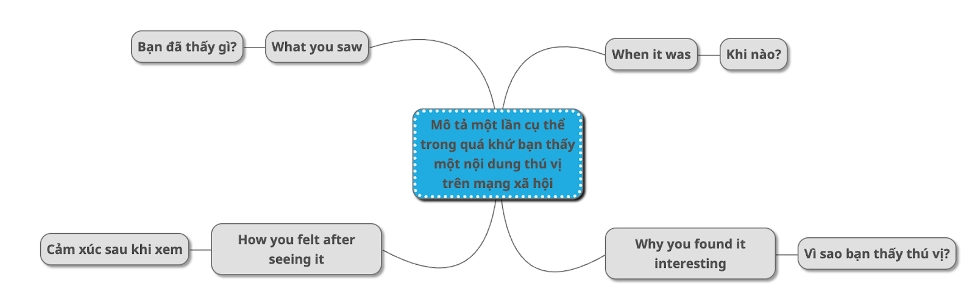
You should say:
when it was
what you saw
why you found it interesting
And explain how you felt after seeing it.
1. Analyze – Phân tích đề bài
Đề bài:Describe a time when you found something interesting on social media.
Từ/cụm từ quan trọng trong đề (để hiểu rõ yêu cầu)
Từ / Cụm từ gốc
Nghĩa tiếng Việt
found something interesting
thấy / bắt gặp một điều gì đó thú vị
on social media
trên mạng xã hội
when it was
đó là khi nào
what you saw
bạn đã nhìn thấy / xem cái gì
why you found it interesting
tại sao bạn thấy nó thú vị
how you felt after seeing it
bạn cảm thấy thế nào sau khi xem
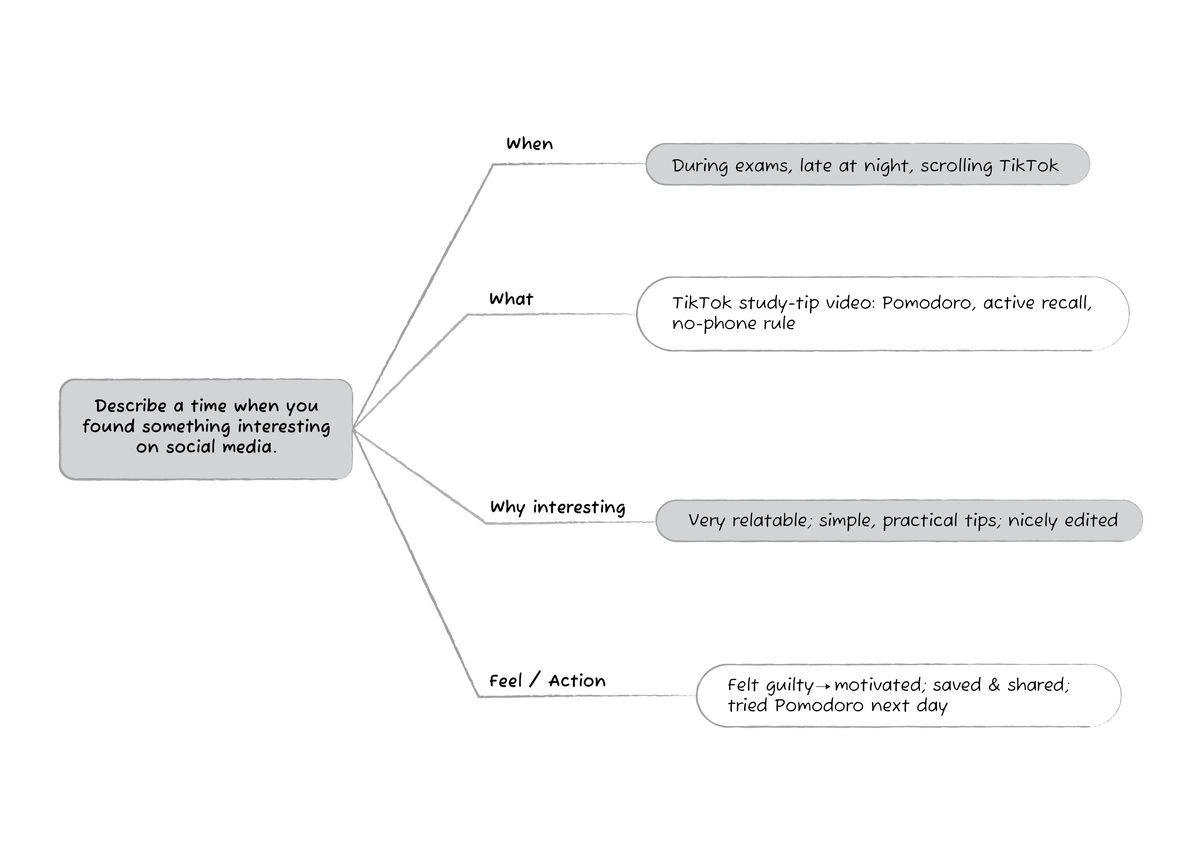
2. Craft – Lên ý tưởng & ghi chú nhanh
3. Execute – Bài nói mẫu
I’d like to talk about a time when I came across something really interesting on social media. It was last semester during my exam period. One night, I was mindlessly scrolling through TikTok instead of revising, and I suddenly found a short study-tips video.
In the clip, there was a girl with a very aesthetic study desk. She explained how she studies for exams using the Pomodoro technique, active recall, and a no-phone rule while she’s working. The video was simple but clear, and she showed exactly how she used these methods in real life.
I found it interesting for several reasons. First, it was so relatable, because I was procrastinating at that exact moment. Second, her advice was simple but practical, not just empty motivation. She didn’t talk too much; instead, she managed to get straight to the point in under a minute, which is perfect for a short video.
After watching it, I felt a bit guilty about wasting time, but then I actually felt more hopeful. I saved the video and the next day I tried studying with the Pomodoro technique and put my phone far away. Surprisingly, I felt more focused and in control of my time. Since then, I’ve slowly tried to change my study habits, and that’s why this small moment on TikTok really stayed in my memory.
1. Do you think it’s better to make friends online or in person?
📌 Point: I think it’s generally better to make friends in person. 📌 Explain: Face-to-face interaction allows people to read body language, build trust, and create deeper connections. Online friendships can be meaningful too, but they sometimes lack real-life experiences. 📌 Example: For example, classmates who study and hang out together often develop stronger bonds than people who only chat through messages. 📌 Link: So overall, in-person friendships tend to feel more genuine and long-lasting.
📚 Vocabulary Highlights:
face-to-face interaction
Phát âm: /ˌfeɪs.təˈfeɪs ˌɪn.t̬ɚˈræk.ʃən/
Dịch: Tương tác trực tiếp
Ví dụ: Face-to-face interaction helps people understand each other better.
genuine
Phát âm: /ˈdʒen.ju.ɪn/
Dịch: Chân thật
Ví dụ: People often look for genuine friendships, not just online contacts.
2. Do people realise that they spend too much time on social media?
📌 Point: Yes, many people are aware that they spend too much time on social media. 📌 Explain: They often complain about feeling tired, distracted, or unproductive after scrolling for hours, which shows they know it’s a problem. 📌 Example: For instance, some students say they want to study but end up wasting time on short videos or endless news feeds. 📌 Link: So even though people realise it, they don’t always change their habits.
📚 Vocabulary Highlights:
distracted
Phát âm: /dɪˈstræk.tɪd/
Dịch: Mất tập trung
Ví dụ: Constant notifications can make people feel distracted.
unproductive
Phát âm: /ˌʌn.prəˈdʌk.tɪv/
Dịch: Kém hiệu quả, không năng suất
Ví dụ: Spending too much time online can make your day unproductive.
3. If they know it’s time-consuming, why do people still use it so much?
📌 Point: People still use social media a lot because it is highly addictive and entertaining. 📌 Explain: The apps are designed to keep users engaged with endless content, instant notifications, and quick rewards like likes and comments. 📌 Example: For example, someone might open an app “just for five minutes” but end up scrolling for an hour without noticing. 📌 Link: So even when they know it’s time-consuming, the habit is hard to break.
📚 Vocabulary Highlights:
addictive
Phát âm: /əˈdɪk.tɪv/
Dịch: Gây nghiện
Ví dụ: Social media can be addictive because it constantly offers new content.
instant reward
Phát âm: /ˈɪn.stənt rɪˈwɔːrd/
Dịch: Phần thưởng tức thì
Ví dụ: Likes and comments give users an instant reward and keep them coming back.
4. Should annoying advertisements appear on social media?
📌 Point: Personally, I think annoying advertisements shouldn’t appear too often on social media. 📌 Explain: While ads help platforms earn money, too many pop-ups or irrelevant promotions can ruin the user experience. 📌 Example: For instance, some users feel frustrated when an ad disrupts their video or appears after every few posts. 📌 Link: So ads are acceptable to some extent, but they should be controlled and more user-friendly.
📚 Vocabulary Highlights:
irrelevant
Phát âm: /ɪˈrel.ə.vənt/
Dịch: Không liên quan
Ví dụ: Irrelevant ads make people more likely to ignore them.
user experience
Phát âm: /ˈjuː.zɚ ɪkˈspɪr.i.əns/
Dịch: Trải nghiệm người dùng
Ví dụ: Too many adverts can negatively affect the user experience.
5. Do people usually present their true selves online?
📌 Point: Not always—many people don’t show their true selves online. 📌 Explain: They tend to share only the positive or “perfect” parts of their lives and hide their problems or negative emotions. 📌 Example: For example, someone might look happy and successful on their profile, but in reality they could be stressed or struggling. 📌 Link: So social media often shows a filtered version of reality rather than the whole truth.
📚 Vocabulary Highlights:
present their true selves
Phát âm: /prɪˈzent ðer truː selvz/
Dịch: Thể hiện con người thật
Ví dụ: It’s hard to know if people are presenting their true selves online.
filtered version
Phát âm: /ˈfɪl.tɚd ˈvɝː.ʒən/
Dịch: Phiên bản đã được “lọc”, chỉnh sửa
Ví dụ: Social media often shows a filtered version of someone’s life.
Qua bài viết, thí sinh đã nắm được cách phân tích đề bài, lên ý tưởng và triển khai câu trả lời hoàn chỉnh cho chủ đề “Describe a time when you found something interesting on social media”. Bài mẫu cùng từ vựng được phân loại theo ngữ cảnh không chỉ giúp người học cải thiện khả năng diễn đạt mà còn xây dựng nền tảng vững chắc cho các chủ đề liên quan đến công nghệ và truyền thông. Phần câu hỏi Part 3 mở rộng trang bị thêm góc nhìn sâu sắc về tác động của mạng xã hội, giúp thí sinh tự tin thảo luận đa chiều và đạt band điểm Speaking mong muốn
Thí sinh có thể tham gia khóa học luyện đề IELTS nâng cao tại ZIM để cải thiện kỹ năng trả lời IELTS Speaking và rèn luyện với các đề thi thực tế.



Bình luận - Hỏi đáp