


Chủ đề IELTS Speaking Part 3: Customer service.
Bài mẫu cho nhóm câu hỏi:
Do expensive shops provide better service?
Should staff follow customers around?
Qualities of good customer service?
Importance of staff training?
Responding to customer pressure?
Nhóm từ vựng: Topic vocabulary (Customer service): Service quality & shopping experience, Staff behaviour & training, và Business decisions & customer pressure.
Bài mẫu IELTS Speaking Part 3 Topic “Customer Service” kèm từ vựng
Trong bài viết này, tác giả sẽ gợi ý bài mẫu cho Topic “Customer Service” và phân tích các từ vựng ghi điểm cho phần thi IELTS Speaking Part 3.
Key takeaways
Bài viết này cung cấp câu trả lời mẫu theo khung Simple Answer và Upgraded Answer cho IELTS Speaking Part 3 topic Customer Service, giúp người học linh hoạt ý tưởng, từ vựng và ngữ pháp khi vào phòng thi. Bài phân tích này sẽ dẫn dắt người học đi qua các câu trả lời mẫu cho chủ đề Customer service, từ những thành ngữ miêu tả sự tận tâm như “go the extra mile”, “raise the bar” đến các cụm từ chuyên sâu về quản lý dịch vụ như “handle complaints professionally” hay “customer feedback”, giúp người học chinh phục giám khảo bằng sự mạch lạc và ngôn ngữ tự nhiên.
IELTS Speaking Part 3: Customer Service - Sample Answer
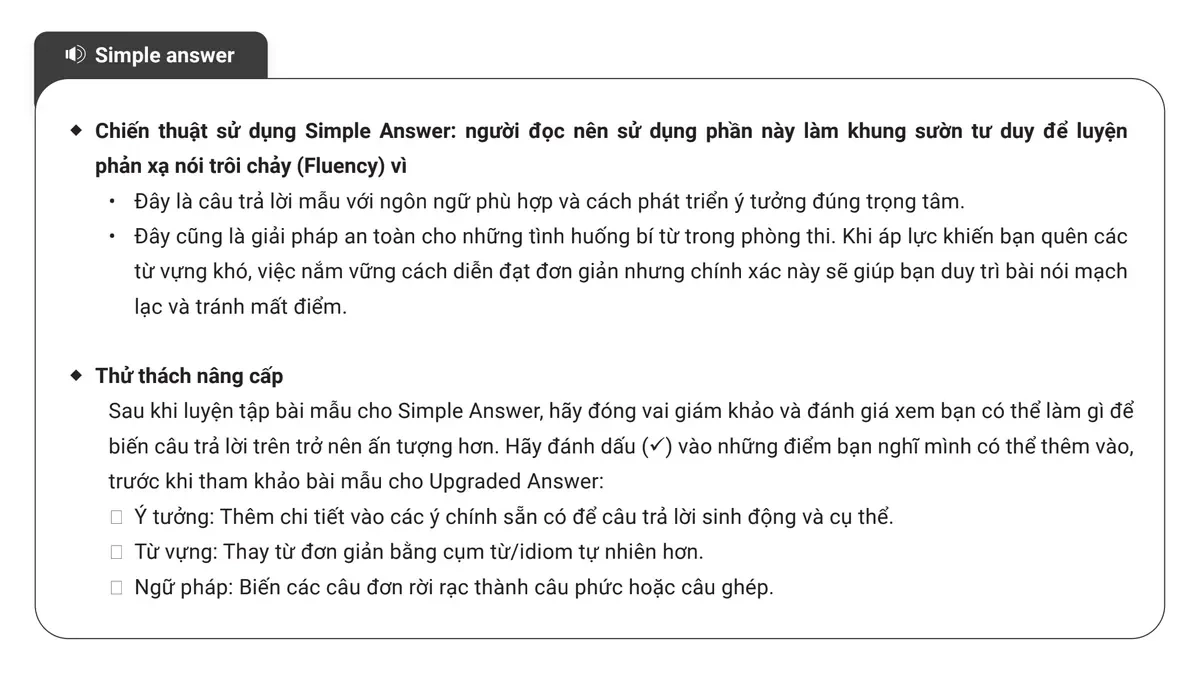
Simple answer
1. Do you think expensive shops usually provide better service? Why or why not?
|
I think expensive shops often provide better service because they want customers to feel special. The staff are usually polite and well-trained. For example, in luxury clothing stores, employees may greet customers warmly and offer personal advice. So, higher prices often come with better service, although not always. |
2. Do you think it is good service when staff follow customers around in a shop? Why or why not?
|
I don’t think it is good service when staff follow customers around too closely. It can make people feel uncomfortable or pressured. For example, some customers just want to look around without being disturbed. Good service means being helpful but also giving customers space. |
3. What qualities make good customer service?
|
I think good customer service requires politeness, patience, and clear communication. Staff should listen carefully and try to solve problems quickly. For example, if a customer has a complaint, employees should stay calm and offer a solution. Overall, respectful and helpful staff create a positive experience. |
4. How important is staff training in improving service quality?
|
In my opinion, staff training is very important for improving service quality. Training helps employees understand how to communicate with customers and handle difficult situations. For example, trained staff know how to deal with complaints in a professional way. So, proper training leads to better service. |
5. Do you think companies should change their policies or products in response to customer pressure?
|
Yes, I think companies should listen to customers and make changes when necessary. Customer feedback helps businesses improve their products and services. For example, many companies update their return policies after receiving complaints. So, responding to customer pressure can help companies build trust and stay competitive. |
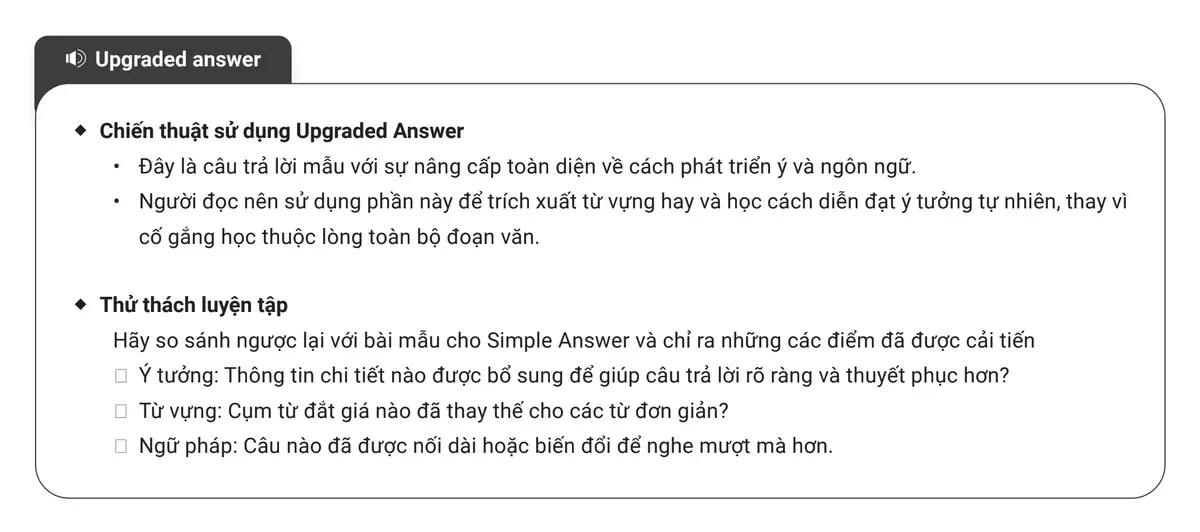
Upgraded answer
1. Do you think expensive shops usually provide better service? Why or why not?
|
Well, in many cases, I’d say yes. Expensive shops often go the extra mile to make customers feel valued because their brand image depends on it. For instance, in luxury boutiques, staff may offer personalised advice and treat customers like VIPs. That said, a high price tag doesn’t always guarantee excellent service. I’ve seen small local stores that provide warm and attentive service even without charging a fortune. So, while expensive shops tend to raise the bar, good service really comes down to management and staff attitude. |
2. Do you think it is good service when staff follow customers around in a shop? Why or why not?
|
Honestly, not really. While staff may have good intentions, constantly following customers can make them feel uneasy. Most people prefer to browse at their own pace without feeling watched. For example, when I shop for clothes, I like having space to think before making a decision. In my view, good service means being available when needed, but not hovering over customers. It’s all about striking the right balance. |
3. What qualities make good customer service?
|
I think good customer service boils down to three main qualities: patience, clear communication, and problem-solving skills. Staff should be able to stay calm under pressure and handle complaints professionally. For example, if a customer receives a faulty product, the employee should apologise sincerely and offer a quick solution rather than shifting the blame. At the end of the day, customers just want to feel heard and respected. |
4. How important is staff training in improving service quality?
|
Oh, I’d say it’s absolutely essential. Without proper training, even friendly staff may struggle to deal with difficult situations. Training equips employees with the tools they need to communicate effectively and solve problems efficiently. For instance, in well-trained companies, staff know exactly how to handle refunds or complaints without causing unnecessary conflict. So, in many ways, staff training lays the foundation for consistent service quality. |
5. Do you think companies should change their policies or products in response to customer pressure?
|
To a certain extent, yes. Companies need to listen to customer feedback because, after all, customers are the backbone of any business. For example, many brands have improved their return policies after receiving complaints online. However, businesses shouldn’t change direction every time a few people raise concerns, as that could harm their long-term strategy. So I think companies should respond thoughtfully rather than react impulsively. |
Đọc thêm: Bài mẫu IELTS Speaking Part 3 Topic “Meals and Eating Habits” kèm từ vựng
Lọc và phân tích từ vựng
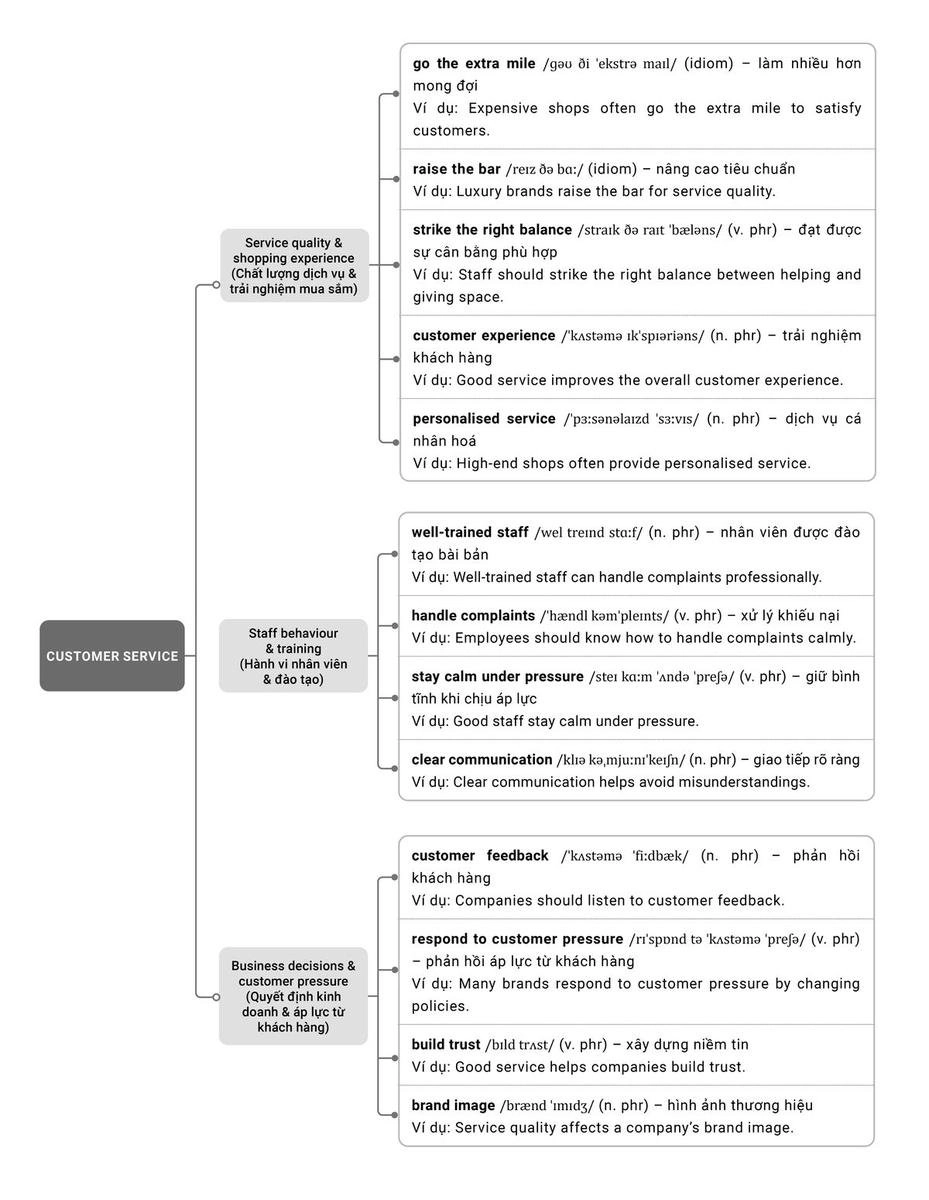
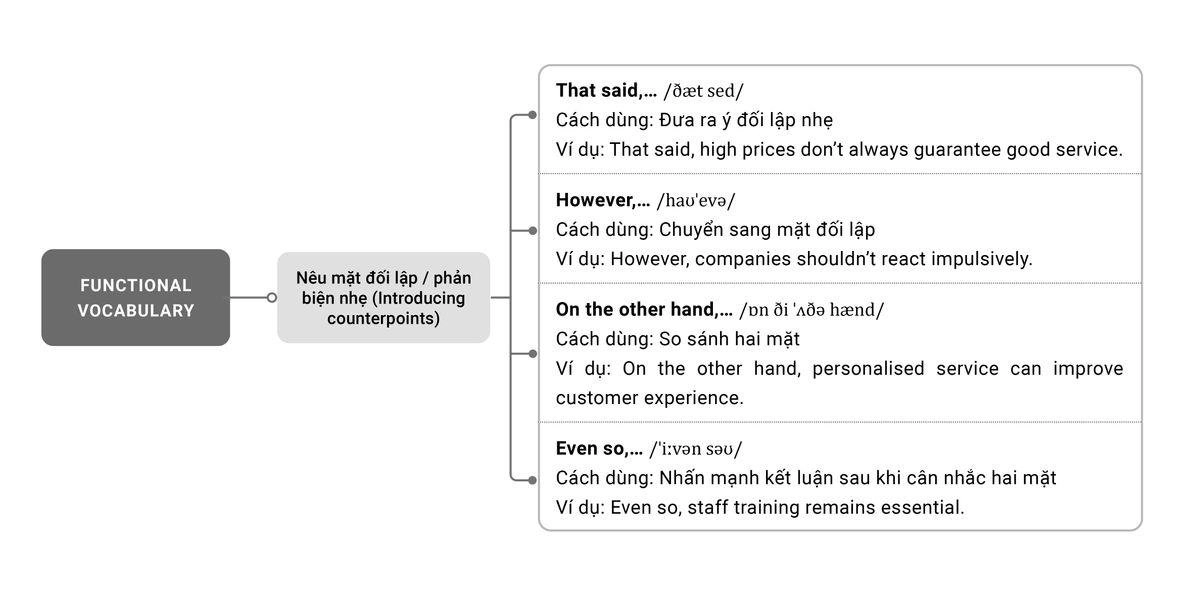
Nhật ký từ vựng & ý tưởng
Ghi chú sau khi luyện tập nói về chủ đề trên
Từ vựng/Ý tưởng (Chọn các từ vựng/ý tưởng mà bạn tâm đắc nhất) | Kỉ niệm cá nhân |
|---|---|
Ví dụ: handle complaints – xử lý khiếu nại | Người đọc tự đặt các câu hỏi cho bản thân, ví dụ:
→ A few months ago, I bought a pair of shoes that turned out to be faulty. At first, I was quite annoyed. However, the staff handled my complaint professionally and offered a quick replacement without asking too many questions. They really went the extra mile to solve the issue. That experience helped build my trust in the brand, and I’ve continued shopping there since then. |
Khoảng trống diễn đạt (Phần khiến bạn ngập ngừng khi nói về chủ đề trên) | Giải pháp (Giải pháp cho các khoảng trống diễn đạt) |
Ví dụ:
| Ví dụ: Dùng từ điển của ZIM hoặc chép các cách diễn đạt từ bài mẫu ở các phần trên để có được cụm từ mà bạn cần. → Thay vì nói “follow customers too much” → dùng hover over customers |
Người đọc có thể tìm từ vựng bằng từ điển ZIM Dictionary.
Các lỗi ngữ pháp thường gặp
1. Nhầm “service” và “services”
❌ Lỗi thường gặp: This shop provides very good services.
✅ Cách dùng đúng:
service (không đếm được) → nói chung về chất lượng phục vụ
services (đếm được) → nhiều loại dịch vụ cụ thể
✔ Câu đúng:
This shop provides very good service.
The hotel offers many different services.
📌 Lý do sai: “Service” khi nói về chất lượng phục vụ nói chung là danh từ không đếm được.
2.Nhầm “polite” và “politely”
❌ Lỗi thường gặp: Staff should speak polite to customers. (người học muốn nói: nói chuyện một cách lịch sự)
✅ Cách dùng đúng:
polite (adj) → bổ nghĩa cho danh từ
politely (adv) → bổ nghĩa cho động từ
✔ Câu đúng:
Staff should speak politely to customers.
Polite staff create a positive impression.
📌 Lý do sai: Sau động từ “speak”, cần dùng trạng từ (politely), không dùng tính từ (polite). Đây là lỗi từ loại rất hay gặp trong Speaking.
3. Nhầm “complain” và “complaint”
❌ Lỗi thường gặp: The customer made a complain about the product.
✅ Cách dùng đúng:
complain (v) phàn nàn
complaint (n) sự phàn nàn
✔ Câu đúng:
The customer made a complaint about the product.
The customer complained about the product.
📌 Lý do sai: Nhầm lẫn giữa danh từ và động từ.
Tham khảo thêm: Complain đi với giới từ gì? Cấu trúc và bài tập vận dụng
Mini practice |
|---|
Dùng đúng cấu trúc trong ngoặc 1. Hãy nói về chất lượng phục vụ của một cửa hàng bạn từng đến. (Dùng: service – không dùng services khi nói chung về chất lượng phục vụ) 2. Hãy nói về cách nhân viên nên nói chuyện với khách hàng. (Dùng: politely – không dùng polite sau động từ) 3. Hãy nói về một tình huống khi khách hàng phàn nàn về sản phẩm. (Dùng: make a complaint / complain – không dùng make a complain) |
Các chủ đề liên quan
Chủ đề liên quan để sử dụng từ vựng & ý tưởng:
Work and careers (Công việc & nghề nghiệp)
Business and marketing (Kinh doanh & tiếp thị)
Technology and modern life (Công nghệ & đời sống hiện đại)
Người đọc có thể sử dụng:
Từ vựng: customer experience, service quality, well-trained staff, handle complaints, build trust, go the extra mile, strike the right balance, customer satisfaction, brand reputation, respond to customer pressure, competitive market, company policy, staff training, professional attitude, loyal customers...
Ý tưởng:
Dịch vụ tốt giúp doanh nghiệp xây dựng niềm tin và giữ chân khách hàng lâu dài.
Nhân viên cần được đào tạo bài bản để xử lý khiếu nại một cách chuyên nghiệp.
Theo sát khách hàng có thể gây khó chịu nếu không "strike the right balance".
Trong thị trường cạnh tranh, customer experience quan trọng không kém chất lượng sản phẩm.
Công ty đôi khi cần thay đổi chính sách hoặc sản phẩm để đáp ứng áp lực từ khách hàng.
Mini practice |
|---|
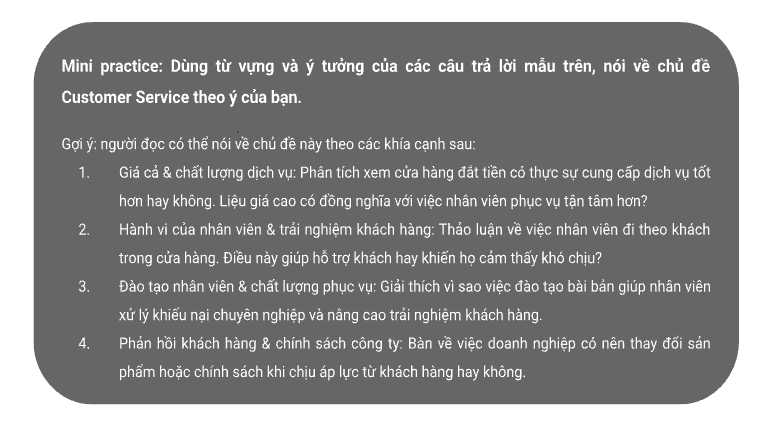
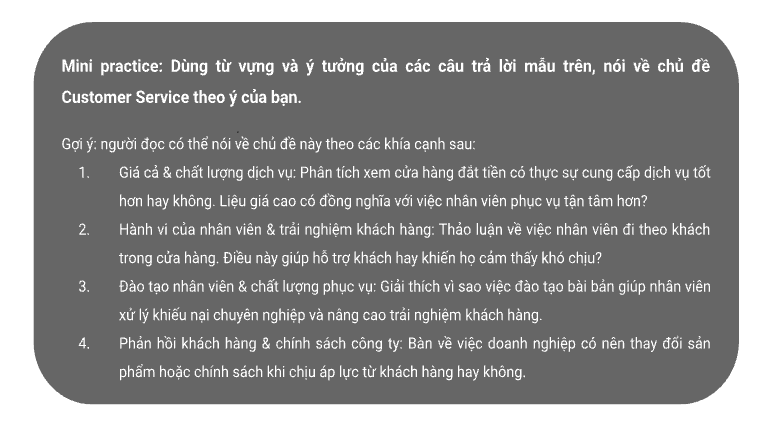
Sử dụng từ vựng và ý tưởng ở trên để trả lời các câu hỏi sau
|
Tham khảo thêm: Cách ôn tập IELTS Speaking hiệu quả khi gần sát ngày thi
Tổng kết
Hy vọng qua việc phân tích hai cấp độ trả lời từ Simple Answer đến Upgraded Answer trong IELTS Speaking Part 3 topic Customer Service, bạn đã nắm được cách phát triển câu trả lời mạch lạc và ấn tượng. Việc cá nhân hóa ý tưởng qua “Nhật ký Từ vựng & Ý tưởng” sẽ giúp bạn tự tin hơn khi nói.
Nếu bạn muốn nâng cao kỹ năng IELTS Speaking theo lộ trình cá nhân hóa, Hệ thống giáo dục ZIM cung cấp các khóa luyện thi IELTS cam kết đầu ra, giúp bạn tối ưu hiệu quả học tập và tiết kiệm đến 80% thời gian tự học. Để được tư vấn chi tiết, vui lòng liên hệ hotline 1900-2833 (nhánh 1) hoặc truy cập khóa học IELTS.
Nguồn tham khảo
1
“Bài mẫu IELTS Speaking Part 3.” OpenAI, chatgpt.com/share/e/6961bf62-bf88-8002-9512-8fe28a8cdcf4. Accessed 13 March 2026.
Bình luận - Hỏi đáp