

Chủ đề IELTS Speaking Part 3: Stories and Children.
Bài mẫu cho nhóm câu hỏi:
Why children love bedtime stories?
Listening vs. Creating stories?
Popularity of traditional stories today?
Role of stories in education?
Influence on values and behaviour?
Nhóm từ vựng: Bedtime & Habits, Preference & Creativity và Tradition & Values.
Bài mẫu IELTS Speaking Part 3 Topic “Stories and Children” kèm từ vựng
Trong bài viết này, tác giả sẽ gợi ý bài mẫu cho Topic “Stories and Children” và phân tích các từ vựng ghi điểm cho phần thi IELTS Speaking Part 3.
Key takeaways
Bài viết này sẽ cung cấp các câu trả lời mẫu cho IELTS Speaking Part 3 Topic Stories and Children theo hai cấp độ: Simple Answer (trả lời cơ bản, rõ ràng) và Upgraded Answer (nâng cấp ý tưởng, từ vựng và ngữ pháp). Thông qua các ví dụ cụ thể, người học sẽ khám phá cách phát triển câu trả lời tự nhiên với những cụm từ quen thuộc như “bedtime routine”, “wind down” cũng như các cách diễn đạt giàu sắc thái như “take a back seat” hay “plant the seeds of good behaviour”. Nhờ đó, bạn có thể mở rộng ý tưởng, sử dụng ngôn ngữ linh hoạt hơn và tự tin hơn khi trả lời các câu hỏi
IELTS Speaking Part 3: Stories and Children - Sample Answer
Simple answer
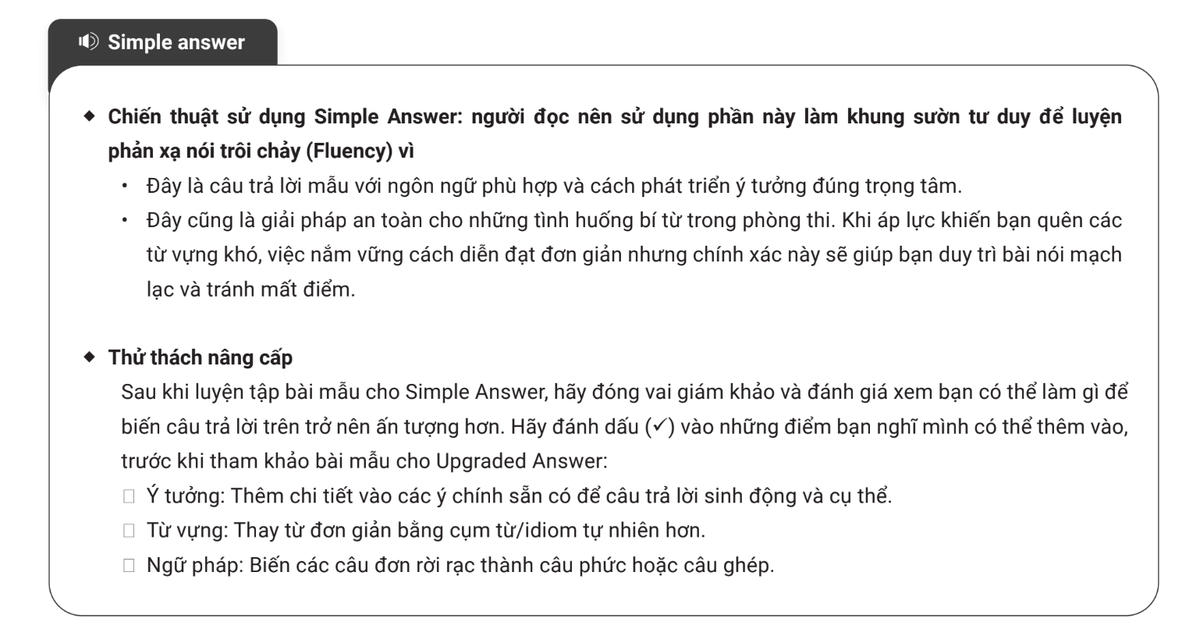
1. Why do children enjoy listening to traditional stories before going to sleep?
|
Children often enjoy listening to traditional stories before bedtime because these stories help them relax. The stories are usually familiar and easy to follow, which makes children feel safe and comfortable. Listening to a calm story can also help them forget about the day and slow down before sleeping. As a result, children tend to fall asleep more easily. Overall, bedtime stories create a warm and peaceful routine. |
2. Do you think children prefer listening to stories or creating their own stories? Why?
|
I think most children prefer listening to stories, especially when they are still young. Listening is simpler and allows children to enjoy the story without thinking too hard. For example, many children like it when parents or teachers read stories to them. Creating stories usually requires more imagination and language skills. So in general, listening is more popular, particularly with younger children. |
3. Do children in your country still enjoy traditional stories today? Why or why not?
|
Yes, some children still enjoy traditional stories today, but they are not as popular as before. Many children now prefer watching videos or playing games on digital devices. However, traditional stories are still told in schools or by grandparents at home. Because of this, children are still exposed to these stories, even if they do not hear them every day. |
4. What role do traditional stories play in a child’s education?
|
Traditional stories play an important role in children’s education. They help children understand basic ideas about right and wrong. Through stories, children can learn values such as honesty, kindness, and respect. For example, many traditional stories show good characters being rewarded. Overall, these stories support both moral learning and language development. |
5. How can traditional stories influence children’s values or behaviour?
|
Traditional stories can influence children’s behaviour by giving them clear role models. Children often pay attention to how characters act and what happens to them. As a result, they may try to copy positive behaviour, such as helping others or being polite. Over time, these messages can shape children’s values in real life. |
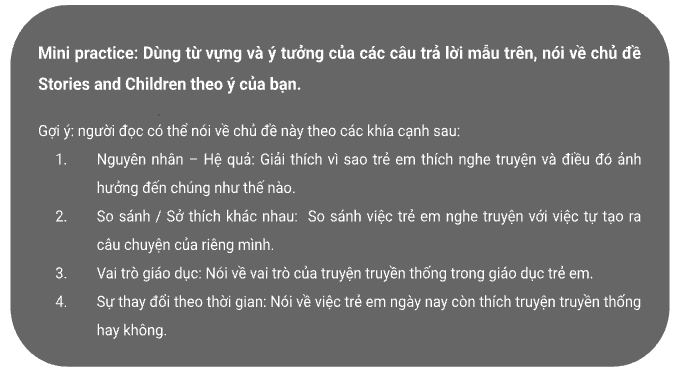
Upgraded answer
1. Why do children enjoy listening to traditional stories before going to sleep?
|
Well, I think one main reason is that traditional stories help children wind down after a long day. These stories are often familiar and predictable, which gives children a sense of comfort and security. As they listen, their minds gradually slow down, making it easier for them to fall asleep. Over time, storytelling becomes part of a bedtime routine that children look forward to. All in all, traditional stories help create a calm atmosphere that prepares children for sleep. |
2. Do you think children prefer listening to stories or creating their own stories? Why?
|
Personally, I think most children prefer listening to stories, especially when they are younger. This is because listening allows them to sit back and enjoy the story without having to come up with ideas on the spot. For example, many children love it when parents or teachers read stories aloud before bedtime or in class. That said, creating stories can be more appealing to older children who enjoy using their imagination. Still, for most young children, listening is the easier and more enjoyable option. |
3. Do children in your country still enjoy traditional stories today? Why or why not?
|
I’d say children today still enjoy traditional stories, but they are no longer the main form of entertainment. With so many digital options available, traditional stories often take a back seat. However, they haven’t completely disappeared. For instance, schools and grandparents still play a role in passing these stories down to younger generations. So although traditional stories are less popular than before, they continue to survive alongside modern entertainment. |
4. What role do traditional stories play in a child’s education?
|
Traditional stories play a valuable role in children’s education by teaching moral lessons and supporting language development. Through simple characters and clear storylines, children learn about right and wrong in an engaging way. For example, many folk tales show that honesty and kindness are rewarded in the end. Of course, stories alone are not enough to educate children fully. Even so, they remain a powerful tool for reinforcing important values in an enjoyable way. |
5. How can traditional stories influence children’s values or behaviour?
|
Traditional stories influence children’s values by showing clear consequences for different types of behaviour. Children often identify with the characters and learn lessons without even realising it. As a result, they may start to copy positive actions, such as helping others or telling the truth. Of course, not every child reacts in the same way, and real-life experience also matters. Still, stories can plant the seeds of good behaviour from an early age. |
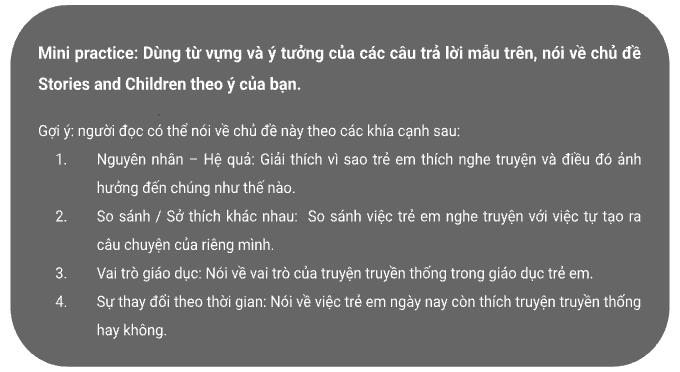
Lọc và phân tích từ vựng
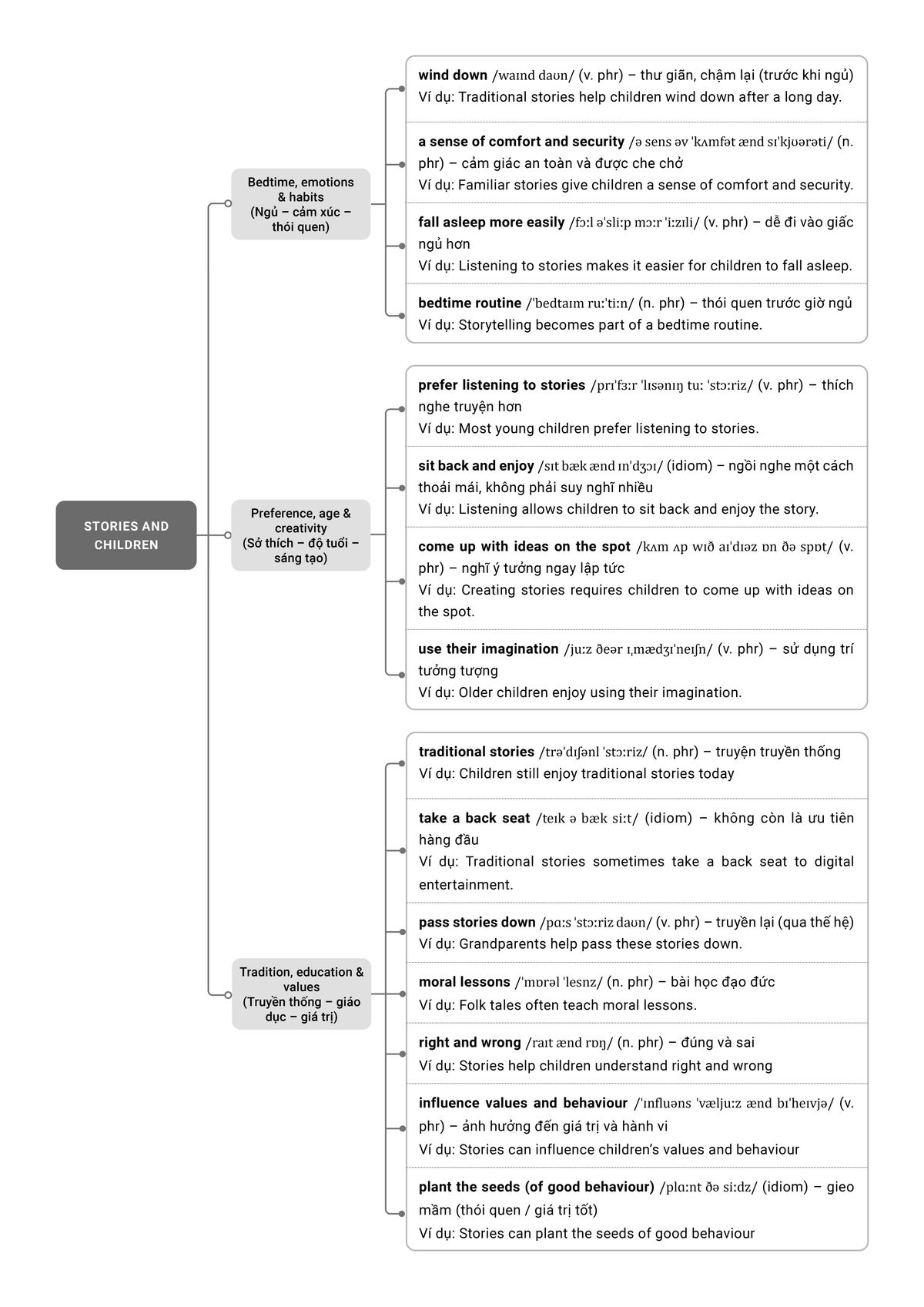
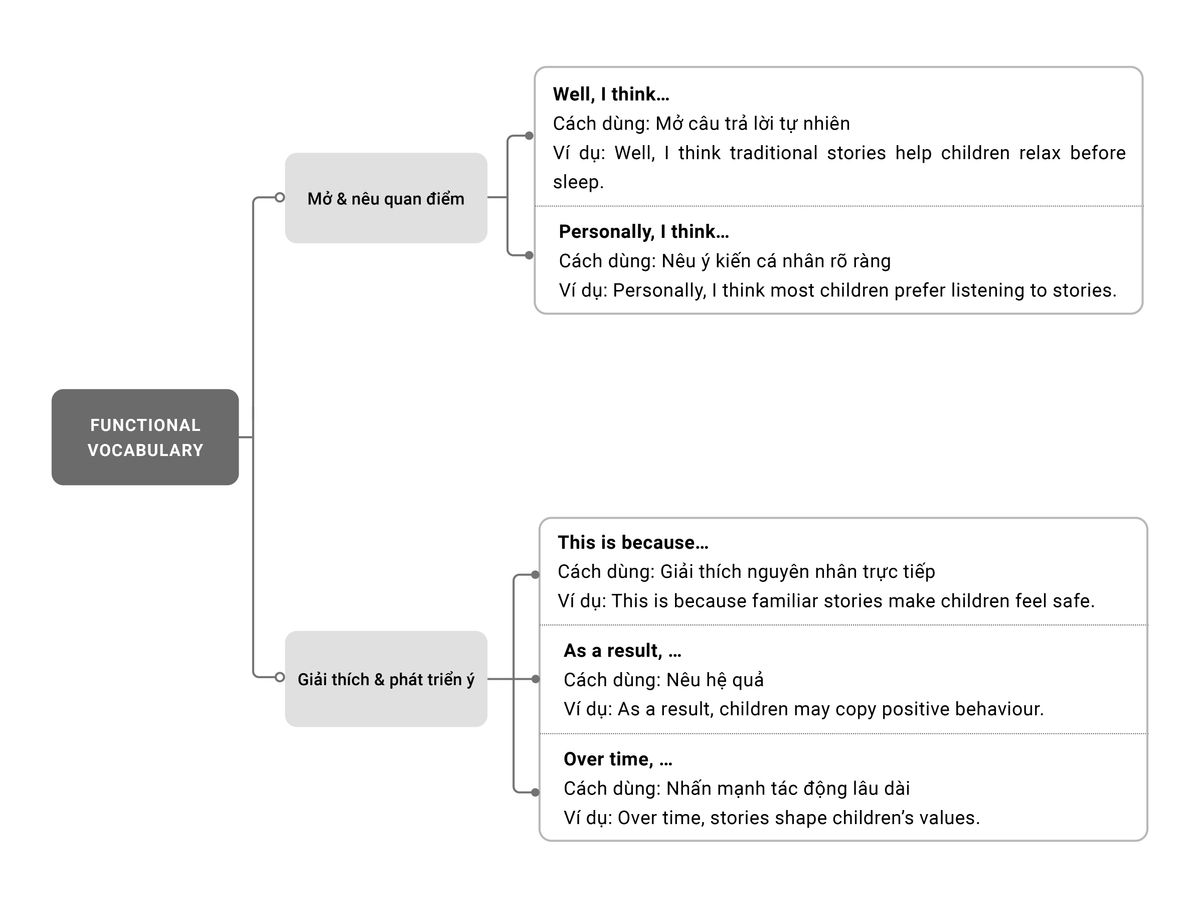
Nhật ký từ vựng & ý tưởng
Ghi chú sau khi luyện tập nói về chủ đề trên
Từ vựng/Ý tưởng (Chọn các từ vựng/ý tưởng mà bạn tâm đắc nhất) | Kỉ niệm cá nhân |
|---|---|
Ví dụ: plant the seeds (of good behaviour) (idiom) – gieo mầm hành vi tốt | Người đọc tự đặt các câu hỏi cho bản thân, ví dụ:
→ When I was a child, listening to traditional stories was part of my bedtime routine. These stories helped me wind down and feel a sense of comfort and security before sleeping. Some stories also taught me clear ideas about right and wrong, which slowly planted the seeds of good behaviour. Even now, I still remember certain moral lessons from those stories. |
Khoảng trống diễn đạt (Phần khiến bạn ngập ngừng khi nói về chủ đề trên) | Giải pháp (Giải pháp cho các khoảng trống diễn đạt) |
Ví dụ:
| Ví dụ: Dùng từ điển của ZIM hoặc chép các cách diễn đạt từ bài mẫu ở các phần trên để có được cụm từ mà bạn cần. → help children wind down → make it easier for children to fall asleep → influence children’s values and behaviour |
Người đọc có thể tìm từ vựng bằng từ điển ZIM Dictionary.
Các lỗi ngữ pháp thường gặp
1. Nhầm cấu trúc “help + V” và “help + to V”
Lỗi thường gặp:
“Traditional stories help children to wind down and to fall asleep.”
(người học muốn nói: Truyện giúp trẻ thư giãn và dễ ngủ)
Cách dùng đúng:
help + V (bare infinitive) → tự nhiên hơn trong nói
help + to V → đúng ngữ pháp nhưng kém tự nhiên trong Speaking
Câu đúng: Traditional stories help children wind down and fall asleep.
Lý do sai: Người học thường lạm dụng to V vì nghĩ “đầy đủ” hơn, nhưng trong IELTS Speaking, help + V nghe tự nhiên và trôi chảy hơn.
2. Dùng sai thì khi nói về thói quen hình thành theo thời gian
Lỗi thường gặp:
“Storytelling became a bedtime routine that children look forward to.”
(trộn quá khứ đơn + hiện tại)
Cách dùng đúng:
Quá trình hình thành → has become / gradually becomes
Thói quen hiện tại → look forward to
Câu đúng: Storytelling has become a bedtime routine that children look forward to.
Lý do sai: Người học hay dùng quá khứ đơn cho mọi hành động trong quá khứ, nhưng khi nói về kết quả còn ảnh hưởng đến hiện tại, cần dùng Present Perfect.
3. Nhầm “identify with” và “identify as”
Lỗi thường gặp: “Children identify as the characters in the story.”
Cách dùng đúng:
identify with + someone → đồng cảm, thấy mình giống nhân vật
identify as → nói về bản dạng (giới tính, nghề nghiệp, v.v.)
Câu đúng: Children often identify with the characters in traditional stories.
Lý do sai: Người học dịch trực tiếp từ “đồng nhất mình là”, dẫn đến dùng sai giới từ. Trong ngữ cảnh truyện, identify with mới là cấu trúc chuẩn.
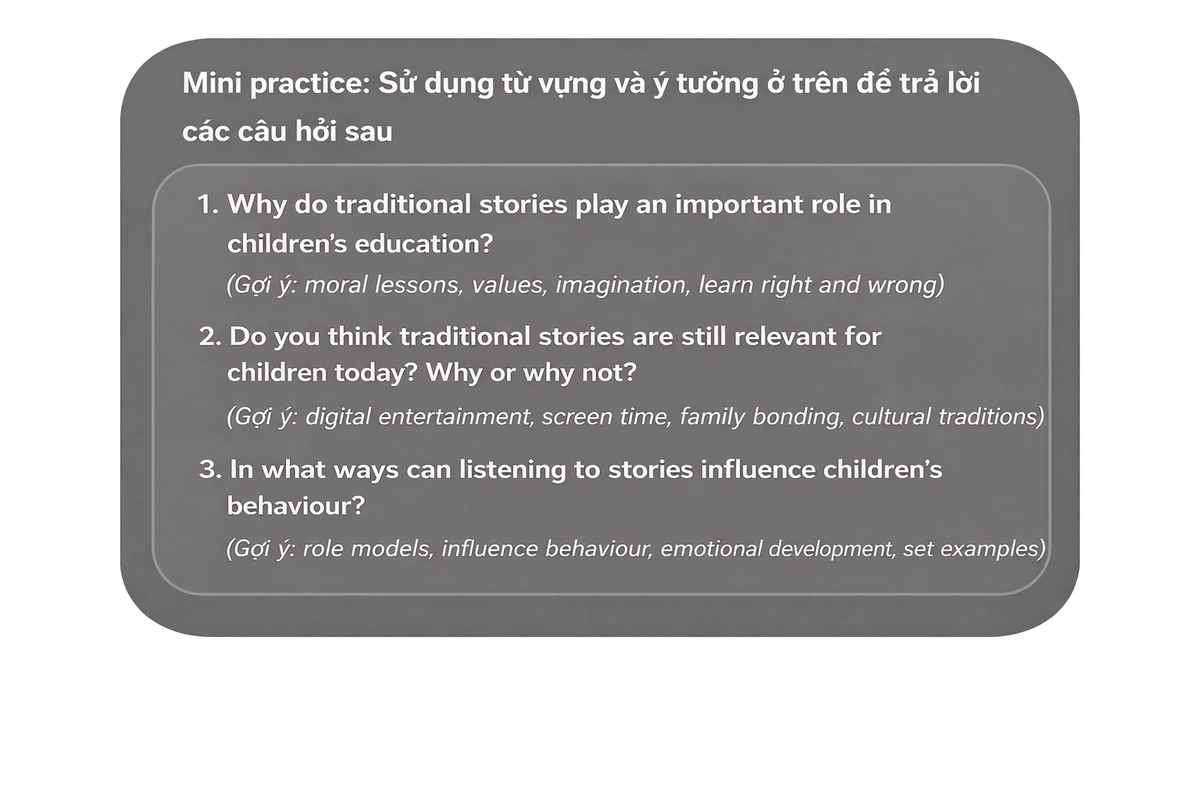
Mini practice |
|---|
Dùng đúng cấu trúc trong ngoặc:
(Dùng: help + V / help + someone + V – không dùng help + to V)
(Dùng: teach + noun / teach + someone + to V – không dùng teach about + V-ing)
(Dùng: fail to + V / cannot + V – không dùng make children not + V) |
Các chủ đề liên quan
Chủ đề liên quan để sử dụng từ vựng & ý tưởng:
Traditional stories & folklore (Truyện dân gian, truyện truyền thống)
Children’s education & development (Giáo dục và phát triển trẻ em)
Family routines & parenting (Thói quen gia đình & nuôi dạy con)
Người đọc có thể sử dụng:
Từ vựng:
traditional stories, bedtime stories, moral lessons, imagination, creativity, values, behaviour, role models, storytelling, family bonding, cultural traditions, pass down stories, digital entertainment, screen time, attention span, emotional development, social skills, learn right and wrong, influence behaviour,...
Ý tưởng:
Truyện truyền thống giúp trẻ thư giãn và dễ ngủ hơn trước giờ đi ngủ
Kể chuyện tạo sự gắn kết giữa cha mẹ và con cái
Truyện dạy trẻ các giá trị đạo đức như trung thực, lòng tốt, sự dũng cảm
Trẻ ngày nay ít tiếp xúc với truyện truyền thống hơn do thiết bị điện tử
Truyện không chỉ giải trí mà còn ảnh hưởng đến hành vi và cách suy nghĩ của trẻ
Tham khảo thêm: Bài mẫu IELTS Speaking Part 3 Topic “Travel” kèm từ vựng
Tổng kết
Qua việc luyện tập theo hai cấp độ Simple Answer và Upgraded Answer, bạn sẽ dễ dàng phát triển ý và nâng cao chất lượng câu trả lời cho IELTS Speaking Part 3 Topic Stories and Children. Hãy duy trì thói quen ghi chép từ vựng, ý tưởng và luyện tập thường xuyên để tự tin hơn khi gặp các câu hỏi thuộc chủ đề này trong bài thi IELTS Speaking
Nếu bạn muốn nâng cao kỹ năng IELTS Speaking theo lộ trình cá nhân hóa, Hệ thống giáo dục ZIM cung cấp các khóa luyện thi IELTS cam kết đầu ra, giúp bạn tối ưu hiệu quả học tập và tiết kiệm đến 80% thời gian tự học. Để được tư vấn chi tiết, vui lòng liên hệ hotline 1900-2833 (nhánh 1) hoặc truy cập khoá học IELTS.
Nguồn tham khảo
1
“Bài mẫu IELTS Speaking Part 3.” OpenAI, chatgpt.com/share/e/6961bf62-bf88-8002-9512-8fe28a8cdcf4. Accessed 2 February 2026.
Bình luận - Hỏi đáp