


Chủ đề IELTS Speaking: Part 3: The Sky & Nature.
Bài mẫu cho các nhóm câu hỏi:
Why look at the sky?
Enough time enjoying nature?
Why different interests in nature?
More sky-viewing opportunities in the countryside?
Interest in nature in the future?
Nhóm từ vựng trọng tâm (Topic Vocabulary):
The Sky and What We See, Time in Nature, và Interest and the Future.
Bài mẫu IELTS Speaking Part 3 topic The Sky & Nature
Bài viết cung cấp các câu trả lời mẫu cho IELTS Speaking Part 3 (The Sky & Nature) theo định hướng cá nhân hóa, được chia thành hai cấp độ: Simple Answer (tập trung phản xạ và độ trôi chảy) và Upgraded Answer (nâng cấp từ vựng, ngữ pháp). Ngoài ra, phần phân tích chi tiết sẽ giúp người học hệ thống hóa từ vựng, khắc phục lỗi ngữ pháp và linh hoạt áp dụng vào các chủ đề tương tự.
Key takeaways
Bài viết sau đây sẽ cung cấp các câu trả lời mẫu theo khung sườn tư duy (Simple Answer) cùng các thử thách nâng cấp (Upgraded Answer) về cả ý tưởng, từ vựng và ngữ pháp để người học lựa chọn được câu trả lời phù hợp với bản thân, sẵn sàng cho các tình huống trong phòng thi. Bài phân tích này sẽ dẫn dắt người học đi qua chủ đề The Sky & Nature, từ vẻ đẹp và cảm giác thư giãn khi ngắm bầu trời đêm quang đãng (a clear night sky), sự khác biệt về ô nhiễm ánh sáng (light pollution) giữa thành phố và nông thôn, cho đến vai trò của khả năng tiếp cận thiên nhiên (access to nature) trong việc hình thành thói quen ở ngoài trời, giúp người học chinh phục giám khảo bằng sự mạch lạc và ngôn ngữ tự nhiên.
IELTS Speaking Part 3: The Sky & Nature
Simple answer
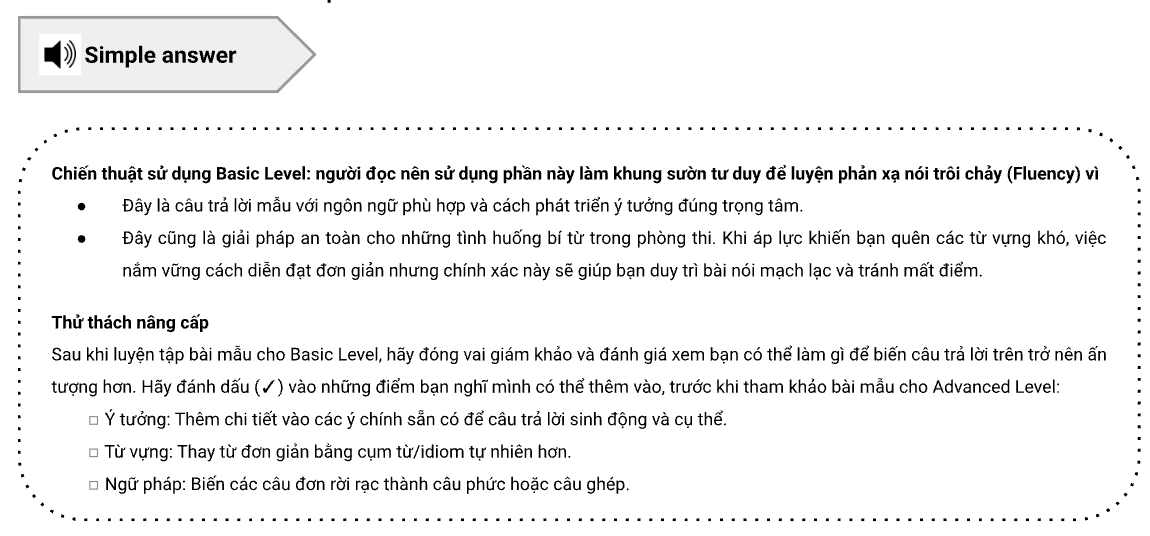
1. Why do people like looking at the sky?
|
I think people enjoy looking at the sky because it is beautiful and helps them relax. The colours change throughout the day, so there is always something new to see. For example, watching a sunset after a busy day can make someone feel calmer. It is a simple way to take a short break. |
2. Do people nowadays spend enough time enjoying nature?
|
I don't think most people spend enough time enjoying nature. Many work or study indoors and then use their phones during their free time. For example, someone might walk past a park every day without stopping to notice it. A short walk outside could help them feel more relaxed. |
3. Why are some people more interested in nature than others?
|
I think it often depends on how people grew up. Someone who spent time outdoors as a child may feel more comfortable and interested in nature. For example, a person who went hiking with their family might still enjoy it as an adult. Others may simply prefer indoor activities. |
4. Do you think people living in the countryside have more opportunities to enjoy the sky than those living in cities?
|
Yes, I think people in the countryside usually have more chances to enjoy the sky. There are often more open spaces and fewer tall buildings blocking the view. For example, they may see the stars clearly on a quiet evening. In a city, bright lights can make that much harder. |
5. Do you think people's interest in nature will change in the future?
|
I think interest in nature may grow in the future. People are learning more about environmental problems and the benefits of spending time outside. For example, more families may choose outdoor activities at weekends. However, this will also depend on whether people have easy access to green spaces. |
Mini practice: Dùng từ vựng và ý tưởng của các câu trả lời mẫu trên, nói về chủ đề The Sky & Nature theo ý của bạn.
Gợi ý: người đọc có thể nói về chủ đề này theo các khía cạnh sau:
Vẻ đẹp và cảm giác khi ngắm bầu trời: Vì sao mọi người thích ngắm bầu trời? Hoàng hôn hoặc bầu trời đầy sao có thể giúp họ thư giãn và tạm quên lo lắng như thế nào?
Thời gian dành cho thiên nhiên trong cuộc sống hiện đại: Công việc, học tập và thói quen dùng điện thoại ảnh hưởng thế nào đến thời gian ở ngoài trời? Một chuyến đi dạo ngắn trong công viên có thể mang lại điều gì?
Trải nghiệm và sự quan tâm đến thiên nhiên: Kỉ niệm thời thơ ấu hoặc chuyến đi cùng gia đình có thể khiến một người gắn bó với thiên nhiên ra sao? Vì sao có người thích hoạt động ngoài trời hơn người khác?
Cơ hội ngắm bầu trời ở thành phố và nông thôn: Nhà cao tầng, không gian mở và ô nhiễm ánh sáng ảnh hưởng đến tầm nhìn như thế nào? Ở đâu dễ ngắm bầu trời đêm quang đãng và các vì sao hơn?
Sự quan tâm đến thiên nhiên trong tương lai: Nhận thức về môi trường và lợi ích của việc ở ngoài trời có thể thay đổi thói quen của mọi người ra sao? Việc tiếp cận không gian xanh có vai trò gì?
Tham khảo: Tổng hợp bài mẫu IELTS Speaking 2026
Upgraded answer
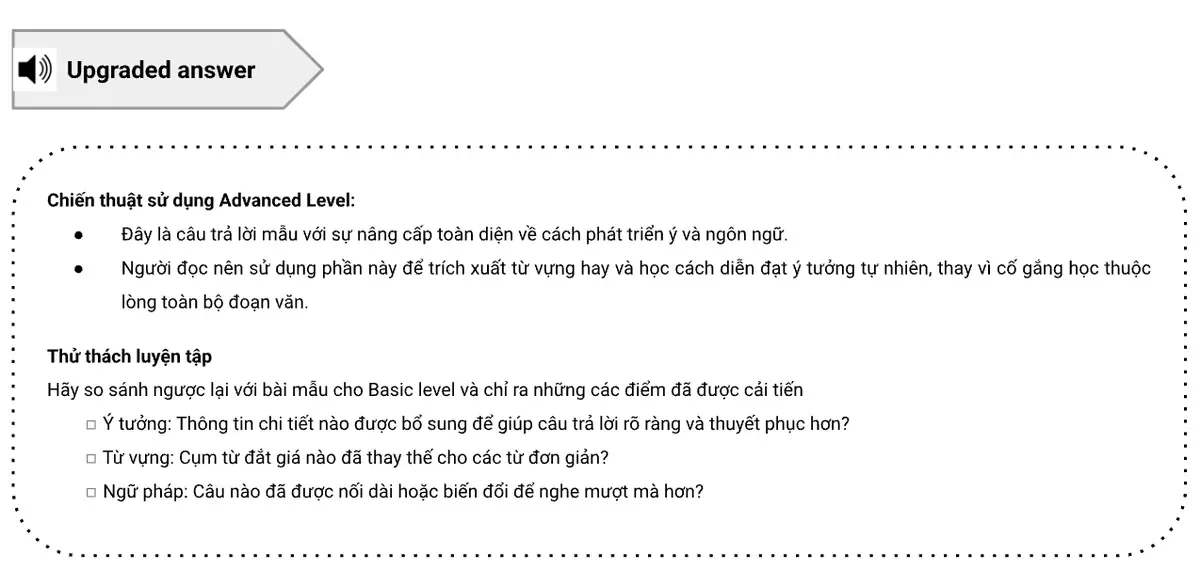
1. Why do people like looking at the sky?
|
People are drawn to the sky for both its beauty and the sense of perspective it gives them. A sunrise or a sky full of stars can make everyday worries feel smaller, even if only for a moment. It also changes constantly, so looking up never feels quite the same twice. For instance, someone leaving work might pause to watch the evening colours and feel more at ease. Of course, not everyone has time to stop, but the sky offers a rare moment of calm that costs nothing. |
2. Do people nowadays spend enough time enjoying nature?
|
Generally, I don't think people spend as much time in nature as they would like. Work, study and screen-based entertainment can fill most of the day, while green spaces may be difficult to reach in some areas. For example, a city resident might spend the whole week indoors and only visit a park at the weekend. That said, some people make a real effort to walk or exercise outside regularly. So the problem is partly personal habits, but access to nature matters as well. |
3. Why are some people more interested in nature than others?
|
I'd say early experiences play a major role. People who grew up visiting parks, gardens or the countryside may feel a stronger connection to the natural world. Personal interests matter too: someone who enjoys photography or birdwatching is more likely to notice small changes outdoors. On the other hand, a person with little free time or limited access to green spaces may have fewer chances to develop that interest. So I wouldn't say some people naturally care more; their experiences and opportunities can shape their curiosity. |
4. Do you think people living in the countryside have more opportunities to enjoy the sky than those living in cities?
|
Overall, yes. Rural areas tend to have wider views and less light pollution, which makes it easier to see clouds, sunsets and stars. Someone living in a village might only need to step outside to enjoy a clear night sky, whereas a city resident may need to travel beyond the bright streets. Still, it is not guaranteed: weather can spoil the view anywhere, and people in the countryside may be too busy to notice it. Cities can also offer rooftop viewpoints or parks, but the opportunity is generally more limited. |
5. Do you think people's interest in nature will change in the future?
|
I expect people's interest in nature to grow, especially as awareness of environmental issues and mental well-being increases. Schools and online media can encourage people to learn about wildlife and spend more time outdoors. For instance, local nature walks or community gardens may become more popular. At the same time, digital entertainment and expanding cities could pull people away from natural spaces. So I think interest may increase, but turning that interest into regular outdoor habits will depend on access and daily routines. |
Mini practice: Dùng từ vựng và ý tưởng của các câu trả lời mẫu trên, nói về chủ đề The Sky & Nature theo ý của bạn.
Gợi ý: người đọc có thể nói về chủ đề này theo các khía cạnh sau:
Vẻ đẹp và cảm giác khi ngắm bầu trời: Vì sao mọi người thích ngắm bầu trời? Hoàng hôn hoặc bầu trời đầy sao có thể giúp họ thư giãn và tạm quên lo lắng như thế nào?
Thời gian dành cho thiên nhiên trong cuộc sống hiện đại: Công việc, học tập và thói quen dùng điện thoại ảnh hưởng thế nào đến thời gian ở ngoài trời? Một chuyến đi dạo ngắn trong công viên có thể mang lại điều gì?
Trải nghiệm và sự quan tâm đến thiên nhiên: Kỉ niệm thời thơ ấu hoặc chuyến đi cùng gia đình có thể khiến một người gắn bó với thiên nhiên ra sao? Vì sao có người thích hoạt động ngoài trời hơn người khác?
Cơ hội ngắm bầu trời ở thành phố và nông thôn: Nhà cao tầng, không gian mở và ô nhiễm ánh sáng ảnh hưởng đến tầm nhìn như thế nào? Ở đâu dễ ngắm bầu trời đêm quang đãng và các vì sao hơn?
Sự quan tâm đến thiên nhiên trong tương lai: Nhận thức về môi trường và lợi ích của việc ở ngoài trời có thể thay đổi thói quen của mọi người ra sao? Việc tiếp cận không gian xanh có vai trò gì?
Lọc và phân tích từ vựng
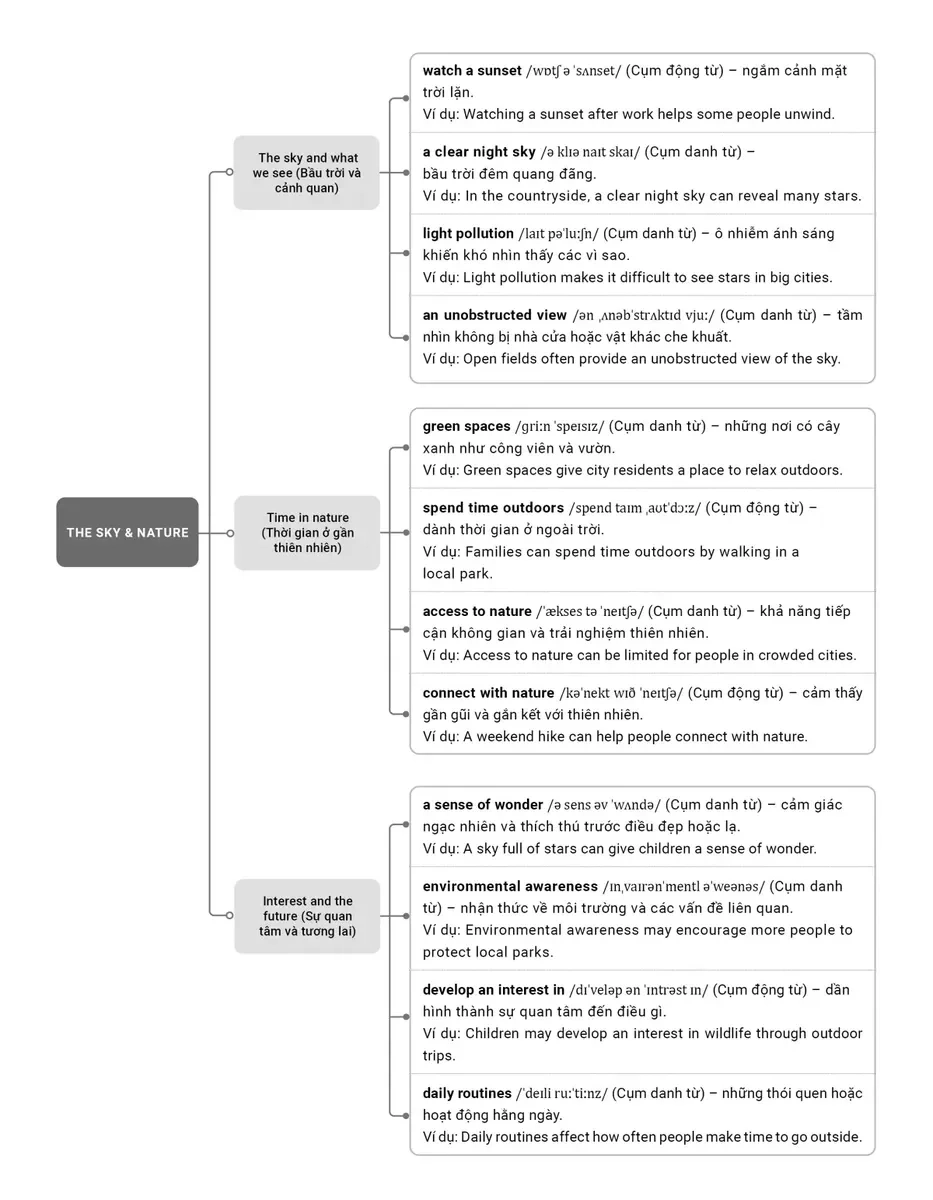
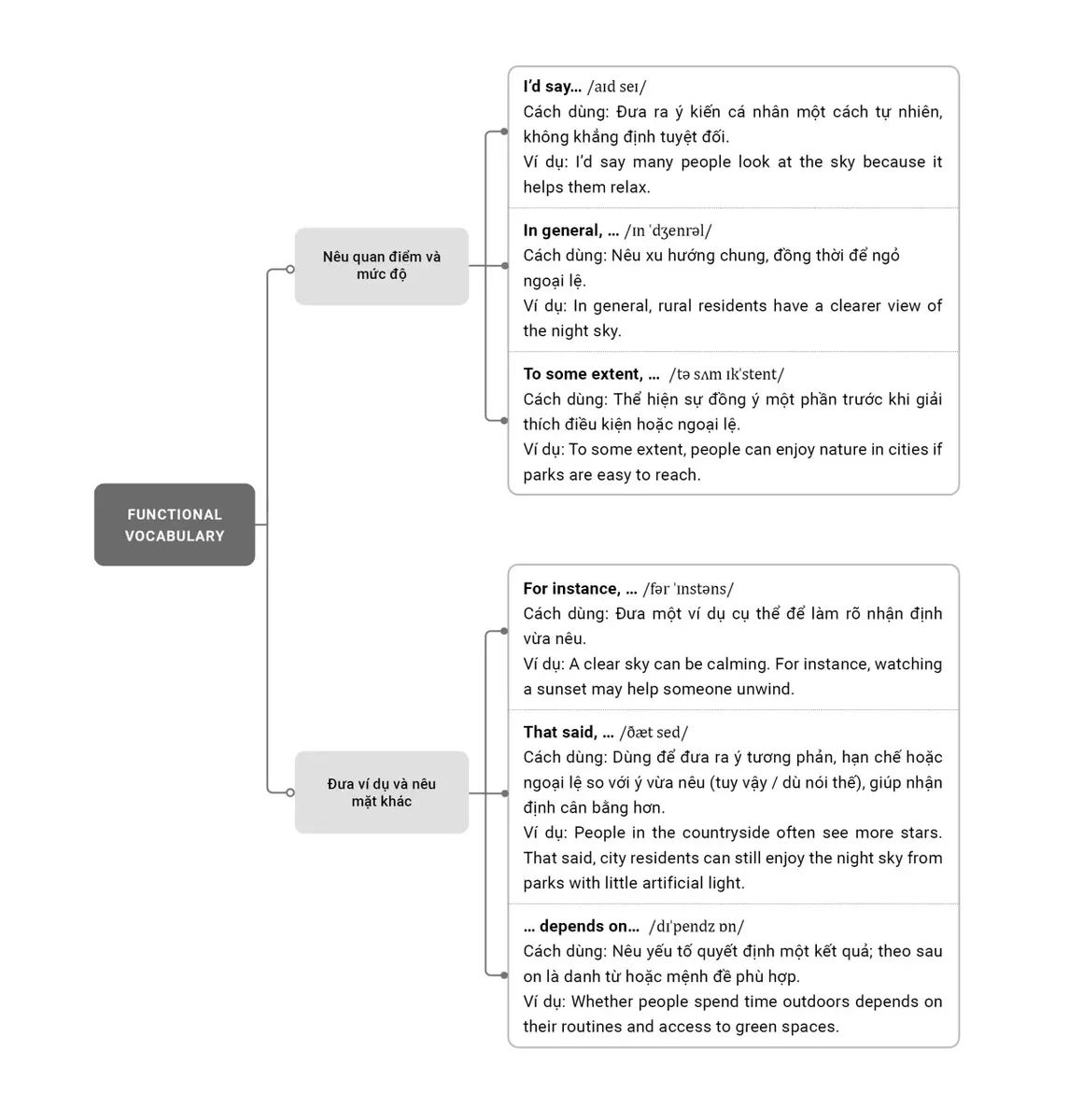
Nhật ký Từ vựng & Ý tưởng
Ghi chú sau khi luyện tập nói về chủ đề trên
Từ vựng/Ý tưởng (Chọn các từ vựng/ý tưởng mà bạn tâm đắc nhất) | Kỉ niệm cá nhân (Gán các từ vựng/ý tưởng đã chọn với kỉ niệm của bản thân) |
|---|---|
Ví dụ: a clear night sky – bầu trời đêm quang đãng; light pollution – ô nhiễm ánh sáng; connect with nature – gắn kết với thiên nhiên. | Người đọc tự đặt các câu hỏi cho bản thân, ví dụ:
→ Last summer, I visited my grandparents in the countryside. One evening, we sat outside and looked at a clear night sky. I could see many more stars than I usually see in the city because there was less light pollution. The quiet moment helped me slow down and connect with nature. Since then, I have tried to spend time outdoors more often, even if it is just a short walk in a nearby park. |
Khoảng trống diễn đạt (Phần khiến bạn ngập ngừng khi nói về chủ đề trên) | Giải pháp (Giải pháp cho các khoảng trống diễn đạt) | ||
|---|---|---|---|
Ví dụ: Tôi muốn so sánh cơ hội ngắm bầu trời ở thành phố và nông thôn, nhưng thiếu cụm từ để nói về tầm nhìn thoáng và ô nhiễm ánh sáng. | Ví dụ: Tra từ điển của ZIM hoặc xem lại bài mẫu để tìm cách diễn đạt rõ ràng, tự nhiên. → Thay vì nói “too many city lights”, có thể dùng light pollution. → Thay vì nói “nothing blocks the sky”, có thể dùng an unobstructed view of the sky. |
Người đọc có thể tìm từ vựng bằng từ điển ZIM Dictionary.
Các lỗi ngữ pháp/từ vựng thường gặp
1. Dùng đúng “look at”, “watch” và “look for”
❌ Lỗi thường gặp:
I enjoy looking the sky at night.
We watched at the sunset yesterday.
✅ Cách dùng đúng:
look at + someone/something: hướng mắt nhìn một người hoặc vật.
watch + something: quan sát trong một khoảng thời gian; không thêm at.
look for + something: tìm kiếm; khác với look at.
✔ Câu đúng:
I enjoy looking at the sky at night.
We watched the sunset yesterday.
📌 Lý do sai:
Câu đầu thiếu at sau look. Câu thứ hai thêm at không cần thiết sau watch. Nếu muốn nói “tìm các vì sao”, dùng look for stars; còn khi ngắm chúng, dùng look at the stars.
2. Dùng đúng “although” và “despite” khi nêu ý trái chiều
❌ Lỗi thường gặp:
Despite many people want to enjoy nature, they rarely make time for it.
Although city parks are easy to reach, but some residents still stay indoors.
✅ Cách dùng đúng:
although/even though + mệnh đề (S + V): mặc dù…
despite/in spite of + danh từ hoặc V-ing: mặc dù…
Không dùng but ngay sau mệnh đề bắt đầu bằng although hoặc even though.
Sau despite, dùng the fact that nếu muốn theo sau bằng một mệnh đề.
✔ Câu đúng:
Despite wanting to enjoy nature, many people rarely make time for it.
Although city parks are easy to reach, some residents still stay indoors.
📌 Lý do sai:
Câu đầu dùng cả mệnh đề sau despite, trong khi despite chỉ đi trực tiếp với danh từ hoặc V-ing. Câu thứ hai dùng thừa but sau mệnh đề bắt đầu bằng although. Có thể dùng despite the fact that nếu muốn giữ một mệnh đề đầy đủ.
Xem thêm: Phân biệt despite, in spite of, although, though, even though
3. Dùng đúng cấu trúc “the more…, the more…”
❌ Lỗi thường gặp:
More time people spend outdoors, the more connected they feel to nature.
The easier it is to reach a park, more often people visit it.
✅ Cách dùng đúng:
the + comparative + mệnh đề, the + comparative + mệnh đề: càng… thì càng…
Mỗi vế đều bắt đầu bằng the; không lược bỏ ở một trong hai vế.
Sau cụm so sánh hơn, giữ trật tự chủ ngữ + động từ trong mệnh đề.
Dùng cấu trúc này để nêu mối liên hệ giữa hai sự thay đổi.
✔ Câu đúng:
The more time people spend outdoors, the more connected they feel to nature.
The easier it is to reach a park, the more often people visit it.
📌 Lý do sai:
Câu đầu thiếu the ở vế thứ nhất; câu thứ hai thiếu the ở vế thứ hai. Trong cấu trúc tương quan này, cả hai vế phải bắt đầu bằng the + so sánh hơn. Phần theo sau vẫn dùng trật tự chủ ngữ + động từ thông thường.
Mini practice |
|---|
Dùng đúng cấu trúc trong ngoặc
|
Chủ đề liên quan để sử dụng từ vựng & ý tưởng:
City life & countryside (Đô thị và nông thôn)
Người đọc có thể sử dụng:
Từ vựng: watch a sunset, a clear night sky, light pollution, an unobstructed view, green spaces, spend time outdoors, access to nature, connect with nature, a sense of wonder, environmental awareness, develop an interest in, daily routines
Ý tưởng:
Màu sắc của bầu trời thay đổi trong ngày; ngắm hoàng hôn có thể giúp mọi người thư giãn sau một ngày bận rộn.
Công việc, học tập và thời gian dùng điện thoại khiến nhiều người ít ra ngoài; một chuyến đi dạo ngắn có thể giúp họ nghỉ ngơi.
Những chuyến đi ngoài trời cùng gia đình từ nhỏ có thể nuôi dưỡng sự quan tâm đến thiên nhiên.
Nông thôn thường có không gian thoáng và ít ô nhiễm ánh sáng hơn nên dễ nhìn thấy các vì sao; thời tiết vẫn ảnh hưởng đến trải nghiệm này.
Không gian xanh và khả năng tiếp cận thiên nhiên giúp người sống ở thành phố có thêm cơ hội hoạt động ngoài trời.
Sự quan tâm đến môi trường có thể tăng trong tương lai, nhưng việc hình thành thói quen ra ngoài còn phụ thuộc vào không gian xanh và lịch sinh hoạt.
Mini practice |
|---|
Sử dụng từ vựng và ý tưởng ở trên để trả lời các câu hỏi sau What do you enjoy doing outdoors? (Gợi ý: watch a sunset, green spaces) Is it easy to see stars where you live? (Gợi ý: a clear night sky, light pollution) How can cities help residents enjoy nature more? (Gợi ý: green spaces, access to nature, daily routines) |
Tổng kết
Hy vọng rằng qua việc phân tích hai cấp độ trả lời từ Simple Answer để đảm bảo sự trôi chảy đến Upgraded Answer để ghi điểm ấn tượng, bạn đã nắm vững được lộ trình để chinh phục chủ đề The Sky & Nature (Part 3). Bằng cách cá nhân hóa các câu trả lời thông qua "Nhật ký Từ vựng & Ý tưởng", bạn sẽ xây dựng được sự tự tin. Đừng quên thực hành các bài tập nhỏ (mini practice) để khắc phục những lỗi ngữ pháp thường gặp và làm chủ ngôn ngữ của mình nhé!
Nếu bạn muốn nâng cao kỹ năng IELTS Speaking theo lộ trình cá nhân hóa, Hệ thống giáo dục ZIM cung cấp các khóa luyện thi IELTS cam kết đầu ra, giúp bạn tối ưu hiệu quả học tập và tiết kiệm đến 80% thời gian tự học. Để được tư vấn chi tiết, vui lòng liên hệ hotline 1900-2833 (nhánh 1) hoặc truy cập Khóa học IELTS.
Nguồn tham khảo
1
“Bài mẫu IELTS Speaking Part 3.” OpenAI, https://chatgpt.com/share/e/6961bf62-bf88-8002-9512-8fe28a8cdcf4. Accessed 3 October 2026.


Bình luận - Hỏi đáp