Bài viết Describe a natural place you would like to visit - Chủ đề IELTS Speaking sẽ bao gồm các đề mục chính:
Bài mẫu Part 2 chủ đề “Describe a natural place you would like to visit”
Phân tích từ vựng trong bài mẫu
Câu trả lời mẫu cho một số câu hỏi Part 3 và phân tích từ vựng
Chủ đề “Describe a natural place you would like to visit” là một trong những chủ đề quen thuộc trong IELTS Speaking, cho phép thí sinh thể hiện khả năng mô tả và bày tỏ cảm xúc cá nhân. Thông qua việc nói về một địa điểm thiên nhiên mong muốn ghé thăm, thí sinh không chỉ mở rộng vốn từ vựng về cảnh quan và môi trường mà còn có cơ hội trình bày những trải nghiệm, sở thích và khát vọng khám phá thế giới. Bài viết này sẽ cung cấp những ý tưởng hữu ích, từ vựng học thuật phù hợp và các gợi ý triển khai nội dung nhằm giúp thí sinh xây dựng câu trả lời mạch lạc và tạo ấn tượng với giám khảo trong kỳ thi IELTS.
Đề bài
Describe a natural place you would like to visit.
You should say:
where it is
what it looks like
what people can do there
And explain why you would like to visit it.
Phân tích đề bài
Thí sinh phải mô tả một địa điểm tự nhiên mà mình muốn ghé thăm. Trong đề trên, các từ khóa chính gồm “natural place” và “would like to visit”.
Thí sinh cần hiểu rằng “natural place” là nơi chốn/ địa điểm chủ yếu được hình thành bởi thiên nhiên, chứ không phải nhân tạo, ví dụ núi, bãi biển, rừng, thác nước, hang động …
Để trả lời, thí sinh nên triển khai bài nói theo các ý chính gợi ý trong đề. Trước hết, hãy giới thiệu vị trí của địa điểm đó, chẳng hạn như nó nằm ở tỉnh, thành phố hoặc quốc gia nào. Tiếp theo, dành phần lớn thời gian để mô tả đặc điểm nổi bật của nơi này, bao gồm cảnh quan, màu sắc, khí hậu, hệ động thực vật hoặc các yếu tố thiên nhiên đặc sắc khác. Sau đó, thí sinh có thể đề cập đến những hoạt động mà du khách thường tham gia tại đây, như đi bộ đường dài, cắm trại, tham quan, chụp ảnh hoặc khám phá thiên nhiên. Sau đó, hãy giải thích lý do mình muốn đến đó, chẳng hạn vì yêu thiên nhiên, muốn thư giãn, tìm kiếm trải nghiệm mới hoặc tạm rời xa nhịp sống bận rộn hằng ngày.
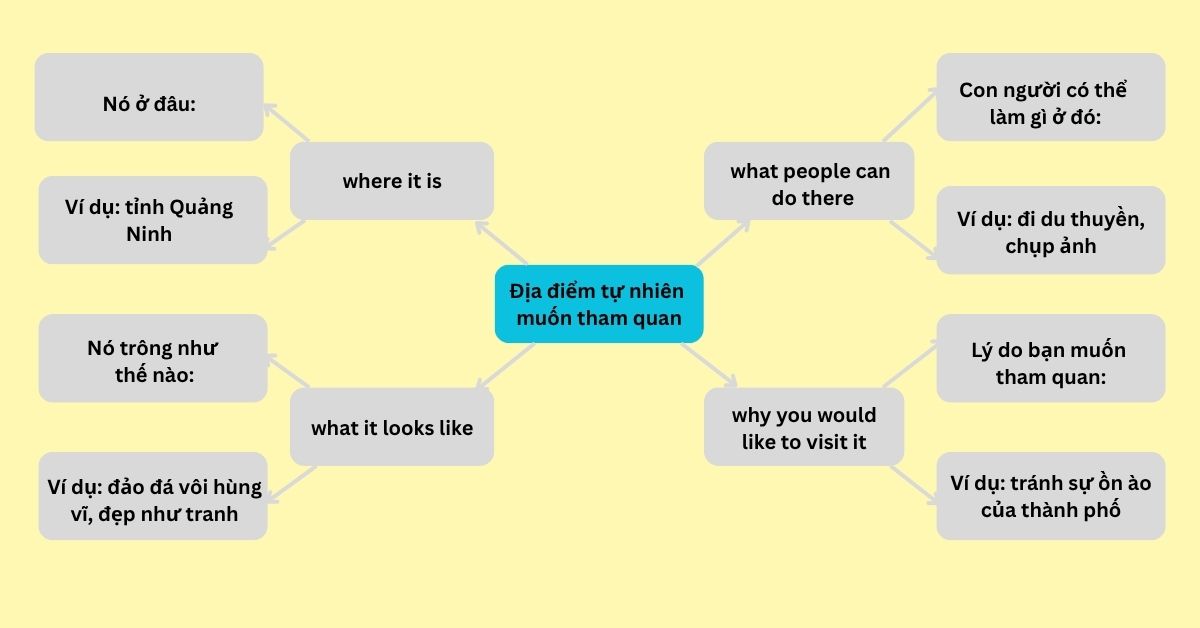
Sau đây là sơ đồ tư duy gồm những khía cạnh của đề bài mà thí sinh cần giải quyết:
Sơ đồ tư duy
Sử dụng phương pháp IWHC để tạo ghi chú tóm tắt cho đề bài trên. Ghi chú cần đủ ngắn để chuẩn bị trong 1 phút nhưng vẫn bao quát các ý chính, hỗ trợ thí sinh phát triển câu trả lời kéo dài từ 1,5 đến 2 phút trong IELTS Speaking Part 2. Thí sinh có thể bỏ phần mở bài hoặc kết bài khi cần thiết để tối ưu thời gian trình bày:
introduction + where it is:
UNESCO World Heritage Site, Ha Long Bay, Quang Ninh Province, northeastern Vietnam.
cruise through the bay, sail around limestone formations, hike to panoramic viewpoints, seafood delicacies, capture stunning photographs.
explain why you would like to visit it:
passionate about nature, escape the hustle and bustle, immerse myself in a tranquil atmosphere, spectacular landscapes, cultural significance, once-in-a-lifetime experience.
conclusion:
remarkable natural wonders, unforgettable memories, broaden my horizons.
I'd like to talk about a natural place that I have always wanted to visit, which is Ha Long Bay, a UNESCO World Heritage Site located in Quang Ninh Province in northeastern Vietnam.
World Heritage Site (Di sản Thế giới): a place recognized by UNESCO for its outstanding cultural or natural importance.
What it looks like
Although I have seen countless photos about this place, I have never had the opportunity to visit it in person. What fascinates me most about Ha Long Bay is its breathtaking seascape. The bay is famous for its emerald waters and towering limestone karsts rising dramatically from the sea. It also features numerous rugged islets and mystical caves, creating a picturesque scenery that looks almost unreal. Whenever I look at pictures of the bay, I am amazed by its awe-inspiring natural beauty and unique geological formations.
breathtaking seascape (cảnh biển ngoạn mục): an extremely beautiful view of the sea that leaves a strong impression.
rugged islet (đảo nhỏ gồ ghề): a small island with a rough, uneven, and rocky surface, often shaped by natural forces over a long period of time.
picturesque (đẹp như tranh vẽ): visually attractive, especially in a charming or scenic way.
awe-inspiring (gây kinh ngạc): making people feel great admiration, wonder, or respect.
What people can do there
There are a variety of activities that tourists can enjoy there. For example, they can cruise through the bay to admire the scenery from different angles, or sail around limestone formations to explore the area more closely. People can also explore hidden caves, many of which contain spectacular rock formations. In addition, some islands offer opportunities to hike to panoramic viewpoints where visitors can enjoy stunning views of the entire bay. Another highlight is the local cuisine, especially the fresh seafood delicacies that attract tourists from all over the world. It is also an ideal destination to capture stunning photographs.
cruise (du ngoạn bằng tàu): a journey on a ship or boat, usually for pleasure and sightseeing.
panoramic viewpoint (điểm ngắm cảnh toàn cảnh): a location that offers a wide and unobstructed view of the surrounding area.
delicacy (đặc sản): a rare or special food that is considered highly desirable or delicious.
Explain why you would like to visit it
I would really like to visit Ha Long Bay because I am passionate about nature. I think it would be the perfect place to escape the hustle and bustle of city life and immerse myself in a tranquil atmosphere. Besides its spectacular landscapes, the bay also has considerable cultural significance, which makes it even more appealing to me. Visiting such an iconic destination would undoubtedly be a once-in-a-lifetime experience.
hustle and bustle (sự nhộn nhịp, hối hả): a lot of busy and noisy activity, especially in a city.
tranquil (yên bình, thanh tĩnh): calm, peaceful, and free from disturbance.
spectacular landscape (cảnh quan ngoạn mục): an impressive and visually striking natural environment.
once-in-a-lifetime (có một không hai trong đời): extremely special and likely to happen only once in a person's life.
Conclusion
Overall, Ha Long Bay is one of the most remarkable natural wonders I can think of. It is definitely my dream destination, and I believe the trip would leave me with unforgettable memories and broaden my horizons.
remarkable (đáng chú ý, nổi bật): unusual or exceptional in a way that deserves attention or admiration.
broaden one’s horizons (mở rộng tầm nhìn): to increase someone’s knowledge, experience, or understanding of the world.
1. Why do many people enjoy visiting natural places?
Câu trả lời mẫu:
Many people enjoy visiting natural places because they provide a welcome escape from the pressures of modern life. Spending time in nature can allow them to relieve stress and improve mental well-being. In addition, natural environments often offer breathtaking scenery that people cannot experience in urban areas. Activities such as hiking, camping, and sightseeing also make these trips both relaxing and rewarding. Overall, natural places help people reconnect with nature and recharge their energy.
Phân tích từ vựng:
Mental well-being: A person's emotional and psychological health and overall state of mind.
Phát âm: /ˌmen.təl ˌwelˈbiː.ɪŋ/
Dịch: sức khỏe tinh thần
Lưu ý: Dùng để chỉ trạng thái tinh thần tích cực, bao gồm cảm xúc, mức độ căng thẳng và sự hài lòng với cuộc sống. Ví dụ: "Spending time in nature can improve mental well-being." (Dành thời gian trong thiên nhiên có thể cải thiện sức khỏe tinh thần.)
Recharge one’s energy: To restore physical or mental strength after feeling tired.
Phát âm: /ˌriːˈtʃɑːrdʒ wʌnz ˈen.ər.dʒi/
Dịch: nạp lại năng lượng
Lưu ý: Thường dùng khi nói về việc nghỉ ngơi hoặc tham gia các hoạt động thư giãn để lấy lại sức lực. Ví dụ: "A short vacation helps me recharge my energy." (Một kỳ nghỉ ngắn giúp tôi nạp lại năng lượng.)
Ví dụ 1
2. Do you think natural areas should be protected by the government?
Câu trả lời mẫu:
Yes, I strongly believe that governments should take responsibility for protecting natural areas. These places play a crucial role in preserving biodiversity and maintaining ecological balance. Without proper regulations, they could be damaged by pollution, deforestation, or excessive tourism. Government protection can also ensure that future generations have the opportunity to enjoy these valuable natural resources. Therefore, conservation efforts are essential for long-term environmental sustainability.
Câu trả lời mẫu
Phân tích từ vựng:
Take responsibility for: To accept the duty of dealing with or being accountable for something.
Phát âm: /teɪk rɪˌspɒn.səˈbɪl.ə.ti fɔːr/
Dịch: chịu trách nhiệm về; đảm nhận trách nhiệm đối với
Lưu ý: Đây là một collocation rất phổ biến, thường được dùng khi nói về trách nhiệm của cá nhân, tổ chức hoặc chính phủ đối với một vấn đề nào đó. Ví dụ: "Governments should take responsibility for protecting natural areas." (Chính phủ nên chịu trách nhiệm bảo vệ các khu vực thiên nhiên.)
Ecological balance: A stable state in which living organisms and their environment interact harmoniously.
Phát âm: /ˌiː.kəˈlɒdʒ.ɪ.kəl ˈbæl.əns/
Dịch: cân bằng sinh thái
Lưu ý: Thường được dùng trong các chủ đề về môi trường và bảo tồn thiên nhiên. Ví dụ: "Protecting forests is essential for maintaining ecological balance." (Bảo vệ rừng là điều cần thiết để duy trì cân bằng sinh thái.)
3. What are the advantages and disadvantages of tourism in natural places?
Câu trả lời mẫu:
Tourism in natural areas can bring significant economic benefits to local communities by creating jobs and generating income. It can also raise public awareness about environmental conservation. However, if tourism is not properly managed, it may lead to pollution, overcrowding, and damage to fragile ecosystems. In some cases, wildlife habitats can be disrupted by large numbers of visitors. For this reason, sustainable tourism practices are necessary to balance economic growth with environmental protection.
Phân tích từ vựng:
Fragile ecosystem: An ecosystem that can be easily damaged by human activities or environmental changes.
Phát âm: /ˈfrædʒ.aɪl ˈiː.kəʊˌsɪs.təm/
Dịch: hệ sinh thái mong manh
Lưu ý: Thường dùng khi nói về các khu vực tự nhiên cần được bảo vệ. Ví dụ: "Mass tourism can harm fragile ecosystems." (Du lịch đại trà có thể gây hại cho các hệ sinh thái mong manh.)
Sustainable tourism: Tourism that minimizes negative environmental impacts while supporting local communities and economies.
Phát âm: /səˈsteɪ.nə.bəl ˈtʊə.rɪ.zəm/
Dịch: du lịch bền vững
Lưu ý: Đề cập đến các hoạt động du lịch có trách nhiệm với môi trường và xã hội. Ví dụ: "Many countries are investing in sustainable tourism." (Nhiều quốc gia đang đầu tư vào du lịch bền vững.)
4. Do you think people today spend enough time in nature?
Câu trả lời mẫu:
No, I do not think most people spend enough time in nature nowadays. One reason is that modern lifestyles are increasingly busy, leaving people with limited free time. In addition, technological devices and social media encourage people to stay indoors rather than engage in outdoor activities. Urbanization has also reduced access to green spaces in many cities. As a result, many people miss out on the physical and psychological benefits that nature can provide.
Phân tích từ vựng:
Green space: An area of trees, grass or other vegetation in an urban environment.
Phát âm: /ɡriːn speɪs/
Dịch: không gian xanh
Lưu ý: Thường chỉ công viên, vườn cây hoặc khu vực có nhiều cây xanh trong thành phố. Ví dụ: "Cities need more green spaces for residents." (Các thành phố cần nhiều không gian xanh hơn cho cư dân.)
Psychological benefit: A positive effect on a person's mental or emotional condition.
Phát âm: /ˌsaɪ.kəˈlɒdʒ.ɪ.kəl ˈben.ɪ.fɪt/
Dịch: lợi ích về mặt tâm lý
Lưu ý: Thường dùng khi nói về tác động tích cực đến cảm xúc hoặc sức khỏe tinh thần. Ví dụ: "Outdoor activities provide significant psychological benefits." (Các hoạt động ngoài trời mang lại những lợi ích tâm lý đáng kể.)
Ví dụ 2
Bài viết trên đã chia sẻ bài mẫu IELTS Speaking chủ đề Describe a natural place you would like to visit. Thí sinh có thể tham khảo các ý tưởng và từ vựng trên để áp dụng cho bài nói của mình.
Để phát triển ý tưởng và sử dụng từ vựng chủ đề Describe a natural place tự nhiên hơn trong IELTS Speaking, người học có thể tham khảo khóa học IELTS cá nhân hóa và cam kết đầu ra 4 kỹ năng, với lộ trình học tập phù hợp mục tiêu.
• Là cử nhân loại giỏi chuyên ngành sư phạm tiếng Anh, 8.0 IELTS (2)
• 3 năm kinh nghiệm giảng dạy tại ZIM, 2 năm làm việc ở các vị trí nghiên cứu và phát triển học liệu, sự kiện tại trung tâm.
• Triết lý giáo dục của tôi xoay quanh việc giúp học viên tìm thấy niềm vui trong học tập, xây dựng lớp học cởi mở, trao đổi tích cực giữa giáo viên, học viên với nhau, tạo môi trường thuận lợi cho việc dung nạp tri thức.
"when the student is ready, the teacher will appear."







Bình luận - Hỏi đáp