

Flow Chart Completion IELTS Reading yêu cầu điền từ ngữ được trích xuất trực tiếp từ bài đọc vào các ô trống để hoàn thiện một sơ đồ quy trình.
Độ phổ biến: Là dạng bài thường xuyên xuất hiện trong phần thi IELTS Reading.
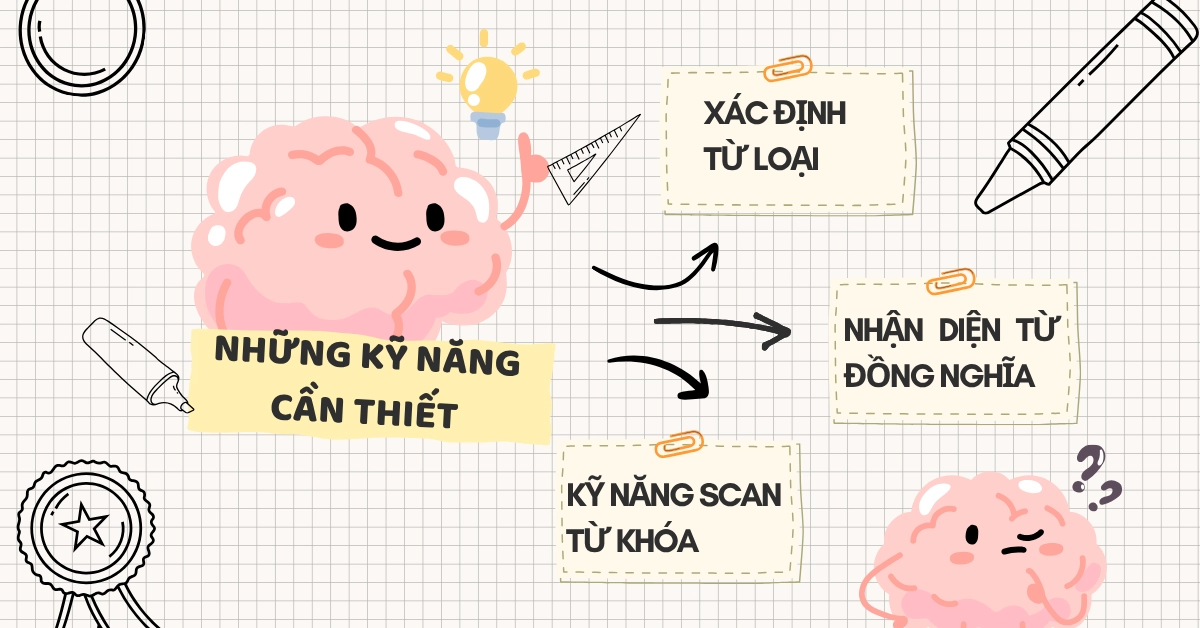
Kỹ năng trọng tâm: Đòi hỏi thí sinh có kĩ năng scan từ khoá và nhận diện từ đồng nghĩa tốt để bám sát mạch thông ti.
Flow Chart Completion IELTS Reading: Tổng quan & bài tập
Bài viết hướng dẫn về dạng bài Flow Chart Completion IELTS Reading, giúp người học nắm vững kỹ thuật giải đề kèm bài tập có đáp án và giải thích.
Key takeaways
Trong cấu trúc bài thi, dạng bài Flow Chart Completion IELTS Reading đóng vai trò quan trọng trong việc kiểm tra khả năng nắm bắt trình tự thông tin và hiểu rõ các quy trình phức tạp. Tuy nhiên, nhiều thí sinh ở trình độ cơ bản đến trung cấp thường đối mặt với những thử thách lớn trước lượng thuật ngữ chuyên ngành dày đặc hoặc mất phương hướng khi văn bản gốc sử dụng quá nhiều từ đồng nghĩa để mô tả một quy trình.
Bài viết này sẽ cung cấp cái nhìn tổng quan, các chiến thuật xử lý hiệu quả cùng hệ thống bài tập thực hành Flow Chart Completion IELTS Reading chi tiết giúp người học tự tin chinh phục dạng bài sơ đồ này.
Tổng quan về dạng bài Flow Chart Completion trong IELTS Reading
Dạng bài Flow Chart Completion IELTS Reading yêu cầu người học hoàn thành các ô trống trong một sơ đồ quy trình bằng cách sử dụng các từ ngữ được trích xuất trực tiếp từ bài đọc [1]. Đây là dạng bài thường xuất hiện dưới hình thức một chuỗi các bước được nối với nhau bằng mũi tên, thể hiện sự vận động của một quá trình sản xuất, một hiện tượng tự nhiên hoặc các giai đoạn của một thí nghiệm khoa học [1].
Các đặc điểm nhận diện chính
Flow Chart Completion IELTS Reading có các đặc điểm nhận diện sau:
Cấu trúc sơ đồ: Thông tin được trình bày dưới dạng các hộp hoặc các dòng ghi chú ngắn gọn, kết nối theo trình tự thời gian hoặc logic nguyên nhân - kết quả.
Giới hạn từ: Đề bài luôn đưa ra yêu cầu khắt khe về số lượng từ được phép điền, ví dụ: NO MORE THAN TWO WORDS (Không quá hai từ) hoặc ONE WORD ONLY (Chỉ một từ duy nhất). Việc điền thừa số từ quy định sẽ dẫn đến mất điểm dù từ đó có chứa nội dung đúng.
Thứ tự thông tin: Trong phần lớn các trường hợp, các câu trả lời sẽ xuất hiện theo trình tự từ trên xuống dưới trong bài đọc. Tuy nhiên, thông tin có thể nằm tập trung trong một đoạn văn duy nhất hoặc rải rác trong một phần của văn bản.
Những kỹ năng cần thiết để xử lý dạng bài
Để làm tốt dạng bài Flow Chart Completion IELTS Reading, thí sinh nên:
Xác định từ loại: Trước khi tìm kiếm thông tin, người học cần dự đoán từ loại (danh từ, động từ, tính từ) và đặc điểm ngữ pháp (số ít hay số nhiều) dựa vào cấu trúc câu trong sơ đồ.
Nhận diện từ đồng nghĩa: Đề bài rất ít khi sử dụng y hệt từ ngữ trong bài đọc. Thay vào đó, các động từ chỉ sự chuyển giao (e.g., follow, lead to, produce) hoặc các danh từ chuyên ngành thường được thay thế bằng các cụm từ có nghĩa tương đương.z
Kỹ năng scan từ khóa: Tập trung tìm kiếm các danh từ riêng, con số hoặc các thuật ngữ kỹ thuật không thể thay thế để khoanh vùng đoạn văn chứa đáp án một cách nhanh nhất.
Xem thêm: Các dạng bài IELTS Reading thường gặp
Bài tập IELTS Reading dạng Flow Chart Completion
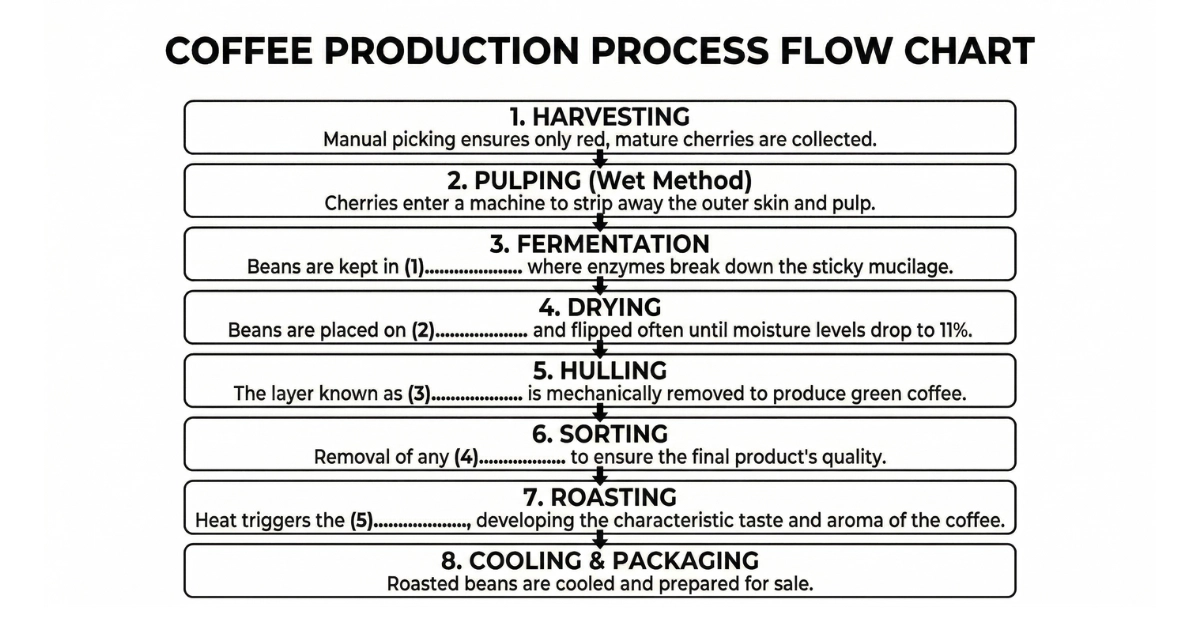
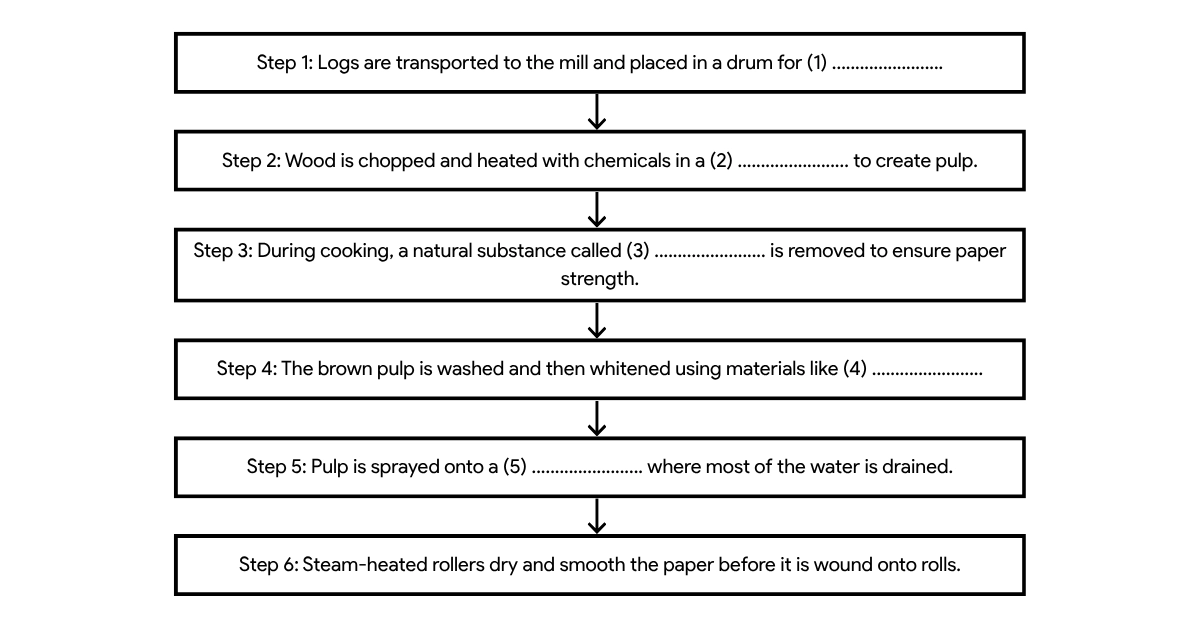
Bài đọc 1: Choose NO MORE THAN TWO WORDS from the passage for each answer.
The Journey of Coffee: From Bean to Cup
The process of producing high-quality coffee is a meticulous journey that begins in the tropical regions known as the "Bean Belt." The first critical step is the harvesting of coffee cherries. Unlike industrial farming, premium coffee is often hand-picked to ensure only the ripe, red cherries are selected, while green, unripe ones remain on the branch.
Once harvested, the cherries must be processed immediately to prevent spoilage. There are two primary methods: the Dry Method and the Wet Method. In the Wet Method, the freshly harvested cherries are passed through a pulping machine to separate the skin and pulp from the bean. Following this, the beans are moved to large, water-filled fermentation tanks. This stage is crucial as it uses enzymes to dissolve the remaining layer of mucilage (a sticky substance) still attached to the parchment.
After fermentation, the beans must be dried to approximately 11% moisture to prepare them for storage. They are usually spread out on large wooden tables or "drying beds," where they are turned regularly to prevent mold growth. Once dried, the coffee is now referred to as "parchment coffee."
The next phase involves "hulling," where machines remove the entire parchment layer from the beans. This results in "green coffee," which is then graded and sorted by size and weight. Any defective beans are discarded at this point to maintain quality. The final transformation occurs during roasting. Here, the green beans are subjected to intense heat, typically around 200°C, causing them to turn brown and release their aromatic oils. This process, known as the Maillard reaction, is what gives coffee its signature flavor and scent. Finally, the roasted beans are cooled quickly using air or water before being packaged for consumers.
Bài đọc 2: Choose NO MORE THAN TWO WORDS from the passage for each answer.
The Modern Papermaking Process
The process of turning trees into paper is a complex operation that involves several distinct stages. It begins with the harvesting of trees, which are then transported to the paper mill. Upon arrival, the logs are fed into a massive tumbling drum where the bark is stripped away, a process known as debarking. It is crucial to remove the bark because it cannot be used in papermaking and would reduce the quality of the final product.
Next, the debarked logs are sent through a chipper that reduces them to small, uniform wood chips. These chips are then transferred to a large pressure cooker called a digester. Inside the digester, the wood chips are cooked with a mixture of water and chemicals at high temperatures. This chemical pulping process breaks down the wood and separates the cellulose fibers from lignin, a natural glue that binds the fibers together. The removal of lignin is essential for producing strong, high-quality paper.
Once the cooking is complete, the resulting mixture, now called pulp, undergoes an extensive washing process to remove any residual chemicals and dissolved lignin. At this stage, the pulp is naturally brown, much like a cardboard box. To produce white paper, the pulp must be bleached. Environmentally friendly facilities typically use hydrogen peroxide or oxygen for this bleaching stage, avoiding harsh chlorine. After bleaching, the pulp is beaten in a refiner, which frays the fibers so they will bond together more tightly.
In the final stage, the heavily diluted pulp—which is now composed of 99% water and 1% fiber—is sprayed onto a continuous, fast-moving mesh screen on the papermaking machine. As the screen moves forward, the water rapidly drains away, leaving a continuous wet web of interwoven fibers. This web then passes through a series of heavy, steam-heated rollers that press out the remaining moisture and smooth the surface. The finished paper is finally wound onto massive jumbo rolls, ready to be cut and shipped.
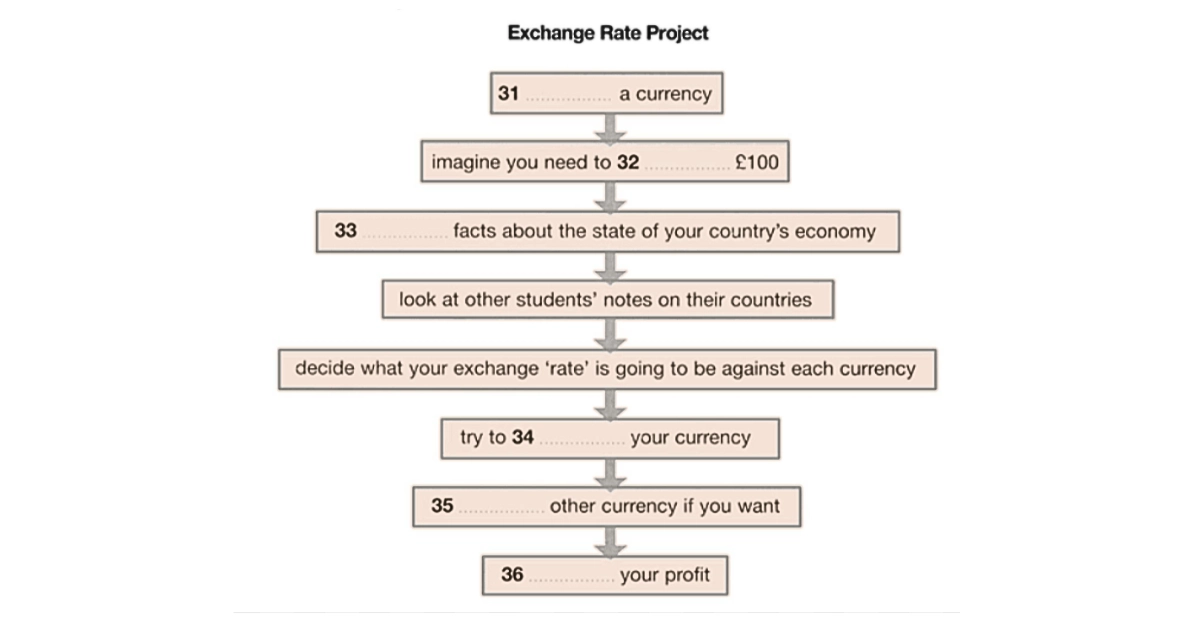
Bài đọc 3: Choose NO MORE THAN ONE WORD from the passage for each answer.
The Exchange Rate Project Simulation
In the second-year macroeconomics module, students participate in a dynamic simulation known as the Exchange Rate Project to better understand global markets. To initiate the activity, each student represents a fictional nation. Before any economic policies can be formulated, participants are required to invent a currency for their specific country, establishing its name and initial value.
Following this initial setup, the simulation provides a baseline financial scenario. Participants must imagine they need to invest £100 into their national reserves to kickstart their simulated economy. To ensure the activity mirrors real-world markets, arbitrary numbers are not allowed. Instead, students must carefully research facts about the state of their country's economy, analyzing key indicators such as projected inflation rates and primary exports.
Once these economic profiles are compiled and shared on a public dashboard, students look at other students' notes on their countries to evaluate the strength of competing nations. Based on this comparative analysis, participants decide what their exchange 'rate' is going to be against each currency in the room.
When the trading floor officially opens, students actively engage with their peers and try to sell their currency to accumulate foreign capital. Throughout the session, as market dynamics shift, they also have the option to buy other currency if they want to diversify their assets. At the conclusion of the trading period, all transactions are frozen. The final requirement is for each student to meticulously calculate their profit to see who managed their simulated economy most effectively.
Bài đọc 4: Choose NO MORE THAN ONE WORD from the passage for each answer.
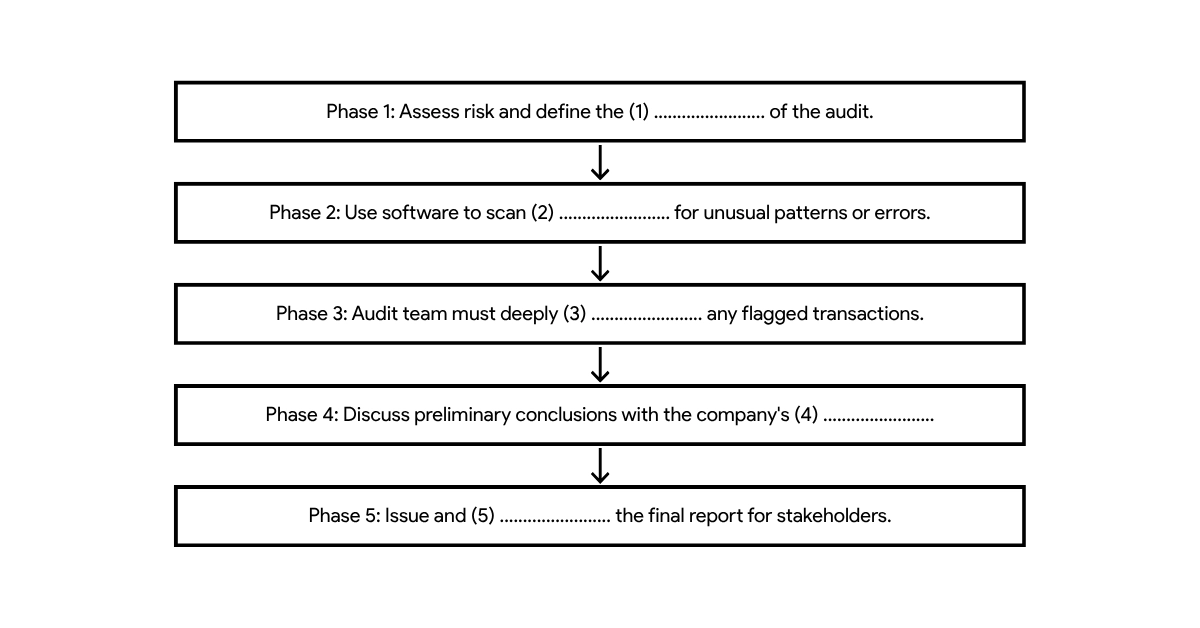
The Modern Audit Process
The modern financial audit process has evolved significantly over the past decade, moving away from traditional manual checking toward a highly sophisticated, technology-driven approach. This transformation is largely due to the integration of advanced data analytics and artificial intelligence. The initial phase of any contemporary audit is rigorous planning, where auditors comprehensively assess the overall risk associated with a company's financial and regulatory environment. During this crucial preparatory stage, the audit team must clearly define the scope of the audit to determine which operational areas, subsidiaries, or specific financial cycles require the most intensive attention and resource allocation.
Following the comprehensive planning phase, auditors proceed to the fieldwork stage to gather substantive evidence. While traditionally this involved manual sampling—checking only a tiny fraction of total transactions—today's audit teams utilize specialized analytical software to scan entire ledgers for unusual patterns, duplications, or anomalies that might indicate error or corporate fraud. By evaluating 100% of the data population, the software provides a much higher level of assurance. However, technology cannot replace human professional skepticism. If the software flags any discrepancies or high-risk entries, the human audit team must deeply investigate these specific transactions. They conduct interviews and review supporting documentation to understand the root cause of the irregularity.
Once the intensive fieldwork and data testing are complete, the findings are carefully compiled into a preliminary draft. Before finalization, it is standard practice for the lead engagement partner to discuss the preliminary conclusions with the company's management. This dialogue is essential to resolve any pending audit queries, ensure there are no misunderstandings regarding the collected data, and propose necessary adjustments to the financial statements.
Finally, after all discrepancies have been addressed, an official audit opinion is formed. In this concluding step, the audit firm will formally issue and publish the final report. This document is then distributed alongside the company's annual financial statements, providing investors, regulators, and other key stakeholders with the necessary independent assurance regarding the accuracy and fairness of the financial disclosures.
Bài đọc 5: Choose NO MORE THAN THREE WORDS from the passage for each answer.
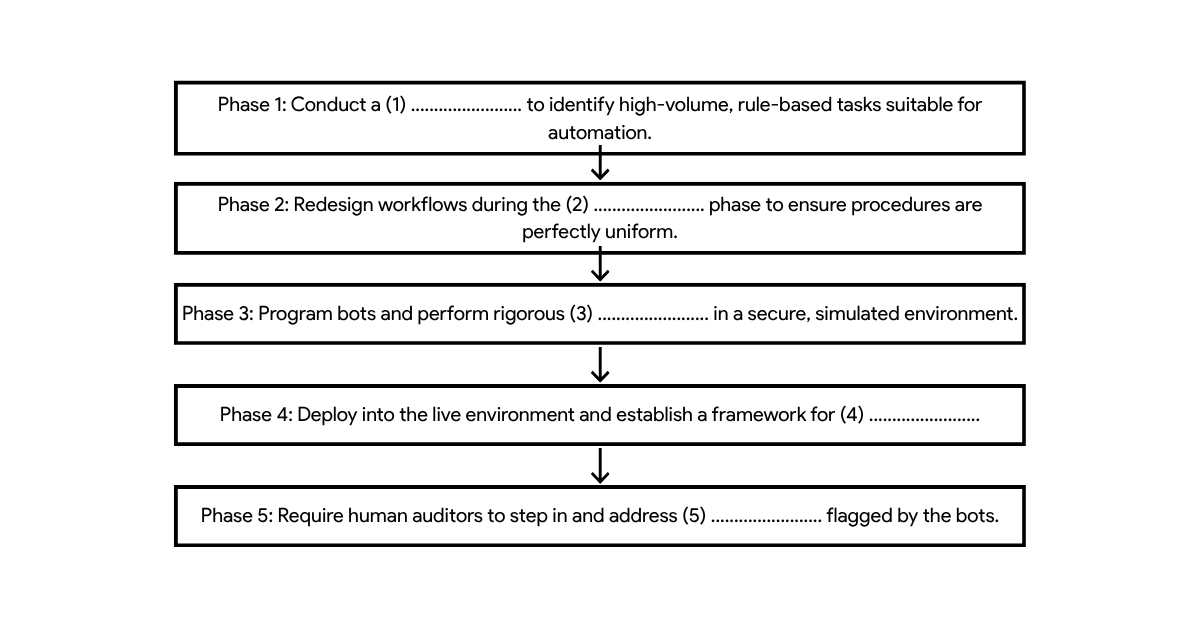
The Implementation of RPA in Financial Auditing
The integration of Robotic Process Automation (RPA) is fundamentally reshaping traditional financial auditing. By delegating repetitive, rule-based tasks to software bots, auditors can redirect their focus toward high-value analytical procedures and complex professional judgments. However, transitioning to an automated audit framework is a highly structured endeavor that requires meticulous execution across several distinct phases.
Before any software can be deployed, audit firms must conduct a comprehensive suitability assessment. This initial diagnostic phase is critical because not all audit procedures are conducive to automation. The goal is to identify high-volume, highly repetitive tasks—such as data extraction or basic reconciliation—that follow clear, unvarying logical rules.
Once the prime candidates for automation have been isolated, the firm cannot simply unleash the bots on existing messy procedures. Instead, they must undertake a strict process standardization phase. During this period, existing workflows are entirely redesigned and simplified to eliminate unnecessary exceptions and create a streamlined, logical pathway. Bots lack human intuition; therefore, the processes they execute must be perfectly uniform.
Following standardization, the actual programming of the RPA bots commences. Before integrating these newly minted bots into the live audit infrastructure, it is mandatory to perform rigorous user acceptance testing (UAT). In this controlled phase, auditors deploy the bots within a secure, simulated environment using historical financial data. This ensures the bots execute their designated tasks flawlessly and do not inadvertently compromise the integrity of the broader IT ecosystem.
Finally, the bots are deployed into the live audit environment. However, the implementation cycle does not conclude with deployment. Firms must establish a robust framework for ongoing exception management. Despite rigorous standardization, bots will inevitably encounter scenarios they are not programmed to handle, such as a missing field on a vendor invoice or an unrecognizable file format. When a bot halts production due to these issues, it flags the item, requiring human auditors to step in, apply their professional judgment, and resolve any unforeseen data anomalies before the audit can proceed.
Xem thêm: IELTS Reading Table Completion
Đáp án và giải thích chi tiết
Bài đọc 1:
Câu | Phân tích ngữ pháp/ngữ cảnh | Scan từ khóa & vị trí | Khớp từ đồng nghĩa (Paraphrasing) | Đáp án |
|---|---|---|---|---|
(1) | Sau giới từ "in" ➔ Cần danh từ chỉ địa điểm/vật chứa (nơi giữ đậu trong quá trình lên men). Sau đáp án có "where enzymes break down...". | Đoạn 2: Tìm "Fermentation". "...moved to large, water-filled fermentation tanks... uses enzymes to dissolve..." | "Beans are kept in" ➔ "moved to". "Where enzymes break down..." ➔ "uses enzymes to dissolve...". Đáp án phải là vật chứa. | fermentation tanks |
(2) | Sau giới từ "on" ➔ Cần danh từ chỉ bề mặt/nơi chốn (nơi đậu được đặt để sấy). Trước có "placed", sau có "flipped often". | Đoạn 3: Tìm "dried" và số "11%". "...spread out on large wooden tables or 'drying beds,' where they are turned regularly..." | "placed on" ➔ "spread out on". "flipped often" ➔ "turned regularly". | drying beds |
(3) | Chủ ngữ của câu, đứng sau "known as" ➔ Cần danh từ riêng (tên gọi của một lớp). Lớp này "mechanically removed" (bị loại bỏ bằng máy). | Đoạn 4: Tìm "Hulling". "...'hulling,' where machines remove the entire parchment layer..." | "layer known as" ➔ "parchment layer". "mechanically removed" ➔ "machines remove". | parchment |
(4) | Đứng sau "any" và trước giới từ ➔ Cần danh từ (số nhiều hoặc không đếm được). Đây là đối tượng bị "Removal" (loại bỏ). | Đoạn 4: Tìm "graded and sorted". "... Any defective beans are discarded at this point..." | "Removal of" ➔ "are discarded". Đáp án là đối tượng bị loại. | defective beans |
(5) | Đứng sau "the" ➔ Cần danh từ/cụm danh từ. Đây là tên một quy trình/phản ứng được "heat triggers" (nhiệt kích hoạt). | Đoạn 4: Tìm "Roasting". "...intense heat... known as the Maillard reaction, is what gives coffee..." | "Heat triggers" ➔ "causing..." hoặc "is what gives...". "known as the" ➔ cần danh từ cụ thể. | Maillard reaction |
Bài đọc 2:
Câu | Phân tích ngữ pháp/ngữ cảnh | Scan từ khóa & vị trí | Khớp từ đồng nghĩa (Paraphrasing) | Đáp án |
|---|---|---|---|---|
(1) | Sau giới từ "for" ➔ Cần danh từ/V-ing chỉ mục đích hoặc tên quá trình diễn ra bên trong lồng quay (drum). | Đoạn 1: Tìm "drum", "logs". "...logs are fed into a massive tumbling drum where the bark is stripped away, a process known as debarking." | "placed in a drum" ➔ "fed into a massive tumbling drum". "for [quá trình]" ➔ "a process known as...". | debarking |
(2) | Sau mạo từ "a" ➔ Cần danh từ đếm được số ít chỉ thiết bị/vật chứa nơi gỗ được đun nóng cùng hóa chất. | Đoạn 2: Tìm "chopped", "heated", "chemicals". "...transferred to a large pressure cooker called a digester. Inside... wood chips are cooked with a mixture of water and chemicals..." | "chopped" ➔ "wood chips". "heated with chemicals" ➔ "cooked with a mixture of water and chemicals". "in a" ➔ "pressure cooker called a". | digester |
(3) | Đứng sau "called" ➔ Cần danh từ chỉ tên của một chất tự nhiên (natural substance) bị loại bỏ để giúp giấy dai hơn. | Đoạn 2: Tìm "removed", "strength". "...separates the cellulose fibers from lignin, a natural glue... The removal of lignin is essential for producing strong... paper." | "natural substance called" ➔ "a natural glue... lignin". "is removed" ➔ "removal of". "ensure paper strength" ➔ "essential for producing strong... paper". | lignin |
(4) | Đứng sau "like" ➔ Cần danh từ chỉ chất liệu/hóa chất được sử dụng để làm trắng bột giấy. | Đoạn 3: Tìm "whitened", "brown pulp". "...pulp is naturally brown... pulp must be bleached... typically use hydrogen peroxide or oxygen for this bleaching stage..." | "whitened" ➔ "bleached". "using materials like" ➔ "use... for this bleaching stage". | hydrogen peroxide (hoặc oxygen) |
(5) | Sau mạo từ "a" ➔ Cần danh từ đếm được số ít chỉ bề mặt hoặc thiết bị mà bột giấy được phun lên để ráo nước. | Đoạn 4: Tìm "sprayed onto", "water", "drained". "...sprayed onto a continuous, fast-moving mesh screen... the water rapidly drains away..." | "sprayed onto a" ➔ "sprayed onto a". "most of the water is drained" ➔ "water rapidly drains away". | mesh screen |
Bài đọc 3:
Câu | Phân tích ngữ pháp/ngữ cảnh | Scan từ khóa & Vị trí | Khớp từ đồng nghĩa (Paraphrasing) | Đáp án |
|---|---|---|---|---|
(31) | Đứng đầu một bước hướng dẫn ➔ Cần động từ nguyên thể. Tân ngữ là "a currency". | Đoạn 1: Tìm "currency", "nation". "...participants are required to invent a currency for their specific country..." | "are required to" ➔ bước hướng dẫn. | invent |
(32) | Đứng sau "to" và trước số tiền "£100" ➔ Cần động từ nguyên thể. | Đoạn 2: Tìm "imagine", "£100". "...Participants must imagine they need to invest £100 into their national reserves." | "must imagine they need to" ➔ "imagine you need to". | invest |
(33) | Đứng đầu một bước hướng dẫn ➔ Cần động từ nguyên thể. Tân ngữ là "facts". | Đoạn 2: Tìm "facts about the state of...". "...students must carefully research facts about the state of their country's economy..." | "must carefully" ➔ bước hướng dẫn bắt buộc. | research |
(34) | Đứng sau cụm "try to" ➔ Cần động từ nguyên thể. Tân ngữ là "your currency". | Đoạn 4: Tìm "try to", "currency". "...actively engage with their peers and try to sell their currency..." | "their currency" (trong ngữ cảnh học sinh) ➔ "your currency". | sell |
(35) | Đứng đầu một bước hướng dẫn ➔ Cần động từ nguyên thể. Tân ngữ là "other currency". | Đoạn 4: Tìm "other currency", "if they want". "...they also have the option to buy other currency if they want..." | "have the option to... if they want" ➔ "...if you want". | buy |
(36) | Đứng đầu một bước hướng dẫn ➔ Cần động từ nguyên thể. Tân ngữ là "your profit". | Đoạn 4: Tìm "profit". "...The final requirement is for each student to meticulously calculate their profit..." | "their profit" ➔ "your profit". | calculate |
Bài đọc 4:
Câu | Phân tích ngữ pháp/ngữ cảnh | Scan từ khóa & vị trí | Khớp từ đồng nghĩa (Paraphrasing) | Đáp án |
|---|---|---|---|---|
(1) | Đứng sau mạo từ "the" và trước "of" ➔ Cần danh từ chỉ một khía cạnh/phạm vi của cuộc kiểm toán. | Đoạn 1: Tìm "assess risk", "define", "audit". "...assess the overall risk... the audit team must clearly define the scope of the audit..." | Giữ nguyên cụm "define the scope of the audit". | scope |
(2) | Đứng sau động từ "scan" ➔ Cần danh từ (thường ở số nhiều) chỉ đối tượng bị phần mềm quét để tìm lỗi. | Đoạn 2: Tìm "software", "scan", "unusual patterns". "...utilize specialized analytical software to scan entire ledgers for unusual patterns... or anomalies..." | "errors" ➔ "anomalies". "scan" ➔ "scan entire". | ledgers |
(3) | Đứng sau trạng từ "deeply" ➔ Cần động từ chỉ hành động của đội kiểm toán đối với các giao dịch bị đánh dấu. | Đoạn 2: Tìm "audit team", "deeply", "flagged transactions". "...If the software flags any discrepancies... the human audit team must deeply investigate these specific transactions." | "any flagged transactions" ➔ "these specific transactions" (liên kết với "flags" ở vế trước). | investigate |
(4) | Đứng sau sở hữu cách "company's" ➔ Cần danh từ chỉ người/ban bệ trong công ty cùng thảo luận với kiểm toán viên. | Đoạn 3: Tìm "discuss preliminary conclusions", "company's". "...discuss the preliminary conclusions with the company's management." | Giữ nguyên cụm "discuss preliminary conclusions with the company's". | management |
(5) | Nằm trong cụm liên kết bằng "and" với "issue" ➔ Cần động từ nguyên thể chỉ hành động xử lý báo cáo cuối cùng. | Đoạn 4: Tìm "issue", "final report", "stakeholders". "...the audit firm will formally issue and publish the final report... providing investors... and other key stakeholders..." | "for stakeholders" ➔ "providing... stakeholders with...". | publish |
Bài đọc 5:
Câu | Phân tích ngữ pháp/ngữ cảnh | Scan từ khóa & vị trí | Khớp từ đồng nghĩa (Paraphrasing) | Đáp án |
|---|---|---|---|---|
(1) | Đứng sau mạo từ "a" ➔ Cần một cụm danh từ đếm được số ít. Hành động này giúp xác định các tác vụ phù hợp. | Đoạn 2: Tìm "conduct", "identify", "tasks". "...audit firms must conduct a comprehensive suitability assessment. This... goal is to identify high-volume... tasks..." | "identify... tasks suitable for automation" ➔ "identify... tasks... conducive to automation". | suitability assessment |
(2) | Đứng trước danh từ "phase" ➔ Cần danh từ/cụm danh từ đóng vai trò bổ nghĩa, chỉ tên của một giai đoạn. | Đoạn 3: Tìm "redesign workflows", "phase", "uniform". "...undertake a strict process standardization phase. During this period, existing workflows are entirely redesigned... must be perfectly uniform." | "during the... phase" ➔ "undertake a... phase". | process standardization |
(3) | Đứng sau tính từ "rigorous" ➔ Cần một cụm danh từ chỉ một loại bài kiểm tra/đánh giá được thực hiện trong môi trường giả lập. | Đoạn 4: Tìm "perform rigorous", "simulated environment". "...mandatory to perform rigorous user acceptance testing (UAT). In this controlled phase... within a secure, simulated environment..." | "perform rigorous" ➔ "perform rigorous". Giữ nguyên cụm từ. | user acceptance testing |
(4) | Đứng sau giới từ "for" ➔ Cần một cụm danh từ chỉ một hệ thống/quy trình được thiết lập sau khi triển khai bot. | Đoạn 5: Tìm "establish a framework for", "live environment". "Finally, the bots are deployed into the live audit environment... Firms must establish a robust framework for ongoing exception management." | "establish a framework for" ➔ "establish a robust framework for". | ongoing exception management |
(5) | Đứng sau động từ "address" (giải quyết) ➔ Cần một cụm danh từ chỉ vấn đề mà kiểm toán viên con người phải xử lý khi bot cắm cờ (flagged). | Đoạn 5: Tìm "human auditors", "flagged". "...it flags the item, requiring human auditors to step in... and resolve any unforeseen data anomalies..." | "address" ➔ "resolve". "flagged by the bots" ➔ "flags the item". | unforeseen data anomalies |
Ngoài Flow Chart Completion IELTS Reading, người đọc có thể xem thêm:
Tóm lại, việc nắm vững các bước phân tích sơ đồ, xác định chính xác từ loại và nhận diện các cụm từ đồng nghĩa là những yếu tố then chốt để xử lý tốt các bài tập quy trình. Hy vọng rằng thông qua hệ thống bài tập thực hành và giải thích chi tiết trong bài viết, người học đã có thể tự tin hơn khi đối mặt với các dạng sơ đồ phức tạp.
Để tối ưu hóa thời gian làm bài và đạt được mục tiêu điểm số mong muốn, việc rèn luyện dưới sự hướng dẫn chuyên sâu là vô cùng cần thiết. Người học có thể tìm hiểu và đăng ký các khóa học luyện thi IELTS tại ZIM Academy để được đội ngũ giáo viên giàu kinh nghiệm hỗ trợ trực tiếp, đồng thời thực hành các chiến thuật phòng thi tối ưu nhất cho dạng bài flow chart completion ielts reading.
- Chiến lược làm bài IELTS Reading
- Cách làm bài Multiple Choice dạng thông tin tổng quan trong IELTS Reading
- So sánh phương pháp đọc mở rộng và đọc chuyên sâu trong học tiếng Anh – Phần 3
- Kỹ năng bổ trợ IELTS Reading: So sánh phương pháp đọc mở rộng và đọc chuyên sâu trong học tiếng Anh (P.1)
- Chiến lược làm bài IELTS Reading dạng câu hỏi Diagram Labelling (dán nhãn biểu đồ)
- Cách làm dạng bài Yes/No/Not Given trong IELTS Reading
- Ứng dụng phương pháp đầu mối ngữ cảnh cải thiện kỹ năng đọc hiểu – Phần 2
- Ứng dụng Evaluative Thinking trong IELTS Reading với dạng bài True-False-Not Given và Yes-No-Not Given
- Ứng dụng phương pháp Extensive Reading trong IELTS Reading
- Cách làm dạng bài Matching Information trong IELTS Reading
- Chiến lược làm dạng bài True/False/Not Given trong IELTS Reading
Tham vấn chuyên môn
Lê Hoàng TùngGiáo viên
Định hướng giáo dục: "In teaching others, we teach ourselves"
Đây chính là động lực để giáo viên đào sâu nghiên cứu, tìm tòi và phát triển chuyên môn và kĩ năng giảng dạy của bản thân, góp phần mở khóa được tiềm năng ngôn ngữ của học viên.
Nguồn tham khảo
1
“IELTS Reading Test: Flow-chart Completion Questions.” IDP IELTS, https://ielts.idp.com/prepare/article-ielts-reading-test-flow-chart-completion-questions. Accessed 14 September 2026.


Bình luận - Hỏi đáp