

Giới thiệu trải nghiệm không được sử dụng điện thoại di động
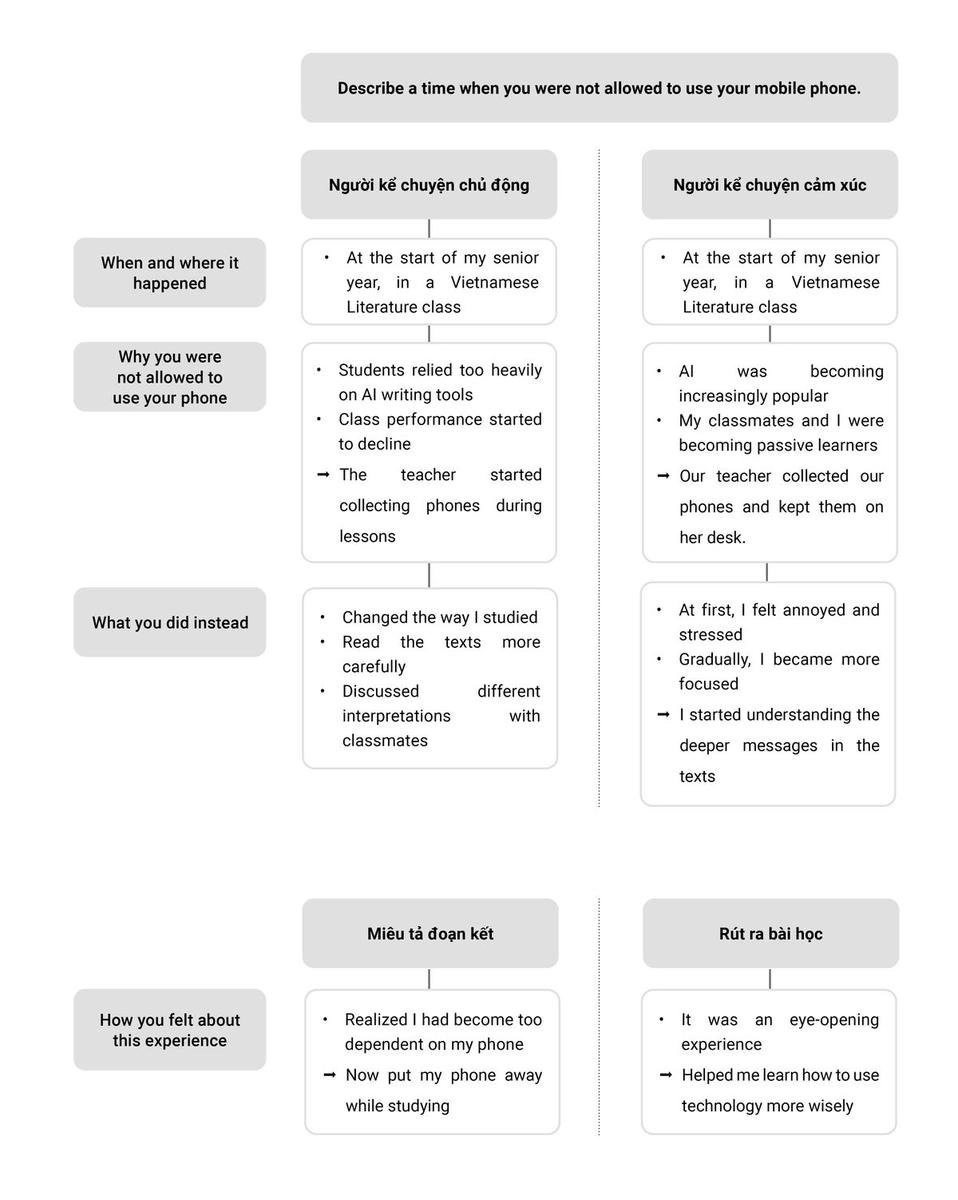
Nêu bối cảnh xảy ra sự việc (thời gian, địa điểm)
Giải thích lý do điện thoại bị cấm sử dụng
Mô tả cảm xúc ban đầu khi không được dùng điện thoại
Thể hiện sự thay đổi trong cách học hoặc suy nghĩ
Kết lại bằng bài học rút ra về việc sử dụng công nghệ hợp lý
Phân tích đề IELTS Speaking Part 2 Tháng 05/2026 - Đề số 1
Bài viết cung cấp câu trả lời mẫu IELTS Speaking Part 2 xoay quanh chủ đề “Describe a time when you were not allowed to use your mobile phone”. Nội dung gồm Simple Answer và Upgraded Answer, kèm audio và phân tích ngắn gọn giúp người học cải thiện cách diễn đạt, mở rộng ý tưởng và sử dụng từ vựng hiệu quả hơn.
Key takeaways
Bài nói mẫu cho chủ đề “Describe a time when you were not allowed to use your mobile phone” tập trung khai thác một trải nghiệm thực tế liên quan đến việc bị hạn chế sử dụng điện thoại trong môi trường học tập, đồng thời làm nổi bật sự thay đổi trong thói quen học tập và cách sử dụng công nghệ của người nói.
Thông qua cách triển khai ý tưởng rõ ràng, kết hợp giữa bối cảnh xảy ra sự việc, cảm xúc cá nhân và bài học rút ra sau trải nghiệm, bài nói thể hiện khả năng phát triển nội dung hiệu quả theo yêu cầu của IELTS Speaking Part 2, đặc biệt ở việc nhấn mạnh tác động của công nghệ đến khả năng tập trung và tư duy độc lập của học sinh.
Đề bài
Describe a time when you were not allowed to use your mobile phone.
You should say:
when and where it happened
why you were not allowed to use your phone
what you did instead
and explain how you felt about this experience.
Tham khảo: Tổng hợp bài mẫu IELTS Speaking 2026
Phân tích đề bài
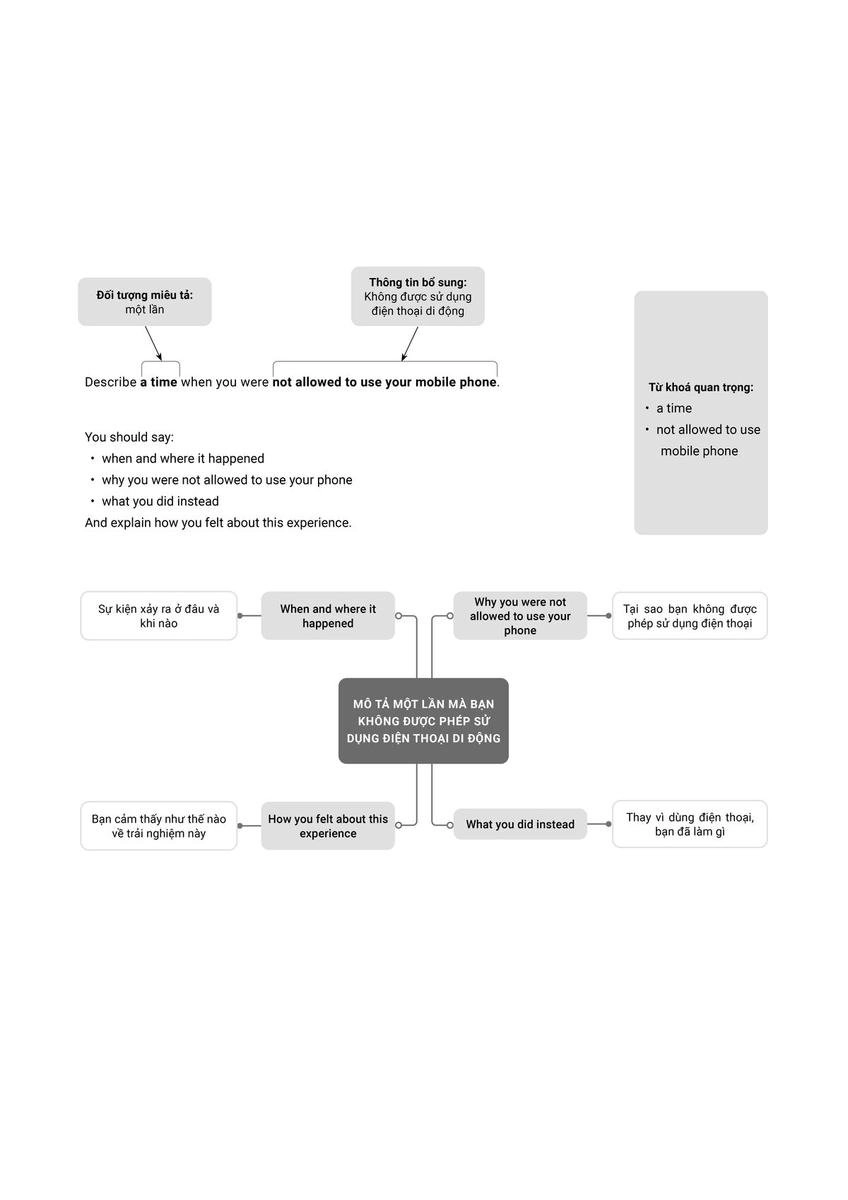
Lên ý tưởng & Ghi chú
Đọc thêm: IELTS Speaking Part 2: Cách trả lời và bài mẫu các nhóm chủ đề
Bài mẫu
Simple answer
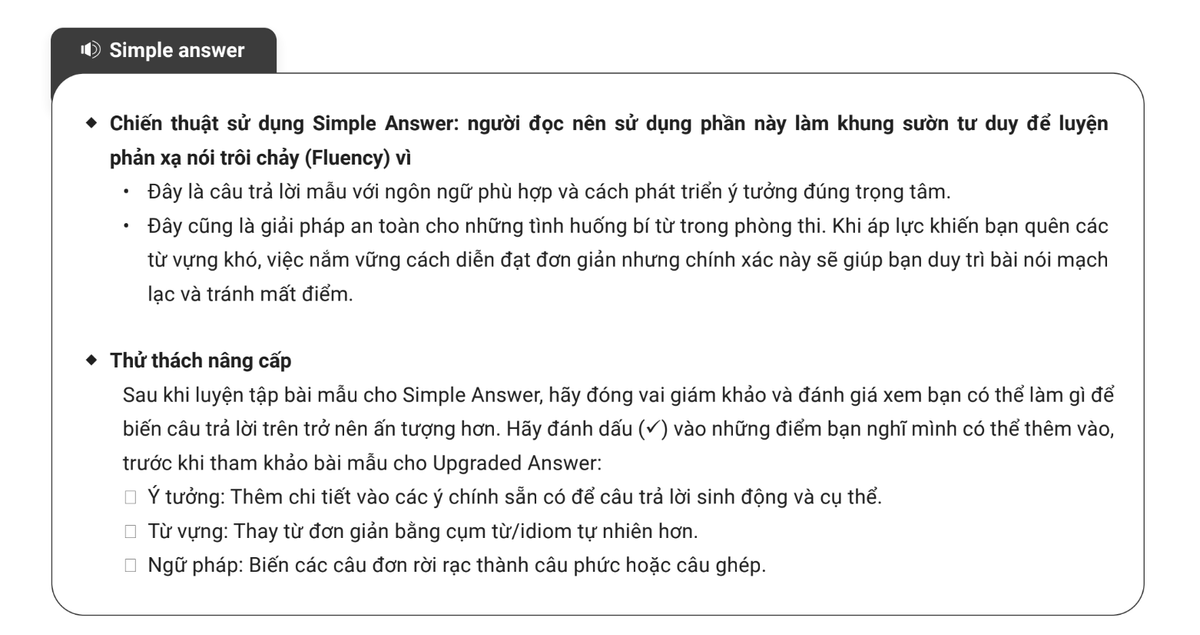
Người đọc có thể kết hợp các phiên bản tùy ý để tạo ra nhiều bài mẫu Part 2 khác nhau từ cùng một đề.
Mở bài và Thân bài | Ver. 1 Người kể chuyện chủ động | Ver. 2 Người kể chuyện cảm xúc |
One time when I was not allowed to use my mobile phone was at the beginning of my senior year, during a Vietnamese Literature lesson. At that time, students started using artificial intelligence to write their assignments. Many of us started relying heavily on technology to complete our assignments. As a result, the class’s overall performance started to decline. To help us focus better, our teacher decided to ban phones during lessons and collected them on her desk. To be honest, I didn’t really stand out from my classmates back then because I also tended to use ChatGPT and sample answers on the internet. Without my phone, I had to change the way I studied. At first, I felt quite annoyed and stressed because I couldn’t instantly search for answers online anymore. However, it turned out to be a positive change. Instead of quickly looking for answers online, I began reading the texts more carefully and had more opportunities to talk things through with my classmates. Gradually, I became more focused and understood the deeper messages better. | I remember a time in my senior year of high school, during my Vietnamese literature classes, when mobile phones were banned during lessons. At that time, artificial intelligence and other support tools were becoming very popular. My friends and I gradually became less motivated and quite passive in class because we tended to search for ready-made answers online to finish tasks. Because of this, our teacher collected all our phones and kept them on her desk. At first, I felt annoyed because I couldn’t rely on my phone or AI anymore. I also felt stressed because I was not very good at writing after becoming too dependent on writing tools instead of improving my own skills. However, after some time, it turned out to be a positive change. Without my phone, my attention span also improved; I could focus more and gradually understand the deeper meanings of the texts because I spent more time listening to my teacher and discussing ideas with my classmates. |
Kết bài | Ver. 1 Miêu tả đoạn kết | Ver. 2 Rút ra bài học |
Since then, I have been trying to keep my phone out of reach when studying or working. Later on, until now, I’m still trying to complete my work without relying on my phone, except for looking up new information. | In the end, it was an eye-opening experience. I realized that technology can affect our learning in a negative way if we use it too much. I also felt thankful to my teacher and learned how to use technology more wisely. From this time, I have been trying to limit my screen time during working and studying hours, giving myself more chances to think more independently. |
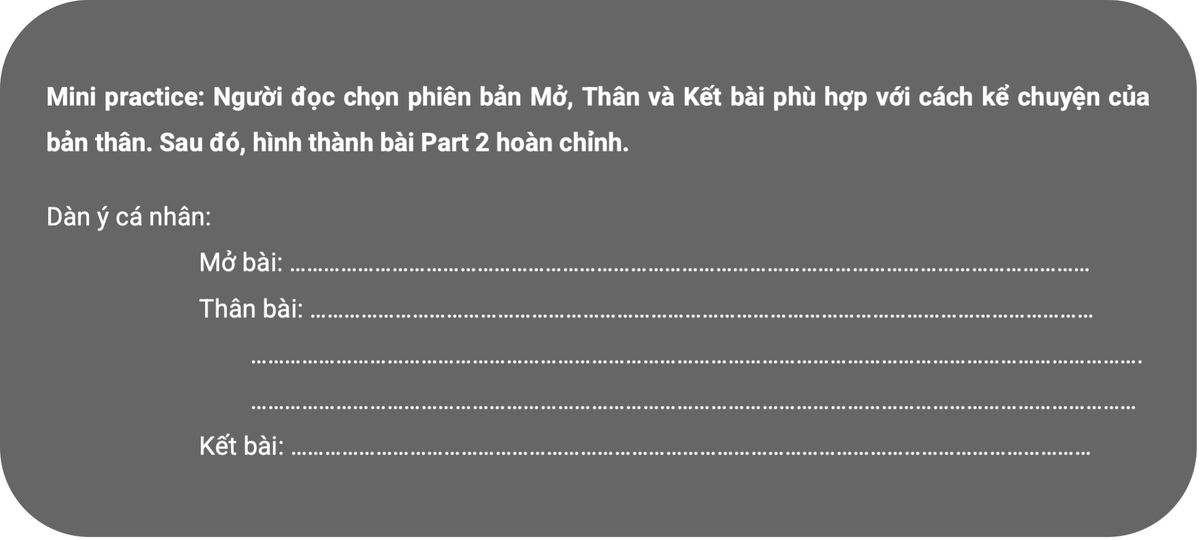
Upgraded answer
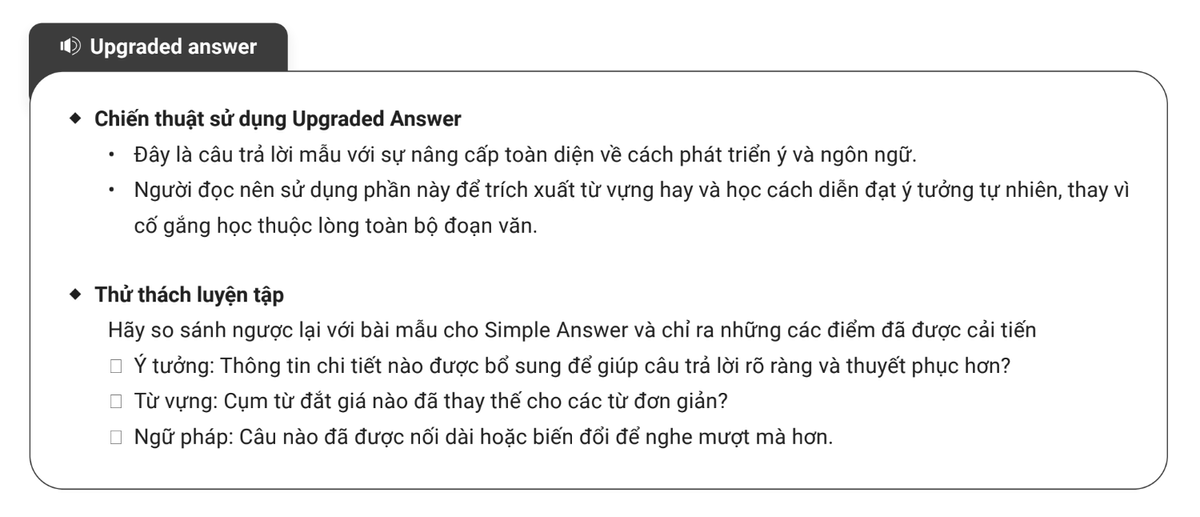
Người đọc có thể kết hợp các phiên bản tùy ý để tạo ra nhiều bài mẫu Part 2 khác nhau từ cùng một đề.
Mở bài và Thân bài | Ver. 1 Người kể chuyện chủ động | Ver. 2 Người kể chuyện cảm xúc |
One time when I was not allowed to use my mobile phone was at the beginning of my senior year in high school, during my Vietnamese literature class. At that time, students had started to rely heavily on artificial intelligence and other support tools to complete their assignments. Because of that, the overall performance of the whole class gradually went downhill. So, my teacher decided to completely ban phones in class. To be honest, back then, I didn’t try to stand out from my friends. I have to admit that I often relied on ChatGPT and sample essays I found online to come up with answers for my teacher’s questions. Without my phone, I had to completely change my studying habits. I found it quite challenging at first, as I could no longer fall back on online tools. However, after a while, I began to adapt. As a result, instead of quickly looking up answers, I started to go through the texts more carefully and figure things out on my own. I also had more opportunities to talk things through with my classmates and exchange different perspectives on the authors’ ideas. | I remember a time in my senior year of high school, during my Vietnamese literature class, when mobile phones were completely banned in class. At that time, artificial intelligence had just become very popular among students, so many of us started picking up the habit of using AI for ideas during class activities. My friends and I became less motivated and quite passive during lessons. Because of this, our teacher collected all our phones and kept them on her desk. At first, I felt quite frustrated because my teacher had taken our phones away, so I could no longer depend on AI whenever I struggled with writing tasks. I also felt stressed, as I wasn’t very good at writing, partly because I had become too dependent on ready-made answers online instead of improving my own skills. However, after a while, I started to understand the lessons better. It turned out that without my phone, I could concentrate more and gradually understand the underlying ideas of the texts. |
Kết bài | Ver. 1 Miêu tả đoạn kết | Ver. 2 Rút ra bài học |
Looking back, it turned out to be a turning point for me. I realized that relying too much on technology can do more harm than good, especially when students are still developing their own way of thinking. Since then, I’ve made a conscious effort to stay away from my phone while studying, not only in literature but also in other subjects. Even now, I try to complete my work independently instead of depending on my phone, except when I need to look up information. | In the end, it was an eye-opening experience. I realized that technology can negatively affect our learning if we rely on it too much. I also felt grateful to my teacher and learned how to use technology more wisely. Since then, I’ve been trying to limit my screen time during study hours, giving myself more opportunities to think more independently. |
Tìm hiểu thêm: Chinh phục IELTS Speaking Part 2 với kỹ thuật Storytelling
Lọc và phân tích từ vựng
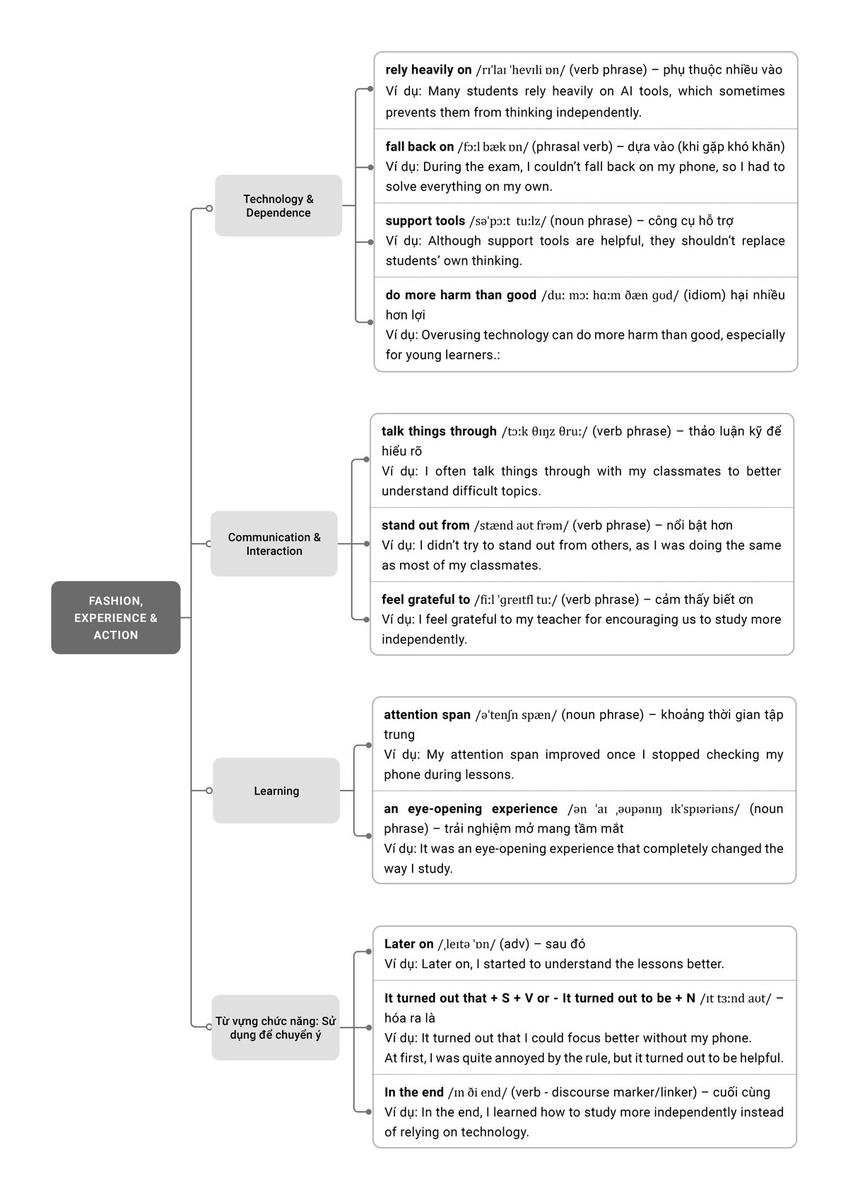
Nhật ký từ vựng & ý tưởng
Ghi chú sau khi luyện tập nói về chủ đề trên
Từ vựng/Ý tưởng (Chọn các từ vựng/ý tưởng mà bạn tâm đắc nhất) | Kỉ niệm cá nhân (Gán các từ vựng/ý tưởng đã chọn với kỉ niệm của bản thân) |
|---|---|
Ví dụ: do more harm than good → hại nhiều hơn lợi | Người đọc tự đặt các câu hỏi cho bản thân, ví dụ:
→ I wouldn’t say technology is completely negative, but if overused, it can definitely do more harm than good, especially for young learners. |
Khoảng trống diễn đạt (Phần khiến bạn ngập ngừng khi nói về chủ đề trên) | Giải pháp (Giải pháp cho các khoảng trống diễn đạt) | ||
|---|---|---|---|
Ví dụ: Tình huống diễn đạt: “Ban đầu tôi thấy khá khó khăn, vì tôi không còn có thể dựa vào các công cụ trực tuyến nữa.” → Không biết diễn đạt cụm “dựa vào” sao cho không sử dụng lặp từ “dependent” | Ví dụ: Sử dụng AI với câu lệnh:
→ rely (heavily) on (verb phrase): phụ thuộc nhiều vào → fall back on (phr. v): dựa vào (khi gặp khó khăn) |
Người đọc có thể tìm từ vựng bằng từ điển ZIM Dictionary.
Các lỗi ngữ pháp thường gặp
Lỗi thường gặp: “I also felt grateful for my teacher.”
Cách dùng đúng:
I also felt grateful to my teacher.
Lý do sai:
Người học nhầm lẫn giữa được 2 cấu trúc
be grateful to + person
be grateful for + thing/action
→ Trong trường hợp này “my teacher” là danh từ chỉ người, sử dụng cấu trúc “be grateful to + person”
Đọc thêm: Grateful đi với giới từ gì: Tổng hợp cách sử dụng
Lỗi thường gặp: I realized that rely too much on technology can do more harm than good.
Cách dùng đúng:
I realized that relying too much on technology can do more harm than good.
Lý do sai:
Theo sau “that” là một mệnh đề
“Rely” là động từ nguyên mẫu, không thể đóng vai trò làm chủ ngữ trong câu. Cần dùng “relying” là một gerund (danh động từ) → Cụm “relying too much on technology” đóng vai trò như một cụm danh từ để làm chủ ngữ của câu.
Lỗi thường gặp: Because of this, our teacher collected all our phones and keep them on her table.
Cách dùng đúng:
Because of this, our teacher collected all our phones and kept them on her table.
Lý do sai:
Sau liên từ “and”, các động từ được liệt kê phải ở cùng dạng hoặc được chia cùng thì. “Collected” được chia theo thì quá khứ đơn → “Keep” cũng phải được chia theo thì quá khứ đơn là “kept”.
Các chủ đề liên quan
Chủ đề liên quan để sử dụng từ vựng và ý tưởng
Describe a time you felt uncomfortable without something
(Liên quan đến sự phụ thuộc, mất thói quen quen thuộc)Describe a situation that made you focus more
(Liên quan đến concentration, distraction)Describe a positive change in your behavior
(Nhấn mạnh sự thay đổi cá nhân sau trải nghiệm)
Từ vựng có thể ứng dụng: rely heavily on, fall back on, do more harm than good, attention span, an eye-opening experience,...
Ý tưởng
ban đầu cảm thấy khó chịu/bất tiện khi không được dùng điện thoại
nhận ra bản thân phụ thuộc quá nhiều vào công nghệ
phải thay đổi cách học (đọc kỹ hơn, suy nghĩ nhiều hơn)
cải thiện khả năng tập trung và hiểu bài sâu hơn
nhận ra công nghệ có hai mặt: hữu ích nhưng cũng dễ gây lệ thuộc
học cách sử dụng điện thoại một cách có kiểm soát hơn, hình thành thói quen học tập độc lập
Tổng kết
Trên đây là phân tích đề IELTS Speaking Task 2 tháng 05/2026 - Đề số 1, giúp người học hình dung cách triển khai ý tưởng và sử dụng ngôn ngữ học thuật hiệu quả. Hy vọng những phân tích và gợi ý trong bài viết sẽ hỗ trợ người học nâng cao kỹ năng viết, từ đó tự tin hơn khi bước vào phòng thi. Nếu người học mong muốn nâng cao kỹ năng IELTS với lộ trình học tập cá nhân hóa, Hệ thống giáo dục ZIM cung cấp các khóa học luyện thi IELTS cam kết đầu ra 4 kỹ năng, giúp tiết kiệm đến 80% thời gian tự học. Để được tư vấn chi tiết, liên hệ hotline 1900-2833 (nhánh số 1) hoặc truy cập Khóa học IELTS.
Bình luận - Hỏi đáp