


Chủ đề IELTS Speaking: Part 3: Inventions & Their Impact on Society.
Bài mẫu cho các nhóm câu hỏi:
Most important inventions?
Improved quality of life?
Always a positive impact?
More government investment?
Future inventions?
Nhóm từ vựng trọng tâm (Topic Vocabulary):
Inventions and Everyday Benefits, Social Impact and Public Investment, và Future Needs.
IELTS Speaking Part 3 topic Inventions & Their Impact on Society
Bài viết cung cấp các câu trả lời mẫu cho IELTS Speaking Part 3 (Inventions & Their Impact on Society) theo định hướng cá nhân hóa, được chia thành hai cấp độ: Simple Answer (tập trung phản xạ và độ trôi chảy) và Upgraded Answer (nâng cấp từ vựng, ngữ pháp). Ngoài ra, phần phân tích chi tiết sẽ giúp người học hệ thống hóa từ vựng, khắc phục lỗi ngữ pháp và linh hoạt áp dụng vào các chủ đề tương tự.
Key takeaways
Bài viết sau đây sẽ cung cấp các câu trả lời mẫu theo khung sườn tư duy (Simple Answer) cùng các thử thách nâng cấp (Upgraded Answer) về cả ý tưởng, từ vựng và ngữ pháp để người học lựa chọn được câu trả lời phù hợp với bản thân, sẵn sàng cho các tình huống trong phòng thi. Bài phân tích này sẽ dẫn dắt người học đi qua chủ đề Inventions & Their Impact on Society, từ vai trò của máy in (the printing press) trong việc lan tỏa tri thức, tác động của công nghệ đến chất lượng cuộc sống (quality of life), cho đến những hệ quả ngoài dự tính (unintended consequences) và vai trò của nguồn tài trợ công (public funding) đối với các phát minh trong tương lai, giúp người học chinh phục giám khảo bằng sự mạch lạc và ngôn ngữ tự nhiên.
IELTS Speaking Part 3: Inventions & Their Impact on Society
Simple answer
1. What do you think are the most important inventions in human history?
|
I think the wheel and the printing press are among the most important inventions. The wheel made it easier to transport goods, while printing allowed knowledge to reach more people. For example, printed books helped people learn without having to meet an expert. These inventions changed how societies moved and shared information. |
2. How have modern inventions improved people's quality of life?
|
Modern inventions have made many daily tasks easier and less time-consuming. Washing machines reduce housework, and the internet helps people communicate and find information. For example, a student can take an online lesson from home. This gives people more convenience and more time for other activities. |
3. Do you think all inventions have a positive impact on society?
|
No, I don’t think so. Some inventions are useful but also create problems. Cars make travelling easier, for example, but heavy traffic can cause pollution and noise. I think the overall impact depends on how an invention is used and whether people manage its disadvantages. |
4. Do you think governments should invest more money in developing new inventions?
|
Yes, I think governments should invest more, especially in inventions that solve important social problems. Some research takes a long time and may not attract private companies. For example, public funding could support cheaper ways to produce clean energy. However, governments should choose projects carefully because they also need money for basic services. |
5. What kinds of inventions do you think people will need in the future?
|
I think people will need inventions that help them use energy and water more efficiently. As populations grow, these resources may face greater pressure. For example, affordable water-saving equipment could help households waste less water. Devices that help older people live safely at home may also become more important. |
Tham khảo: Tổng hợp bài mẫu IELTS Speaking 2026
Upgraded answer
1. What do you think are the most important inventions in human history?
|
I’d put the wheel and the printing press near the top of the list because they changed what entire societies could do. The wheel made transporting goods much more practical, while the printing press enabled knowledge to be shared on a much wider scale. For instance, people could learn from books rather than relying entirely on information passed on in person. More recently, the internet has transformed communication in a similar way. It’s difficult to choose a single winner, but I would judge an invention by how widely it expanded people’s opportunities, rather than simply how impressive it looked. |
2. How have modern inventions improved people's quality of life?
|
In general, modern inventions have improved quality of life by reducing routine work and widening access to services. Household appliances save time, while digital tools allow people to study, work and communicate across long distances. For instance, someone in a remote area may be able to take an online course that would otherwise require a long journey. That said, convenience is not the same as well-being: being constantly connected can also make it difficult to switch off. So the greatest benefits come when inventions meet a real need and people can use them without becoming overly dependent on them. |
3. Do you think all inventions have a positive impact on society?
|
Not necessarily. An invention can bring substantial benefits and still have unintended consequences. Cars, for example, give people freedom to travel, but widespread car use can contribute to congestion and pollution. Digital platforms make communication easier, yet they may also allow false information to spread quickly. I don’t think that automatically makes these inventions bad; it shows that their social impact depends partly on how they are designed, used and regulated. We need to consider both the benefits and the costs, and put safeguards in place where an invention could cause harm. |
4. Do you think governments should invest more money in developing new inventions?
|
Yes, provided the investment has a clear public purpose. Governments can support research that offers long-term benefits but is too uncertain or slow to attract enough private funding. For instance, a project to develop affordable clean-energy technology could benefit society even if it does not make a quick profit. However, more spending is not automatically better. Funding should be allocated transparently, and projects should be assessed alongside other priorities, such as schools and basic infrastructure. I would favour targeted public investment, with regular reviews to check whether it is delivering useful results. |
5. What kinds of inventions do you think people will need in the future?
|
I expect demand to grow for inventions that address resource shortages and support an ageing population. More efficient energy storage and affordable water-saving systems could help communities use limited resources more carefully. At the same time, assistive devices may help older people remain independent at home. For example, a simple device that makes everyday tasks easier could be more valuable than a complicated gadget with many unnecessary features. Of course, future needs are difficult to predict precisely. The most useful inventions will probably be those that are reliable, affordable and accessible to the people who need them most. |
Lọc và phân tích từ vựng
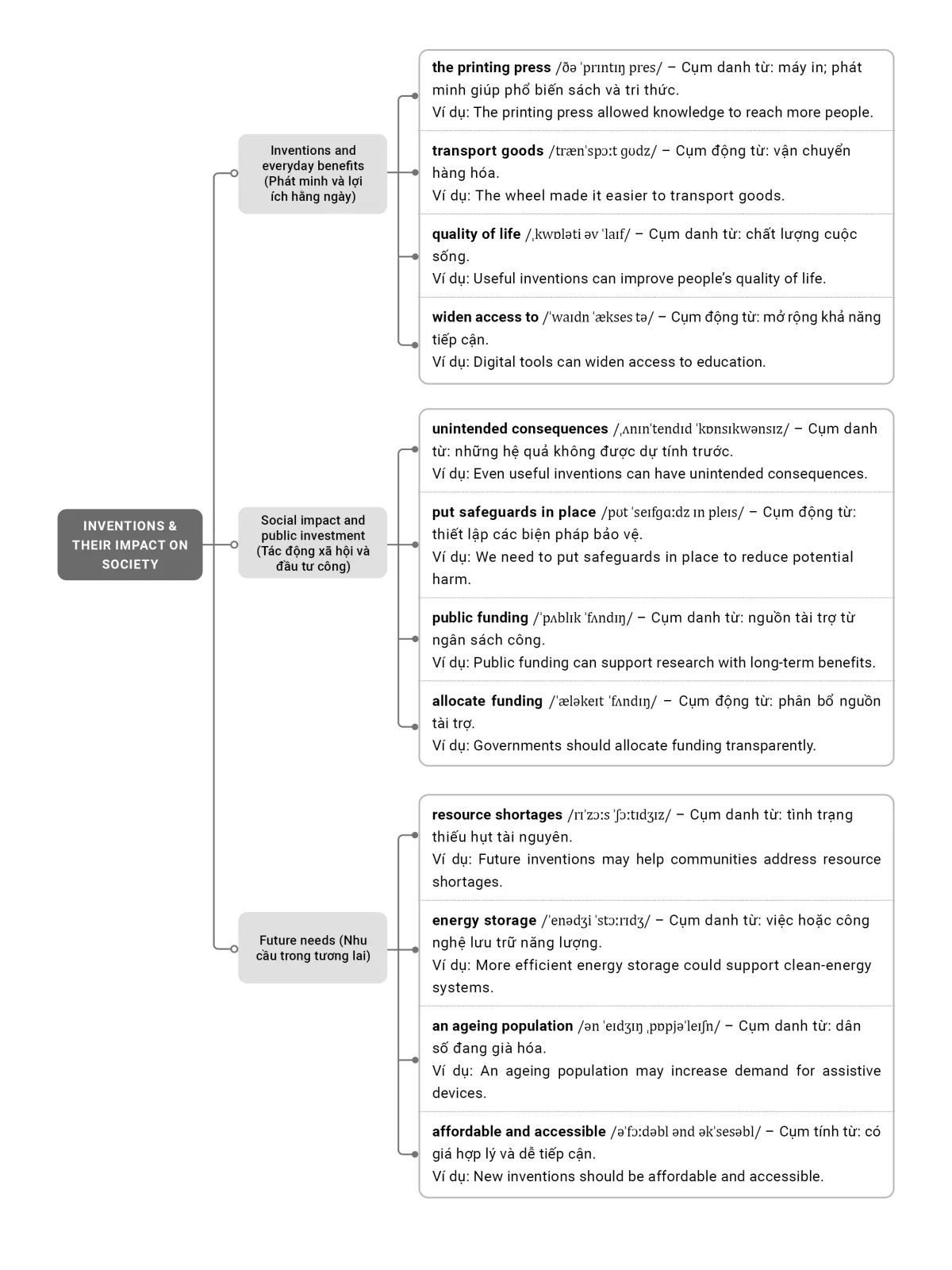
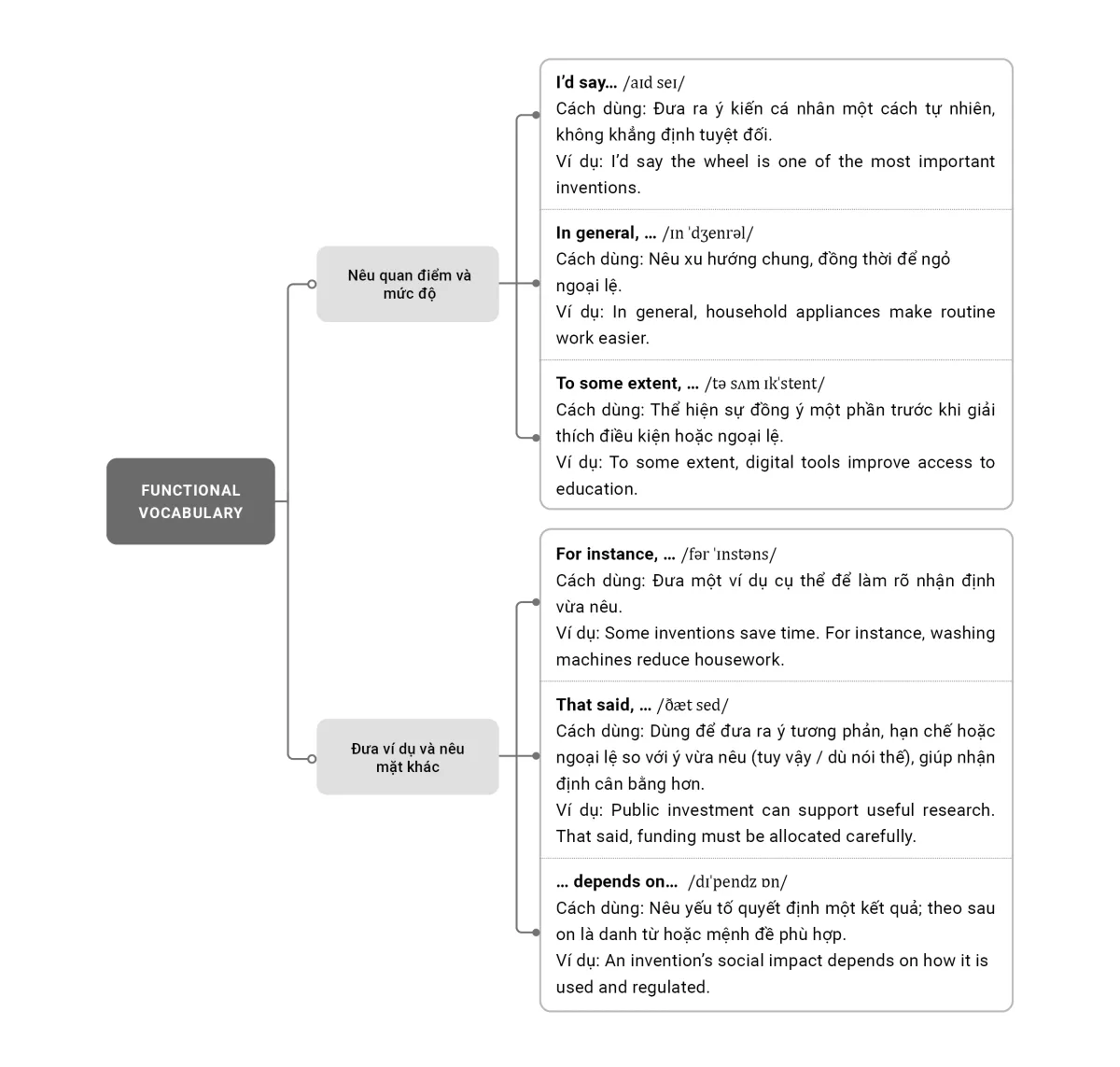
Nhật ký Từ vựng & Ý tưởng
Ghi chú sau khi luyện tập nói về chủ đề trên
Từ vựng/Ý tưởng (Chọn các từ vựng/ý tưởng mà bạn tâm đắc nhất) | Kỉ niệm cá nhân (Gán các từ vựng/ý tưởng đã chọn với kỉ niệm của bản thân) |
|---|---|
Ví dụ: quality of life – chất lượng cuộc sống; widen access to – mở rộng khả năng tiếp cận; unintended consequences – hệ quả ngoài dự tính. | Người đọc tự đặt các câu hỏi cho bản thân, ví dụ:
→ During a busy semester, I used an online learning platform to attend lessons from home. It saved travel time and widened my access to useful courses. However, I also found it harder to switch off because notifications kept interrupting me. This experience helped me see that an invention can improve quality of life while creating unintended consequences. For society as a whole, access, affordability and responsible use matter as much as convenience. |
Khoảng trống diễn đạt | Giải pháp |
|---|---|
Ví dụ: Tôi muốn nói phát minh có thể gây “hệ quả ngoài dự tính” và chính phủ cần “phân bổ ngân sách minh bạch”, nhưng chỉ nghĩ được “bad results” và “give money”. | Ví dụ: Tra từ điển của ZIM hoặc xem lại bài mẫu để tìm cách diễn đạt rõ ràng, tự nhiên. |
Người đọc có thể tìm từ vựng bằng từ điển ZIM Dictionary.
Các lỗi ngữ pháp/từ vựng thường gặp
1. Phân biệt “invention”, “discovery” và “innovation”
❌ Lỗi thường gặp:
Scientists invented electricity.
The internet was an important discovery.
✅ Cách dùng đúng:
invention: thứ hoặc phương pháp mới do con người tạo ra; ví dụ the printing press.
discovery: việc tìm ra điều đã tồn tại; ví dụ discovering a natural phenomenon.
innovation: ý tưởng, phương pháp hoặc cải tiến mới được đưa vào sử dụng; có thể dựa trên phát minh sẵn có.
✔ Câu đúng:
Scientists discovered how electricity works and invented ways to use it.
The internet was an important invention.
📌 Lý do sai:
Không dùng invent cho một hiện tượng tự nhiên đã tồn tại như điện. Invention nhấn mạnh thứ mới do con người tạo ra; discovery nhấn mạnh việc tìm ra điều đã có. Innovation có thể là cải tiến cách sử dụng hoặc ứng dụng một phát minh, nên ba từ không hoàn toàn thay thế cho nhau.
2. Phân biệt “affect”, “effect” và “impact on”
❌ Lỗi thường gặp:
Modern inventions effect people’s daily lives.
The internet has a positive impact to education.
✅ Cách dùng đúng:
affect + someone/something (v): ảnh hưởng đến ai hoặc điều gì; không thêm on/to.
have an effect on + someone/something: có ảnh hưởng đến ai hoặc điều gì.
have a positive/negative impact on + someone/something: có tác động tích cực/tiêu cực lên ai hoặc điều gì.
Trong các mẫu câu này, affect là động từ; effect và impact là danh từ đứng sau have, đi với on.
✔ Câu đúng:
Modern inventions affect people’s daily lives.
The internet has a positive impact on education.
📌 Lý do sai:
Trong câu đầu, cần động từ affect để nói “ảnh hưởng đến”. Effect thường là danh từ trong cụm have an effect on; động từ effect mang nghĩa trang trọng “tạo ra/đem lại” nên không phù hợp ở đây. Câu thứ hai dùng sai giới từ: nói have an impact on, không dùng impact to.
Xem thêm: Phân biệt Affect và Effect
3. Dùng đúng “enable”, “allow” và “help” khi nói về lợi ích của phát minh
❌ Lỗi thường gặp:
Online courses enable students study from home.
Assistive devices help older people to living independently.
✅ Cách dùng đúng:
enable + someone + to V: giúp hoặc tạo điều kiện cho ai có thể làm gì.
allow + someone + to V: cho phép hoặc tạo điều kiện để ai làm gì.
help + someone + V / to V: giúp ai làm gì; cả hai cách đều đúng.
Sau enable/allow + người, cần to V; sau help + người, dùng V hoặc to V, không dùng to V-ing.
✔ Câu đúng:
Online courses enable students to study from home.
Assistive devices help older people live independently. / Assistive devices help older people to live independently.
📌 Lý do sai:
Câu đầu thiếu to trước study vì enable đi với someone + to V. Câu thứ hai dùng living sau to, trong khi to ở cấu trúc này là dấu hiệu của động từ nguyên mẫu, không phải giới từ. Help có thể đi với someone + V hoặc someone + to V.
Mini practice |
|---|
Dùng đúng cấu trúc trong ngoặc
|
Các chủ đề liên quan
Chủ đề liên quan để sử dụng từ vựng & ý tưởng:
Education (Giáo dục)
Environment (Môi trường)
Người đọc có thể sử dụng:
Từ vựng: quality of life, widen access to, unintended consequences, put safeguards in place, public funding, allocate funding, resource shortages, energy storage, an ageing population, affordable and accessible.
Ý tưởng:
Công nghệ giúp giảm việc lặp lại và tiết kiệm thời gian, nhưng việc luôn kết nối có thể khiến con người khó nghỉ ngơi.
Công cụ học trực tuyến mở rộng khả năng tiếp cận giáo dục, nhưng người học vẫn cần thiết bị và kết nối phù hợp.
Một phát minh có thể mang lại lợi ích và đồng thời gây ra hệ quả ngoài dự tính; cần xem xét cả cách sử dụng và các biện pháp bảo vệ.
Đầu tư công có thể hỗ trợ nghiên cứu đem lại lợi ích lâu dài, nhưng cần phân bổ minh bạch và cân nhắc các nhu cầu thiết yếu khác.
Những phát minh tiết kiệm nước và lưu trữ năng lượng có thể giúp giải quyết áp lực lên tài nguyên.
Thiết bị hỗ trợ người cao tuổi cần dễ dùng, đáng tin cậy và có giá hợp lý để nhiều người có thể hưởng lợi.
Một phát minh hữu ích nên được đánh giá bằng khả năng giải quyết nhu cầu thực tế và mức độ dễ tiếp cận.
Mini practice |
|---|
Sử dụng từ vựng và ý tưởng ở trên để trả lời các câu hỏi sau 1. Has technology made people’s lives better? 2. How can technology improve access to education? 3. What inventions could help protect the environment? |
Tổng kết
Hy vọng rằng qua việc phân tích hai cấp độ trả lời từ Simple Answer để đảm bảo sự trôi chảy đến Upgraded Answer để ghi điểm ấn tượng, bạn đã nắm vững được lộ trình để chinh phục chủ đề Inventions & Their Impact on Society (Part 3). Bằng cách cá nhân hóa các câu trả lời thông qua "Nhật ký Từ vựng & Ý tưởng", bạn sẽ xây dựng được sự tự tin. Đừng quên thực hành các bài tập nhỏ (mini practice) để khắc phục những lỗi ngữ pháp thường gặp và làm chủ ngôn ngữ của mình nhé!
Nếu bạn muốn nâng cao kỹ năng IELTS Speaking theo lộ trình cá nhân hóa, Hệ thống giáo dục ZIM cung cấp các khóa luyện thi IELTS cam kết đầu ra, giúp bạn tối ưu hiệu quả học tập và tiết kiệm đến 80% thời gian tự học. Để được tư vấn chi tiết, vui lòng liên hệ hotline 1900-2833 (nhánh 1) hoặc truy cập Khóa học IELTS.
Nguồn tham khảo
1
“Bài mẫu IELTS Speaking Part 3.” OpenAI, https://chatgpt.com/share/e/6961bf62-bf88-8002-9512-8fe28a8cdcf4. Accessed 10 October 2026.


Bình luận - Hỏi đáp