


Chủ đề IELTS Speaking: Part 3: Technology in Daily Life.
Bài mẫu cho các nhóm câu hỏi:
How tech helps with household chores?
Do people depend too much on technology?
Benefits of technology for students?
How tech changed learning methods?
Impact of AI on independent thinking?
Nhóm từ vựng trọng tâm (Topic Vocabulary): Smart Home, Modern Education, và AI & Critical Thinking.
Bài mẫu IELTS Speaking Part 3 topic Technology in Daily Life + từ vựng
Bài viết cung cấp các câu trả lời mẫu cho IELTS Speaking Part 3 Technology in Daily Life theo định hướng cá nhân hóa, được chia thành hai cấp độ: Simple Answer (tập trung phản xạ và độ trôi chảy) và Upgraded Answer (nâng cấp từ vựng, ngữ pháp). Đi kèm với mỗi câu trả lời là file audio hỗ trợ luyện phát âm chuẩn xác. Ngoài ra, phần phân tích chi tiết sẽ giúp người học hệ thống hóa từ vựng, khắc phục lỗi ngữ pháp và linh hoạt áp dụng vào các chủ đề tương tự.
Key takeaways
Bài viết sau đây sẽ cung cấp các câu trả lời mẫu theo khung sườn tư duy (Simple Answer) cùng các thử thách nâng cấp (Upgraded Answer) về cả ý tưởng, từ vựng và ngữ pháp để người học lựa chọn được câu trả lời phù hợp với bản thân, sẵn sàng cho các tình huống trong phòng thi. Bài phân tích này sẽ dẫn dắt người học đi qua chủ đề Technology in Daily Life, từ sự hỗ trợ đắc lực của các thiết bị gia dụng thông minh (smart appliances) giúp tự động hóa công việc nhà cho đến tính ưu việt của phương pháp học lấy người học làm trung tâm (student-centred learning), đồng thời phân tích thấu đáo hai mặt của trí tuệ nhân tạo đối với khả năng phát triển tư duy phản biện (critical thinking) của học sinh, giúp người học chinh phục giám khảo bằng sự mạch lạc và ngôn ngữ tự nhiên.
IELTS Speaking Part 3: Technology in Daily Life
Simple answer
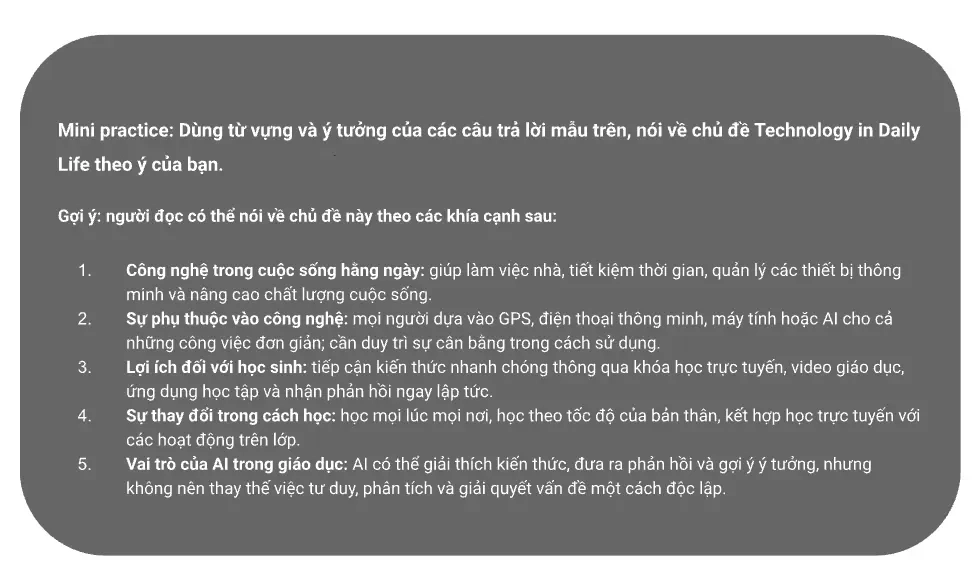
1. How does technology help people in their daily lives at home?
|
Well, technology makes everyday life much more convenient. People can use smart devices to clean the house, cook meals, or control home appliances. For example, robot vacuum cleaners save a lot of time. So, technology helps people manage household tasks more efficiently. |
2. Do you think people depend too much on technology nowadays? Why or why not?
|
Yes, to some extent. Many people rely on technology for work, study, and even simple daily tasks. For example, some people use GPS even when travelling to familiar places. Although technology is helpful, I think people should avoid becoming overly dependent on it. |
3. How does technology benefit students in their studies?
|
I think technology gives students quick access to information and learning resources. They can watch online lessons, join virtual classes, and use educational apps. For example, many students use online platforms to review lessons before exams. As a result, learning becomes more flexible and effective. |
4. Do you think technology has changed the way students learn? How?
|
Yes, definitely. Students can now learn anytime and anywhere through the internet. For example, they can attend online courses, watch educational videos, and practise with learning apps. I think technology has made learning much more interactive and convenient. |
5. Do you think using tools like AI can affect students’ ability to think independently? Why or why not?
|
Yes, if students rely on AI too much. They may stop thinking carefully or solving problems by themselves. For example, some students use AI to complete homework without understanding the lessons. However, if AI is used wisely, it can be a useful learning tool rather than a replacement for independent thinking. |
Tham khảo: Tổng hợp bài mẫu IELTS Speaking 2026
Upgraded answer
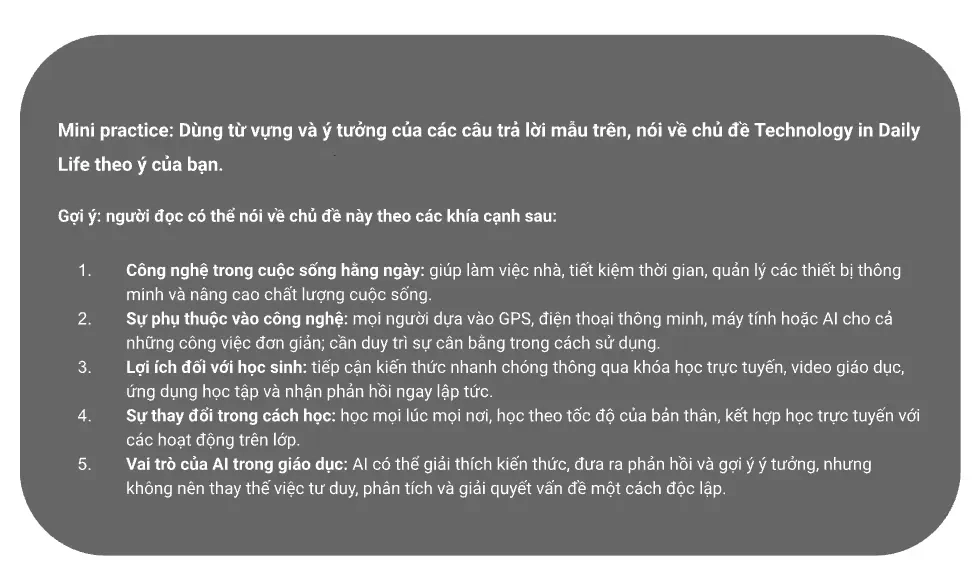
1. How does technology help people in their daily lives at home?
|
Technology has made household chores much more convenient and time-efficient. Smart appliances, such as robot vacuum cleaners, washing machines, and voice assistants, can automate many routine tasks, allowing people to spend more time with their families or focus on work. For example, instead of cleaning the house manually every day, people can schedule a robot vacuum to do the job automatically. Of course, these devices can be expensive, but I think the time and effort they save make them a worthwhile investment for many households. |
2. Do you think people depend too much on technology nowadays? Why or why not?
|
To some extent, yes. Technology has become an essential part of modern life, but many people rely on it even for tasks they could easily do themselves. For instance, some people use GPS to travel to places they have visited many times or depend on calculators for very simple calculations. That being said, technology itself isn't the problem. The real issue is whether people use it as a tool to improve their lives or become completely dependent on it. So, I believe maintaining a balance is the key. |
3. How does technology benefit students in their studies?
|
Technology provides students with instant access to an enormous amount of knowledge and learning resources. Instead of relying only on textbooks, they can attend online courses, watch educational videos, use interactive learning platforms, and receive immediate feedback through digital tools. For example, a student preparing for an IELTS exam can practise listening, speaking, and vocabulary using different apps on the same day. As a result, learning becomes more personalised, engaging, and efficient. |
4. Do you think technology has changed the way students learn? How?
|
Absolutely. Compared with the past, students today have far more opportunities to learn independently and at their own pace. Previously, they depended mainly on teachers and printed materials, whereas now they can access high-quality lessons anytime through online platforms and educational apps. For example, many students watch recorded lectures before class and then use classroom time for discussions or practical activities. Overall, technology has transformed learning from a teacher-centred approach into a much more flexible and student-centred one. |
5. Do you think using tools like AI can affect students’ ability to think independently? Why or why not?
|
Yes, I think it certainly can if students use AI irresponsibly. When learners rely on AI to complete assignments without analysing the information themselves, they may gradually lose the habit of critical thinking and independent problem-solving. For example, some students simply copy AI-generated answers instead of evaluating whether the information is accurate or relevant. Having said that, AI can also be an excellent learning assistant when it's used to explain difficult concepts, provide feedback, or suggest ideas rather than produce complete answers. So, in my opinion, AI should support students' thinking instead of replacing it. |
Xem thêm: 3 cách phát triển câu trả lời IELTS Speaking Part 3
Lọc và phân tích từ vựng
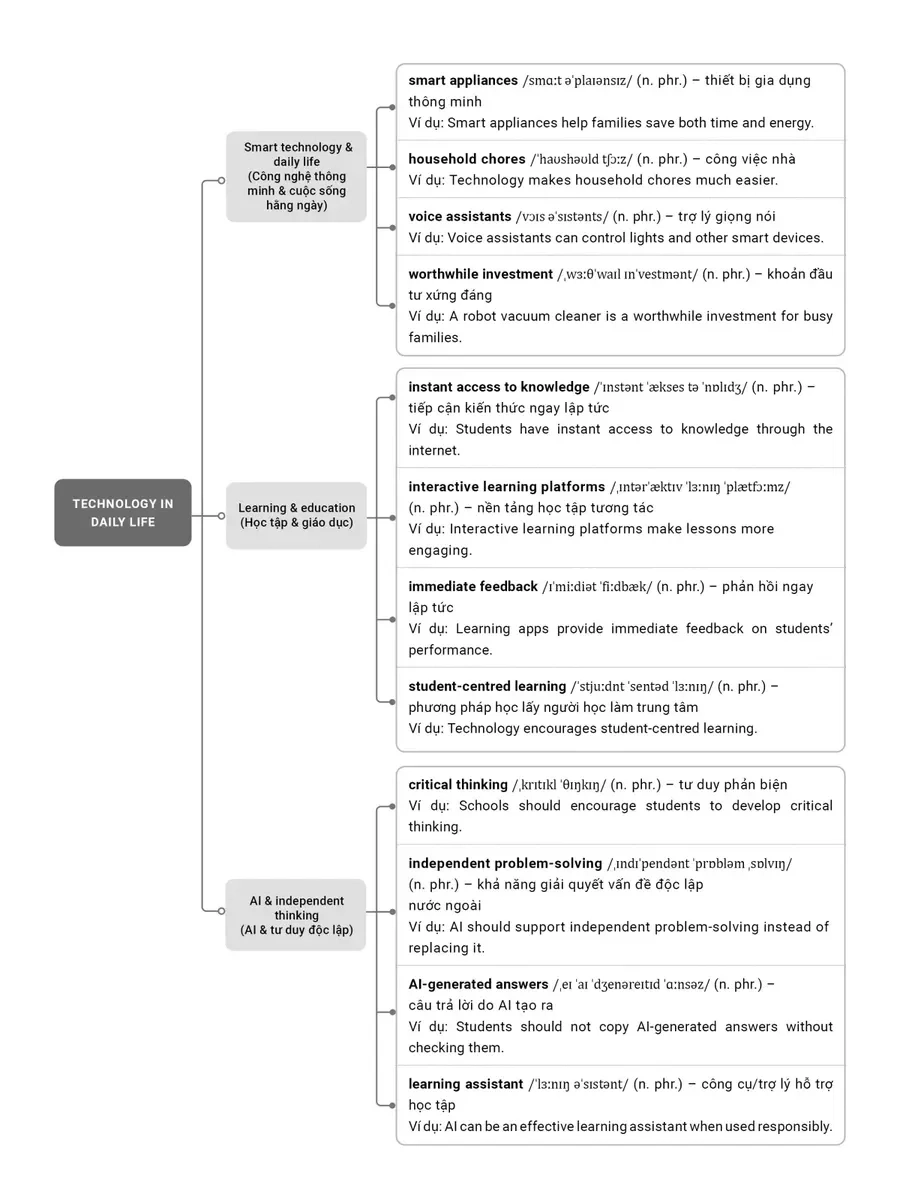
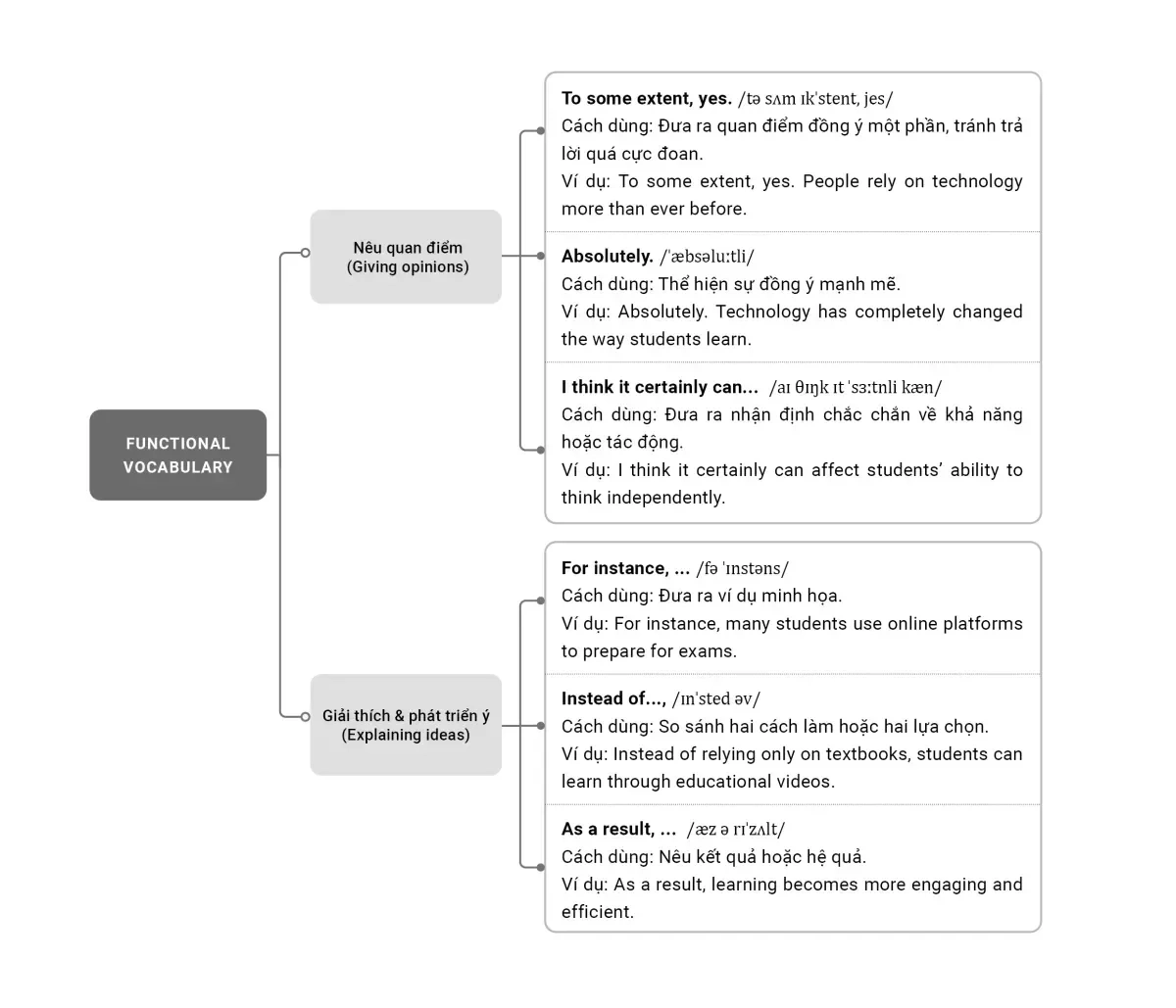
Nhật ký Từ vựng & Ý tưởng
Ghi chú sau khi luyện tập nói về chủ đề trên
Từ vựng/Ý tưởng (Chọn các từ vựng/ý tưởng mà bạn tâm đắc nhất) | Kỉ niệm cá nhân |
|---|---|
Ví dụ: critical thinking – tư duy phản biện | Người đọc tự đặt các câu hỏi cho bản thân, ví dụ: • Công nghệ giúp ích cho tôi nhiều nhất trong cuộc sống hằng ngày là gì? • Tôi thường sử dụng công nghệ để học tập như thế nào? • Tôi đã từng sử dụng AI để làm bài tập hoặc học ngoại ngữ chưa? Trải nghiệm đó ra sao? • Theo tôi, AI giúp việc học hiệu quả hơn hay khiến học sinh trở nên phụ thuộc hơn? Vì sao? • Tôi có từng phụ thuộc quá nhiều vào điện thoại, GPS hoặc các ứng dụng công nghệ không? → I use technology almost every day, especially for studying English. I often watch online lessons, use learning apps, and sometimes ask AI to explain difficult grammar points. However, I try not to rely on AI-generated answers because I want to develop my own critical thinking and problem-solving skills. In my opinion, technology is most useful when it supports learning instead of doing everything for us. |
Khoảng trống diễn đạt (Phần khiến bạn ngập ngừng khi nói về chủ đề trên) | Giải pháp (Giải pháp cho các khoảng trống diễn đạt) |
|---|---|
Ví dụ:
| Ví dụ: Dùng từ điển của ZIM hoặc chép các cách diễn đạt từ bài mẫu ở các phần trên để có được cụm từ mà bạn cần. → Thay technology is useful bằng Technology has become an essential part of modern life hoặc Technology has made everyday tasks more time-efficient. |
Người đọc có thể tìm từ vựng bằng từ điển của ZIM
ZIM Dictionary |
Các lỗi ngữ pháp/từ vựng thường gặp
1. Dùng sai encourage somebody to do something
❌ Lỗi thường gặp:
Technology encourages students learn independently.
✅ Cách dùng đúng:
✔ Câu đúng:
Technology encourages students to learn independently.
Hoặc:
Interactive learning platforms encourage learners to practise more regularly.
📌 Lý do sai:
Trong bài mẫu có câu "This kind of immersion... encourages them to use it in everyday situations." Sau encourage + tân ngữ, luôn phải dùng to + động từ nguyên mẫu. Người học thường bỏ to, đặc biệt khi nói nhanh trong IELTS Speaking.
2. Dùng sai rather than + V-ing / noun (Parallel structure)
❌ Lỗi thường gặp:
Students should use AI to generate ideas rather than copy the whole answer.
✅ Cách dùng đúng:
Hai vế phải song song về mặt ngữ pháp.
✔ Câu đúng:
Students should use AI to generate ideas rather than copying the whole answer.
Hoặc:
AI should support students' thinking rather than replace it. ❌
AI should support students' thinking rather than replacing it. ✅
📌 Lý do sai:
Trong bài mẫu có câu AI should support learning rather than replace it (rút gọn theo mệnh đề). Tuy nhiên khi nối hai hành động trong cùng một cấu trúc, người học nên giữ parallel structure, thường là V-ing, để tránh lỗi mất cân đối ngữ pháp.
3. Dùng sai Not only... but also... (Parallel structure)
❌ Lỗi thường gặp:
Technology not only provides instant access to information but also students can receive immediate feedback.
✅ Cách dùng đúng:
Hai vế sau not only... but also... phải cùng chức năng ngữ pháp.
✔ Câu đúng:
Technology not only provides instant access to information but also offers immediate feedback.
Hoặc:
Technology not only helps students learn independently but also improves their critical thinking.
📌 Lý do sai:
Trong Part 3, người học thường muốn liệt kê nhiều lợi ích của công nghệ nhưng lại nối một cụm động từ với một mệnh đề hoàn chỉnh, làm mất tính song song. Đây là lỗi ngữ pháp nâng cao ảnh hưởng trực tiếp đến tiêu chí Grammatical Range & Accuracy.
Mini practice |
|---|
Dùng đúng cấu trúc trong ngoặc 1. Hãy nói rằng các nền tảng học trực tuyến khuyến khích học sinh tự học thường xuyên hơn. (Dùng: encourage + somebody + to + V – không dùng encourage + somebody + V.) 2. Hãy nói rằng học sinh nên sử dụng AI để gợi ý ý tưởng thay vì sao chép toàn bộ câu trả lời. (Dùng: rather than + V-ing / noun – đảm bảo hai vế song song.) 3. Hãy nói rằng công nghệ không chỉ giúp học sinh tiếp cận kiến thức nhanh hơn mà còn cung cấp phản hồi ngay lập tức. (Dùng: not only... but also... – hai vế phải song song về mặt ngữ pháp.) |
Các chủ đề liên quan
Chủ đề liên quan để sử dụng từ vựng & ý tưởng:
Artificial Intelligence (Trí tuệ nhân tạo)
Người đọc có thể sử dụng:
Từ vựng: smart appliances, instant access to knowledge, interactive learning platforms, immediate feedback, critical thinking, independent problem-solving, AI-generated answers, rely on technology, maintain a balance, student-centred learning, digital tools, essential part of modern life, learning assistant....
Ý tưởng:
Công nghệ đã trở thành một phần thiết yếu của cuộc sống hiện đại, giúp mọi người tiết kiệm thời gian, làm việc hiệu quả hơn và tiếp cận thông tin dễ dàng.
Trong giáo dục, công nghệ mang đến nhiều cơ hội học tập linh hoạt thông qua các nền tảng trực tuyến, ứng dụng học tập và AI, cho phép học sinh học theo tốc độ của riêng mình.
Mặc dù AI có thể cung cấp phản hồi nhanh và giải thích những kiến thức khó, học sinh vẫn cần tự phân tích và giải quyết vấn đề để phát triển tư duy phản biện và khả năng học tập độc lập.
Điều quan trọng không phải là tránh sử dụng công nghệ mà là biết sử dụng nó đúng cách, xem công nghệ như một công cụ hỗ trợ thay vì phụ thuộc hoàn toàn vào nó.
Mini practice: Sử dụng từ vựng và ý tưởng ở trên để trả lời các câu hỏi sau
How has technology changed the way people work and communicate?
(Gợi ý: digital tools, essential part of modern life, rely on technology, maintain a balance)What are the advantages and disadvantages of using AI in education?
(Gợi ý: AI-generated answers, immediate feedback, critical thinking, independent problem-solving)Do you think students will depend more on technology in the future? Why or why not?
(Gợi ý: interactive learning platforms, student-centred learning, learning assistant, rely on technology)
Tổng kết
Hy vọng rằng qua việc phân tích hai cấp độ trả lời từ Simple Answer để đảm bảo sự trôi chảy đến Upgraded Answer để ghi điểm ấn tượng, bạn đã nắm vững được lộ trình để chinh phục chủ đề Technology in Daily Life (Part 3). Bằng cách cá nhân hóa các câu trả lời thông qua "Nhật ký Từ vựng & Ý tưởng", bạn sẽ xây dựng được sự tự tin. Đừng quên thực hành các bài tập nhỏ (mini practice) để khắc phục những lỗi ngữ pháp thường gặp và làm chủ ngôn ngữ của mình nhé!
Nếu bạn muốn nâng cao kỹ năng IELTS Speaking theo lộ trình cá nhân hóa, Hệ thống giáo dục ZIM cung cấp các khóa luyện thi IELTS cam kết đầu ra, giúp bạn tối ưu hiệu quả học tập và tiết kiệm đến 80% thời gian tự học. Để được tư vấn chi tiết, vui lòng liên hệ hotline 1900-2833 (nhánh 1) hoặc truy cập Khóa học IELTS.
Nguồn tham khảo
1
“Bài mẫu IELTS Speaking Part 3.” OpenAI, https://chatgpt.com/share/e/6961b6c8-4368-8002-995c-cd65b4729b18. Accessed 2 August 2026.
Bình luận - Hỏi đáp