


Chủ đề IELTS Speaking: Part 3: Business Trends & Entrepreneurship.
Bài mẫu cho các nhóm câu hỏi:
Popular businesses nowadays?
Reasons for their popularity?
Running your own business?
Start-up challenges?
Business success and failure?
Nhóm từ vựng trọng tâm (Topic Vocabulary):
Business Models and Customers, Starting and Running a Business, và Success and Failure.
IELTS Speaking Part 3 topic Business Trends & Entrepreneurship
Bài viết cung cấp các câu trả lời mẫu cho IELTS Speaking Part 3 (Business Trends & Entrepreneurship) theo định hướng cá nhân hóa, được chia thành hai cấp độ: Simple Answer (tập trung phản xạ và độ trôi chảy) và Upgraded Answer (nâng cấp từ vựng, ngữ pháp). Ngoài ra, phần phân tích chi tiết sẽ giúp người học hệ thống hóa từ vựng, khắc phục lỗi ngữ pháp và linh hoạt áp dụng vào các chủ đề tương tự.
Key takeaways
Bài viết sau đây sẽ cung cấp các câu trả lời mẫu theo khung sườn tư duy (Simple Answer) cùng các thử thách nâng cấp (Upgraded Answer) về cả ý tưởng, từ vựng và ngữ pháp để người học lựa chọn được câu trả lời phù hợp với bản thân, sẵn sàng cho các tình huống trong phòng thi. Bài phân tích này sẽ dẫn dắt người học đi qua chủ đề Business Trends & Entrepreneurship, từ sự phát triển của bán lẻ trực tuyến (online retail) và mong muốn tự làm chủ (be your own boss), cho đến những thách thức về vốn khởi nghiệp (start-up capital), dòng tiền (cash flow) và việc xây dựng nhóm khách hàng trung thành (loyal customers), giúp người học chinh phục giám khảo bằng sự mạch lạc và ngôn ngữ tự nhiên.
IELTS Speaking Part 3: Business Trends & Entrepreneurship
Simple Answer
1. What kinds of businesses are becoming increasingly popular nowadays?
|
I’d say online shops and services such as food delivery and online tutoring are becoming more popular in many places. They allow customers to buy things or get help without travelling far. For example, a tutor can teach students from different towns online. However, the most popular type of business will depend on local needs. |
2. Why do you think these businesses are becoming more popular?
|
I think convenience is a major reason. Many customers want services that save them time and are easy to use. Technology also makes it easier for small businesses to reach customers. For example, a local bakery can take orders online and arrange delivery. This can attract people who cannot visit the shop. |
3. Why do some people prefer running their own businesses to working for a company?
|
Some people want more control over their work and the chance to develop their own ideas. They may also hope to earn more if the business does well. For example, a chef might open a small restaurant to create their own menu. However, being the owner often means longer hours and less predictable income. |
4. What are the main challenges people face when starting a business?
|
One major challenge is finding enough money to get started and cover daily costs. Another is attracting customers when the business is still unknown. For example, a new café must pay rent and buy ingredients before it has many regular customers. Owners therefore need to plan carefully and understand what local people actually want. |
5. Why do some businesses succeed while others fail?
|
I think successful businesses usually understand their customers and manage their money well. They offer something people value and provide reliable service. For example, a shop may keep customers by selling good products at fair prices. Others may struggle because their costs are too high or demand is weak, although unexpected events can also cause failure. |
Mini practice: Dùng từ vựng và ý tưởng để trả lời theo cách của em.
1. Loại hình phổ biến: Chọn hai ví dụ như online retail hoặc online tutoring; giải thích chúng đáp ứng nhu cầu gì.
2. Nguyên nhân: Nêu sự tiện lợi và vai trò của công nghệ; dùng một ví dụ về việc đặt hàng trực tuyến.
3. Tự làm chủ: Nêu quyền quyết định và khả năng phát triển ý tưởng; cân nhắc trách nhiệm và thu nhập không ổn định.
4. Khó khăn ban đầu: Giải thích start-up capital, cash flow và việc tìm khách hàng đầu tiên.
5. Thành công và thất bại: So sánh việc hiểu khách hàng, kiểm soát chi phí và thích nghi; thêm một yếu tố ngoài tầm kiểm soát.
Tham khảo: Tổng hợp bài mẫu IELTS Speaking 2026
Upgraded answer
1. What kinds of businesses are becoming increasingly popular nowadays?
|
I’d say businesses built around convenience are particularly noticeable, especially online retail, food delivery and online learning services. These models allow people to shop or access expertise without travelling to a particular location. For instance, a small tutoring business can reach students beyond its immediate neighbourhood through online lessons. There also seems to be room for specialist businesses that serve a clearly defined group, such as shops selling products for a particular hobby. That said, I wouldn’t assume the same trend applies everywhere. What becomes popular depends on local incomes, habits and access to technology. |
2. Why do you think these businesses are becoming more popular?
|
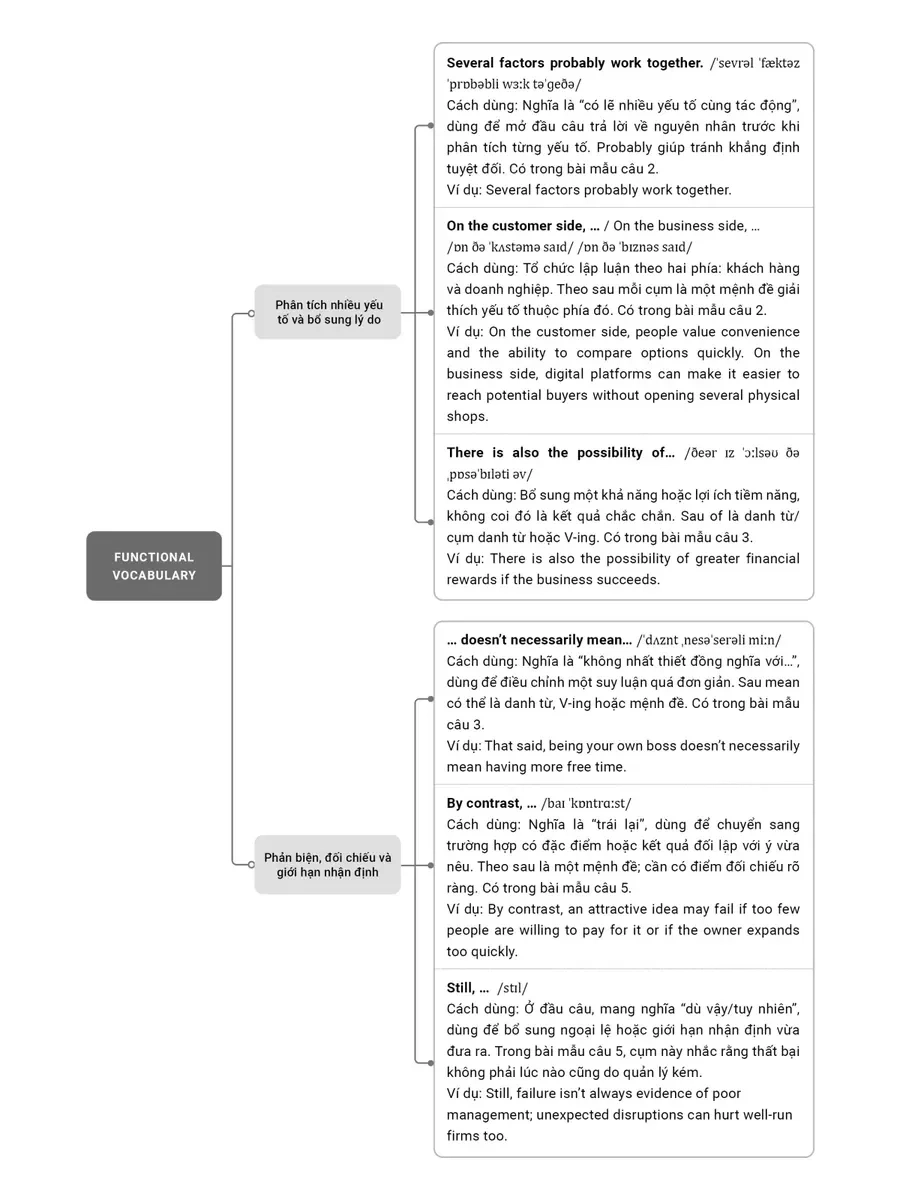
Several factors probably work together. On the customer side, people value convenience and the ability to compare options quickly. On the business side, digital platforms can make it easier to reach potential buyers without opening several physical shops. For instance, a small bakery could use social media to show its products and accept advance orders, making purchases simpler for busy customers. However, lower barriers to entry can also mean stronger competition. So technology may help explain why these businesses attract attention, but they still need reliable service and a clear reason for customers to choose them. |
3. Why do some people prefer running their own businesses to working for a company?
|
I think independence is a major attraction. Some people want to make their own decisions, choose the kind of work they do and turn a personal interest into a source of income. There is also the possibility of greater financial rewards if the business succeeds. A skilled baker, for example, might prefer building a brand around their own recipes to following someone else’s menu. That said, being your own boss doesn’t necessarily mean having more free time. Owners remain responsible for customers, staff and bills, so the appeal is often greater control rather than an easier life. |
4. What are the main challenges people face when starting a business?
|
The biggest challenges are usually securing enough start-up capital, attracting customers and keeping cash flowing while the business gets established. These problems are connected: an owner may have to pay rent and suppliers long before sales become steady. For example, a new café might be busy at weekends but still struggle to cover its monthly costs. There is also a learning curve, since someone who makes an excellent product may have little experience in pricing or managing staff. Starting on a manageable scale can help, although even careful planning cannot remove all uncertainty. |
5. Why do some businesses succeed while others fail?
|
A business is more likely to succeed when it meets a real customer need, controls its costs and adapts when circumstances change. Good service can turn first-time buyers into loyal customers, which gives the business a more stable base. By contrast, an attractive idea may fail if too few people are willing to pay for it or if the owner expands too quickly. For instance, a popular shop could run short of cash after opening a second branch. Still, failure isn’t always evidence of poor management; unexpected disruptions can hurt well-run firms too. Success depends on both decisions and circumstances. |
Mini practice: Dùng từ vựng và ý tưởng để trả lời theo cách của em.
1. Loại hình phổ biến: Chọn hai ví dụ như online retail hoặc online tutoring; giải thích chúng đáp ứng nhu cầu gì.
2. Nguyên nhân: Nêu sự tiện lợi và vai trò của công nghệ; dùng một ví dụ về việc đặt hàng trực tuyến.
3. Tự làm chủ: Nêu quyền quyết định và khả năng phát triển ý tưởng; cân nhắc trách nhiệm và thu nhập không ổn định.
4. Khó khăn ban đầu: Giải thích start-up capital, cash flow và việc tìm khách hàng đầu tiên.
5. Thành công và thất bại: So sánh việc hiểu khách hàng, kiểm soát chi phí và thích nghi; thêm một yếu tố ngoài tầm kiểm soát.
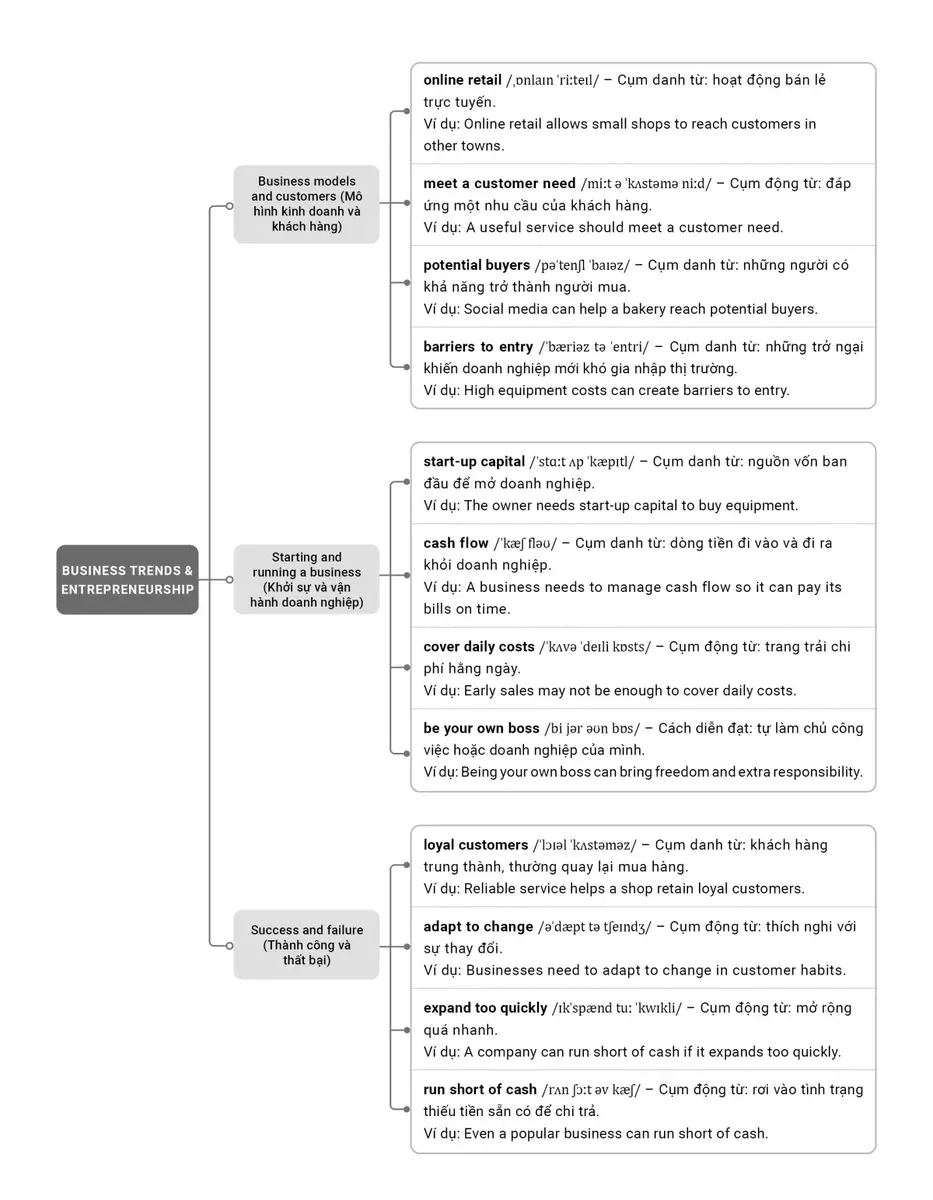
Lọc và phân tích từ vựng
Nhật ký Từ vựng & Ý tưởng
Ghi chú sau khi luyện tập nói về chủ đề trên
Từ vựng/Ý tưởng (Chọn các từ vựng/ý tưởng mà bạn tâm đắc nhất) | Kỉ niệm cá nhân (Gán các từ vựng/ý tưởng đã chọn với kỉ niệm của bản thân) |
|---|---|
Ví dụ: meet a customer need – đáp ứng nhu cầu khách hàng; cash flow – dòng tiền; loyal customers – khách hàng trung thành. | Người đọc tự đặt các câu hỏi cho bản thân, ví dụ:
→ A small bakery near my home began taking orders through social media. I found this convenient because I could collect my order after work without waiting. The owner also remembered regular customers’ preferences, which encouraged me to return. This helped me understand how meeting a customer need and providing reliable service can build loyalty. However, being popular does not automatically mean making a profit: the owner still has to manage costs and cash flow. |
Khoảng trống diễn đạt (Phần khiến bạn ngập ngừng khi nói về chủ đề trên) | Giải pháp (Giải pháp cho các khoảng trống diễn đạt) | ||
|---|---|---|---|
Ví dụ: Tôi muốn nói doanh nghiệp phải “trang trải chi phí” và có thể “thiếu tiền để thanh toán”, nhưng chỉ nghĩ được “pay money” và “not enough money”. | Ví dụ: Tra từ điển của ZIM hoặc xem lại bài mẫu để tìm cách diễn đạt rõ ràng, tự nhiên. → Để nói “trang trải chi phí hằng ngày”, có thể dùng cover daily costs. → Để nói “rơi vào tình trạng thiếu tiền sẵn có”, có thể dùng run short of cash; khi nói về tiền đi vào và đi ra, dùng cash flow. |
Người đọc có thể tìm từ vựng bằng từ điển ZIM Dictionary.
Các lỗi ngữ pháp/từ vựng thường gặp
1. Phân biệt “although” và “despite/in spite of”
❌ Lỗi thường gặp:
Although running a business offers more freedom, but it also brings financial risks.
Despite online shops are convenient, some customers prefer physical stores.
✅ Cách dùng đúng:
although/even though + S + V: mặc dù… Dùng để nối hai ý tương phản trong cùng một câu.
despite/in spite of + danh từ hoặc V-ing: mặc dù… Ví dụ: Despite offering low prices, the shop struggles to attract customers.
Muốn dùng một mệnh đề đầy đủ sau despite, thêm the fact that: despite the fact that + S + V. Không ghép although và but để nối cùng hai mệnh đề.
✔ Câu đúng:
Although running a business offers more freedom, it also brings financial risks.
Despite the fact that online shops are convenient, some customers prefer physical stores.
📌 Lý do sai:
Câu đầu dùng thừa but vì although đã thể hiện quan hệ nhượng bộ. Câu thứ hai đặt trực tiếp S + V sau despite; cần thêm the fact that hoặc đổi thành Despite the convenience of online shops, some customers prefer physical stores. Khi dùng V-ing sau despite, bảo đảm chủ thể được hiểu phù hợp: Despite offering low prices, the shop… (chính cửa hàng đưa ra giá thấp).
2. Dùng mệnh đề danh từ với “whether / how / what”
❌ Lỗi thường gặp:
A company’s success depends on how well does it understand its customers.
Whether a business succeeds depend on several factors.
✅ Cách dùng đúng:
Sau depends on, dùng whether + S + V để nêu việc có hay không: Success depends on whether the business meets a real need.
Dùng how + S + V hoặc how + trạng từ + S + V để nói cách thức/mức độ: how it operates; how well it manages cash flow.
Dùng what + S + V để nói điều mà ai cần hoặc muốn: Businesses need to understand what customers want.
Trong mệnh đề danh từ, dùng trật tự câu trần thuật; không đảo trợ động từ như câu hỏi. Khi cả một mệnh đề làm chủ ngữ như Whether a business succeeds, động từ chính thường chia số ít.
✔ Câu đúng:
A company’s success depends on how well it understands its customers.
Whether a business succeeds depends on several factors.
📌 Lý do sai:
Câu hỏi trực tiếp là How well does it understand its customers? Nhưng sau depends on, cần how well it understands its customers: bỏ does và chia understands theo it. Ở câu thứ hai, chủ ngữ là cả mệnh đề Whether a business succeeds nên dùng depends. Whether diễn đạt ý “liệu… hay không”; không thay bằng that nếu muốn giữ ý này.
3. Phân biệt “economic”, “economical” và “profitable”
❌ Lỗi thường gặp:
Economical growth can create opportunities for new businesses.
The company earned more than it spent last year, so it was economic.
✅ Cách dùng đúng:
economic (adj): thuộc về nền kinh tế hoặc kinh tế học. Cụm thường gặp: economic growth (tăng trưởng kinh tế), economic conditions (điều kiện kinh tế).
economical (adj): tiết kiệm tiền, nhiên liệu hoặc nguồn lực khi sử dụng. Ví dụ: an economical delivery vehicle (xe giao hàng tiết kiệm chi phí vận hành).
profitable (adj): có lãi, tạo ra lợi nhuận. Ví dụ: a profitable business (doanh nghiệp có lãi); become profitable (bắt đầu có lãi).
Chọn từ theo ý cần nói: tình hình nền kinh tế → economic; tiết kiệm khi sử dụng → economical; doanh thu lớn hơn chi phí → profitable. Không dùng ba từ này thay thế nhau chỉ vì đều liên quan đến tiền.
✔ Câu đúng:
Economic growth can create opportunities for new businesses.
The company earned more than it spent last year, so it was profitable.
📌 Lý do sai:
Economical không mang nghĩa “thuộc nền kinh tế”, nên phải dùng economic growth. Ở câu thứ hai, ý cần diễn đạt là công ty có lãi nên dùng profitable. Economic còn có thể mang nghĩa đem lại đủ giá trị hoặc lợi ích tài chính để đáng thực hiện, như economically viable; tuy nhiên, khi khẳng định doanh nghiệp có lãi, profitable diễn đạt trực tiếp và rõ hơn. Một phương tiện economical giúp giảm chi phí nhưng không bảo đảm cả doanh nghiệp sẽ profitable.
Xem thêm: Phân biệt “economy”, “economics”, “economic”, “economical”
Mini practice |
|---|
Dùng đúng cấu trúc trong ngoặc
|
Các chủ đề liên quan
Chủ đề liên quan để sử dụng từ vựng & ý tưởng:
Technology & Shopping (Công nghệ và mua sắm)
Người đọc có thể sử dụng:
Từ vựng: online retail, meet a customer need, potential buyers, barriers to entry, start-up capital, cash flow, cover daily costs, be your own boss, loyal customers, adapt to change, expand too quickly, run short of cash.
Ý tưởng:
Tự kinh doanh có thể đem lại quyền quyết định và cơ hội phát triển ý tưởng, nhưng thu nhập khó dự đoán và trách nhiệm lớn hơn.
Công nghệ giúp doanh nghiệp tiếp cận người mua và đơn giản hóa việc đặt hàng; mức độ hiệu quả còn phụ thuộc vào nhóm khách hàng.
Dịch vụ tiện lợi thu hút người bận rộn, nhưng chất lượng và độ tin cậy vẫn quyết định việc họ có quay lại hay không.
Doanh nghiệp mới cần vốn ban đầu và đủ tiền để thanh toán chi phí trong khi chờ doanh thu ổn định.
Một người giỏi làm sản phẩm chưa chắc đã có kinh nghiệm định giá, quản lý nhân viên hoặc kiểm soát dòng tiền.
Lắng nghe phản hồi và duy trì dịch vụ tốt giúp xây dựng nhóm khách hàng trung thành.
Mở rộng quá nhanh có thể gây thiếu tiền; thất bại cũng có thể do thay đổi thị trường hoặc sự kiện ngoài tầm kiểm soát.
Mini practice |
|---|
Sử dụng từ vựng và ý tưởng ở trên để trả lời các câu hỏi sau
|
Tổng kết
Hy vọng rằng qua việc phân tích hai cấp độ trả lời từ Simple Answer để đảm bảo sự trôi chảy đến Upgraded Answer để ghi điểm ấn tượng, bạn đã nắm vững được lộ trình để chinh phục chủ đề Business Trends & Entrepreneurship (Part 3). Bằng cách cá nhân hóa các câu trả lời thông qua "Nhật ký Từ vựng & Ý tưởng", bạn sẽ xây dựng được sự tự tin. Đừng quên thực hành các bài tập nhỏ (mini practice) để khắc phục những lỗi ngữ pháp thường gặp và làm chủ ngôn ngữ của mình nhé!
Nếu bạn muốn nâng cao kỹ năng IELTS Speaking theo lộ trình cá nhân hóa, Hệ thống giáo dục ZIM cung cấp các khóa luyện thi IELTS cam kết đầu ra, giúp bạn tối ưu hiệu quả học tập và tiết kiệm đến 80% thời gian tự học. Để được tư vấn chi tiết, vui lòng liên hệ hotline 1900-2833 (nhánh 1) hoặc truy cập Khóa học IELTS.
Nguồn tham khảo
1
“Bài mẫu IELTS Speaking Part 3.” OpenAI, https://chatgpt.com/share/e/6961bf62-bf88-8002-9512-8fe28a8cdcf4. Accessed 17 October 2026.


Bình luận - Hỏi đáp