


Chủ đề IELTS Speaking Part 3: Creativity and Education.
Bài mẫu cho nhóm câu hỏi:
Which jobs require high creativity?
Creativity: more important now than in the past?
Should children learn music or art early?
Do schools focus enough on creative subjects?
Innate talent vs. Developed through education?
Nhóm từ vựng: Topic Vocabulary: Creative jobs & modern workplace và Education & skill development.
Bài mẫu IELTS Speaking Part 3 Topic Creativity and Education
Trong bài viết này, tác giả sẽ gợi ý bài mẫu cho Topic “Creativity and Education” và phân tích các từ vựng ghi điểm cho phần thi IELTS Speaking Part 3.
Key takeaways
Bài viết sau đây sẽ cung cấp các câu trả lời mẫu theo khung sườn tư duy (Simple Answer) cùng các thử thách nâng cấp (Upgraded Answer) về cả ý tưởng, từ vựng và ngữ pháp để người học lựa chọn được câu trả lời phù hợp với bản thân, sẵn sàng cho các tình huống trong phòng thi. Bài phân tích này sẽ dẫn dắt người học đi qua các câu trả lời mẫu cho chủ đề Creativity and Education, từ những cụm từ miêu tả kỹ năng làm việc hiện đại như 'come up with fresh ideas', 'stay competitive' đến những thảo luận về giáo dục như 'project-based learning' hay 'overall development', giúp người học chinh phục giám khảo bằng sự mạch lạc và ngôn ngữ tự nhiên.
IELTS Speaking Part 3: Creativity and Education - Sample Answer
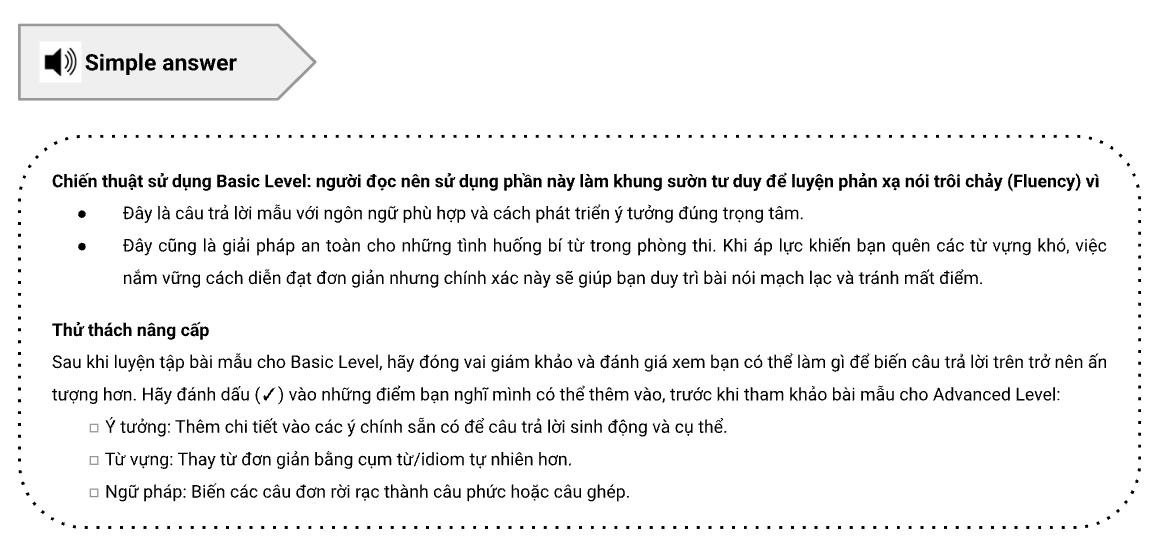
Simple answer
1. Which kinds of jobs require a high level of creativity? Why?
|
I think jobs like artists, fashion designers, and YouTubers need a high level of creativity. These people have to think of new ideas all the time. For example, a YouTuber needs to make interesting videos so viewers don’t get bored and stop watching. So creativity is very important in these kinds of jobs. |
2. Do you think creativity is more important now than in the past?
|
Yes, I think creativity is more important today. Many simple jobs are now done by machines, so people need creative skills to find better opportunities. For example, robots can work in factories, but they cannot create new ideas for a business. So creative people may have more chances to succeed nowadays. |
3. Should children learn music or art from a young age? Why or why not?
|
Yes, I think children should learn music or art when they are young. These subjects help them use their imagination. For example, when children learn to draw, they can show their ideas in pictures instead of just using words. So creative subjects help children grow in different ways. |
4. Do you think schools focus enough on creative subjects?
|
In my opinion, many schools focus more on academic subjects than creative ones. Students usually spend more time studying math and science. For example, art classes may only happen once a week in some schools. Because of this, students may not have enough time to develop their creative skills. |
5. Is creativity something people are born with, or can it be developed through education?
|
I think creativity can be developed through education. Some children may be naturally creative, but practice can help improve this skill. For example, if teachers give students group projects where they have to think of their own ideas, students can become more creative over time. So I believe creativity can be learned. |
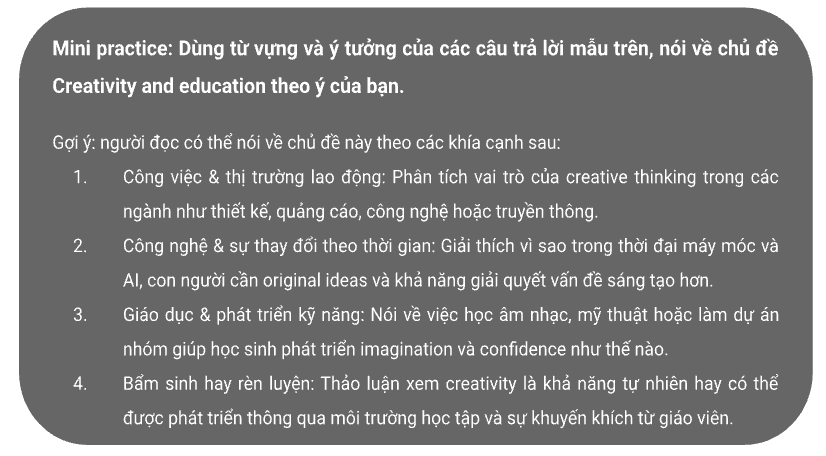
Upgraded answer
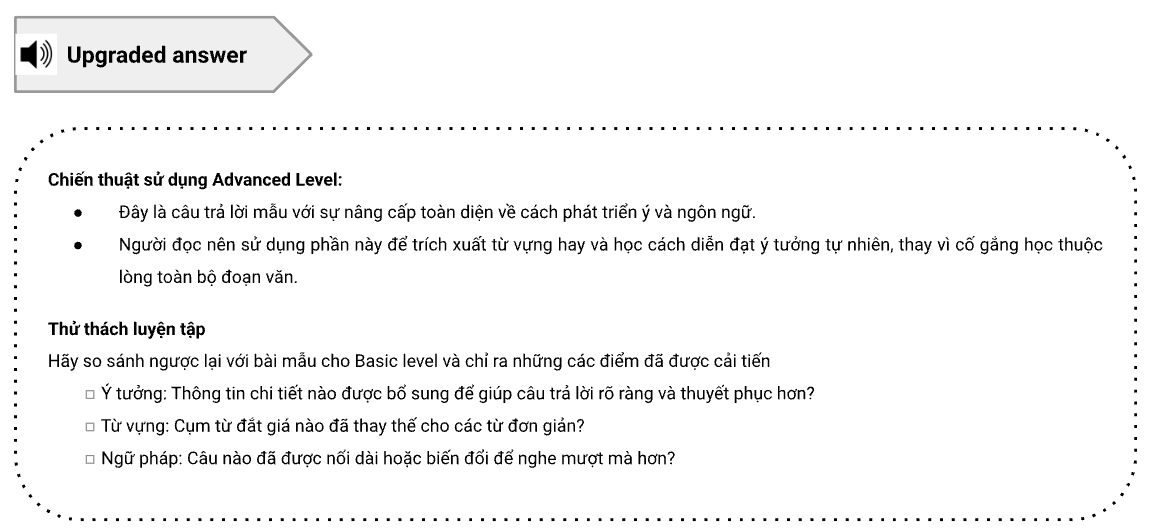
1. Which kinds of jobs require a high level of creativity? Why?
|
Well, I’d say jobs in areas like design, advertising, filmmaking, or even social media content creation require a high level of creativity. In these fields, people are expected to come up with fresh ideas all the time, otherwise their work can quickly become boring. For example, an advertising team has to design a campaign that makes customers notice their product instead of many similar ones on the market. If the idea is not original, people simply ignore it. So in creative industries, imagination is not just helpful — it’s essential. |
2. Do you think creativity is more important now than in the past?
|
Yes, I do think creativity is more important nowadays. A lot of routine work is being done by machines or software, so people need creative thinking to stay competitive. For instance, factory tasks can be automated, but developing a new app or designing a brand still requires human ideas. That said, creativity was also important in the past, especially in art and culture. However, in today’s fast-changing world, creative skills seem to play a bigger role in almost every field. |
3. Should children learn music or art from a young age? Why or why not?
|
Personally, I believe children should learn music or art at an early age. These subjects allow them to express themselves and build confidence. For example, a child who learns to play the guitar may feel proud when performing in front of classmates. Over time, this can improve not only creativity but also communication skills. So creative subjects can support children’s overall development, not just their artistic ability. |
4. Do you think schools focus enough on creative subjects?
|
In my view, most schools still focus more on academic subjects than on creative ones. Subjects like math and science are often prioritised because they are tested in major exams. For example, students might have art classes only once a week, while they study core subjects almost every day. On the other hand, some schools are starting to include more project-based learning, which encourages creativity. Even so, I think creative subjects still deserve more attention overall. |
5. Is creativity something people are born with, or can it be developed through education?
|
I’d say creativity is partly natural but can definitely be developed through education. Some people may be naturally imaginative, but training and practice make a big difference. For example, students who are encouraged to share ideas freely in class often become more confident and creative over time. Of course, not everyone will become an artist or inventor. Still, with the right support, most people can improve their creative thinking skills. |
Xem thêm: Bài mẫu IELTS Speaking Part 3 Topic “Customer Service” kèm từ vựng
Lọc và phân tích từ vựng
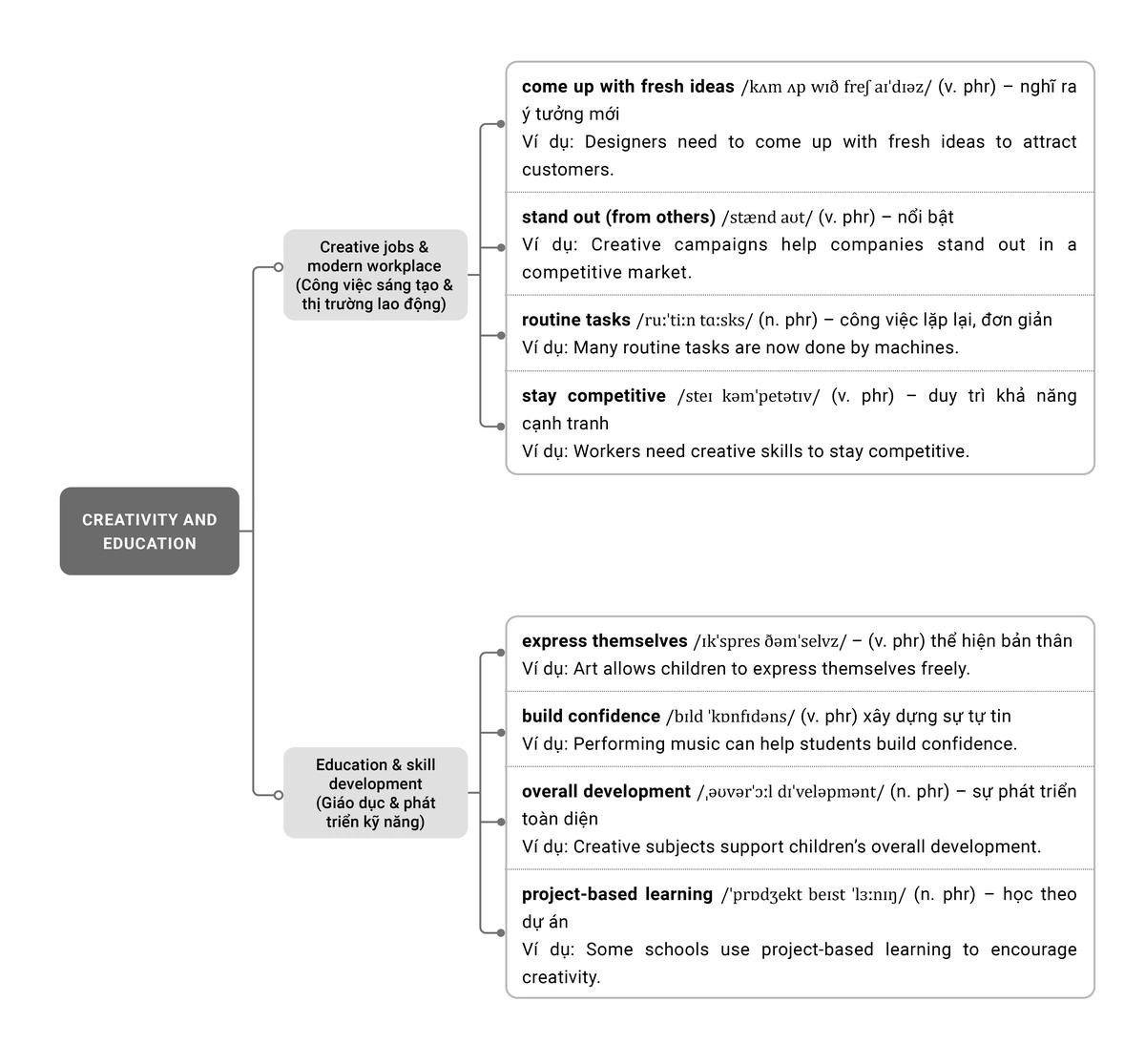
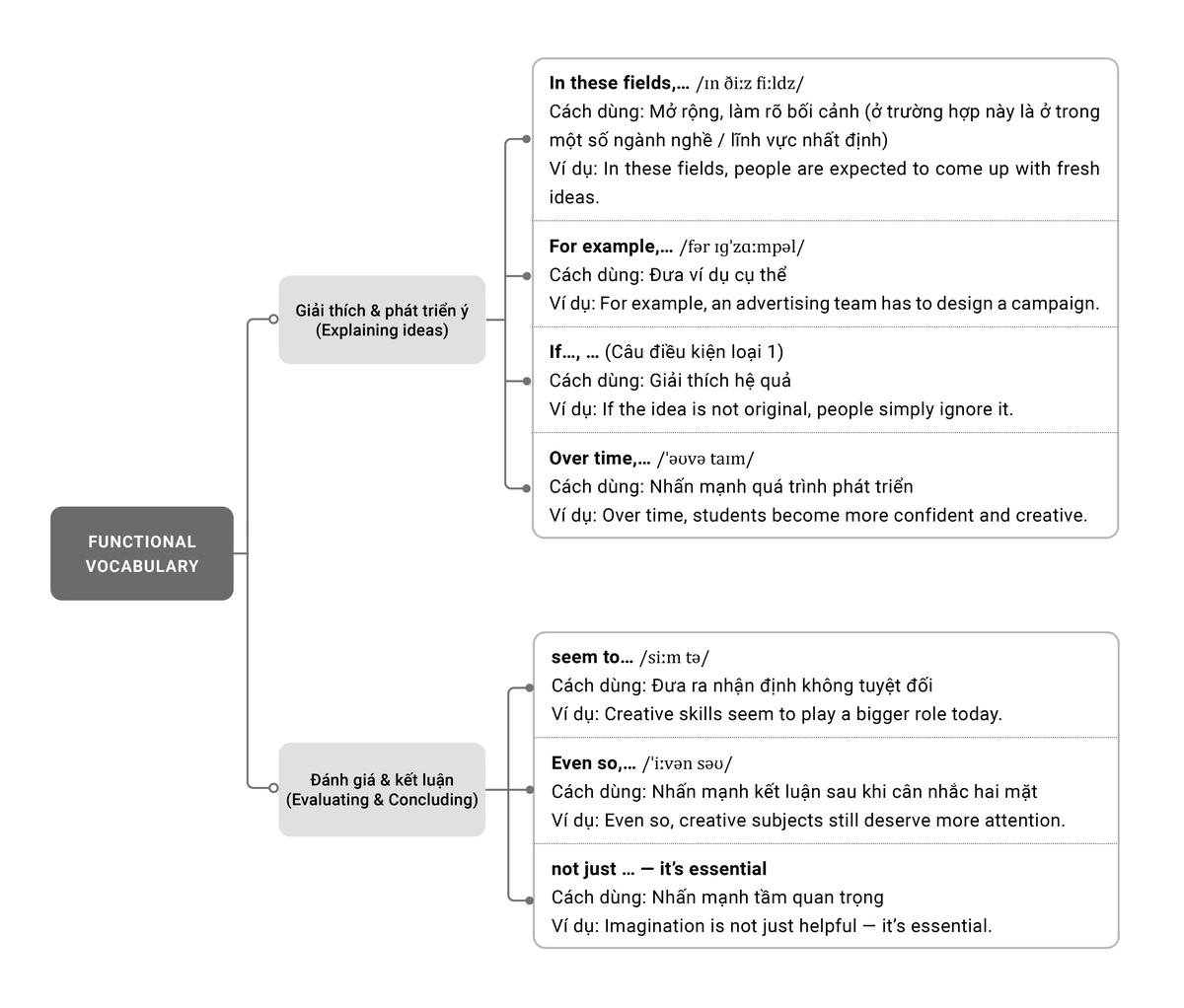
Nhật ký Từ vựng & Ý tưởng
Ghi chú sau khi luyện tập nói về chủ đề trên
Từ vựng/Ý tưởng (Chọn các từ vựng/ý tưởng mà bạn tâm đắc nhất) | Kỉ niệm cá nhân |
|---|---|
Ví dụ: come up with fresh ideas – nghĩ ra ý tưởng mới | Người đọc tự đặt các câu hỏi cho bản thân, ví dụ:
→ When I was in high school, we had a group project where we had to create a short video about environmental protection. At first, it was difficult to come up with fresh ideas. However, with the right support from our teacher, we gradually developed creative thinking skills and became more confident. That experience showed me that creativity can definitely be developed through practice. |
Khoảng trống diễn đạt (Phần khiến bạn ngập ngừng khi nói về chủ đề trên) | Giải pháp (Giải pháp cho các khoảng trống diễn đạt) | ||
|---|---|---|---|
Ví dụ:
| Ví dụ: Dùng từ điển của ZIM hoặc chép các cách diễn đạt từ bài mẫu ở các phần trên để có được cụm từ mà bạn cần. → Thay vì nói “very creative” → dùng come up with fresh ideas |
Người đọc có thể tìm từ vựng bằng từ điển ZIM Dictionary.
Các lỗi ngữ pháp thường gặp
1. Nhầm “creative” và “creatively”
❌ Lỗi thường gặp:
Students should think more creative in class.
(người học muốn nói: suy nghĩ một cách sáng tạo)
✅ Cách dùng đúng:
creative (adj) → bổ nghĩa cho danh từ
creatively (adv) → bổ nghĩa cho động từ
✔ Câu đúng:
Students should think more creatively in class.
Creative subjects help students develop imagination.
📌 Lý do sai:
Nhiều thí sinh dùng tính từ thay vì trạng từ sau động từ “think”, gây lỗi cơ bản về từ loại.
2. Dùng sai cấu trúc với “important”
❌ Lỗi thường gặp:
Creativity is very important for develop new ideas.
✅ Cách dùng đúng:
important + for + noun / V-ing
important + to + V
✔ Câu đúng:
Creativity is important for developing new ideas.
Creativity is important to develop new ideas.
📌 Lý do sai:
Sau “for” phải là danh từ hoặc V-ing, không dùng động từ nguyên mẫu.
3. Dùng sai cấu trúc khi nói về khả năng phát triển
❌ Lỗi thường gặp:
Creativity can be develop through education.
✅ Cách dùng đúng:
can be + V3 (bị động)
✔ Câu đúng:
Creativity can be developed through education.
📌 Lý do sai:
Quên dạng quá khứ phân từ trong câu bị động là lỗi rất hay gặp trong Speaking.
Mini practice |
|---|
Dùng đúng cấu trúc trong ngoặc 1. Hãy nói về việc học sinh nên suy nghĩ sáng tạo hơn trong lớp học. (Dùng: creatively – không dùng creative sau động từ “think”) 2. Hãy nói về tầm quan trọng của sáng tạo trong việc tạo ra ý tưởng mới. (Dùng: important for + V-ing / important to + V – không dùng “for + V”) 3. Hãy nói về việc sáng tạo có thể được phát triển thông qua giáo dục. (Dùng: can be + V3 – không dùng can be + V nguyên mẫu) |
Các chủ đề liên quan
hủ đề liên quan để sử dụng từ vựng & ý tưởng:
Work and careers (Công việc & nghề nghiệp)
Technology and modern life (Công nghệ & đời sống hiện đại)
School and education system (Trường học & hệ thống giáo dục)
Người đọc có thể sử dụng:
Từ vựng: creative thinking, come up with fresh ideas, stay competitive, routine tasks, automation, fast-changing world, express themselves, build confidence, overall development, project-based learning, academic subjects, naturally imaginative, develop creative skills, with the right support, make a difference…
Ý tưởng:
Công việc hiện đại yêu cầu sáng tạo để nổi bật trong môi trường cạnh tranh.
Máy móc có thể thay thế công việc lặp lại, nhưng không thể thay thế ý tưởng sáng tạo của con người.
Học âm nhạc và mỹ thuật giúp trẻ tự tin và thể hiện bản thân tốt hơn.
Nhiều trường học vẫn ưu tiên môn học học thuật hơn môn sáng tạo.
Sáng tạo có thể là bẩm sinh, nhưng môi trường học tập và thực hành giúp phát triển kỹ năng này.
Mini practice |
|---|
Sử dụng từ vựng và ý tưởng ở trên để trả lời các câu hỏi sau
|
Tham khảo thêm: Cách ôn tập IELTS Speaking hiệu quả khi gần sát ngày thi
Hy vọng rằng qua việc phân tích hai cấp độ trả lời từ Simple Answer để đảm bảo sự trôi chảy đến Upgraded Answer để ghi điểm ấn tượng, bạn đã nắm vững được lộ trình để chinh phục chủ đề Creativity and Education (Part 3). Bằng cách cá nhân hóa các câu trả lời thông qua "Nhật ký Từ vựng & Ý tưởng", bạn sẽ xây dựng được sự tự tin. Đừng quên thực hành các bài tập nhỏ (mini practice) để khắc phục những lỗi ngữ pháp thường gặp và làm chủ ngôn ngữ của mình nhé!
Nếu bạn muốn nâng cao kỹ năng IELTS Speaking theo lộ trình cá nhân hóa, Hệ thống giáo dục ZIM cung cấp các khóa luyện thi IELTS cam kết đầu ra, giúp bạn tối ưu hiệu quả học tập và tiết kiệm đến 80% thời gian tự học. Để được tư vấn chi tiết, vui lòng liên hệ hotline 1900-2833 (nhánh 1) hoặc truy cập Khóa học IELTS.
Nguồn tham khảo
1
“Bài mẫu IELTS Speaking Part 3.” OpenAI, https://chatgpt.com/share/e/6961bf62-bf88-8002-9512-8fe28a8cdcf4. Accessed 1 March 2026.
Bình luận - Hỏi đáp