


Chủ đề IELTS Speaking Part 3: Persuasion.
Bài mẫu cho nhóm câu hỏi:
Situations for persuasion?
Effective ways of persuading someone?
Young vs. Older people: Who is easier to persuade?
Face-to-face vs. Online persuasion?
How advertising influences buying decisions?
Nhóm từ vựng: Topic Vocabulary: Situations & contexts, Methods & strategies, Psychology & influence, và Advertising.
Bài mẫu IELTS Speaking Part 3 Topic “Persuasion” kèm từ vựng
Trong bài viết này, tác giả sẽ gợi ý bài mẫu cho Topic “Persuasion” và phân tích các từ vựng ghi điểm cho phần thi IELTS Speaking Part 3.
Key takeaways
Bài viết sau đây sẽ cung cấp các câu trả lời mẫu theo khung sườn tư duy (Simple Answer) cùng các thử thách nâng cấp (Upgraded Answer) về cả ý tưởng, từ vựng và ngữ pháp để người học lựa chọn được câu trả lời phù hợp với bản thân, sẵn sàng cho các tình huống trong phòng thi. Bài phân tích này sẽ dẫn dắt người học đi qua các câu trả lời mẫu cho IELTS Speaking Part 3 Topic Persuasion, từ những khái niệm căn bản trong giao tiếp như “get someone on board”, “find common ground” đến những kỹ thuật tâm lý chuyên sâu như “emotional appeal” hay “fear of missing out”, giúp người học chinh phục giám khảo bằng sự mạch lạc và ngôn ngữ tự nhiên.
IELTS Speaking Part 3: Persuasion - Sample Answer
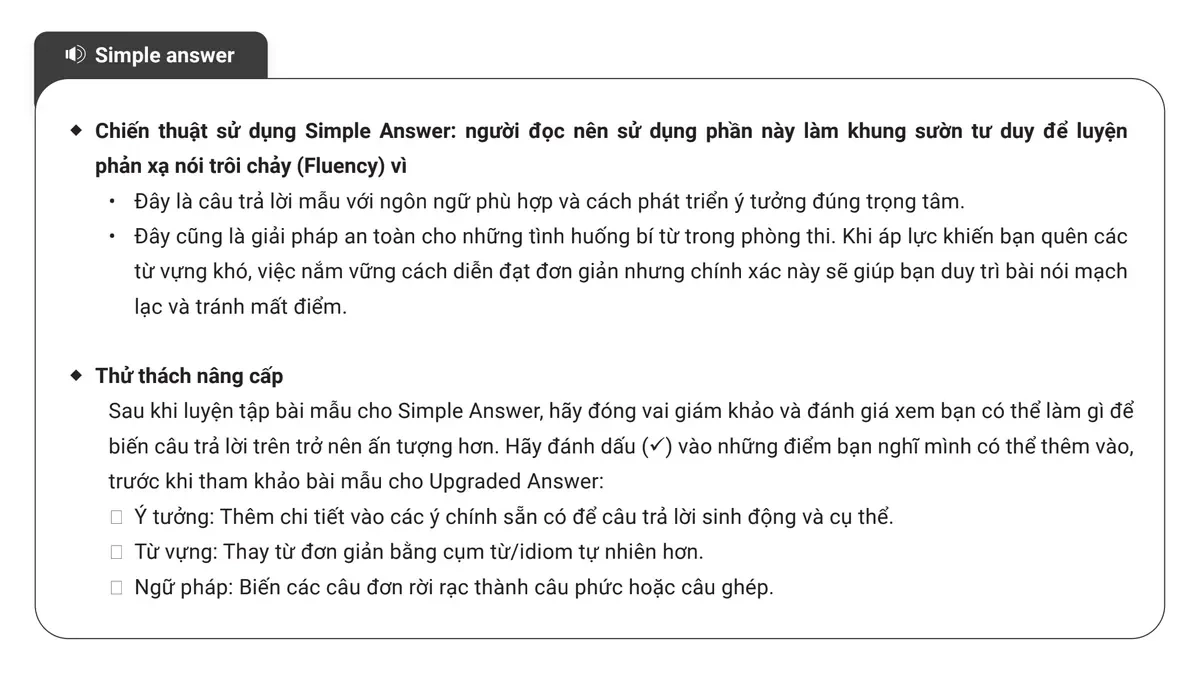
Simple answer
1. In what situations do people usually try to persuade others?
|
People usually try to persuade others in everyday situations and at work. For example, parents may persuade their children to study harder or eat healthier food. At work, managers often persuade staff to accept new plans. In daily life, friends may try to persuade each other when deciding where to go or what to buy. So persuasion happens quite often in both personal and professional life. |
2. What are some effective ways of persuading someone?
|
One effective way is to give clear reasons and practical examples. When people understand the benefits, they are more likely to agree. For instance, if you explain how exercising improves health, your friend may be more willing to join you. Speaking calmly and respectfully is also important. In general, logical arguments and a positive attitude can make persuasion more successful. |
3. Do you think young people are easier to persuade than older people? Why or why not?
|
I think young people can be easier to persuade because they are still developing their opinions. They may be more open to new ideas and trends. For instance, teenagers are often influenced by their friends or social media. Older people usually have more experience and stronger views. So age can affect how easily someone is persuaded. |
4. Is it easier to persuade someone face to face or online? Why?
|
In my opinion, it is easier to persuade someone face to face. When talking directly, you can see their facial expressions and body language. For example, if they look confused, you can explain your idea more clearly. Online communication can be convenient, but it may lack emotional connection. So face-to-face interaction is usually more effective for persuasion. |
5. How does advertising persuade people to buy products?
|
Advertising persuades people by highlighting the benefits of a product and creating emotional appeal. For example, an advertisement may show happy families using a product, which makes viewers associate it with positive feelings. Ads also use attractive images and simple messages. As a result, people may feel more interested in buying the product. |
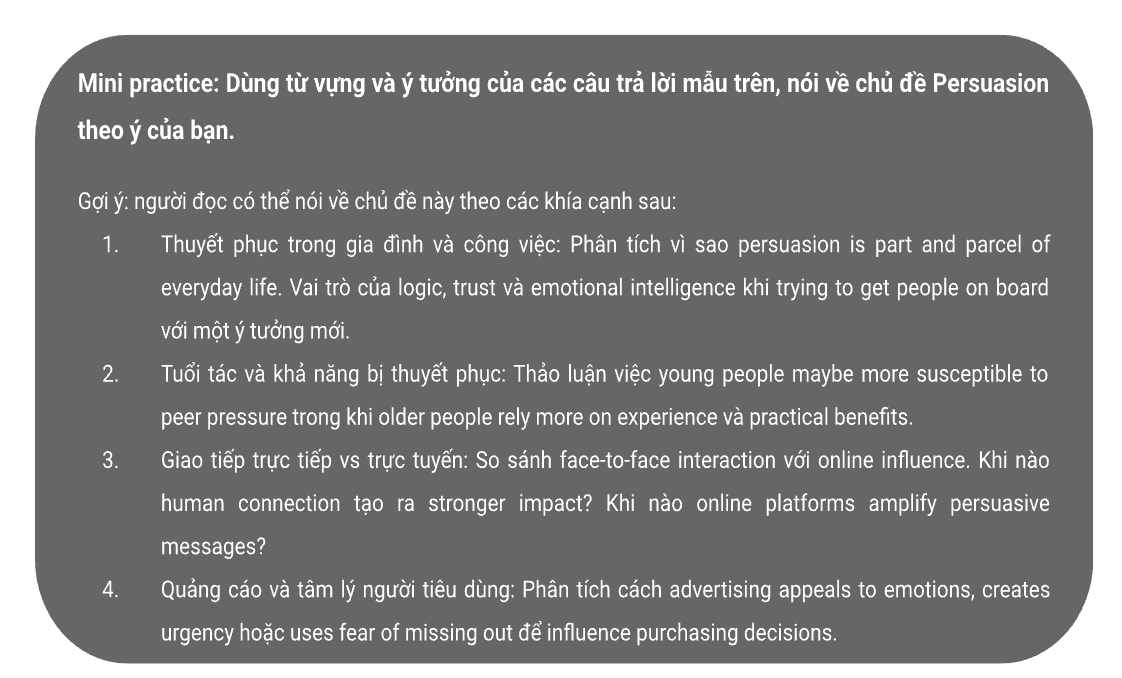
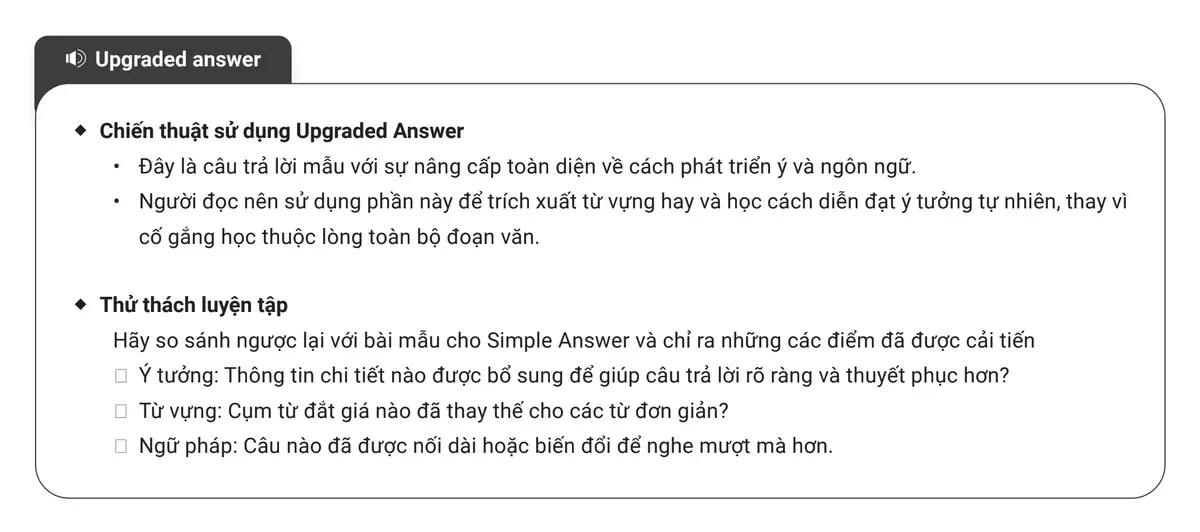
Upgraded answer
1. In what situations do people usually try to persuade others?
|
Well, if you think about it, persuasion is part and parcel of everyday life. People try to influence others whenever there’s a difference in opinion or interest. In families, for instance, parents often try to steer their children in what they believe is the right direction, such as choosing a certain major or limiting social media use. In business, persuasion is even more crucial — leaders need to get their teams on board with new strategies or organisational changes. That said, persuasion isn’t always about control; sometimes it’s simply about finding common ground. So overall, it’s safe to say persuasion underpins most human interactions, whether personal or professional. |
2. What are some effective ways of persuading someone?
|
I’d say the most effective approach is a combination of logic and emotional intelligence. On the one hand, solid evidence and clear reasoning help build credibility. If you can back up your argument with facts, people are far more likely to take you seriously. On the other hand, appealing to emotions can be just as powerful. For example, charities often share personal stories to tug at people’s heartstrings and encourage donations. However, relying purely on emotion without logic can backfire, especially when dealing with well-informed individuals. So, more often than not, striking the right balance between rational arguments and emotional appeal is the key to successful persuasion. |
3. Do you think young people are easier to persuade than older people? Why or why not?
|
That’s an interesting question. I’d argue that young people may be more susceptible to persuasion, mainly because they’re still shaping their identities and beliefs. Peer pressure and social media trends, for example, can easily sway their opinions. However, it would be an oversimplification to say older people are difficult to persuade. In fact, adults might change their views if they see clear practical benefits or strong evidence. Experience can make them cautious, but not necessarily stubborn. So at the end of the day, it’s less about age and more about personality traits and critical thinking skills. |
4. Is it easier to persuade someone face to face or online? Why?
|
Personally, I’d lean towards face-to-face communication. When you interact directly, you can read subtle cues like facial expressions and tone of voice, which allows you to adjust your message on the spot. That human connection often makes arguments more convincing. That being said, online platforms can amplify persuasive messages on a large scale. Influencers, for example, can shape public opinion with just a single post. Still, in one-on-one situations, nothing quite beats personal interaction. It tends to build trust more effectively and leaves a stronger impression. |
5. How does advertising persuade people to buy products?
|
Advertising is, in many ways, persuasion at its finest. Companies tap into consumers’ emotions, aspirations, and even insecurities. For instance, luxury brands often associate their products with status and success, subtly suggesting that owning the product will elevate one’s social image. Moreover, advertisers frequently create a sense of urgency through limited-time offers, making people feel they might miss out — a classic example of the “fear of missing out.” Of course, consumers today are more media-savvy and may question exaggerated claims. Nevertheless, when done cleverly, advertising can shape purchasing decisions without people even realising it. |
Đọc thêm: Bài mẫu IELTS Speaking Part 3 Topic “Customer Service” kèm từ vựng
Lọc và phân tích từ vựng
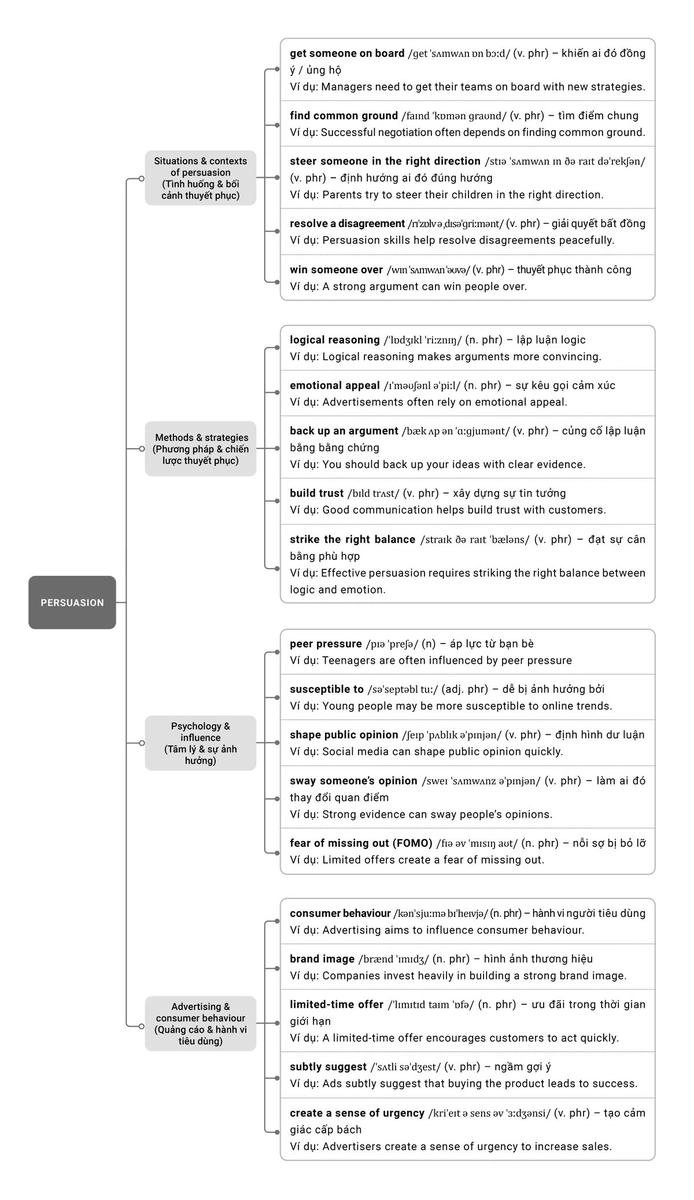
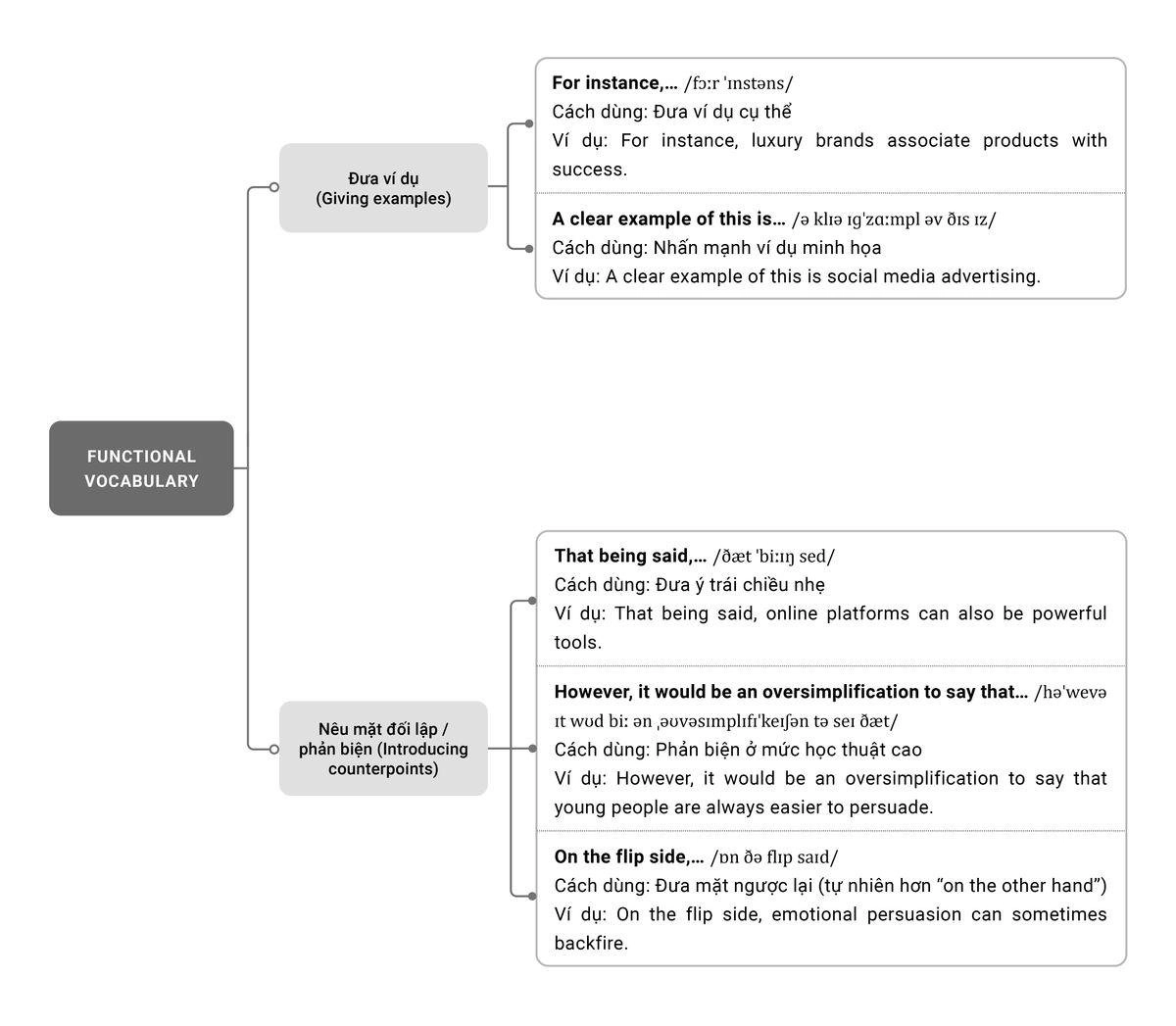
Nhật ký từ vựng & ý tưởng
Ghi chú sau khi luyện tập nói về chủ đề trên
Từ vựng/Ý tưởng (Chọn các từ vựng/ý tưởng mà bạn tâm đắc nhất) | Kỉ niệm cá nhân |
|---|---|
Ví dụ: sway someone’s opinion – làm thay đổi quan điểm | Người đọc tự đặt các câu hỏi cho bản thân, ví dụ:
→Last year, I tried to persuade my friend to join a volunteer project. At first, she wasn’t interested, but I backed up my argument by explaining the benefits for her CV. In the end, I managed to get her on board. That experience showed me how important logical reasoning is in persuasion. |
Khoảng trống diễn đạt (Phần khiến bạn ngập ngừng khi nói về chủ đề trên) | Giải pháp (Giải pháp cho các khoảng trống diễn đạt) |
Ví dụ:
| Ví dụ: Dùng từ điển của ZIM hoặc chép các cách diễn đạt từ bài mẫu ở các phần trên để có được cụm từ mà bạn cần. → Thay vì nói “convince” → dùng win someone over / sway someone’s opinion. |
Người đọc có thể tìm từ vựng bằng từ điển ZIM Dictionary.
Các lỗi ngữ pháp thường gặp
1. Nhầm “persuade” và “convince” trong cấu trúc
❌ Lỗi thường gặp: He persuaded me that buy the product.
✅ Cách dùng đúng:
persuade + someone + to + V
convince + someone + that + clause
✔ Câu đúng:
He persuaded me to buy the product.
He convinced me that it was a good choice.
📌 Lý do sai: “Persuade” đi với “to + V”, còn “convince” thường đi với “that + clause”.
2. Dùng sai cấu trúc với “suggest”
❌ Lỗi thường gặp: The advertisement suggests people to try the new product.
✅ Cách dùng đúng:
suggest + V-ing
suggest + that + S + (should) + V
✔ Câu đúng:
The advertisement suggests trying the new product.
The advertisement suggests that people should try the new product.
📌 Lý do sai: “Suggest” không đi với “someone + to V”.
3. Nhầm “influence” và “affect”
❌ Lỗi thường gặp: Advertising affects people to buy products.
✅ Cách dùng đúng:
influence + someone + to + V
affect + noun (không dùng “to V”)
✔ Câu đúng:
Advertising influences people to buy products.
Advertising affects consumer behaviour.
📌 Lý do sai: “Affect” không đi với “to + V”, trong khi “influence” có thể đi với cấu trúc đó.
Mini practice |
|---|
Dùng đúng cấu trúc trong ngoặc 1. Hãy nói về việc thuyết phục ai đó chấp nhận một ý tưởng mới. (Dùng: persuade + someone + to + V – không dùng persuade + that) 2. Hãy nói về cách quảng cáo gợi ý khách hàng thử sản phẩm mới. (Dùng: suggest + V-ing / suggest that + S + should + V – không dùng suggest + someone + to V) 3. Hãy nói về việc mạng xã hội ảnh hưởng đến quan điểm của giới trẻ. (Dùng: influence + someone + to + V / affect + noun – không dùng affect + someone + to V) |
Các chủ đề liên quan
Chủ đề liên quan để sử dụng từ vựng & ý tưởng:
Advertising & Consumer behaviour (Quảng cáo & hành vi tiêu dùng)
Business & Marketing (Kinh doanh & tiếp thị)
Media & Social media influence (Truyền thông & mạng xã hội)
Người đọc có thể sử dụng:
Từ vựng: persuasion, influence, convince, emotional appeal, logical reasoning, build trust, peer pressure, sway someone's opinion, shape public opinion, brand image, consumer behaviour, limited-time offer, create a sense of urgency, fear of missing out, get someone on board, strike the right balance,...
Ý tưởng:
Trong kinh doanh, khả năng thuyết phục giúp doanh nghiệp thu hút và giữ chân khách hàng.
Quảng cáo sử dụng cảm xúc và hình ảnh để tác động đến hành vi mua hàng.
Mạng xã hội có thể định hình dư luận và ảnh hưởng mạnh đến giới trẻ.
Giáo dục nên giúp học sinh phát triển tư duy phản biện để không dễ bị thao túng.
Thuyết phục không chỉ là thay đổi ý kiến người khác mà còn là tìm điểm chung và xây dựng sự tin tưởng lâu dài.
Mini practice |
|---|
Sử dụng từ vựng và ý tưởng ở trên để trả lời các câu hỏi sau 1. How does persuasion play an important role in business and marketing? (Gợi ý: build trust, brand image, consumer behaviour, emotional appeal, logical reasoning) 2. Do you think social media makes people easier to persuade? Why or why not? (Gợi ý: peer pressure, shape public opinion, sway someone's opinion, fear of missing out, online influence) 3. Should schools teach students how to resist persuasion? Why? (Gợi ý: critical thinking skills, media literacy, emotional appeal, logical reasoning, make informed decisions) |
Tìm hiểu thêm: Thi thử IELTS - Trải nghiệm chuẩn thi thật tại Anh Ngữ ZIM
Tổng kết
Hy vọng rằng qua việc phân tích hai cấp độ trả lời từ Simple Answer để đảm bảo sự trôi chảy đến Upgraded Answer để ghi điểm ấn tượng, bạn đã nắm vững được lộ trình để chinh phục IELTS Speaking Part 3 Topic Persuasion. Bằng cách cá nhân hóa các câu trả lời thông qua “Nhật ký Từ vựng & Ý tưởng”, bạn sẽ xây dựng được sự tự tin. Đừng quên thực hành các bài tập nhỏ (mini practice) để khắc phục những lỗi ngữ pháp thường gặp và làm chủ ngôn ngữ của mình nhé!
Nếu bạn muốn nâng cao kỹ năng IELTS Speaking theo lộ trình cá nhân hóa, Hệ thống giáo dục ZIM cung cấp các khóa luyện thi IELTS cam kết đầu ra, giúp bạn tối ưu hiệu quả học tập và tiết kiệm đến 80% thời gian tự học. Để được tư vấn chi tiết, vui lòng liên hệ hotline 1900-2833 (nhánh 1) hoặc truy cập khóa học IELTS.
Nguồn tham khảo
1
“Bài mẫu IELTS Speaking Part 3.” OpenAI, chatgpt.com/share/e/6961bf62-bf88-8002-9512-8fe28a8cdcf4. Accessed 21 March 2026.
Bình luận - Hỏi đáp