


Chủ đề IELTS Speaking: Part 3: Smiling and Emotions.
Bài mẫu cho các nhóm câu hỏi:
Why people smile? (Happiness, politeness, social bond).
Children vs. Adults: Who smiles more? (Carefree vs. Responsibility).
Unwillingness to smile? (Shyness, stress, self-consciousness).
Smiling in photos? (Approachable, capturing the mood).
Impact on others? (Contagious, lifting the mood).
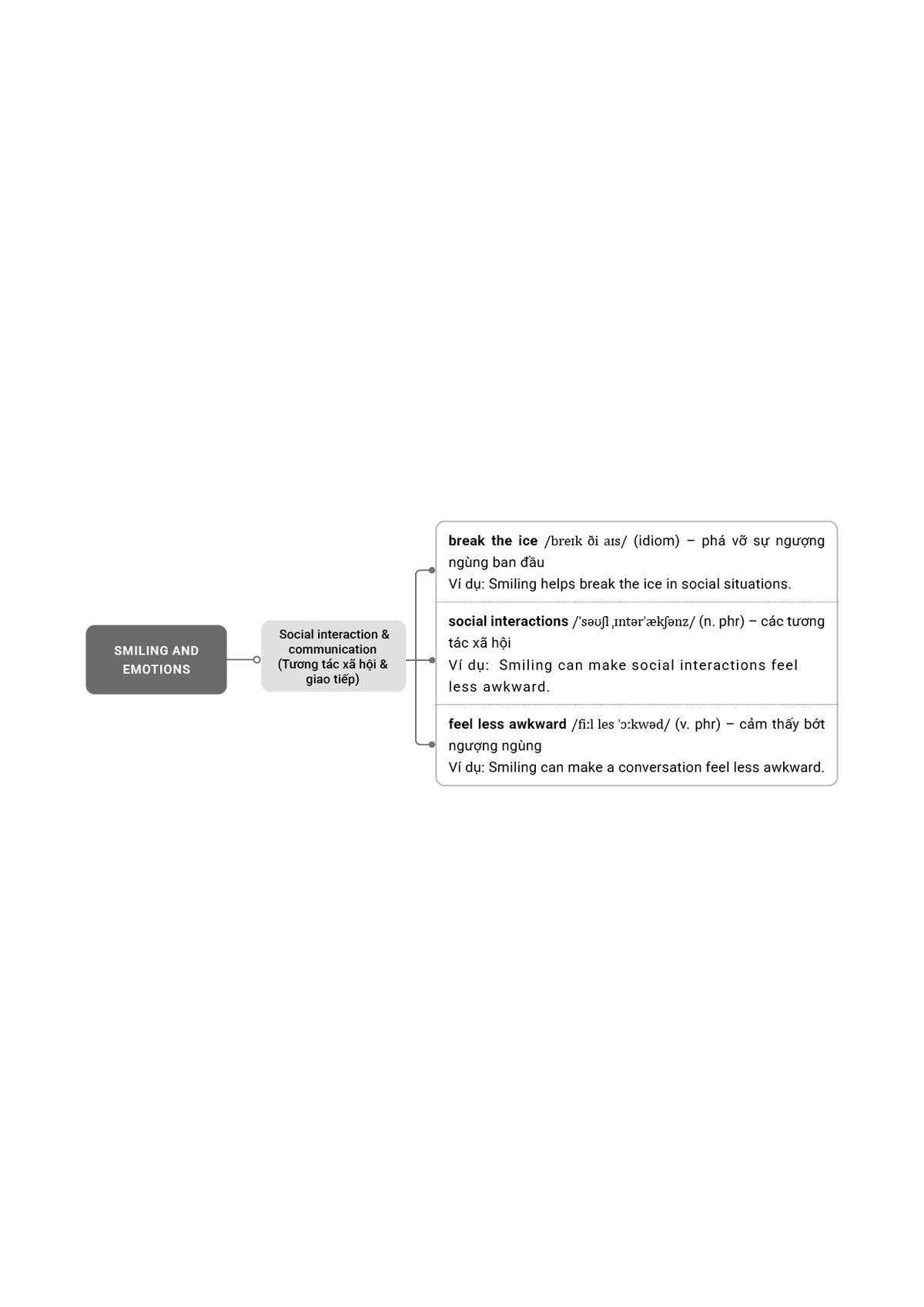
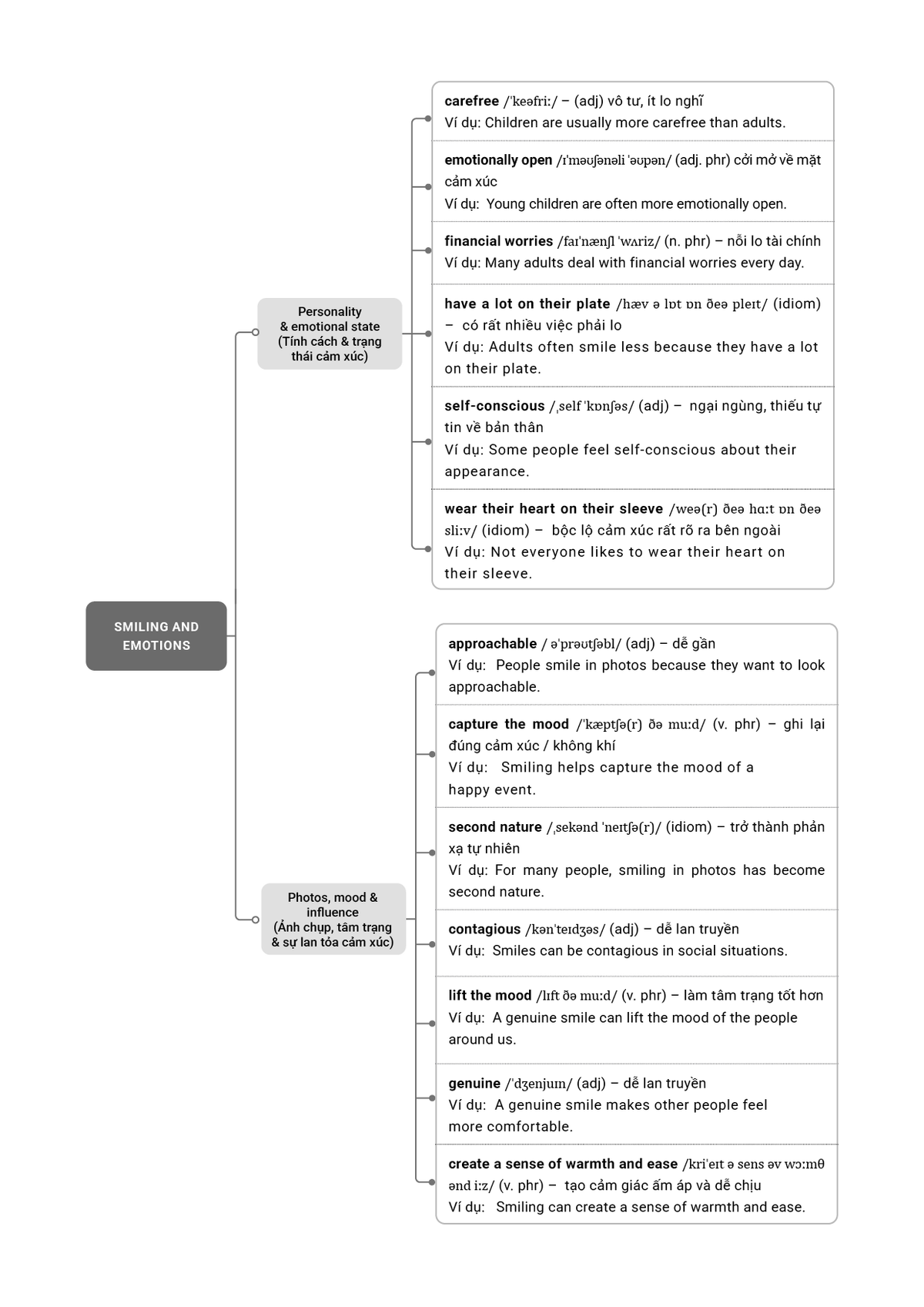
Nhóm từ vựng trọng tâm (Topic Vocabulary): Social Interaction, Personality & Emotions, và Influence & Mood.
Bài mẫu IELTS Speaking Part 3 Topic “Smiling and Emotions” kèm từ vựng
Trong bài viết này, tác giả sẽ gợi ý bài mẫu cho Topic “Smiling and Emotions” và phân tích các từ vựng ghi điểm cho phần thi IELTS Speaking Part 3.
Key takeaways
Bài viết sau đây sẽ cung cấp các câu trả lời mẫu theo khung sườn tư duy (Simple Answer) cùng các thử thách nâng cấp (Upgraded Answer) về cả ý tưởng, từ vựng và ngữ pháp để người học lựa chọn được câu trả lời phù hợp với bản thân, sẵn sàng cho các tình huống trong phòng thi. Bài phân tích này sẽ dẫn dắt người học đi qua chủ đề IELTS Speaking Part 3 Smiling and Emotions, từ những lợi ích của nụ cười trong giao tiếp như 'break the ice' (phá vỡ sự ngại ngùng) đến các trạng thái tâm lý phức tạp khiến con người trở nên 'reserved' (kín đáo) hay 'self-conscious' (tự ti), giúp người học chinh phục giám khảo bằng sự mạch lạc và ngôn ngữ tự nhiên.
IELTS Speaking Part 3: Smiling and Emotions
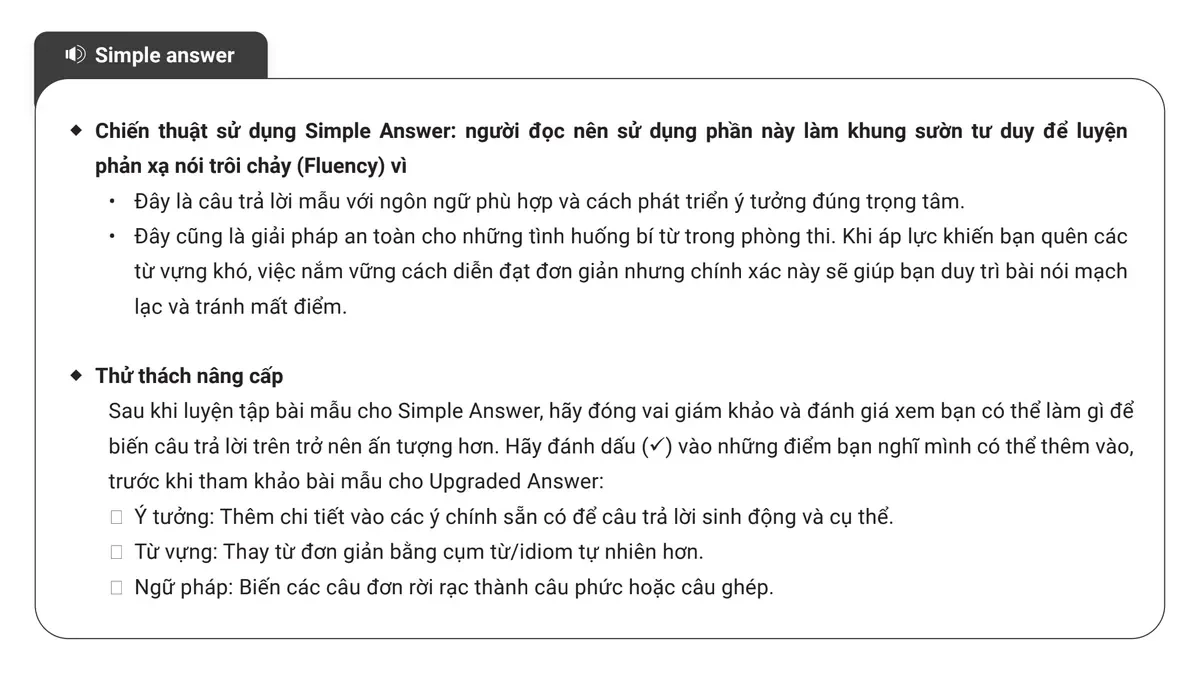
Simple answe
1. Why do people tend to smile?
|
I think people tend to smile because they feel happy, comfortable, or pleased. Smiling is a natural way to show good feelings to other people. For example, people often smile when they meet a friend, hear good news, or enjoy a funny moment. So overall, smiling is a simple way to show positive emotions. |
2. Do you think children smile more often than adults? Why or why not?
|
Yes, I think children smile more often than adults. The main reason is that children are usually more relaxed, playful, and open with their feelings. For example, they can smile easily when they play games or watch something funny, while adults often worry about work or daily problems. So, children usually smile more naturally and more often. |
3. Why are some people unwilling to smile?
|
Some people are unwilling to smile because they feel shy, stressed, tired, or upset. Another reason is that some people are naturally quiet or serious. For example, if someone is having a hard time at work or in life, they may not feel like smiling. So, there are different personal reasons why some people do not smile much. |
4. Why do people usually smile when having their photos taken?
|
Well, people usually smile when having their photos taken because they want to look happy and friendly. A smile also makes the photo look nicer and more pleasant. For example, at parties, birthdays, or family events, people often smile so the picture feels more cheerful. So overall, smiling helps make a photo look better. |
5. Do you think smiling can affect other people’s emotions? How?
|
Yes, I think smiling can affect other people’s emotions. When one person smiles, it can make others feel more relaxed, welcome, and happy too. For example, if a teacher, friend, or shop assistant smiles, people around them may feel more comfortable. So yes, smiling can spread positive feelings to other people. |
Upgraded answer
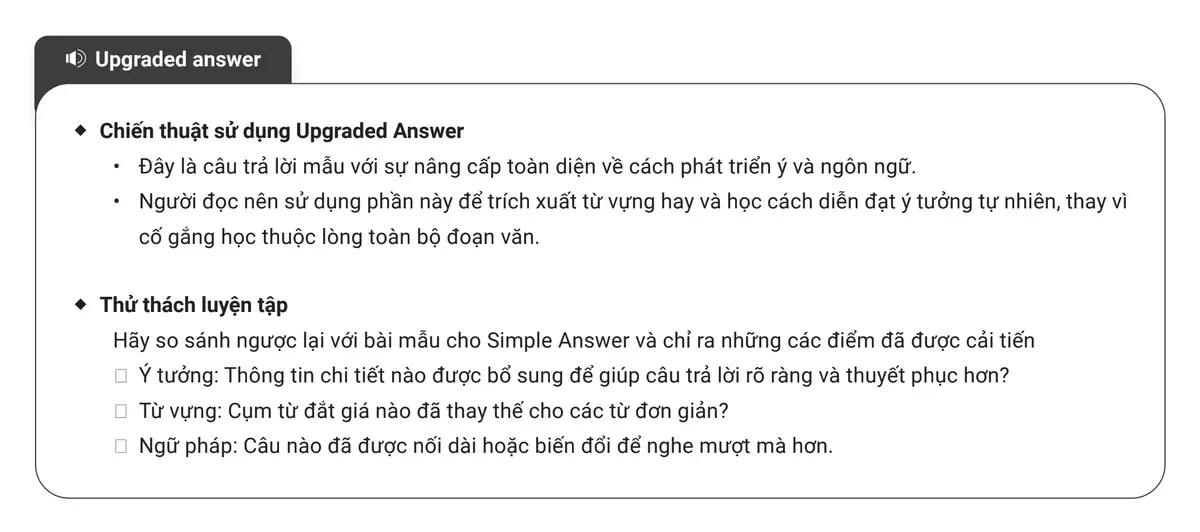
1. Why do people tend to smile?
|
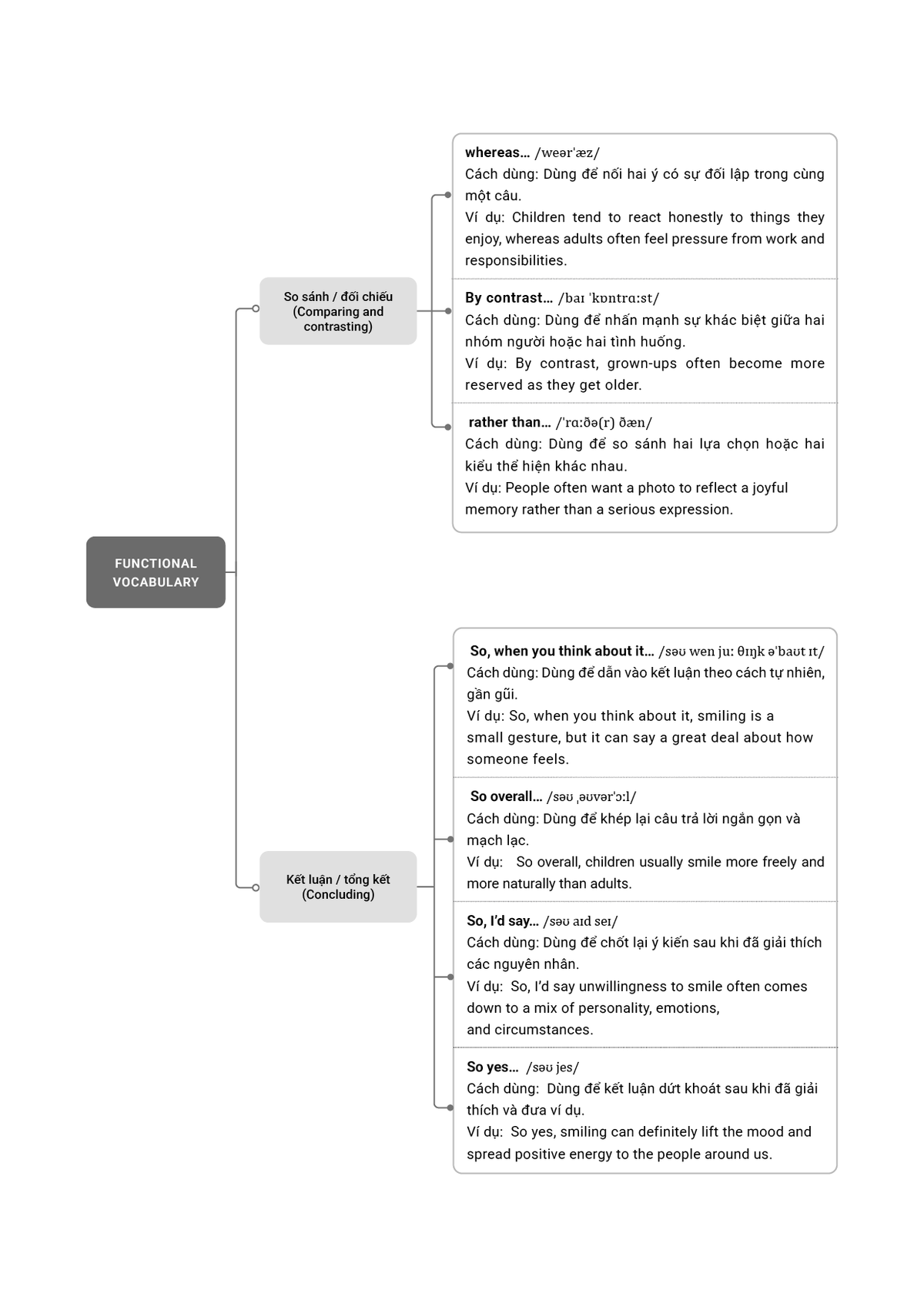
Well, I’d say people tend to smile because it is one of the most natural and effortless ways to express positive emotions. A smile can show happiness, friendliness, relief, or even simple politeness, so in many situations, it speaks louder than words. On top of that, smiling often helps break the ice and makes social interactions feel less awkward. For example, when people meet an old friend unexpectedly, receive a kind compliment, or share a funny story, they usually smile without even thinking about it. So, when you think about it, smiling is a small gesture, but it can say a great deal about how someone feels. |
2. Do you think children smile more often than adults? Why or why not?
|
Yes, absolutely. I do think children smile more often than adults, mainly because they are generally more carefree and emotionally open. They tend to react to things very honestly, whereas adults often have a lot on their plate, such as work pressure, financial worries, or family responsibilities, which can make them seem more serious. For instance, a child can burst into laughter and smile over something as simple as a cartoon, a toy, or a game with friends, while an adult in the same situation may still be distracted by unfinished tasks or daily stress. By contrast, grown-ups often become more reserved as they get older. So overall, children usually smile more freely and more naturally than adults. |
3. Why are some people unwilling to smile?
|
I think there are quite a few reasons for that, to be honest. First of all, some people may be shy, stressed, or simply in a bad mood, so smiling does not come naturally to them at that moment. Besides that, some individuals just have a more serious personality and are not the type to wear their heart on their sleeve. In other cases, people may feel self-conscious about their appearance, especially if they are unhappy with their teeth or the way they look in public. For example, someone who has been dealing with work pressure or personal problems for a long time may not feel comfortable smiling, even if they do not mean to seem unfriendly. So, I’d say unwillingness to smile often comes down to a mix of personality, emotions, and circumstances. |
4. Why do people usually smile when having their photos taken?
|
Well, in most cases, people smile in photos because they want to look cheerful, approachable, and attractive. A smiling face tends to make a picture feel warmer and more lively, so it naturally creates a better impression. On top of that, photos are often taken during important or happy occasions, so smiling helps capture the mood of the moment. For example, at weddings, birthday celebrations, graduation ceremonies, or family reunions, people usually smile because they want the photo to reflect a joyful memory rather than a blank or serious expression. So, in a way, smiling in photos has become second nature for many people, since it helps preserve a more positive image of the event. |
5. Do you think smiling can affect other people’s emotions? How?
|
Yes, definitely. I believe smiling can have a surprisingly strong effect on other people’s emotions because it creates a sense of warmth, ease, and connection. When someone smiles at you, it can instantly make you feel more welcome and less tense, especially in unfamiliar or stressful situations. In fact, smiles can be contagious, so one person’s positive expression can easily rub off on others. For instance, if a receptionist, teacher, cashier, or even a stranger greets people with a genuine smile, the whole interaction usually feels smoother, friendlier, and less awkward. That said, the effect is even stronger when the smile feels natural rather than forced. So yes, smiling can definitely lift the mood and spread positive energy to the people around us. |
Xem thêm: IELTS Speaking Part 3 Topic Children and Reading
Lọc và phân tích từ vựng
Nhật ký Từ vựng & Ý tưởng
Ghi chú sau khi luyện tập nói về chủ đề trên
Từ vựng/Ý tưởng (Chọn các từ vựng/ý tưởng mà bạn tâm đắc nhất) | Kỉ niệm cá nhân |
|---|---|
Ví dụ: break the ice – phá vỡ sự ngượng ngùng ban đầu | Người đọc tự đặt các câu hỏi cho bản thân, ví dụ:
→ When I was younger, I smiled a lot more easily, especially when I was playing with friends or talking to my family. Even now, I still think a smile can break the ice and make conversations feel less awkward. For example, when a teacher or a stranger smiles at me, I usually feel more relaxed and welcome. However, there are also times when I do not feel like smiling, especially if I am stressed or self-conscious. So, when I think about it, smiling may seem simple, but it can strongly affect both my mood and the feelings of people around me. |
Khoảng trống diễn đạt (Phần khiến bạn ngập ngừng khi nói về chủ đề trên) | Giải pháp (Giải pháp cho các khoảng trống diễn đạt) | Khoảng trống diễn đạt (Phần khiến bạn ngập ngừng khi nói về chủ đề trên) | Giải pháp (Giải pháp cho các khoảng trống diễn đạt) |
|---|---|---|---|
Ví dụ:
| Ví dụ: Dùng từ điển của ZIM hoặc chép các cách diễn đạt từ bài mẫu ở các phần trên để có được cụm từ mà bạn cần. → Thay vì chỉ nói “show happiness” → dùng express positive emotions / show friendliness / create a sense of warmth and ease → | ||
Người đọc có thể tìm từ vựng bằng từ điển ZIM Dictionary.
Các lỗi ngữ pháp thường gặp
1. Dùng sai “smile” như danh từ và động từ
❌ Lỗi thường gặp:
People often give smile when they feel happy.
Children smile a lot, and their smile a lot too.
✅ Cách dùng đúng:
• give a smile / have a smile = danh từ
• smile = động từ
✔ Câu đúng:
People often give a smile when they feel happy.
Children smile a lot, and they smile very naturally.
📌 Lý do sai:
Người học dễ nhầm giữa “smile” là danh từ và “smile” là động từ. Khi dùng như động từ, không cần thêm danh từ khác phía sau.
2. Dùng sai giữa “fun” và “funny”
❌ Lỗi thường gặp:
Children smile when they see something funnily.
People often smile during fun moments because they see something fun.
✅ Cách dùng đúng:
• funny = gây buồn cười
• fun = vui, thú vị
✔ Câu đúng:
Children smile when they see something funny.
People often smile during fun moments with friends.
📌 Lý do sai:
Người học hay nhầm “fun” và “funny”. “Funny” dùng cho thứ gì đó khiến người ta cười, còn “fun” nói về trải nghiệm
3. Dùng sai cấu trúc so sánh hơn
❌ Lỗi thường gặp:
Children are more happier than adults.
Adults are more seriouser than children.
✅ Cách dùng đúng:
• happier than
• more serious than
✔ Câu đúng:
Children are happier than adults.
Adults are more serious than children.
📌 Lý do sai:
Người học thường mắc lỗi “double comparison”, tức là vừa dùng “more” vừa dùng tính từ đã có đuôi so sánh hơn.
Mini practice |
|---|
Dùng đúng cấu trúc trong ngoặc
(Dùng: give a smile / smile)
(Dùng: funny / fun)
(Dùng: happier than / more serious than – không dùng double comparison) |
Các chủ đề liên quan
Social behaviour and communication (Hành vi xã hội & giao tiếp)
Children and upbringing (Trẻ em & sự nuôi dạy)
Photos and memories (Ảnh chụp & kỉ niệm)
Người đọc có thể sử dụng:
Từ vựng: break the ice, friendliness, social interactions, feel less awkward, carefree, emotionally open, self-conscious, cheerful, approachable, contagious, genuine smile, lift the mood...
Ý tưởng:
Nụ cười là một cách tự nhiên để thể hiện cảm xúc tích cực và tạo bầu không khí thân thiện hơn trong giao tiếp.
Trẻ em thường cười nhiều hơn người lớn vì các em vô tư hơn và bộc lộ cảm xúc một cách tự nhiên hơn.
Một số người không muốn cười vì ngại ngùng, căng thẳng, mệt mỏi hoặc thiếu tự tin về ngoại hình.
Mọi người thường cười khi chụp ảnh vì họ muốn trông vui vẻ, dễ gần và lưu lại một kỉ niệm đẹp.
Nụ cười có thể ảnh hưởng tích cực đến cảm xúc của người khác vì nó làm người đối diện cảm thấy thoải mái và dễ chịu hơn.
Mini practice |
|---|
Sử dụng từ vựng và ý tưởng ở trên để trả lời các câu hỏi sau 1. Why is smiling important in social interactions? (Gợi ý: break the ice, friendliness, feel less awkward, positive emotions) 2. Why do children usually show their feelings more clearly than adults? (Gợi ý: carefree, emotionally open, work pressure, serious) 3. Can a smile change the atmosphere of a conversation? Why? (Gợi ý: genuine smile, contagious, lift the mood, create a sense of warmth and ease) |
Tìm hiểu thêm: Thi thử IELTS - Trải nghiệm chuẩn thi thật tại Anh Ngữ ZIM
Hy vọng rằng qua việc phân tích hai cấp độ trả lời từ Simple Answer để đảm bảo sự trôi chảy đến Upgraded Answer để ghi điểm ấn tượng, bạn đã nắm vững được lộ trình để chinh phục chủ đề Smiling and Emotions trong IELTS Speaking Part 1. Bằng cách cá nhân hóa các câu trả lời thông qua "Nhật ký Từ vựng & Ý tưởng", bạn sẽ xây dựng được sự tự tin. Đừng quên thực hành các bài tập nhỏ (mini practice) để khắc phục những lỗi ngữ pháp thường gặp và làm chủ ngôn ngữ của mình nhé!
Nếu bạn muốn nâng cao kỹ năng IELTS Speaking theo lộ trình cá nhân hóa, Hệ thống giáo dục ZIM cung cấp các khóa luyện thi IELTS cam kết đầu ra, giúp bạn tối ưu hiệu quả học tập và tiết kiệm đến 80% thời gian tự học. Để được tư vấn chi tiết, vui lòng liên hệ hotline 1900-2833 (nhánh 1) hoặc truy cập Khóa học IELTS.
Nguồn tham khảo
1
“Bài mẫu IELTS Speaking Part 3.” OpenAI, https://chatgpt.com/share/e/6961bf62-bf88-8002-9512-8fe28a8cdcf4. Accessed 18 April 2026.
Bình luận - Hỏi đáp