


Định dạng: Bài thi B2 (VSTEP, Cambridge) yêu cầu xử lý các văn bản học thuật dài khoảng 400-500 từ.
Kiến thức: Trọng tâm cần nắm là từ vựng chuyên đề (khoa học, xã hội) và các cấu trúc ngữ pháp phức tạp.
Chiến thuật: Áp dụng linh hoạt Skimming, Scanning và kỹ năng đoán nghĩa từ mới qua ngữ cảnh.
Bài đọc tiếng Anh B2: Chiến thuật làm bài và bộ đề luyện tập
Hướng dẫn toàn diện cách xử lý bài đọc tiếng Anh B2: Từ cấu trúc bài thi, chiến thuật Skimming/Scanning đến bộ bài luyện đọc mẫu giúp bạn nâng band hiệu quả.
Key takeaways
Bài đọc tiếng Anh B2 là dạng bài đánh giá năng lực thấu hiểu văn bản ở mức độ trung cấp cao (Upper-Intermediate). Ở trình độ này, người học không chỉ cần đọc hiểu các thông tin hiển ngôn mà còn phải biết cách phân tích ngữ cảnh, suy luận ý chính và xử lý các từ vựng học thuật. Bài viết dưới đây sẽ phân tích chi tiết cấu trúc của các kỳ thi phổ biến, trang bị cho bạn nền tảng từ vựng, ngữ pháp cốt lõi và các chiến thuật làm bài thực chiến. Đặc biệt, bạn sẽ được tiếp xúc với bộ bài luyện đọc mẫu chuẩn định dạng B2 để tự đánh giá và nâng cấp kỹ năng.
Cấu trúc bài thi đọc VSTEP B2
Bài thi Đọc hiểu VSTEP (dành cho cấp độ B1-B2-C1) được thiết kế để đánh giá toàn diện khả năng xử lý văn bản của thí sinh trong thời gian giới hạn.
Thời lượng và khối lượng: Thí sinh có 60 phút để hoàn thành 4 bài đọc độc lập. Tổng số câu hỏi là 40 câu trắc nghiệm (10 câu cho mỗi bài đọc).
Độ dài và chủ đề: Mỗi bài đọc có độ dài dao động từ 400 đến 500 từ. Độ khó của các văn bản sẽ tăng dần từ bài 1 đến bài 4 (trải dài từ mức độ B1 dễ thở đến C1 phức tạp). Chủ đề rất đa dạng, bao quát các lĩnh vực khoa học, xã hội, giáo dục, môi trường và văn hóa.
Dạng câu hỏi: VSTEP chủ yếu sử dụng dạng câu hỏi trắc nghiệm nhiều lựa chọn (Multiple choice - A, B, C, D). Các câu hỏi kiểm tra khả năng tìm thông tin chi tiết, tìm ý chính, suy luận, xác định thái độ tác giả và đoán nghĩa từ vựng trong ngữ cảnh.
Cách chấm điểm: Tương tự nhiều bài thi chuẩn hóa khác, VSTEP không trừ điểm cho các lựa chọn sai. Do đó, nguyên tắc sống còn là thí sinh không được bỏ trống bất kỳ câu hỏi nào trên phiếu trả lời (answer sheet).
Cấu trúc bài thi đọc Cambridge B2 First (FCE)
Nhóm Use of English (Kiểm tra Ngữ pháp & Từ vựng) | Nhóm Reading (Kỹ năng Đọc hiểu): |
|---|---|
Multiple-choice cloze: Điền từ vào chỗ trống (tập trung vào từ vựng, collocations). | Multiple choice: Đọc hiểu chi tiết văn bản và trả lời trắc nghiệm. |
Open cloze: Tự điền từ thích hợp vào chỗ trống (tập trung vào cấu trúc ngữ pháp). | Gapped text: Điền các đoạn văn/câu bị rút ra vào đúng vị trí logic trong bài. |
Word formation: Cấu tạo từ. | Multiple matching: Nối thông tin với đoạn văn tương ứng. |
Key word transformation: Viết lại câu với từ cho sẵn. |
Các dạng câu hỏi đặc trưng: Bài thi gồm 7 phần, chia thành 2 nhóm chính
Khác biệt cốt lõi: B2 First đòi hỏi kỹ năng xử lý ngôn ngữ chi tiết hơn, đặc biệt là sự kết nối logic giữa các câu (thể hiện qua dạng bài Gapped text) và khả năng quét thông tin nhanh giữa nhiều văn bản ngắn (Multiple matching).
Từ vựng và ngữ pháp cần thiết cho bài đọc B2
Để chuyển tiếp thành công từ B1 lên B2, sự tích lũy về mặt lượng và chất của từ vựng cũng như ngữ pháp là yếu tố mang tính quyết định.
Vốn từ vựng theo chủ đề thường gặp
Văn bản B2 hiếm khi đề cập đến các chủ đề giao tiếp sinh hoạt đơn thuần. Bạn cần xây dựng vốn từ vựng học thuật xoay quanh 4 nhóm chủ đề chính:
Khoa học tự nhiên: Các thuật ngữ về sinh học, vật lý cơ bản, vũ trụ, gen di truyền, hệ sinh thái.
Khoa học xã hội: Dân số học, tâm lý học, hành vi con người, sự phát triển đô thị, các vấn đề kinh tế vĩ mô.
Môi trường: Biến đổi khí hậu, năng lượng tái tạo, bảo tồn động vật hoang dã, sự cạn kiệt tài nguyên.
Đời sống và Giáo dục: Chuyển đổi số trong giáo dục, phương pháp học tập tiên tiến, toàn cầu hóa, cân bằng công việc và cuộc sống.
Xem chi tiết: Từ vựng B2 tiếng Anh: Tổng hợp từ vựng và cách học hiệu quả
Cấu trúc ngữ pháp trong bài đọc tiếng Anh B2
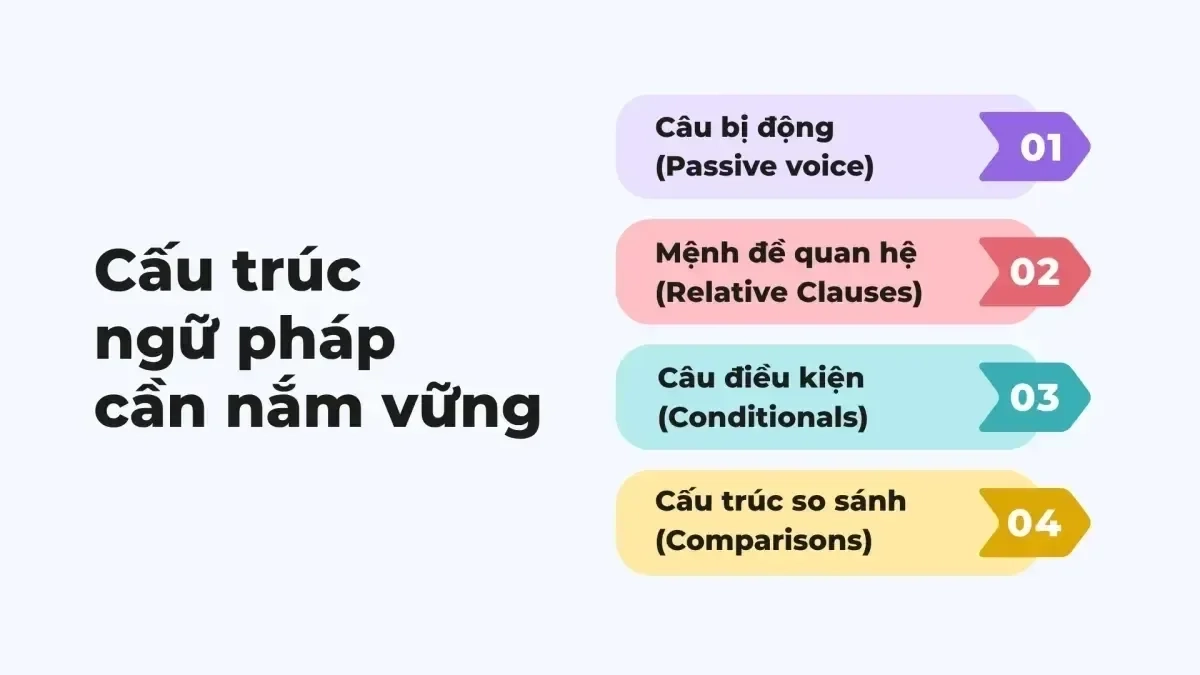
Trong các bài đọc B2, câu văn thường dài và chứa nhiều mệnh đề. Bạn cần thành thạo việc nhận diện và phân tích các cấu trúc sau để không bị lạc lối:
Câu bị động (Passive Voice): Rất phổ biến trong các văn bản khoa học để nhấn mạnh vào quá trình hoặc kết quả thay vì chủ thể hành động. (Ví dụ: The results were found to be highly significant...)
Mệnh đề quan hệ (Relative Clauses): Đặc biệt là mệnh đề quan hệ rút gọn (sử dụng V-ing hoặc V-ed/V3) được dùng liên tục để bổ nghĩa cho danh từ mà không làm câu quá rườm rà.
Câu điều kiện (Conditionals): Bao gồm cả các dạng câu điều kiện hỗn hợp hoặc đảo ngữ của câu điều kiện (Ví dụ: Had the government intervened earlier, the crisis would have been avoided.)
Cấu trúc so sánh (Comparisons): So sánh kép (The more... the more...), so sánh bội số (twice as much as).
»Bài viết liên quan: Ngữ pháp tiếng Anh B2 | Cách học & tài liệu học ngữ pháp hữu ích
Kỹ năng đoán nghĩa từ mới qua ngữ cảnh
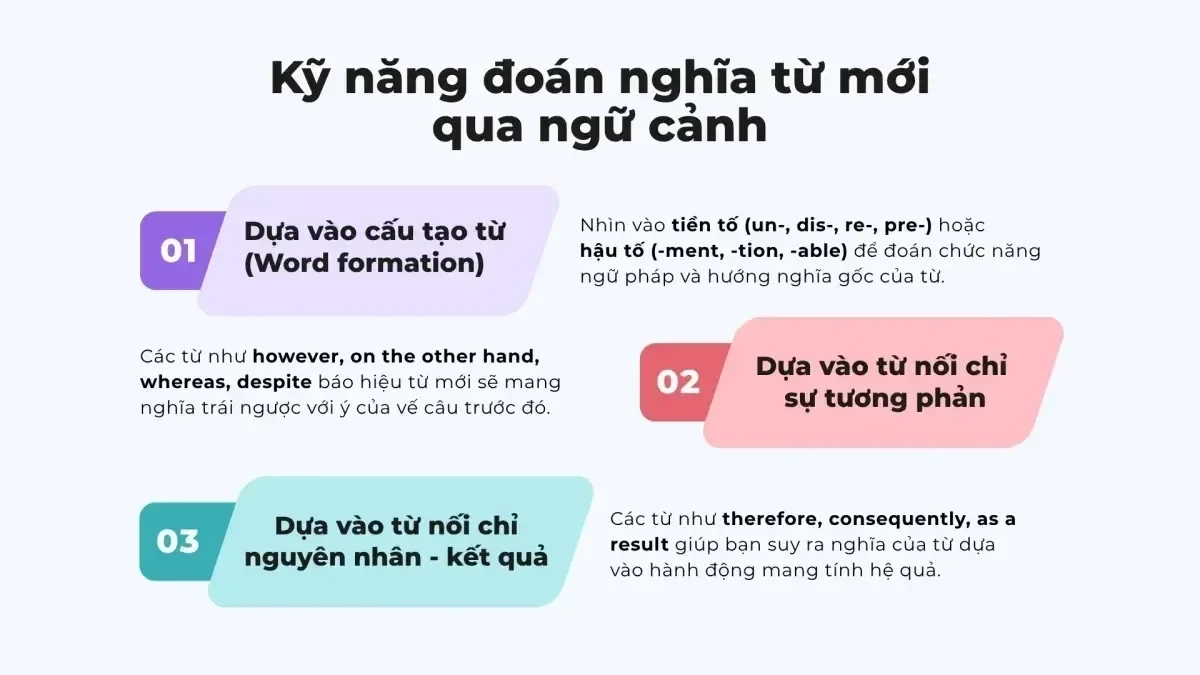
Một sai lầm phổ biến của người học B1 là cố gắng dịch từng từ và hoảng sợ khi gặp từ mới. Ở trình độ B2, việc xuất hiện từ vựng ngoài tầm hiểu biết là điều chắc chắn. Thay vì tra từ điển liên tục khi luyện tập, bạn cần rèn luyện kỹ năng phán đoán nghĩa của từ:
Dựa vào cấu tạo từ (Word formation): Nhìn vào tiền tố (un-, dis-, re-, pre-) hoặc hậu tố (-ment, -tion, -able) để đoán chức năng ngữ pháp và hướng nghĩa gốc của từ.
Dựa vào từ nối chỉ sự tương phản: Các từ như however, on the other hand, whereas, despite báo hiệu từ mới sẽ mang nghĩa trái ngược với ý của vế câu trước đó.
Dựa vào từ nối chỉ nguyên nhân - kết quả: Các từ như therefore, consequently, as a result giúp bạn suy ra nghĩa của từ dựa vào hành động mang tính hệ quả.
Bạn đang luyện đọc tiếng Anh B2 nhưng chưa biết khả năng hiện tại của mình đang ở mức nào và cần cải thiện những gì? Hãy kiểm tra trình độ để xác định hướng học phù hợp. |
|---|
Chiến thuật làm bài đọc hiểu B2 hiệu quả
Thời gian luôn là áp lực lớn nhất trong phòng thi. Việc áp dụng các nguyên tắc làm bài khoa học sẽ giúp bạn tối ưu hóa số điểm.
Nguyên tắc chung và quá trình chuẩn bị
Trước tiên, thay vì lao vào đọc từng chữ, hãy đọc tiêu đề chính, tiêu đề phụ và câu đầu tiên của bài để kích hoạt các kiến thức nền sẵn có của bạn về chủ đề đó. Khi não bộ đã được chuẩn bị và nắm được bức tranh tổng thể, việc tiếp thu các thông tin chi tiết phía sau sẽ diễn ra trơn tru hơn rất nhiều. Phân bổ thời gian hợp lý, ưu tiên xử lý các bài đọc có chủ đề quen thuộc hoặc cấu trúc câu hỏi dễ trước.
Chiến thuật đọc lướt và đọc quét (Skimming và Scanning)
Đây là bộ đôi kỹ năng sinh tồn trong mọi kỳ thi đọc hiểu.
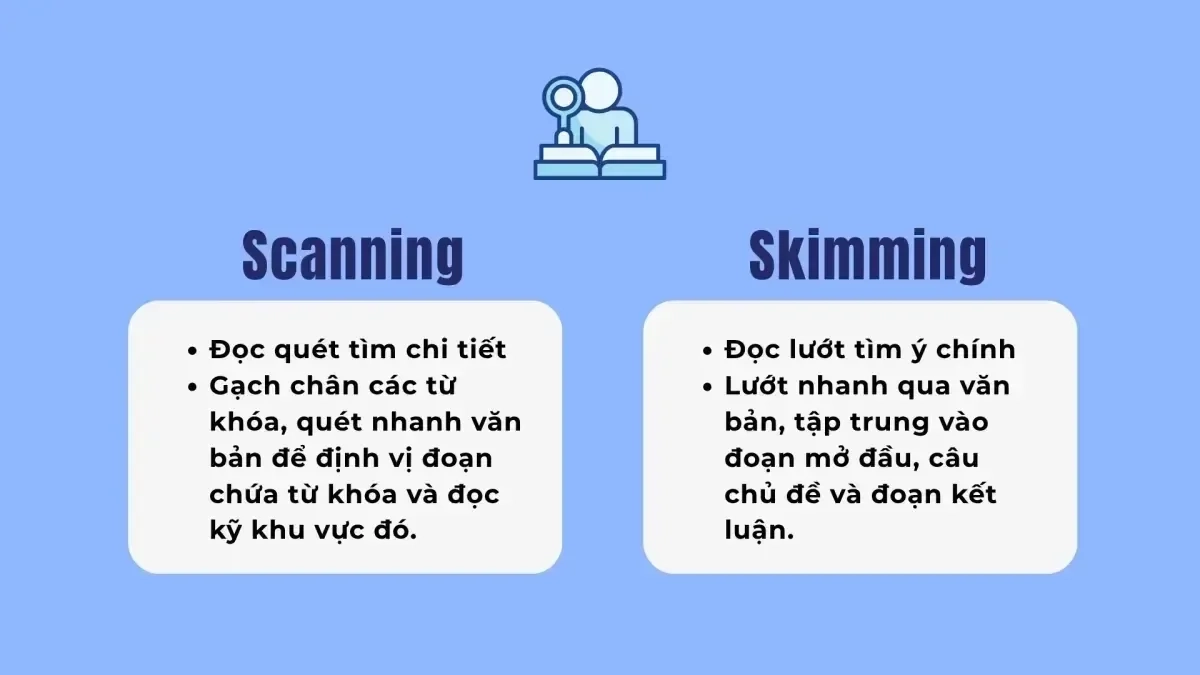
Skimming (Đọc lướt tìm ý chính): Hãy lướt nhanh qua văn bản, tập trung vào đoạn mở đầu, câu chủ đề (thường là câu đầu tiên hoặc câu thứ hai của mỗi đoạn) và đoạn kết luận. Chiến thuật này giúp bạn trả lời các câu hỏi dạng: "What is the main idea of the passage?" hoặc "What is the best title for the text?".
Scanning (Đọc quét tìm chi tiết): Sử dụng chiến lược đọc chuyên sâu để tìm kiếm một mẩu thông tin cụ thể. Trước tiên, gạch chân các từ khóa (keywords) trong câu hỏi, ưu tiên tên riêng, con số, ngày tháng, thuật ngữ chuyên ngành vì chúng không thể bị paraphrase (viết lại bằng từ đồng nghĩa). Sau đó, dùng mắt quét nhanh văn bản để định vị đoạn chứa từ khóa đó và chỉ đọc kỹ xung quanh khu vực đó.
Chiến thuật xử lý câu hỏi suy luận và từ vựng trong ngữ cảnh
Câu hỏi suy luận (Inference): Thường có các từ nhận diện như infer, imply, suggest, conclude. Thông tin để trả lời sẽ không nằm lộ liễu trên mặt chữ. Bạn phải loại trừ các đáp án gây nhiễu bằng cách đối chiếu trực tiếp: đáp án nào nêu thông tin trái ngược bài đọc (False) hoặc không được nhắc tới (Not Given) lập tức loại bỏ. Đáp án đúng thường là một kết luận logic được rút ra từ các bằng chứng trong bài.
Câu hỏi từ vựng (Vocabulary in context): Không chọn đáp án dựa trên nghĩa từ điển mà bạn biết, vì tác giả có thể dùng từ đó ở lớp nghĩa thứ hai hoặc thứ ba. Đọc kỹ câu chứa từ đó, câu ngay phía trước và câu ngay phía sau để tìm manh mối. Thử thay thế 4 đáp án A, B, C, D vào vị trí của từ đó xem từ nào tạo ra câu văn hợp lý nhất về mặt logic.
Quản lý thời gian trong 60 phút làm bài
Đối với bài thi VSTEP (4 bài đọc/60 phút), thời gian trung bình cho mỗi bài là 15 phút. Tuy nhiên, thực tế độ khó tăng dần, bạn nên áp dụng chiến thuật phân bổ:
Bài 1 (Dễ nhất): 10 - 12 phút.
Bài 2 (Trung bình): 12 - 14 phút.
Bài 3 (Khó): 15 - 17 phút.
Bài 4 (Rất khó): 15 - 17 phút. Dành ra khoảng 3-5 phút cuối cùng để rà soát toàn bộ phiếu trả lời, đảm bảo không điền lệch dòng và không có câu hỏi nào bị bỏ trống.
Tổng hợp bài luyện đọc tiếng Anh B2
Dưới đây là bộ 4 bài luyện đọc mẫu, mỗi bài dài khoảng 400 - 500 từ, được thiết kế bám sát định dạng VSTEP B2. Các bài đọc được chia theo 4 chủ đề thiết yếu, đi kèm 5 câu hỏi trắc nghiệm để bạn có thể luyện tập độc lập và đánh giá kỹ năng của mình.
1. Bài đọc chủ đề Khoa học tự nhiên và Môi trường
The Future of Renewable Energy
The transition from fossil fuels to renewable energy sources is no longer a theoretical debate but an urgent global necessity. For over a century, human progress has been largely powered by coal, oil, and natural gas. However, the environmental cost of this reliance is now undeniable. Greenhouse gas emissions have accelerated climate change, leading to extreme weather events, rising sea levels, and the disruption of ecosystems worldwide. In response, scientists, engineers, and policymakers are aggressively pushing for the adoption of cleaner energy alternatives.
Solar power has emerged as a frontrunner in this energy revolution. Over the past decade, the cost of manufacturing photovoltaic panels has plummeted, making solar energy economically competitive with traditional power sources in many regions. Furthermore, technological advancements have significantly improved the efficiency of these panels, allowing them to convert a higher percentage of sunlight into usable electricity. In desert regions and sunny climates, massive solar farms are now generating enough power to supply entire cities.
Wind energy is another critical component of the renewable energy portfolio. Wind turbines, both onshore and offshore, harness the kinetic energy of the wind to generate electricity. Offshore wind farms are particularly promising because ocean winds tend to be stronger and more consistent than those on land. Despite some concerns regarding the aesthetic impact of turbines on landscapes and their potential hazard to migratory birds, wind power remains one of the fastest-growing energy sectors globally.
However, the transition is not without significant challenges. One of the primary obstacles is the intermittency of renewable energy. Unlike a coal-fired power plant that can operate continuously, solar panels only generate electricity when the sun shines, and wind turbines only spin when the wind blows. To ensure a stable and reliable energy grid, large-scale energy storage solutions are essential. The development of advanced battery technologies, such as lithium-ion batteries and emerging solid-state alternatives, is critical to storing excess energy produced during peak times for use during periods of low generation.
Ultimately, achieving a sustainable energy future will require a multifaceted approach. It is not merely about replacing one energy source with another, but also about upgrading aging electrical grids, implementing smart technologies for better energy management, and encouraging energy conservation among consumers.
Questions:
What is the primary purpose of the first paragraph?
A. To explain how coal and oil are extracted from the earth.
B. To highlight the severe environmental consequences of using fossil fuels.
C. To argue that fossil fuels are still necessary for human progress.
D. To introduce the different types of extreme weather events.
According to paragraph 2, why has solar power become more competitive recently?
A. Because governments have banned the use of coal.
B. Because there is more sunlight available due to climate change.
C. Because the cost of producing solar panels has decreased significantly.
D. Because solar panels are now being manufactured in deserts.
The word "intermittency" in paragraph 4 is closest in meaning to:
A. The high cost of installation.
B. The ability to produce energy continuously.
C. The state of not being continuous or steady.
D. The environmental damage caused by batteries.
What does the author suggest about offshore wind farms?
A. They are less effective than onshore wind turbines.
B. They are favored because ocean winds are stronger and more reliable.
C. They cause the most damage to migratory bird populations.
D. They are currently the cheapest form of renewable energy.
It can be inferred from the final paragraph that a sustainable energy future:
A. Will rely exclusively on solar power and advanced batteries.
B. Cannot be achieved without completely rebuilding all electrical grids.
C. Depends solely on consumers using less electricity at home.
D. Requires a combination of new energy sources, upgraded infrastructure, and consumer awareness.
2. Bài đọc chủ đề Đời sống và Xã hội
The Psychological Impact of Urbanization
More than half of the world's population currently resides in urban areas, a figure that is projected to increase to nearly 70% by 2050. The migration from rural to urban environments is driven by the promise of better employment opportunities, improved access to education, and superior healthcare facilities. However, the rapid expansion of cities has brought profound changes to human lifestyle, bringing both unprecedented conveniences and significant psychological challenges.
Living in a densely populated metropolis often translates to a fast-paced, high-stress lifestyle. The constant barrage of sensory stimuli-noise from traffic, bright artificial lights, and crowded public spaces can overwhelm the human nervous system. Psychologists refer to this phenomenon as "urban overload." To cope with this continuous stimulation, city dwellers often develop a psychological defense mechanism where they intentionally ignore their surroundings and distance themselves from strangers. While this helps them function daily, it can lead to a pervasive sense of social isolation and alienation, even when surrounded by millions of people.
Furthermore, the structure of modern cities can negatively impact mental well-being by reducing access to green spaces. Numerous studies have demonstrated the restorative power of nature. Exposure to parks, forests, and bodies of water has been linked to lower levels of cortisol, the primary stress hormone, and a reduced risk of anxiety and depression. Unfortunately, in many rapidly developing cities, green areas are frequently sacrificed to make way for commercial and residential developments. This lack of natural environments deprives residents of a vital buffer against the stresses of urban life.
Housing affordability and cramped living conditions also contribute significantly to urban stress. As populations swell, the demand for housing outpaces supply, driving up rents and forcing many individuals into small, inadequate living spaces. The lack of personal space and privacy can escalate tensions within households and contribute to feelings of claustrophobia and helplessness.
Addressing the psychological toll of urbanization requires thoughtful urban planning. Forward-thinking architects and city planners are now emphasizing the concept of "biophilic design," which seeks to integrate natural elements into the built environment. Creating more accessible public parks, designing buildings with natural light and ventilation, and fostering community-oriented spaces are essential steps toward building cities that support not just the economic prosperity, but also the mental health of their inhabitants.
Questions:
What is the main driving force behind rural-to-urban migration mentioned in the text?
A. The desire to escape the fast-paced lifestyle of the countryside.
B. The availability of more green spaces in the city.
C. The pursuit of better jobs, education, and healthcare.
D. The need to find more affordable housing options.
The phrase "urban overload" in paragraph 2 refers to:
A. The excessive number of vehicles on city streets.
B. The psychological defense mechanism of ignoring strangers.
C. The overwhelming amount of sensory information in a city.
D. The increasing population density in modern metropolises.
According to paragraph 3, what is a consequence of sacrificing green spaces for development?
A. It creates more jobs for city residents.
B. It removes a natural mechanism for reducing stress and anxiety.
C. It increases the amount of natural light in residential buildings.
D. It solves the problem of housing affordability.
The word "escalate" in paragraph 4 is closest in meaning to:
A. Decrease
B. Resolve
C. Intensify
D. Hide
What solution does the author propose to mitigate the negative psychological impacts of cities?
A. Encouraging people to migrate back to rural areas.
B. Lowering the rent for all small apartments.
C. Incorporating nature into urban architecture and planning.
D. Banning all traffic in densely populated areas.
3. Bài đọc chủ đề Giáo dục và Công nghệ
Artificial Intelligence in the Modern Classroom
The integration of Artificial Intelligence (AI) into the educational sector is transforming the traditional dynamics of teaching and learning. For decades, the standard educational model has been characterized by a "one-size-fits-all" approach, where a single teacher delivers the same lesson to a diverse group of students at the same pace. Today, AI-driven technologies are dismantling this paradigm, paving the way for highly personalized learning experiences.
One of the most significant applications of AI in education is the development of Intelligent Tutoring Systems (ITS). These software platforms use complex algorithms to track a student's interactions, analyze their responses, and identify specific areas where they struggle. Based on this data, the system can instantly adjust the difficulty level of the material, provide customized exercises, and offer real-time feedback. If a student is having trouble with algebraic fractions, for instance, the AI will provide additional resources and practice problems tailored to that specific concept until mastery is achieved. This level of individualization was previously impossible in a classroom of thirty or more students.
Moreover, AI is proving to be an invaluable tool for educators by automating administrative tasks. Grading multiple-choice tests, tracking attendance, and analyzing student performance data can consume a vast amount of a teacher's time. By taking over these repetitive duties, AI allows teachers to focus more on what they do best: mentoring students, facilitating discussions, and developing creative lesson plans. AI can also assist in curriculum design by identifying trends in student performance and suggesting modifications to course materials.
Despite the clear benefits, the implementation of AI in schools raises several valid concerns. Data privacy is a major issue, as AI systems require the collection and analysis of massive amounts of personal student data to function effectively. Ensuring that this sensitive information is protected from cyber threats and unauthorized access is paramount. Furthermore, there is a fear that an overreliance on technology could diminish the essential human element of education. Social interaction, empathy, and emotional intelligence are crucial components of a child's development that machines cannot replicate.
In conclusion, while AI will not replace human teachers, it is poised to fundamentally redefine their role. The classroom of the future will likely be a collaborative environment where educators and intelligent machines work in tandem to unlock every student's full potential.
Questions:
What criticism of the traditional educational model is presented in the first paragraph?
A. It relies too heavily on expensive technology.
B. It treats all students as if they learn in the exact same way.
C. It lacks competent teachers to deliver the lessons.
D. It focuses only on administrative tasks instead of teaching.
How do Intelligent Tutoring Systems (ITS) assist students?
A. By grading their essays and written assignments automatically.
B. By providing the same standardized exercises to the whole class.
C. By analyzing their performance and customizing the learning material.
D. By connecting them with human tutors via video calls.
Which of the following is NOT mentioned as an administrative task that AI can automate?
A. Facilitating classroom discussions.
B. Grading multiple-choice tests.
C. Tracking student attendance.
D. Analyzing student performance data.
The word "paramount" in paragraph 4 is closest in meaning to:
A. Unnecessary
B. Extremely important
C. Difficult to understand
D. Temporarily delayed
Which heading best summarizes the main idea of the fourth paragraph?
A. The Evolution of Curriculum Design
B. The Superiority of Machine Learning
C. Challenges and Ethical Concerns of Educational AI
D. How to Protect Student Data Online
4. Bài đọc chủ đề Văn hoá và Lịch sử
The Evolution of Written Language
The invention of writing is widely considered one of the most significant achievements in human history, marking the transition from prehistory to recorded history. Before the existence of written language, knowledge, traditions, and historical accounts were passed down through oral storytelling. While oral traditions were rich and complex, they were inherently vulnerable to alteration and loss over generations. Writing provided a mechanism to store information permanently, allowing civilizations to accumulate knowledge and organize complex societies.
The earliest known form of writing, Cuneiform, emerged in Mesopotamia (modern-day Iraq) around 3400 BCE. Developed by the Sumerians, Cuneiform began as a system of pictograms, simple drawings used to represent physical objects, primarily for accounting and tracking agricultural goods. Over centuries, these pictograms evolved into a more abstract system of wedge-shaped marks impressed into wet clay tablets using a reed stylus. This evolution allowed scribes to record not just physical objects, but also abstract concepts, laws, and literature, such as the famous Epic of Gilgamesh.
Independently, roughly around 3200 BCE, the ancient Egyptians developed their own writing system known as Hieroglyphics. Unlike Cuneiform, which became highly abstract, Hieroglyphics retained a strong pictorial element. The symbols represented objects, sounds, and ideas, and were intricately carved into stone monuments or written on papyrus, an early form of paper made from river reeds. Because of its complexity and sacred nature, knowledge of Hieroglyphics was restricted to a small elite class of scribes and priests.
A revolutionary shift in the history of writing occurred with the development of the alphabet. Early writing systems required individuals to memorize hundreds or even thousands of distinct characters. Around 1050 BCE, the Phoenicians, a maritime trading culture based in the Mediterranean, created a phonetic alphabet consisting of just 22 consonant symbols. Because it was based on the sounds of speech rather than ideas or objects, the Phoenician alphabet was vastly easier to learn and adapt.
The Greeks later adopted this system, adding symbols for vowels, which gave rise to the alphabet structure we recognize today. This democratization of writing facilitated broader literacy, enabling the spread of philosophy, science, and administration across empires. The written word transformed human culture from a localized, memory-based existence into a global, continuous dialogue across time and space.
Questions:
According to the first paragraph, what was a major disadvantage of oral traditions?
A. They were too difficult for common people to understand.
B. They were susceptible to being changed or forgotten over time.
C. They could only be used for storytelling, not for history.
D. They required a high level of literacy to perform.
How did Cuneiform change over time in ancient Sumeria?
A. It shifted from abstract concepts to simple pictograms.
B. It was originally written on papyrus and later carved into stone.
C. It evolved from drawing physical objects to abstract wedge-shaped marks
D. It was replaced by a 22-character alphabet.
Why was the ability to read and write Hieroglyphics limited to a small group of people?
A. Because it was considered a sacred and complex system.
B. Because there was a shortage of papyrus in ancient Egypt.
C. Because the symbols only represented sounds, not ideas.
D. Because it was only used for accounting purposes.
What made the Phoenician writing system revolutionary compared to earlier systems?
A. It was the first system to use vowels.
B. It used thousands of characters to represent every word.
C. It was based on the sounds of speech, making it easier to learn.
D. It was invented specifically to record the Epic of Gilgamesh.
What can be inferred about the impact of the alphabet from the final paragraph?
A. It caused the decline of the Phoenician trading empire.
B. It made writing more exclusive and restricted to the elite.
C. It significantly increased the number of people who could read and write.
D. It forced everyone to speak the Greek language.
Đáp án
Dưới đây là phần đáp án và giải thích chi tiết cho 4 bài luyện đọc mẫu. Việc đối chiếu và hiểu rõ nguyên nhân sai sót là bước cực kỳ quan trọng để cải thiện kỹ năng.
Đáp án Bài 1 (Khoa học tự nhiên và Môi trường)
B. Lời giải: Đoạn 1 nhắc đến việc con người phụ thuộc vào nhiên liệu hóa thạch và hậu quả của nó: "environmental cost... is undeniable", "accelerated climate change", "extreme weather events". Tóm lại, đoạn này nhấn mạnh hậu quả môi trường nghiêm trọng.
C. Lời giải: Đoạn 2 ghi rõ: "the cost of manufacturing photovoltaic panels has plummeted, making solar energy economically competitive" (chi phí sản xuất giảm mạnh khiến năng lượng mặt trời có tính cạnh tranh).
C. Lời giải: Câu sau giải thích cho từ "intermittency": "solar panels only generate electricity when the sun shines, and wind turbines only spin when the wind blows". Sự kiện chỉ xảy ra khi có điều kiện, tức là không liên tục (not continuous or steady).
B. Lời giải: Đoạn 3 nêu rõ: "Offshore wind farms are particularly promising because ocean winds tend to be stronger and more consistent than those on land".
D. Lời giải: Đoạn cuối khẳng định "achieving a sustainable energy future will require a multifaceted approach" (cần một cách tiếp cận đa diện), bao gồm cả nâng cấp mạng lưới điện, quản lý công nghệ và ý thức tiết kiệm của người tiêu dùng.
Đáp án Bài 2 (Đời sống và Xã hội)
C. Lời giải: Đoạn 1 nêu: "migration... is driven by the promise of better employment opportunities, improved access to education, and superior healthcare facilities".
C. Lời giải: Cụm từ "urban overload" được giải thích ở ngay câu trước đó: "The constant barrage of sensory stimuli... can overwhelm the human nervous system" (Lượng thông tin cảm quan ồ ạt làm quá tải hệ thần kinh).
B. Lời giải: Đoạn 3 chỉ ra thiên nhiên giúp giảm stress. Khi không gian xanh bị hi sinh (sacrificed), người dân bị tước đi một lớp đệm quan trọng chống lại căng thẳng ("deprives residents of a vital buffer against the stresses").
C. Lời giải: Từ "escalate" nằm trong ngữ cảnh thiếu không gian cá nhân làm "escalate tensions" (làm leo thang/tăng cường sự căng thẳng). Đồng nghĩa với Intensify.
C. Lời giải: Đoạn cuối tác giả đề xuất "biophilic design" - thiết kế tích hợp các yếu tố thiên nhiên vào môi trường kiến trúc ("integrate natural elements into the built environment").
Đáp án Bài 3 (Giáo dục và Công nghệ)
B. Lời giải: Đoạn 1 chỉ trích mô hình truyền thống là "one-size-fits-all" (một kích cỡ cho tất cả), nơi giáo viên dạy cùng một bài cho các học sinh khác nhau ở cùng một tốc độ.
C. Lời giải: Đoạn 2 mô tả hệ thống ITS phân tích dữ liệu học sinh ("analyze their responses") để điều chỉnh độ khó và cung cấp bài tập tùy chỉnh ("customized exercises").
A. Lời giải: Đoạn 3 liệt kê các việc hành chính AI làm được: "Grading multiple-choice tests, tracking attendance, and analyzing student performance data". Việc "facilitating discussions" (điều phối thảo luận) là việc mà giáo viên con người sẽ có thời gian tập trung làm, không phải việc AI tự động hóa.
B. Lời giải: "Paramount" đi kèm với việc bảo đảm thông tin cá nhân của học sinh không bị đánh cắp ("Ensuring that this sensitive information is protected... is paramount"). Trong bối cảnh này, nó mang nghĩa vô cùng quan trọng (Extremely important).
C. Lời giải: Đoạn 4 mở đầu bằng "valid concerns" (những lo ngại đáng giá) và đề cập đến Data privacy (bảo mật dữ liệu) và nỗi lo mất đi yếu tố con người (human element). Đáp án C bao quát nhất.
Đáp án Bài 4 (Văn hoá và Lịch sử)
B. Lời giải: Đoạn 1 nói rõ truyền thống truyền miệng "were inherently vulnerable to alteration and loss over generations" (dễ bị thay đổi và biến mất qua các thế hệ).
C. Lời giải: Đoạn 2 mô tả Cuneiform bắt đầu như hệ thống chữ tượng hình ("system of pictograms") và phát triển thành hệ thống trừu tượng dạng góc cạnh ("abstract system of wedge-shaped marks").
A. Lời giải: Đoạn 3 giải thích: "Because of its complexity and sacred nature, knowledge of Hieroglyphics was restricted to a small elite class...".
C. Lời giải: Đoạn 4 chỉ ra chữ cái của người Phoenicia đột phá ở chỗ nó dựa trên âm thanh tiếng nói ("based on the sounds of speech"), giúp nó dễ học hơn rất nhiều ("vastly easier to learn").
C. Lời giải: Đoạn cuối khẳng định sự phát triển của bảng chữ cái đã tạo điều kiện cho sự phổ cập chữ viết ("facilitated broader literacy"), suy ra số lượng người biết đọc biết viết đã tăng lên đáng kể.
Bài đọc hiểu tiếng Anh B2 không chỉ là bài kiểm tra về lượng từ vựng mà còn là thước đo khả năng xử lý thông tin, phân tích logic và suy luận ngữ cảnh. Dù lựa chọn thi VSTEP hay Cambridge B2 First, việc nắm vững cấu trúc đề, phân bổ thời gian hợp lý và làm chủ các kỹ năng skimming/scanning là điều bắt buộc. Bạn hãy tận dụng triệt để bộ 4 bài luyện đọc mẫu phía trên, luyện tập đi xem lại nhiều lần kết hợp với phần giải thích chi tiết để nhanh chóng khắc phục lỗ hổng kiến thức.
Tham vấn chuyên môn
Định hướng giáo dục: "In teaching others, we teach ourselves"
Đây chính là động lực để giáo viên đào sâu nghiên cứu, tìm tòi và phát triển chuyên môn và kĩ năng giảng dạy của bản thân, góp phần mở khóa được tiềm năng ngôn ngữ của học viên.
Nguồn tham khảo
1
“B2 First (FCE) là gì? Cấu trúc bài thi, cách tính điểm & lệ phí thi.” Zim Academy, https://zim.vn/b2-first-fce. Accessed 5 September 2026.
2
“VSTEP Reading là gì? Cách ôn thi VSTEP Reading hiệu quả.” Zim Academy, https://zim.vn/vstep-reading-la-gi. Accessed 5 September 2026.
3
“B2 First Reading | Cấu trúc đề, các dạng bài và chiến thuật ôn luyện.” Zim Academy, https://zim.vn/b2-first-reading. Accessed 5 September 2026.
Bình luận - Hỏi đáp