Bài mẫu IELTS Speaking Part 3 Topic “Learning about animals” kèm từ vựng
Bài viết cung cấp các câu trả lời mẫu cho IELTS Speaking Part 3 (Learning about animals) theo định hướng cá nhân hóa, được chia thành hai cấp độ: Simple Answer (tập trung phản xạ và độ trôi chảy) và Upgraded Answer (nâng cấp từ vựng, ngữ pháp). Đi kèm với mỗi câu trả lời là file audio hỗ trợ luyện phát âm chuẩn xác. Ngoài ra, phần phân tích chi tiết sẽ giúp người học hệ thống hóa từ vựng, khắc phục lỗi ngữ pháp và linh hoạt áp dụng vào các chủ đề tương tự.
Chủ đề IELTS Speaking: Part 3: Learning about animals.
Bài mẫu cho các nhóm câu hỏi:
Should children learn about animals?
School vs. Free time?
Visiting zoos?
Technology's role?
Do people care enough?
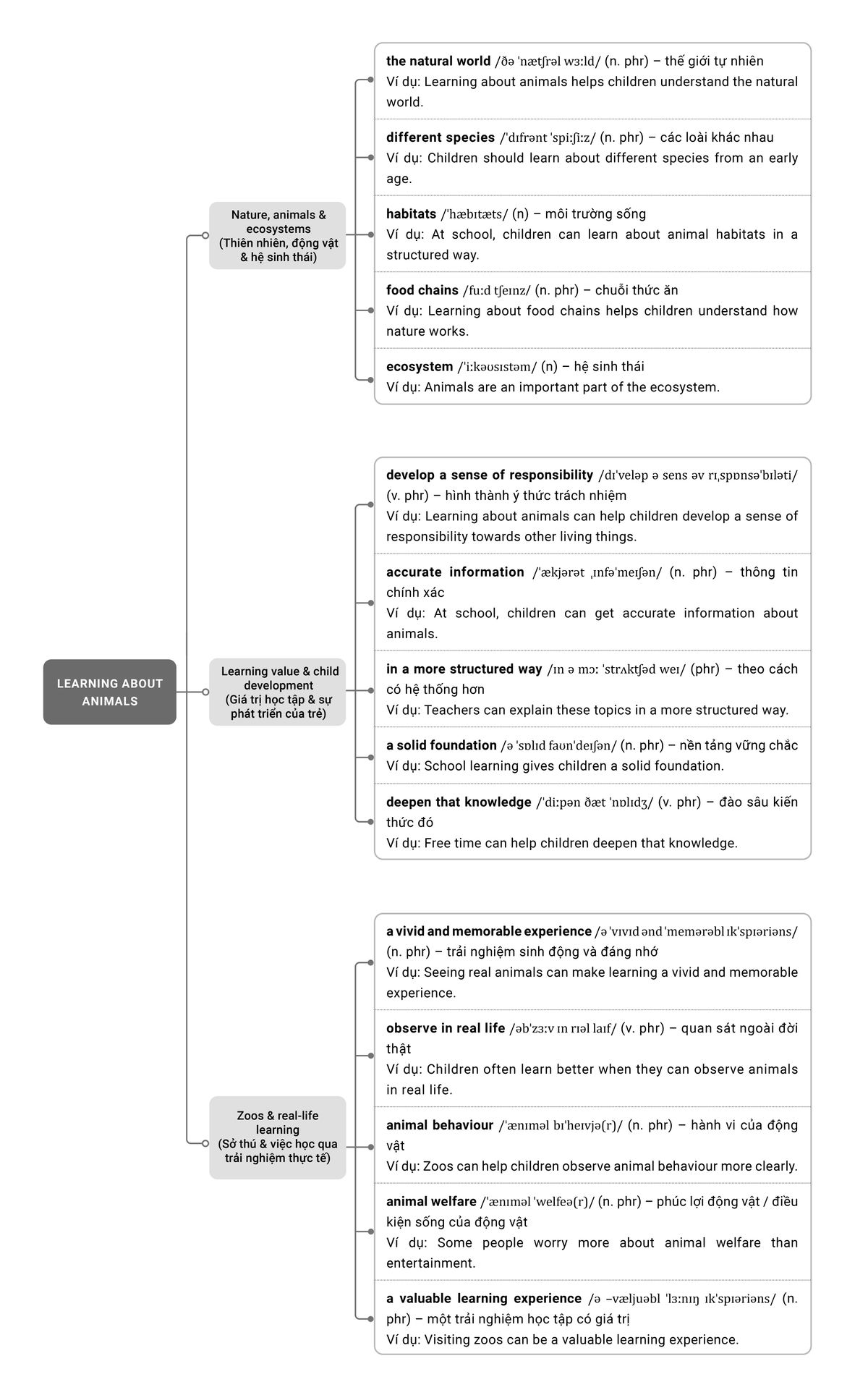
Nhóm từ vựng trọng tâm (Topic Vocabulary): Ecosystems, Child Development, Experience & Welfare, và Solutions.
Bài viết sau đây sẽ cung cấp các câu trả lời mẫu theo khung sườn tư duy (Simple Answer) cùng các thử thách nâng cấp (Upgraded Answer) về cả ý tưởng, từ vựng và ngữ pháp để người học lựa chọn được câu trả lời phù hợp với bản thân, sẵn sàng cho các tình huống trong phòng thi. Bài phân tích này sẽ dẫn dắt người học đi qua chủ đề IELTS Speaking Part 3 Learning about animals, từ vai trò của việc giáo dục thế giới tự nhiên (the natural world) nhằm hình thành ý thức trách nhiệm (develop a sense of responsibility) cho trẻ em, đến những tranh luận xoay quanh điều kiện sống của động vật (animal welfare) tại các sở thú hiện nay, giúp người học chinh phục giám khảo bằng sự mạch lạc và ngôn ngữ tự nhiên.
IELTS Speaking Part 3: Learning about animals
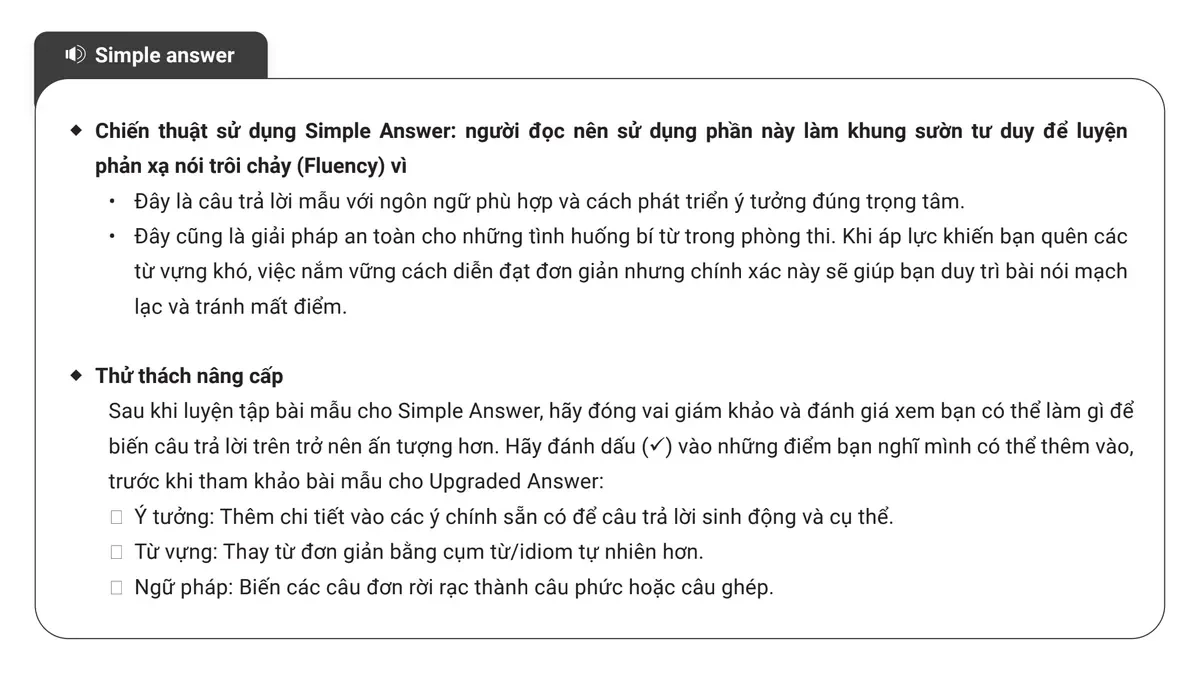
Simple answer
1. Do you think children should learn about animals? Why or why not?
Yes, I think children should learn about animals. The main reason is that it helps them understand nature and teaches them to care about other living things. For example, when children learn about wild animals, pets, or endangered species, they can become more interested in protecting them. So overall, learning about animals is both educational and meaningful for children.
2. Where do you think children should learn about animals, at school or in their free time?
I think children should learn about animals in both places, but school is probably more important. At school, they can get correct information from teachers and books, while in their free time they can explore the topic in a more fun way. For example, they may learn about animal habitats in class and then watch animal videos or read storybooks about animals at home. So, I think both are useful, but school gives children a stronger foundation.
3. Do you think visiting zoos is a good way for children to learn about animals? Why or why not?
Yes, I think visiting zoos can be a good way for children to learn about animals. The reason is that children can see real animals closely instead of only reading about them in books. For example, if they see giraffes, elephants, or monkeys in real life, they may remember the lesson more easily and feel more excited about learning. So overall, zoos can make learning about animals more interesting and memorable.
4. How can technology help children learn more about animals?
Loại câu hỏi: Explanation
Cấu trúc gợi ý: Main ways → Other way → Example → Conclusion
Well, technology can help children learn more about animals in many ways. First, it gives them easy access to videos, photos, and information online. It can also make learning more fun through educational apps, games, and documentaries. For example, a child can watch a video about sea animals or use an app to learn the sounds and names of different animals. So, technology can make learning about animals easier and more enjoyable.
5. Do you think people today care enough about protecting animals? Why or why not?
I do not think people today care enough about protecting animals. Although many people say they love animals, human activities still harm them in many ways. For example, forests are being destroyed, oceans are polluted, and some animals are hunted or kept in poor conditions. So, I think people need to do much more to protect animals and their habitats.
Social media has made communication between celebrities and the public much faster and more direct. In the past, fans could only see famous people on TV or in newspapers, but now they can interact through platforms like Instagram, TikTok, and Facebook. For example, celebrities can reply to comments, livestream, or share daily updates. As a result, the relationship between famous people and their fans has become closer and more personal.
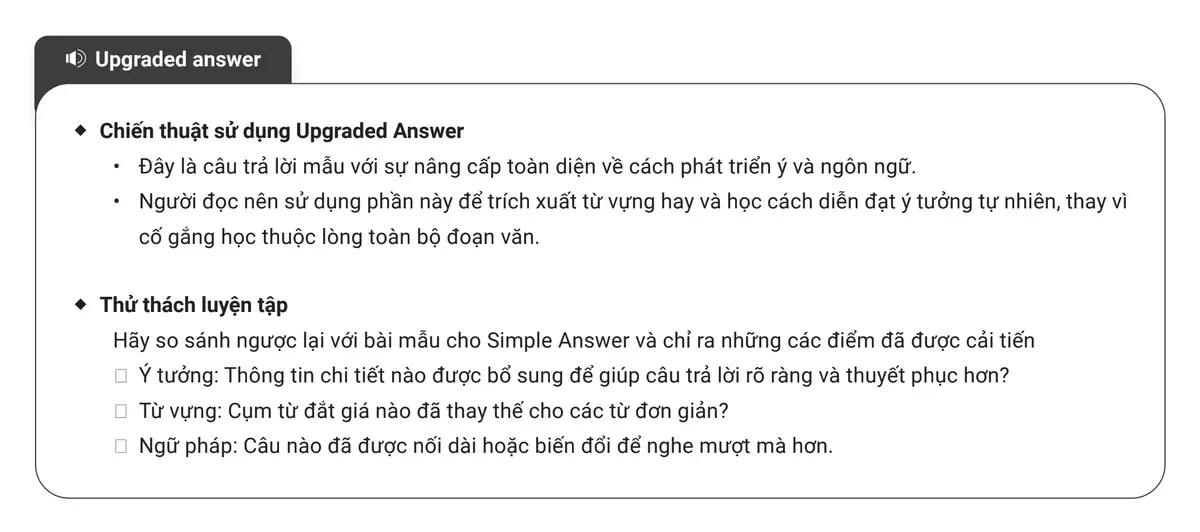
Upgraded answer
1. Do you think children should learn about animals? Why or why not?
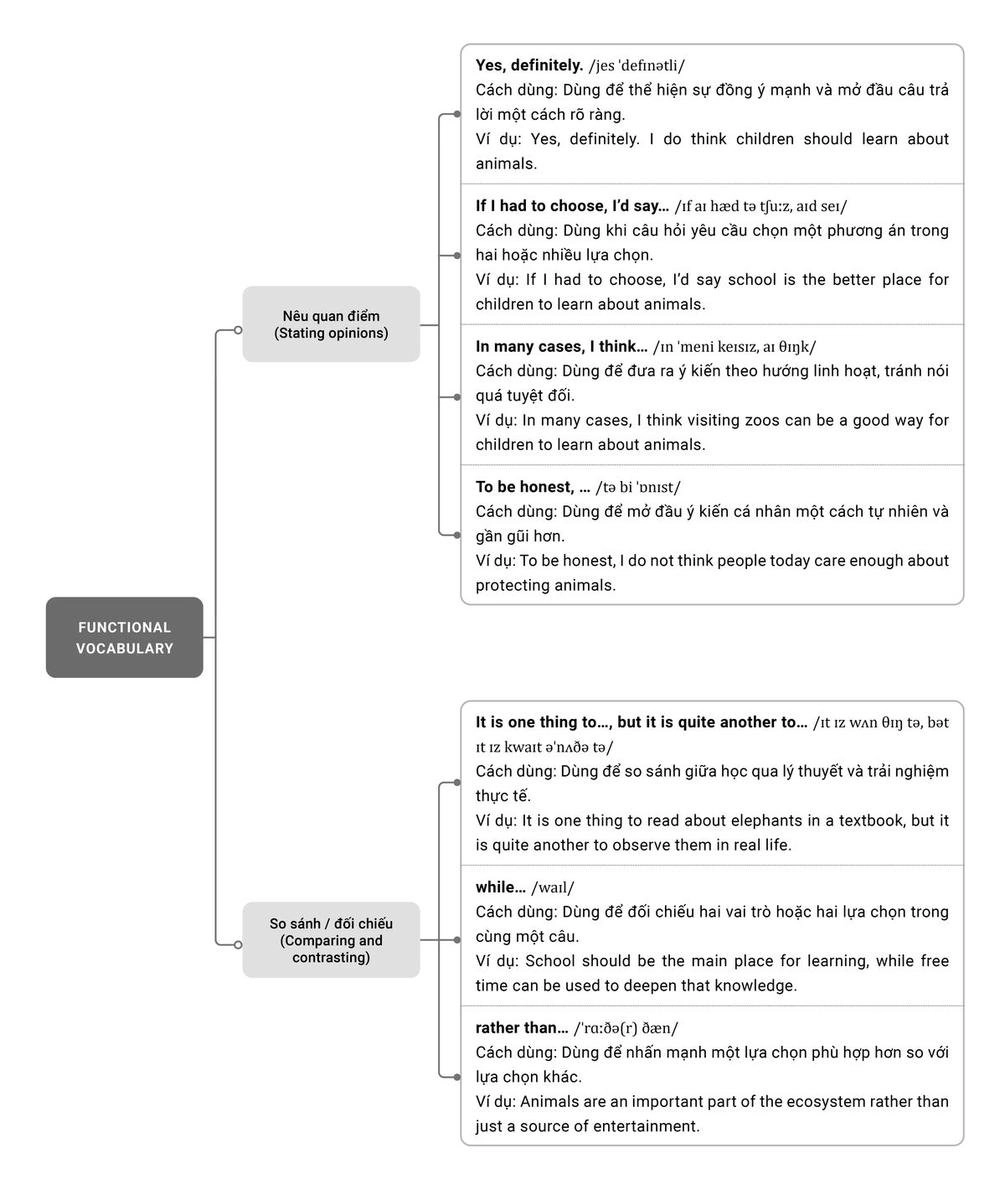
Yes, definitely. I do think children should learn about animals, mainly because it helps them understand the natural world and develop a sense of responsibility towards other living things. When children learn about different species, habitats, and food chains, they begin to realise that animals are not just for entertainment, but are actually an important part of the ecosystem. For example, if children learn about endangered animals such as tigers, sea turtles, or pandas, they may become more interested in conservation and more aware of the harm caused by human activities. On top of that, learning about animals can also make children more curious and observant in general. So overall, I’d say it is an important part of a child’s education.
2. Where do you think children should learn about animals, at school or in their free time?
If I had to choose, I’d say school is the better place, because children can get accurate information in a more structured way. Teachers can explain topics such as habitats, animal behaviour, and endangered species step by step, which gives children a solid foundation. For example, in science lessons, students may learn why polar bears are affected by climate change or how bees help plants grow through pollination. That said, free time also plays an important role, since children are often more relaxed and curious when they explore topics on their own through books, videos, or documentaries. Even so, I still think school should be the main place for learning, while free time can be used to deepen that knowledge.
3. Do you think visiting zoos is a good way for children to learn about animals? Why or why not?
Yes, in many cases, I think visiting zoos can be a good way for children to learn about animals because seeing real animals often makes the experience more vivid and memorable. It is one thing to read about elephants or giraffes in a textbook, but it is quite another to observe their size, movement, and behaviour in real life. For instance, a child who sees penguins swimming or monkeys interacting in a zoo may remember much more than they would from a picture alone. That said, I would not say all zoos are equally educational, because some places focus more on entertainment than animal welfare. So, as long as the zoo is well-managed and cares properly for the animals, I think it can be a valuable learning experience.
4. How can technology help children learn more about animals?
Loại câu hỏi: Explanation
Cấu trúc gợi ý: Main ways → Other way → Example → Conclusion
Well, I’d say technology can help a lot because it makes learning more accessible, visual, and engaging. Children can now watch documentaries, use educational apps, explore interactive websites, and even take virtual tours of wildlife parks or aquariums without leaving home. For example, a child might use a tablet to watch a short video about how lions hunt in groups or use an app that teaches animal names, sounds, and habitats through games. On top of that, technology allows children to learn about rare or dangerous animals that they would probably never see in person. So, when you think about it, technology can make learning about animals both easier and far more exciting.
5. Do you think people today care enough about protecting animals? Why or why not?
To be honest, I do not think people today care enough about protecting animals. Although there is now more discussion about animal rights and wildlife protection, human activities are still causing serious harm to many species. For example, deforestation, illegal hunting, plastic pollution, and climate change are destroying natural habitats and putting many animals at risk. Of course, there are still people and organisations that work very hard to protect wildlife, and that is definitely a positive sign. Even so, I think society as a whole still has a long way to go, because protecting animals should be a shared responsibility rather than the job of just a few groups.
Lọc và phân tích từ vựng
Nhật ký Từ vựng & Ý tưởng
Ghi chú sau khi luyện tập nói về chủ đề trên
Từ vựng/Ý tưởng
(Chọn các từ vựng/ý tưởng mà bạn tâm đắc nhất)
Kỉ niệm cá nhân (Gán các từ vựng/ý tưởng đã chọn với kỉ niệm của bản thân)
Ví dụ: develop a sense of responsibility – hình thành ý thức trách nhiệm
Người đọc tự đặt các câu hỏi cho bản thân, ví dụ:
Khi còn nhỏ, bạn có thích tìm hiểu về động vật không? Vì sao?
Bạn học về động vật chủ yếu qua trường học, sách, video hay những chuyến đi thực tế?
Bạn đã từng đi sở thú hoặc xem phim tài liệu về động vật chưa? Bạn nhớ điều gì nhất?
Bạn nghĩ công nghệ có làm cho việc học về động vật thú vị hơn không?
Bạn có nghĩ con người ngày nay đã làm đủ để bảo vệ động vật chưa?
→ When I was a child, I was always curious about animals, especially wild ones like tigers, dolphins, and elephants. I think learning about them helped me understand that animals are not just interesting creatures, but also an important part of the natural world. I still remember visiting a zoo once and being amazed by how large and active some animals were in real life compared with the pictures I had seen in books. Later on, I also watched documentaries and used the internet to learn more about endangered species and their habitats. Looking back, I feel that learning about animals not only made me more curious, but also helped me develop a stronger sense of responsibility towards protecting wildlife.
Khoảng trống diễn đạt
(Phần khiến bạn ngập ngừng khi nói về chủ đề trên)
Giải pháp
(Giải pháp cho các khoảng trống diễn đạt)
Ví dụ:
Tôi chưa quen diễn đạt ý con người vẫn chưa quan tâm đủ đến việc bảo vệ động vật.
Ví dụ: Dùng từ điển của ZIM hoặc chép các cách diễn đạt từ bài mẫu ở các phần trên để có được cụm từ mà bạn cần.
→ Thay vì chỉ nói “people do not protect animals enough” → dùng cause serious harm to many species / destroy natural habitats / put animals at risk / a shared responsibility
Hãy nói rằng trẻ em nên tìm hiểu về động vật từ khi còn nhỏ.
(Dùng: learn about + danh từ / learn at school)
Hãy nói rằng học ở trường tốt hơn học trong thời gian rảnh khi nói về kiến thức cơ bản về động vật.
(Dùng: better than / more important than)
Hãy nói rằng trẻ em có thể nhìn thấy động vật thật ở sở thú và xem phim tài liệu để học thêm ở nhà.
(Dùng: see / watch)
Các chủ đề liên quan
Chủ đề liên quan để sử dụng từ vựng & ý tưởng:
ature and environmental education (Thiên nhiên & giáo dục về môi trường)
Technology and children’s learning (Công nghệ & việc học của trẻ em)
Animal protection and human responsibility (Bảo vệ động vật & trách nhiệm của con người)
Người đọc có thể sử dụng:
Từ vựng: the natural world, different species, habitats, food chains, ecosystem, develop a sense of responsibility, accurate information, a solid foundation, endangered animals, conservation, animal behaviour, animal welfare, educational apps, virtual tours, wildlife protection, natural habitats, at risk, a shared responsibility...
Ý tưởng:
Trẻ em nên học về động vật vì điều đó giúp các em hiểu hơn về thiên nhiên và hình thành ý thức trách nhiệm với các sinh vật sống khác.
Trường học là nơi phù hợp để trẻ có kiến thức chính xác và có hệ thống, trong khi thời gian rảnh giúp các em đào sâu kiến thức theo cách thú vị hơn.
Sở thú có thể là một cách học tốt nếu được quản lý tốt và chú ý đúng mức đến phúc lợi động vật.
Công nghệ giúp việc học về động vật trở nên dễ tiếp cận, trực quan và hấp dẫn hơn thông qua video, ứng dụng, website tương tác và tham quan ảo.
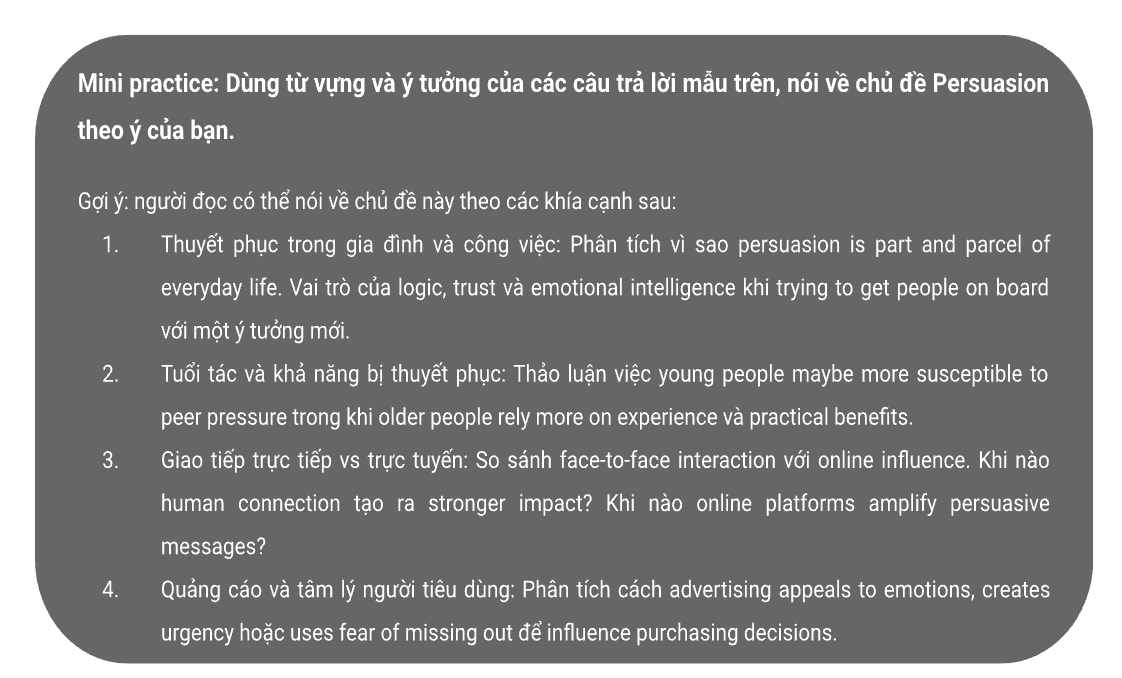
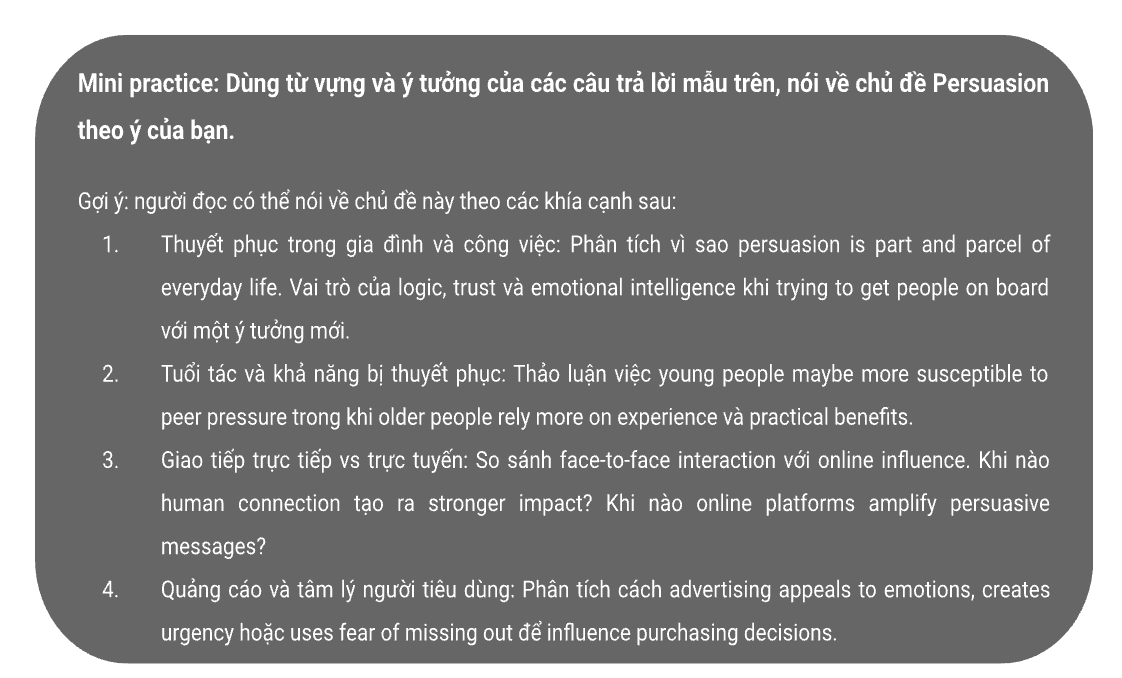
Mini practice
Sử dụng từ vựng và ý tưởng ở trên để trả lời các câu hỏi sau
1. Why is learning about animals important for children?
(Gợi ý: the natural world, ecosystem, develop a sense of responsibility, endangered animals)
2. Is technology a better way than zoos for children to learn about animals?
Hy vọng rằng qua việc phân tích hai cấp độ trả lời từ Simple Answer để đảm bảo sự trôi chảy đến Upgraded Answer để ghi điểm ấn tượng, bạn đã nắm vững được lộ trình để chinh phục chủ đề Learning about animals (Part 3). Bằng cách cá nhân hóa các câu trả lời thông qua "Nhật ký Từ vựng & Ý tưởng", bạn sẽ xây dựng được sự tự tin. Đừng quên thực hành các bài tập nhỏ (mini practice) để khắc phục những lỗi ngữ pháp thường gặp và làm chủ ngôn ngữ của mình nhé!
Nếu bạn muốn nâng cao kỹ năng IELTS Speaking theo lộ trình cá nhân hóa, Hệ thống giáo dục ZIM cung cấp các khóa luyện thi IELTS cam kết đầu ra, giúp bạn tối ưu hiệu quả học tập và tiết kiệm đến 80% thời gian tự học. Để được tư vấn chi tiết, vui lòng liên hệ hotline 1900-2833 (nhánh 1) hoặc truy cập Khóa học IELTS.
Nguồn tham khảo
1
OpenAI. “Bài mẫu IELTS Speaking Part 3.” OpenAI,https://chatgpt.com/share/e/6961bf62-bf88-8002-9512-8fe28a8cdcf4. Accessed 16 May 2026.



Bình luận - Hỏi đáp