


Dùng khung Idea → Explain → Example → Result/Conclusion cho một số dạng câu hỏi Part 3: Accommodation.
Từ vựng chủ đề: life circumstances/priorities, a learning curve, comfort zone, find their feet.
Từ vựng so sánh và kết ý: On the one hand… / On the other hand… / Overall…
Tránh lỗi: live (dài hạn) ≠ stay (tạm thời); kể trải nghiệm dùng Past Simple; nói “nhiều người khác” dùng other + N(pl).
Bài mẫu IELTS Speaking Part 3 Topic “Accommodation” kèm từ vựng
Trong bài viết này, tác giả sẽ gợi ý bài mẫu cho Topic “Accommodation” và phân tích các từ vựng ghi điểm cho phần thi IELTS Speaking Part 3.
Key takeaways
Phần thi IELTS Speaking Part 3 với chủ đề “Accommodation” yêu cầu thí sinh không chỉ trả lời câu hỏi đơn thuần mà còn phải phân tích, so sánh và đưa ra quan điểm cá nhân một cách logic và thuyết phục. Nhiều thí sinh gặp khó khăn trong việc triển khai ý tưởng mạch lạc cũng như sử dụng từ vựng học thuật phù hợp khi bàn về các vấn đề như sống một mình hay ở chung, chi phí sinh hoạt, không gian cá nhân và tính tự lập. Bài viết cung cấp bài mẫu chi tiết cho chủ đề này, kèm theo phân tích cấu trúc trả lời hiệu quả, hệ thống từ vựng ghi điểm theo ngữ cảnh và các lỗi ngữ pháp thường gặp cần tránh, giúp thí sinh tự tin thảo luận sâu và hướng tới band điểm cao.
IELTS Speaking Part 3: Accommodation
Simple answer
1. Why do people decide to move to a new place to live?
|
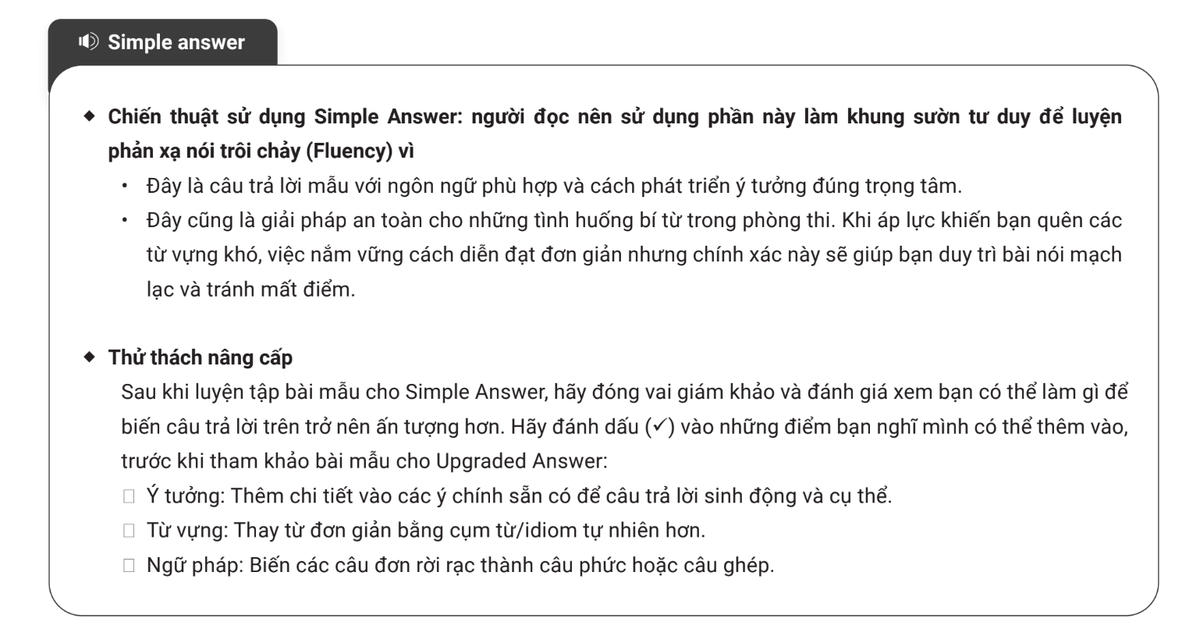
People decide to move to a new place because their life situation changes. This can be related to work, study, or family reasons. Sometimes they want a place that is closer to their workplace or school. For example, many people move to the city to find better job opportunities. As a result, moving helps them live more conveniently and save time. |
2. What can people learn from the experience of moving to a new accommodation?
|
I think people can learn to be more independent when they move to a new accommodation. They need to take care of daily tasks by themselves, such as paying bills and cleaning the house. This helps them become more responsible. For example, living alone teaches people how to manage their time better. Overall, moving helps people grow and become more mature. |
3. What are the differences between living on your own and sharing accommodation with others?
|
Living on your own and sharing accommodation are quite different experiences. When you live alone, you have more privacy and freedom. However, sharing accommodation means you have to think about other people’s needs and habits. For example, you may need to share common areas like the kitchen or bathroom. Overall, living alone offers more independence, while sharing helps people learn cooperation. |
4. Which do you think is more suitable for young people, living alone or living with others? Why?
|
I think living with others is more suitable for young people. It helps them save money and feel less lonely. Young people can also learn important social skills by sharing daily life with others. For example, they learn how to communicate and solve small problems together. In general, living with others can make young people feel more supported. |
Tìm hiểu thêm: Cause and Effect Essay - Hướng dẫn cách viết trong IELTS Writing Task 2
Upgraded answer
1. Why do people decide to move to a new place to live?
|
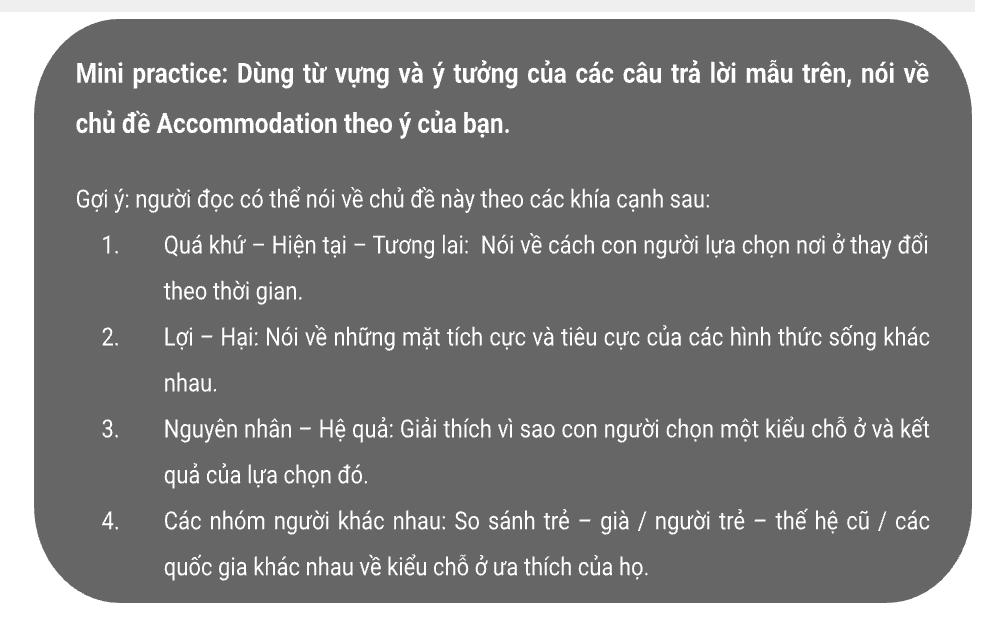
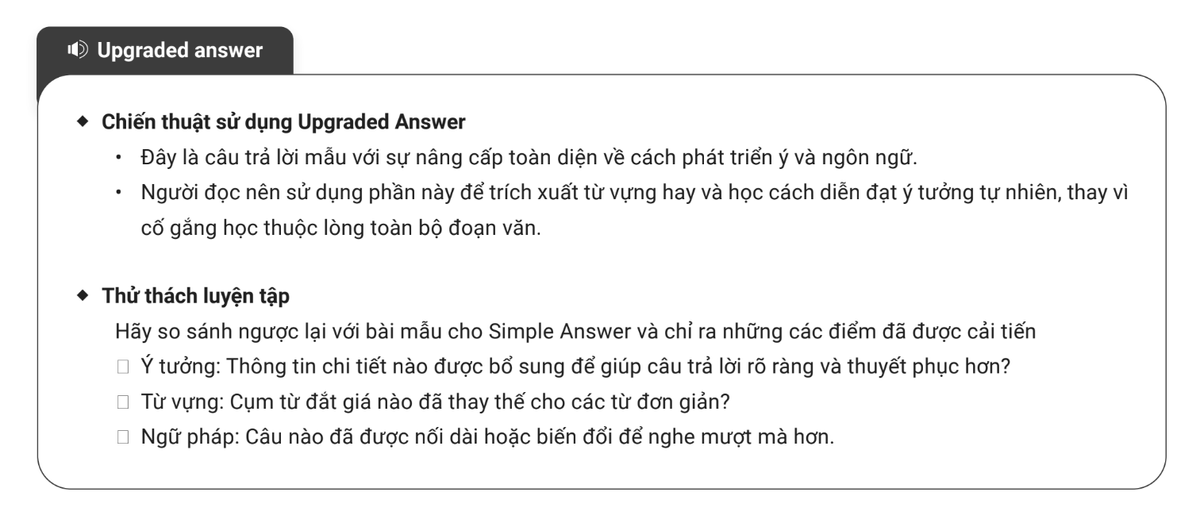
Well, I’d say people usually decide to move when their priorities or circumstances start to change. This often happens at different stages of life, especially when work, study, or family situations shift. For example, someone might move to a bigger city to be closer to job opportunities or simply to have a more active lifestyle. In other cases, people feel that their current place no longer fits who they are or what they need. So, in a way, moving is often about making life work better for them in the long run. |
2. What can people learn from the experience of moving to a new accommodation?
|
Actually, moving to a new place can be a real learning curve because it pushes people out of their comfort zone and forces them to handle things they may not have dealt with before. You know, managing rent, bills, or unexpected problems teaches them to think and act independently. For instance, many first-time movers quickly learn how to budget their money and organise their time. All in all, this experience usually helps people grow up faster and become more confident in daily life. |
3. What are the differences between living on your own and sharing accommodation with others?
|
Well, there’s quite a clear contrast between living alone and sharing accommodation. On the one hand, living on your own gives you complete freedom and personal space, which can be very appealing, but at the same time, it can feel a bit lonely and means you’re fully responsible for everything. Sharing accommodation, on the other hand, requires compromise and communication, since you’re dealing with other people’s habits. So overall, living alone builds independence, while sharing accommodation helps people learn how to get along with others. |
4. Which do you think is more suitable for young people, living alone or living with others? Why?
|
To be honest, I think living with others is generally more suitable for young people. At that stage of life, many young adults are still finding their feet, both socially and financially. Living with others makes things more affordable and also provides emotional support in everyday life. For example, sharing a place with roommates can make stressful days easier and even more enjoyable. All things considered, living with others offers young people a healthier balance between independence and social connection. |
Tham khảo: Cách tiếp cận hoàn toàn đồng ý hoặc bác bỏ trong IELTS Writing Task 2 Dạng Opinion
Lọc và phân tích từ vựng
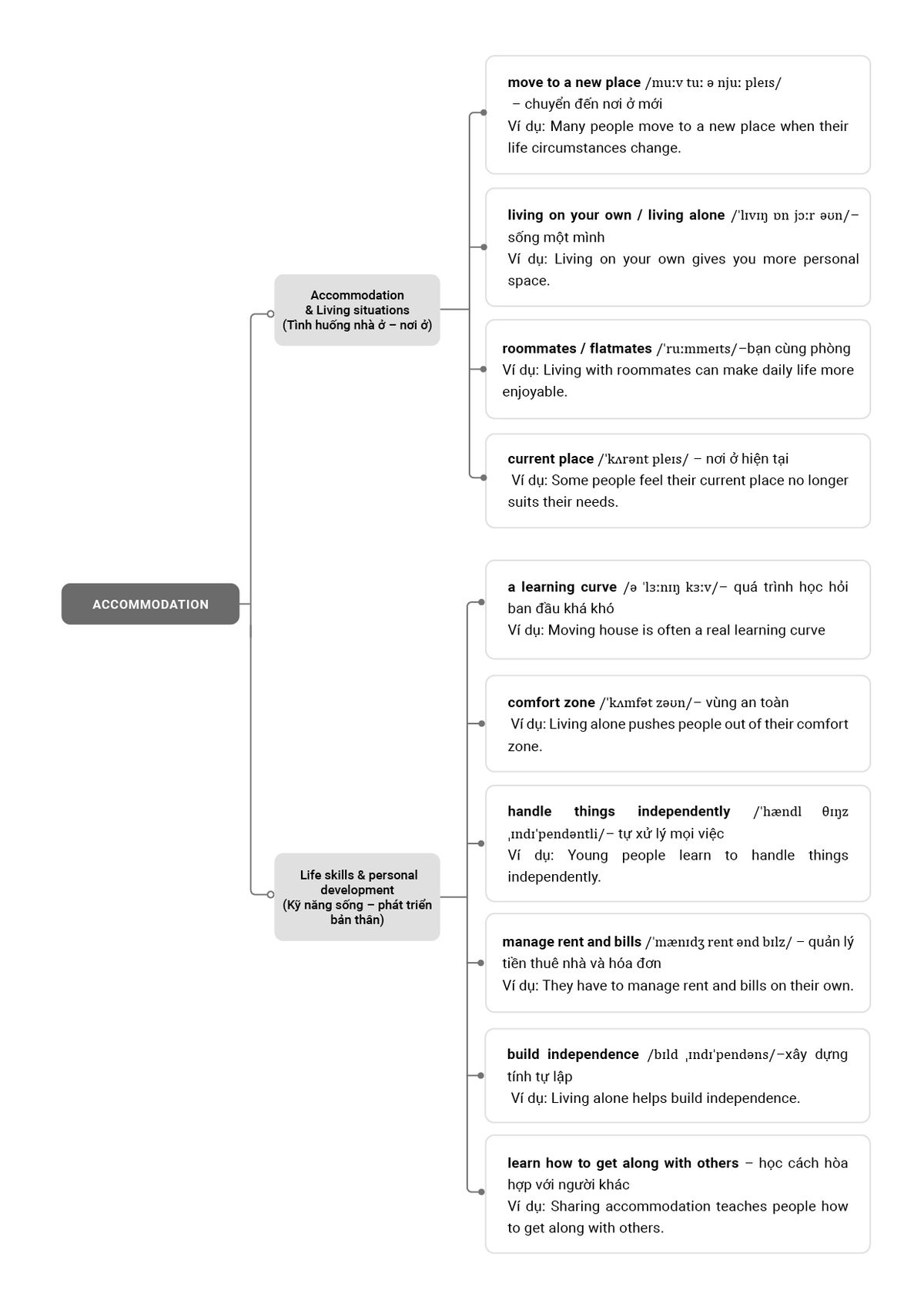
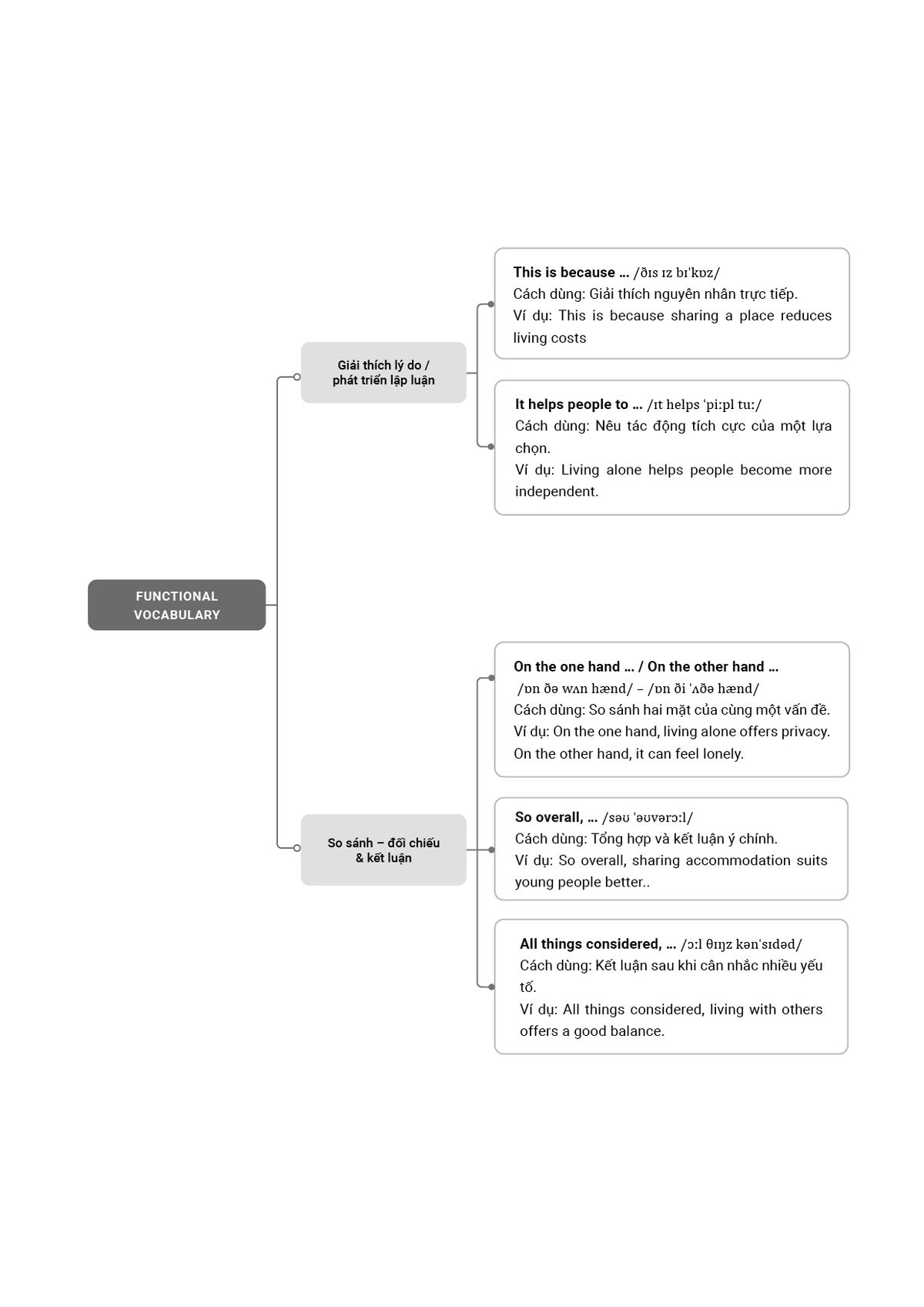
Nhật ký từ vựng & ý tưởng
Ghi chú sau khi luyện tập nói về chủ đề trên.
Từ vựng/Ý tưởng (Chọn các từ vựng/ý tưởng mà bạn tâm đắc nhất) | Kỉ niệm cá nhân |
|---|---|
Ví dụ: find their feet /faɪnd ðeə fiːt/ (idiom) – dần ổn định, làm quen với cuộc sống mới | Người đọc tự đặt các câu hỏi cho bản thân, ví dụ:
→ When I first moved out, I decided to share accommodation with friends to reduce living costs. It helped me save money and gave me emotional support, especially when I was still finding my feet in a new city. However, I also realised that I sometimes missed having my own personal space. |
Khoảng trống diễn đạt (Phần khiến bạn ngập ngừng khi nói về chủ đề trên) | Giải pháp (Giải pháp cho các khoảng trống diễn đạt) | ||
|---|---|---|---|
Ví dụ:
| Ví dụ: Dùng từ điển, công cụ AI, … để tìm cụm từ mà bạn cần. → reduce living costs – giảm chi phí sinh hoạt → feel less lonely – bớt cảm thấy cô đơn → learn to compromise – học cách thỏa hiệp → get along with others – hòa hợp với người khác |
Người đọc có thể tìm từ vựng bằng từ điển ZIM Dictionary.
Các lỗi ngữ pháp thường gặp
1. “live” vs “stay” (dùng sai động từ)
Lỗi thường gặp:
“I stay in this apartment for three years.”
(người học muốn nói: Tôi sống ở căn hộ này 3 năm rồi.)
Cách dùng đúng:
live: nói về nơi ở lâu dài
stay: ở tạm thời, ngắn hạn
Câu đúng: I have lived in this apartment for three years.
Lý do sai: Người học thường dùng stay theo thói quen, nhưng khi nói về chỗ ở lâu dài, động từ đúng là live.
2. Dùng sai thì khi nói về trải nghiệm cá nhân
Lỗi thường gặp:
“When I move to a new apartment, I learn how to manage money.”
(người học muốn nói về trải nghiệm đã xảy ra)
Cách dùng đúng: Trải nghiệm trong quá khứ → Past Simple
Câu đúng: When I moved to a new apartment, I learned how to manage my money.
Lý do sai: Người học thường dùng hiện tại đơn theo thói quen, nhưng khi kể trải nghiệm cụ thể trong quá khứ, cần dùng quá khứ đơn để rõ thời điểm.
3. “another” vs “other” với danh từ số nhiều
Lỗi thường gặp: “I live with another people in the same house.”
Cách dùng đúng:
another + danh từ số ít
other + danh từ số nhiều
Câu đúng: I live with other people in the same house.
Lý do sai: Another không đi với danh từ số nhiều. Khi nói về nhiều người khác, phải dùng other people.
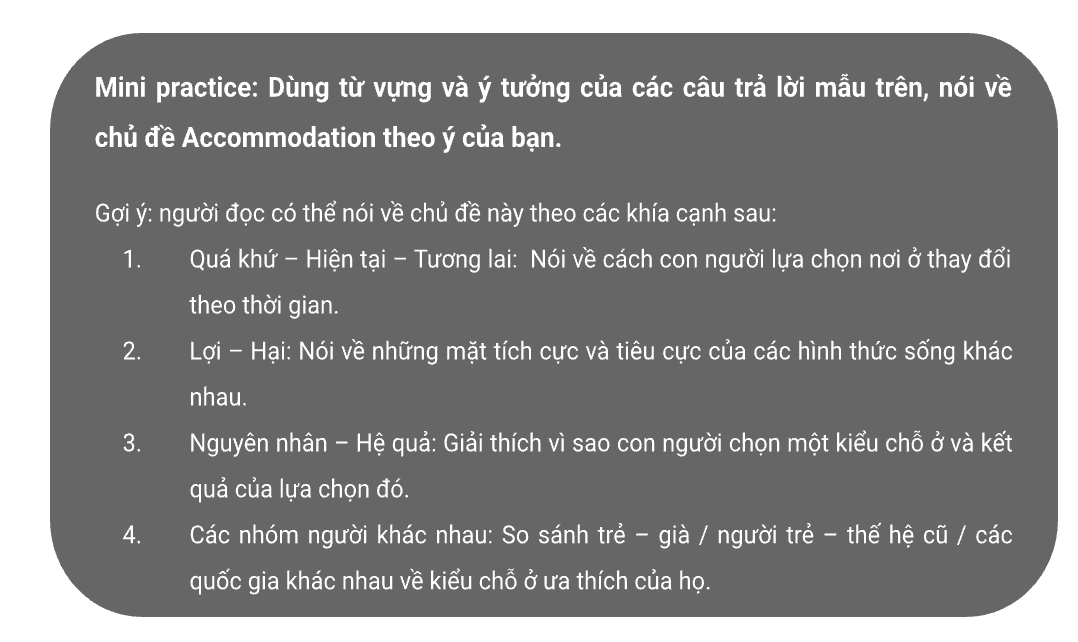
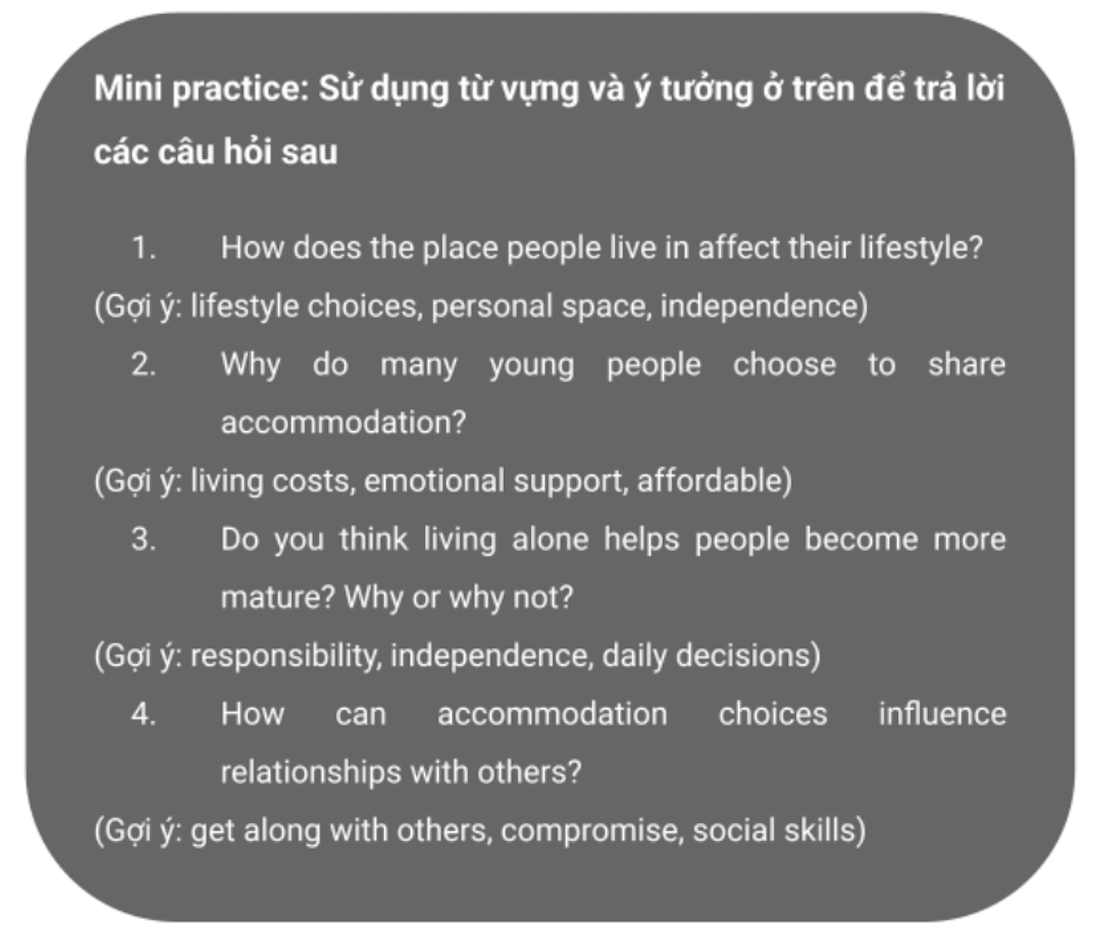
Mini practice
Dùng đúng cấu trúc trong ngoặc
Hãy nói về lý do tại sao nhiều người thường ở một nơi trong thời gian dài (ví dụ: vì công việc/học tập/gia đình).
(Dùng: live – không dùng stay)Hãy nói về điều mọi người thường học được sau khi chuyển đến chỗ ở mới (ví dụ: tự lập hơn, biết quản lý tiền).
(Dùng: Past Simple để nói về trải nghiệm phổ biến – moved, learned, realised)Hãy nói về lợi ích và bất lợi của việc nhiều người sống chung với người khác (ví dụ: bạn cùng phòng, gia đình).
(Dùng: other + noun số nhiều)
Các chủ đề liên quan
Chủ đề liên quan để sử dụng từ vựng & ý tưởng:
Lifestyle choices (Lựa chọn lối sống)
Independence and responsibility (Sự tự lập và trách nhiệm)
Young people and adulthood (Người trẻ và quá trình trưởng thành)
Người đọc có thể sử dụng:
Từ vựng:
live alone, share accommodation, personal space, independence, responsibility, living costs, emotional support, compromise, get along with others, affordable housing, sense of freedom, ...
Ý tưởng:
Sống một mình giúp phát triển tính tự lập nhưng đi kèm nhiều trách nhiệm
Ở chung giúp tiết kiệm chi phí và có sự hỗ trợ tinh thần
Người trẻ thường chọn ở chung vì chưa ổn định tài chính
Kiểu chỗ ở ảnh hưởng đến lối sống, thói quen và mối quan hệ xã hội
Việc chuyển chỗ ở là một bước quan trọng trong quá trình trưởng thành
Tham khảo thêm: Bài mẫu IELTS Speaking Part 3 Topic “Habits/Globalisation” kèm từ vựng
Tổng kết
Chủ đề Accommodation giúp thí sinh luyện cách trả lời IELTS Speaking Part 3 một cách mạch lạc thông qua các cấu trúc quen thuộc như giải thích, so sánh và nêu quan điểm. Việc ghi chép từ vựng trọng tâm (như live alone, share accommodation, personal space, living costs, emotional support, …), gắn với trải nghiệm cá nhân và luyện nói theo cấu trúc sẽ giúp người học diễn đạt tự nhiên, lập luận rõ ràng và tránh lỗi ngữ pháp phổ biến. Nhờ đó, thí sinh có thể tự tin thảo luận sâu và nâng cao band điểm ở Part 3.
Đối với thí sinh đang trong giai đoạn chuẩn bị cho kỳ thi IELTS, việc trải nghiệm một bài thi thử có cấu trúc và độ khó tương đương với đề thi thật là bước chuẩn bị quan trọng. Thi thử IELTS tại ZIM Academy mang đến đánh giá chính xác với đề thi có cấu trúc giống 100% bài thi thật. Chat trực tiếp trên website để được tư vấn nhanh chóng và đăng ký lịch thi phù hợp.
Nguồn tham khảo
1
“Bài mẫu IELTS Speaking Part 3.” OpenAI, chatgpt.com/share/e/6961bf62-bf88-8002-9512-8fe28a8cdcf4. Accessed 12 January 2026.
Bình luận - Hỏi đáp