


Chủ đề IELTS Speaking: Part 3: Culture and Home Visits.
Bài mẫu cho các nhóm câu hỏi:
Is visiting homes common in your country?
On what occasions do people visit?
What do visitors usually bring?
Are there rules or customs when visiting?
Do young and old people view home visits differently?
Nhóm từ vựng trọng tâm (Topic Vocabulary): Social Relations, Occasions & Etiquette, và Customs & Generations.
Bài mẫu IELTS Speaking Part 3 topic Culture and Home visits kèm từ vựng
Bài viết cung cấp các câu trả lời mẫu cho IELTS Speaking Part 3 Culture and Home visits theo định hướng cá nhân hóa, được chia thành hai cấp độ: Simple Answer (tập trung phản xạ và độ trôi chảy) và Upgraded Answer (nâng cấp từ vựng, ngữ pháp). Đi kèm với mỗi câu trả lời là file audio hỗ trợ luyện phát âm chuẩn xác. Ngoài ra, phần phân tích chi tiết sẽ giúp người học hệ thống hóa từ vựng, khắc phục lỗi ngữ pháp và linh hoạt áp dụng vào các chủ đề tương tự.
Key takeaways
Bài viết sau đây sẽ cung cấp các câu trả lời mẫu theo khung sườn tư duy (Simple Answer) cùng các thử thách nâng cấp (Upgraded Answer) về cả ý tưởng, từ vựng và ngữ pháp để người học lựa chọn được câu trả lời phù hợp với bản thân, sẵn sàng cho các tình huống trong phòng thi. Bài phân tích này sẽ dẫn dắt người học đi qua chủ đề Culture and Home Visits, từ nét đẹp văn hóa ghé thăm nhà thân nhân (drop by a relative's house) nhằm thắt chặt mối quan hệ gia đình (maintain family ties), cho đến các chuẩn mực ứng xử như báo trước lịch trình (let the host know before coming) thay vì đột ngột xuất hiện (turn up unexpectedly), giúp người học chinh phục giám khảo bằng sự mạch lạc và ngôn ngữ tự nhiên.
IELTS Speaking Part 3: Culture and home visits
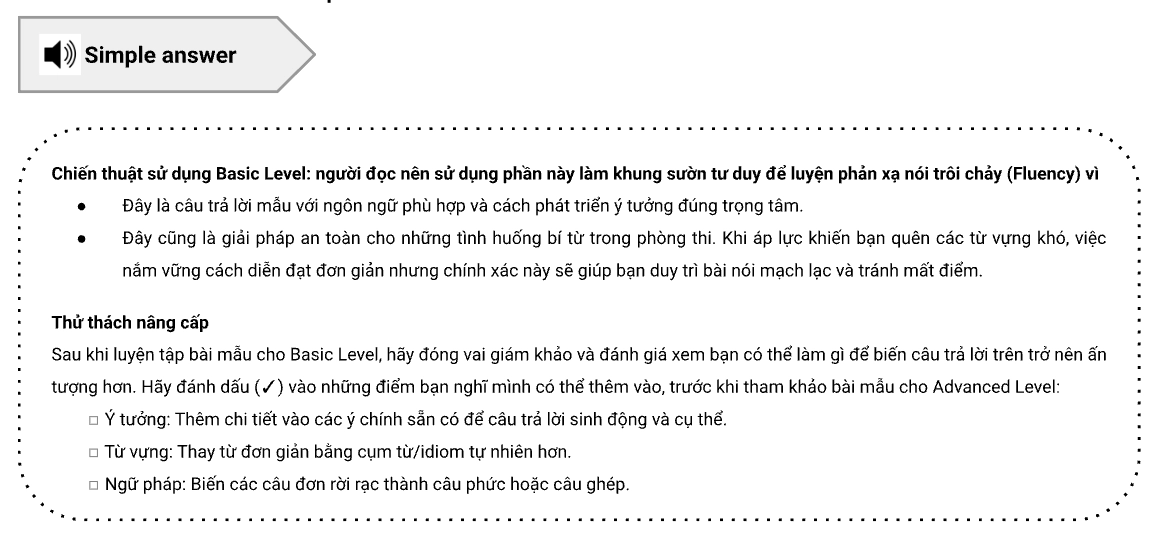
Simple answer
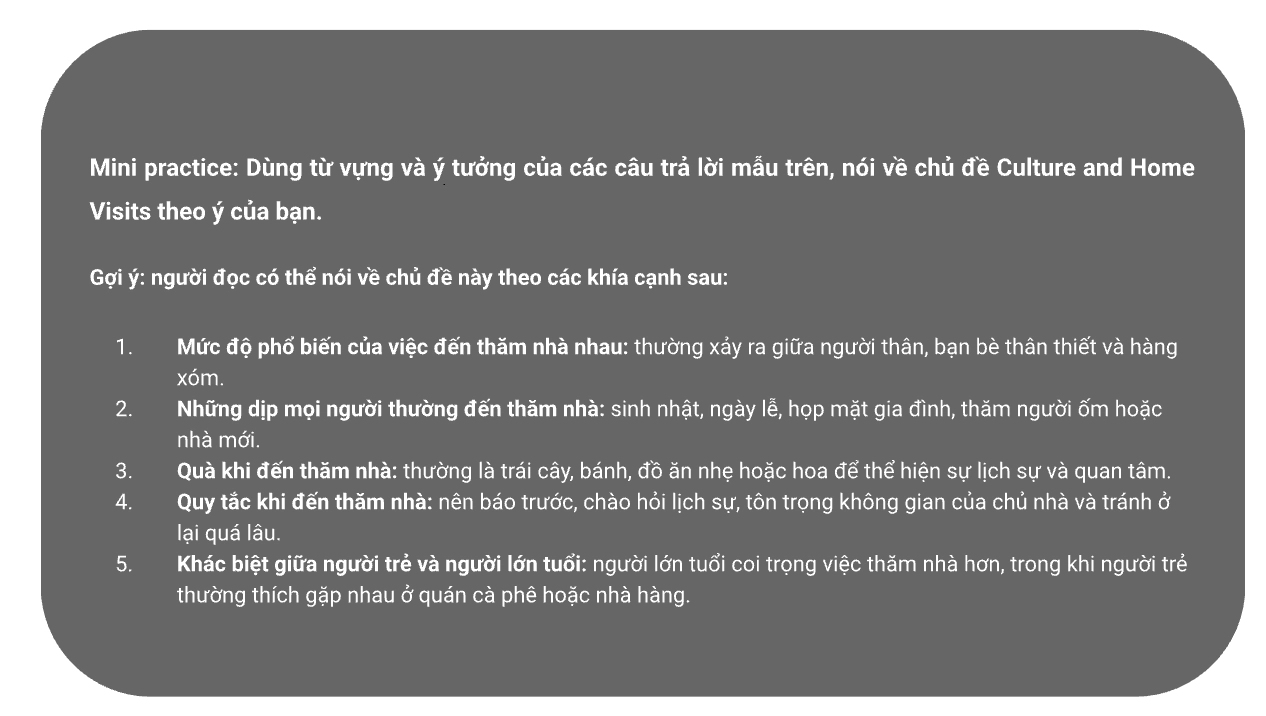
1. Is it common for people in your country to visit each other’s homes?
|
Yes, I think it is quite common, especially among family members, relatives, and close friends. People often visit each other to spend time together, have a meal, or simply have a chat. For example, some families visit their relatives at weekends or during holidays. So, home visits are still an important part of social life in my country. |
2. On what occasions do people usually visit someone else’s home?
|
People usually visit someone’s home on special occasions such as birthdays, holidays, family gatherings, or festivals. They may also visit when someone is sick, has just had a baby, or has moved into a new house. For example, during major holidays, many people visit relatives and spend time together. So, home visits are often connected with important family or social events. |
3. What do people usually bring when they visit someone’s home?
|
People often bring a small gift, such as fruit, snacks, flowers, or a box of cakes. It is a polite way to show respect and appreciation to the host. For example, if someone visits a family during a holiday, they may bring fruit or sweets for everyone to share. So, the gift does not need to be expensive, but it should be thoughtful. |
4. Are there any rules or customs people should follow when visiting someone’s home?
|
Yes, there are a few common customs. Visitors should usually arrive on time, greet the host politely, and avoid staying too long. In some homes, people are also expected to take off their shoes before entering. For example, if the host offers food or drinks, it is polite to accept at least something. Overall, visitors should behave respectfully and make the host feel comfortable. |
5. Do younger and older people have different attitudes towards home visits?
|
Yes, I think there is some difference. Older people often value home visits more because they see them as a good way to maintain family relationships. Younger people may prefer meeting in cafés, restaurants, or other public places because it is more convenient. For example, young friends may choose to meet for coffee instead of visiting each other’s homes. So, home visits are probably more important to older generations than younger ones. |
Tham khảo: Tổng hợp bài mẫu IELTS Speaking 2026
Upgraded answer
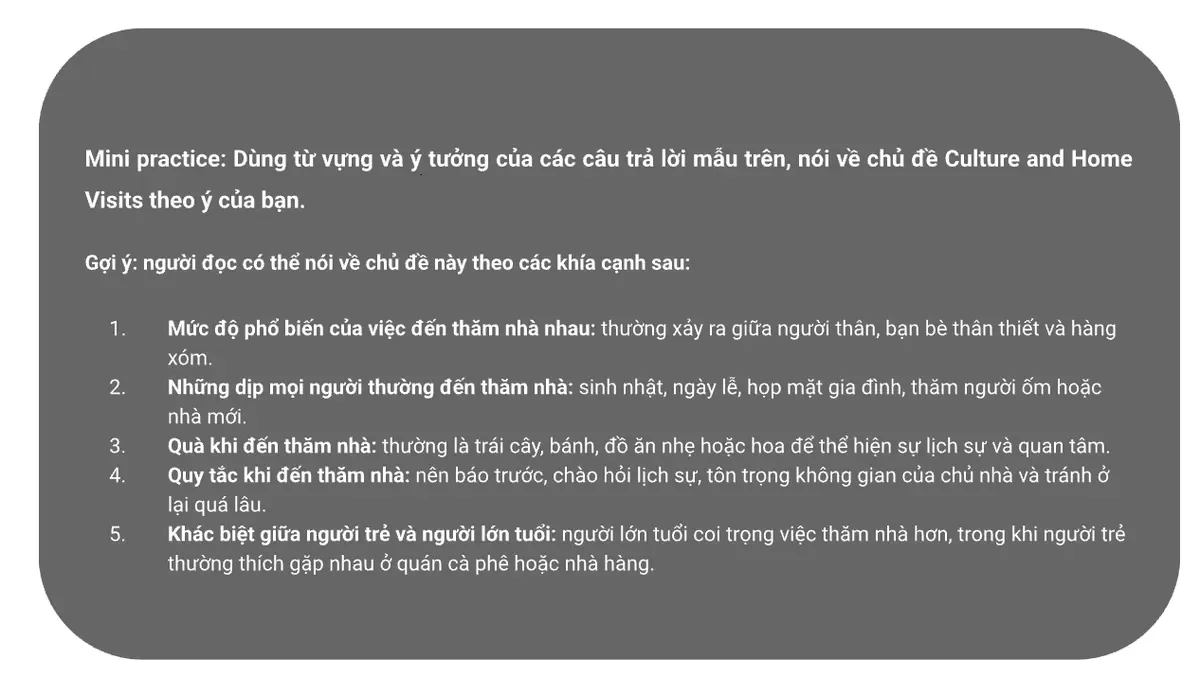
1. Is it common for people in your country to visit each other’s homes?
|
Yes, I’d say it is still quite common, particularly among relatives, close friends, and neighbours. Home visits are often seen as a good way to maintain personal relationships and spend quality time together in a more relaxed setting. For example, people may drop by a relative’s house at the weekend, have a meal together, or simply sit down for a long conversation. That said, younger people may do this less frequently than older generations because they often prefer meeting outside. So overall, home visits are still an important social custom, although they may be becoming slightly less common among young people. |
2. On what occasions do people usually visit someone else’s home?
|
People usually visit someone’s home on special occasions such as birthdays, public holidays, family celebrations, or traditional festivals. They may also pay someone a visit when that person is ill, has recently had a baby, or has moved into a new home. For instance, during major holidays, families often visit relatives, share a meal, and catch up with one another. In addition, people sometimes visit without a particular celebration simply because they have not seen each other for a while. So, home visits can be both a social tradition and a way of showing care and support. |
3. What do people usually bring when they visit someone’s home?
|
In most cases, visitors bring a small gift as a sign of politeness and appreciation. Common choices include fruit, cakes, snacks, flowers, or something for the children in the family. For example, if someone is visiting during a holiday, they might bring a box of sweets or some fresh fruit for everyone to share. Flowers can also be a nice choice because they make the visit feel more thoughtful and can brighten up the home. Of course, the gift does not have to be expensive. What matters more is the gesture and the intention behind it. |
4. Are there any rules or customs people should follow when visiting someone’s home?
|
Yes, there are several basic customs that visitors are generally expected to follow. First of all, it is polite to let the host know before coming rather than turning up unexpectedly. Visitors should also greet everyone properly, behave respectfully, and avoid staying for too long unless they are invited to. In some households, people are expected to take off their shoes before entering, and it is usually polite to accept at least some food or drink when it is offered. For example, refusing everything immediately might make the host feel that their hospitality is not appreciated. So overall, the main idea is to respect the host’s home and make the visit comfortable for everyone. |
5. Do younger and older people have different attitudes towards home visits?
|
Yes, I think there is a noticeable difference between the two generations. Older people tend to place greater importance on home visits because they often see them as a way to maintain family ties and show respect to relatives. Younger people, on the other hand, may prefer meeting in cafés, restaurants, or shopping centres because these places are more convenient and require less preparation. For example, a group of young friends might find it easier to meet for coffee than to invite everyone to someone’s home. That said, younger people still visit family members on important occasions. So I would say home visits remain meaningful to both groups, but older generations generally value them more strongly. |
Xem thêm: Cách phát triển ý tưởng cho IELTS Speaking Part 3
Lọc và phân tích từ vựng
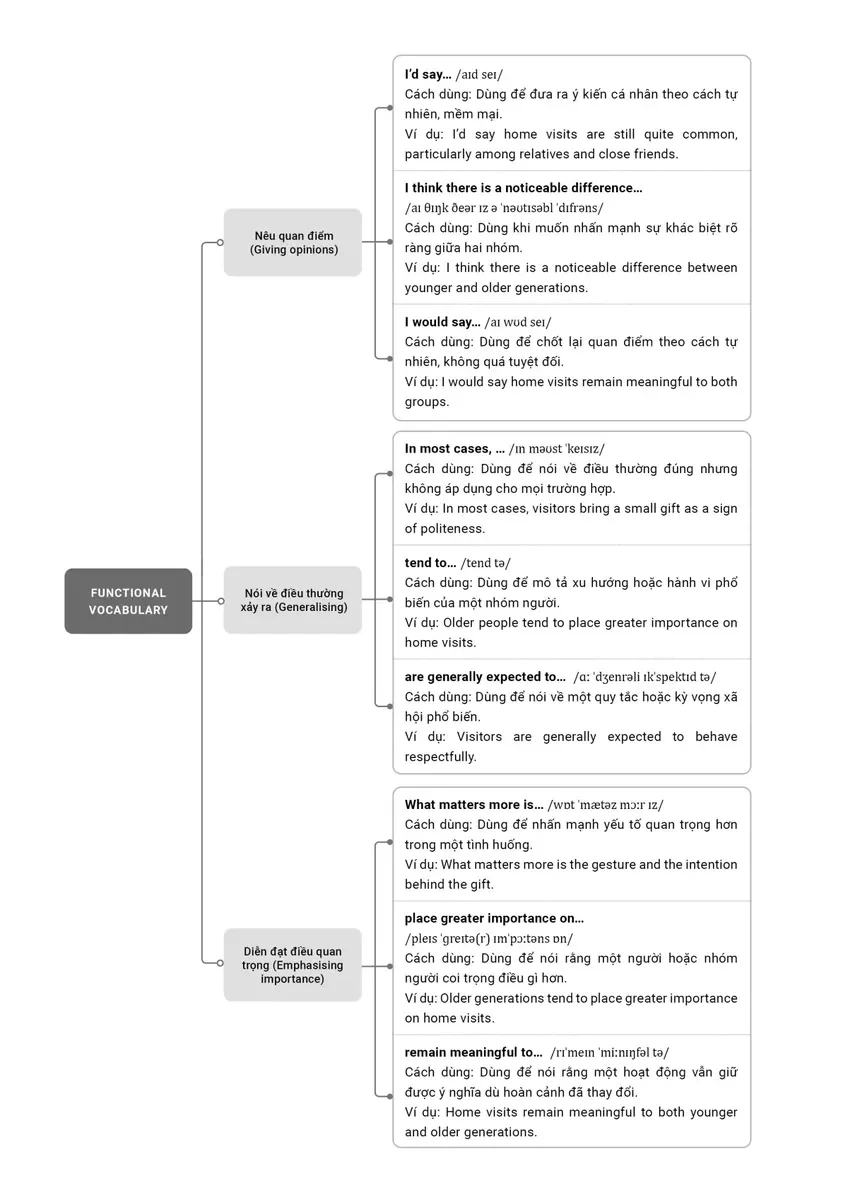
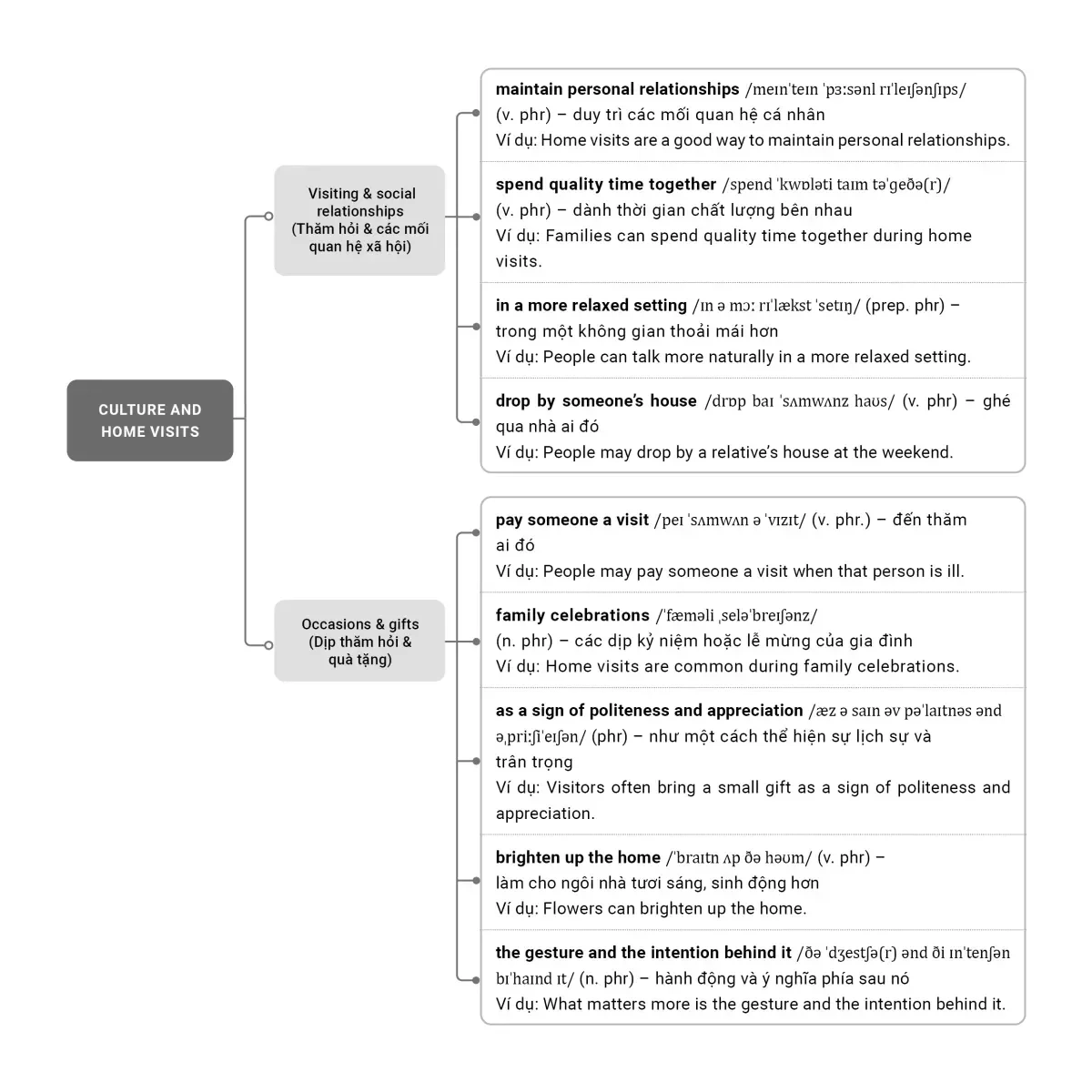
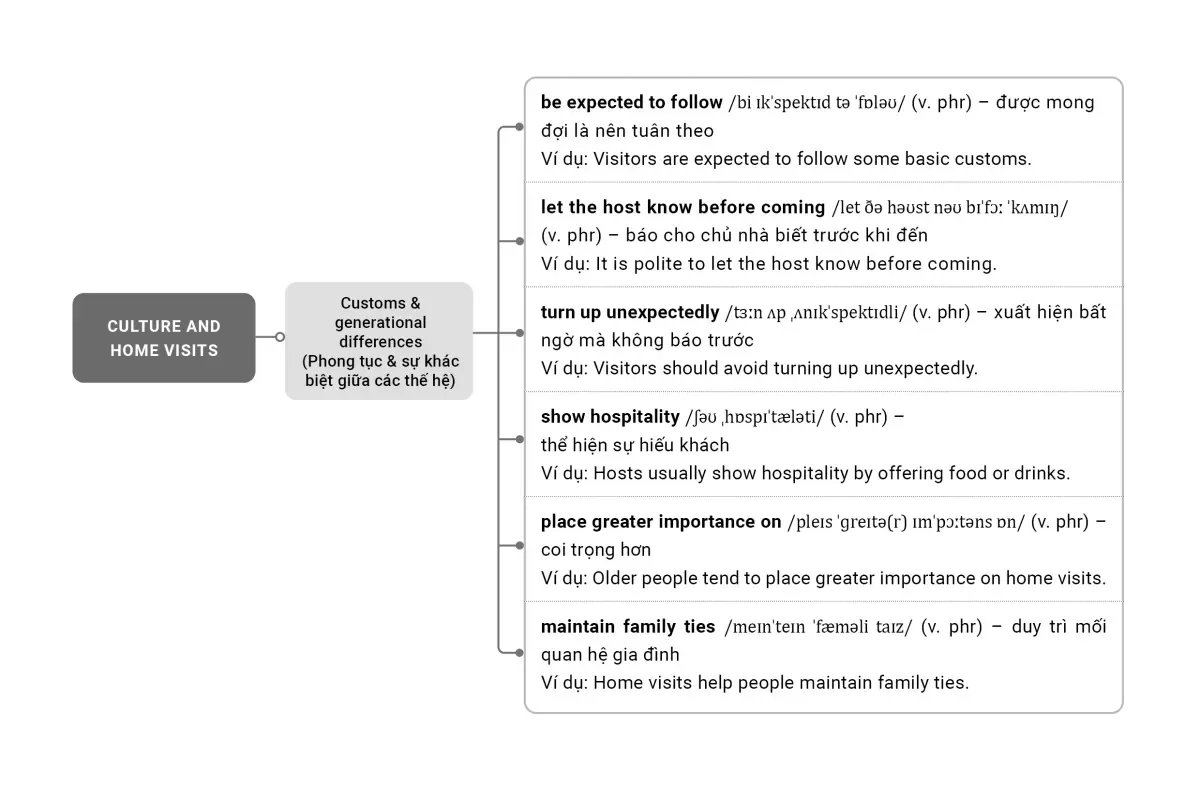
Nhật ký Từ vựng & Ý tưởng
Ghi chú sau khi luyện tập nói về chủ đề trên
Từ vựng/Ý tưởng (Chọn các từ vựng/ý tưởng mà bạn tâm đắc nhất) | Kỉ niệm cá nhân |
|---|---|
Ví dụ: maintain family ties – duy trì mối quan hệ gia đình | Người đọc tự đặt các câu hỏi cho bản thân, ví dụ:
→ I usually visit my relatives during holidays or family celebrations because it is a good way to maintain family ties. When I visit someone’s home, I normally bring some fruit or snacks as a sign of politeness and appreciation. I also try to let the host know before coming instead of turning up unexpectedly. Personally, I enjoy home visits because people can spend quality time together in a more relaxed setting. |
Khoảng trống diễn đạt (Phần khiến bạn ngập ngừng khi nói về chủ đề trên) | Giải pháp (Giải pháp cho các khoảng trống diễn đạt) |
|---|---|
Ví dụ:
| Ví dụ: Dùng từ điển của ZIM hoặc chép các cách diễn đạt từ bài mẫu ở các phần trên để có được cụm từ mà bạn cần. → Thay vì chỉ nói older people think home visits are important thì hãy dùng older people tend to place greater importance on home visits |
Người đọc có thể tìm từ vựng bằng từ điển ZIM Dictionary.
Các lỗi ngữ pháp/từ vựng thường gặp
1. Dùng sai cấu trúc nhượng bộ “although / despite”
❌ Lỗi thường gặp:
Despite younger people prefer meeting outside, they still visit relatives on important occasions.
Although of home visits requiring more preparation, they remain meaningful.
✅ Cách dùng đúng:
despite/in spite of + noun/V-ing
✔ Câu đúng:
Although younger people prefer meeting outside, they still visit relatives on important occasions.
Despite requiring more preparation, home visits remain meaningful.
📌 Lý do sai:
“Although” phải đi với một mệnh đề hoàn chỉnh, trong khi “despite/in spite of” đi với danh từ, cụm danh từ hoặc V-ing.
2. Dùng sai “have someone over”
❌ Lỗi thường gặp:
We sometimes have our relatives come over our house for dinner.
My parents often have guests to our home during holidays.
✅ Cách dùng đúng:
have someone over = mời ai đến nhà
invite someone over
have someone over for + meal/event
✔ Câu đúng:
We sometimes have our relatives over for dinner.
My parents often invite guests over during holidays.
📌 Lý do sai:
“Have someone over” đã mang nghĩa mời/đón ai đến nhà, nên không cần thêm “come over our house”.
3. Dùng sai “avoid + V-ing”
❌ Lỗi thường gặp:
People should avoid to turn up unexpectedly.
Visitors should avoid to stay for too long.
✅ Cách dùng đúng:
✔ Câu đúng:
People should avoid turning up unexpectedly.
Visitors should avoid staying for too long.
📌 Lý do sai:
“avoid” phải đi với V-ing, không dùng “to V”.
Mini practice |
|---|
Dùng đúng cấu trúc trong ngoặc
|
Các chủ đề liên quan
Chủ đề liên quan để sử dụng từ vựng & ý tưởng:
Family relationships (Mối quan hệ gia đình)
Social customs and traditions (Phong tục và truyền thống xã hội)
Generational differences (Sự khác biệt giữa các thế hệ)
Người đọc có thể sử dụng:
Từ vựng: maintain family ties, spend quality time together, pay someone a visit, show care and support, as a sign of politeness and appreciation, turn up unexpectedly, show hospitality, place greater importance on, remain meaningful to ...
Ý tưởng:
Việc đến thăm nhà giúp các thành viên trong gia đình duy trì mối quan hệ và dành thời gian cho nhau.
Mang một món quà nhỏ khi đến thăm nhà thể hiện sự lịch sự và trân trọng đối với chủ nhà.
Một số quy tắc như báo trước khi đến hoặc không ở lại quá lâu giúp mọi người cảm thấy thoải mái hơn.
Người lớn tuổi thường coi trọng các phong tục thăm hỏi và gặp gỡ gia đình hơn.
Người trẻ vẫn coi trọng các mối quan hệ nhưng thường thích gặp nhau ở quán cà phê hoặc nhà hàng vì tiện hơn.
Mini practice: Sử dụng từ vựng và ý tưởng ở trên để trả lời các câu hỏi sau
Why is spending time with family important?
(Gợi ý: maintain family ties, spend quality time together, show care and support)Why are social customs important when visiting someone?
(Gợi ý: politeness and appreciation, show hospitality, turn up unexpectedly)Why do younger and older people sometimes have different social habits?
(Gợi ý: place greater importance on, convenient, require less preparation, remain meaningful to)
Tổng kết
Hy vọng rằng qua việc phân tích hai cấp độ trả lời từ Simple Answer để đảm bảo sự trôi chảy đến Upgraded Answer để ghi điểm ấn tượng, bạn đã nắm vững được lộ trình để chinh phục chủ đề Culture and Home visits (Part 3). Bằng cách cá nhân hóa các câu trả lời thông qua "Nhật ký Từ vựng & Ý tưởng", bạn sẽ xây dựng được sự tự tin. Đừng quên thực hành các bài tập nhỏ (mini practice) để khắc phục những lỗi ngữ pháp thường gặp và làm chủ ngôn ngữ của mình nhé!
Nếu bạn muốn nâng cao kỹ năng IELTS Speaking theo lộ trình cá nhân hóa, Hệ thống giáo dục ZIM cung cấp các khóa luyện thi IELTS cam kết đầu ra, giúp bạn tối ưu hiệu quả học tập và tiết kiệm đến 80% thời gian tự học. Để được tư vấn chi tiết, vui lòng liên hệ hotline 1900-2833 (nhánh 1) hoặc truy cập Khóa học IELTS.
Nguồn tham khảo
1
“Bài mẫu IELTS Speaking Part 3.” OpenAI, https://chatgpt.com/share/e/6961b6c8-4368-8002-995c-cd65b4729b18. Accessed 8 August 2026.
Bình luận - Hỏi đáp