


Chủ đề IELTS Speaking: Part 3: Environmental Protection.
Bài mẫu cho các nhóm câu hỏi:
Government's role? (Introduce laws, strict enforcement, create a framework).
Children's awareness? (School lessons, exposed to topics earlier).
Schools' actions? (Curriculum, hands-on activities like tree-planting).
Individual contribution? (Small habits, reusable items, meaningful impact).
Now vs. Past? (Industrial activity, population growth, global scale).
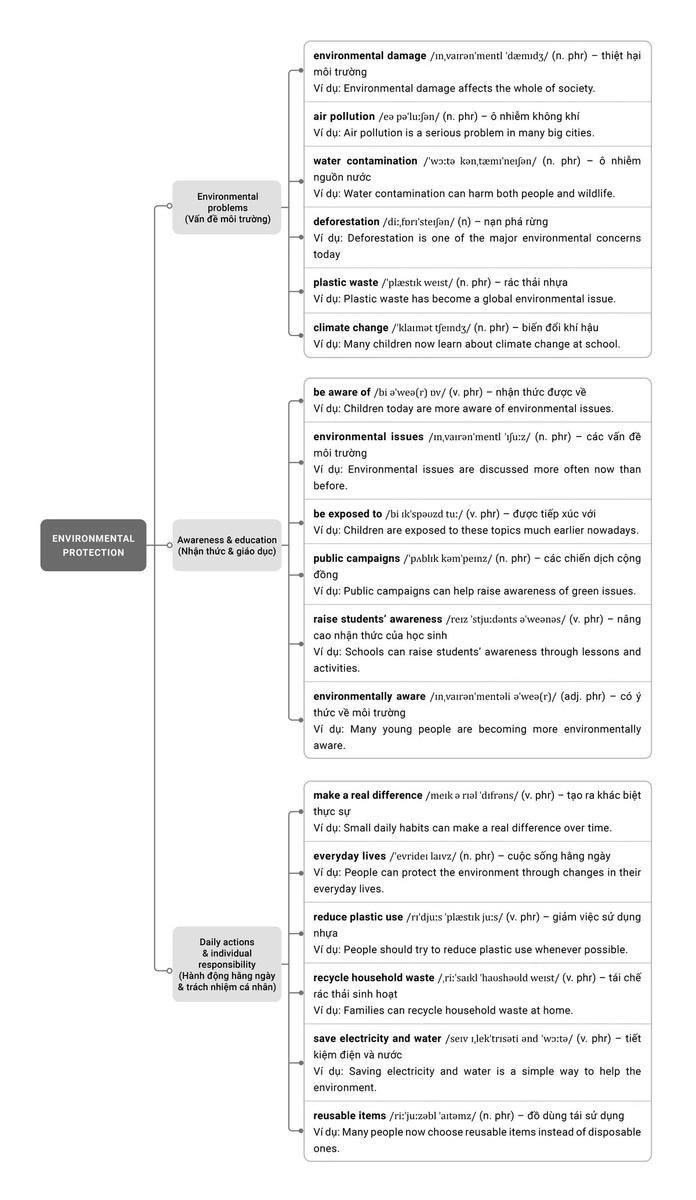
Nhóm từ vựng trọng tâm (Topic Vocabulary): Environmental Issues, Awareness & Education, Solutions & Laws, và Daily Habits.
Bài mẫu IELTS Speaking Part 3 Topic “Environmental Protection” kèm từ vựng
Trong bài viết này, tác giả sẽ gợi ý bài mẫu cho Topic “Environmental Protection” và phân tích các từ vựng ghi điểm cho phần thi IELTS Speaking Part 3.
Key takeaways
Bài viết tham khảo cho chủ đề IELTS Speaking Part 3 Topic Environmental Protection sau đây sẽ cung cấp các câu trả lời mẫu theo khung sườn tư duy (Simple Answer) cùng các thử thách nâng cấp (Upgraded Answer) về cả ý tưởng, từ vựng và ngữ pháp để người học lựa chọn được câu trả lời phù hợp với bản thân, sẵn sàng cho các tình huống trong phòng thi. Bài phân tích này sẽ dẫn dắt người học đi qua chủ đề Environmental Protection, từ những nỗ lực cấp vĩ mô như việc ban hành 'environmental laws' và 'strict enforcement' (thực thi nghiêm ngặt) đến những hành động nhỏ của cá nhân giúp 'make a real difference' (tạo ra khác biệt thực sự), giúp người học chinh phục giám khảo bằng sự mạch lạc và ngôn ngữ tự nhiên.
IELTS Speaking Part 3: Environmental Protection - Sample Answer
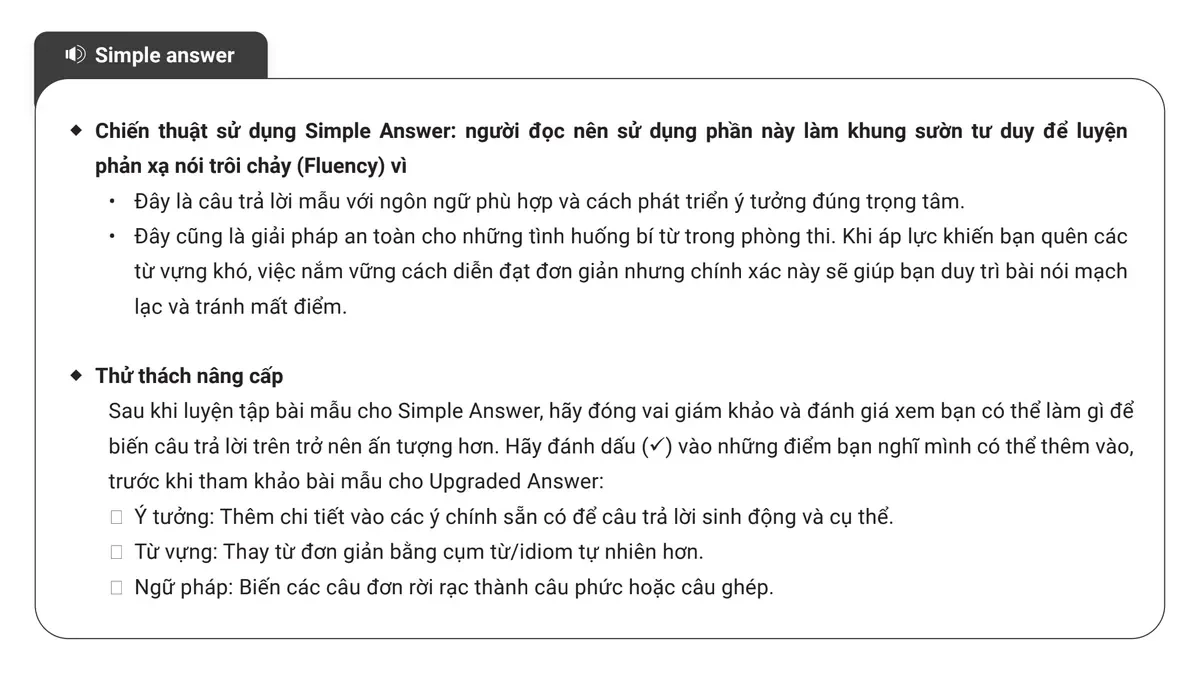
Simple answer
1. Do you think governments should introduce more laws to protect the environment? Why or why not?
|
Yes, I think governments should introduce more laws to protect the environment. The main reason is that environmental problems affect everyone, so strong rules are needed to control pollution and protect natural resources. For example, governments can make laws to reduce plastic use, limit factory emissions, or punish illegal dumping. So overall, stricter environmental laws can help create a cleaner and safer place to live. |
2. Do you think children are aware of environmental issues today? Why or why not?
|
Yes, I think many children today are more aware of environmental issues than before. This is because they learn about topics like pollution, recycling, and climate change at school and also see them on TV or the internet. For example, many children know that they should not waste water or throw rubbish on the ground. So, I think children today understand environmental problems better than in the past. |
3. What can schools do to raise students’ awareness of environmental protection?
|
I think schools can do many things to raise students’ awareness of environmental protection. First, they can teach students about environmental problems in lessons and explain simple ways to protect nature. They can also organize activities like tree planting, clean-up days, or recycling projects. For example, if students join a school recycling campaign, they can learn good habits through real action. So overall, schools can help students become more responsible toward the environment. |
4. How can individuals contribute to protecting the environment in their daily lives?
|
Well, individuals can contribute to protecting the environment by making small changes in their daily lives. They can save water, use less plastic, recycle waste, and choose public transport instead of private cars when possible. For example, bringing a reusable bottle or cloth bag is a simple action, but it can reduce waste over time. So, even small everyday actions can make a positive difference. |
5. Do you think environmental problems are more serious now than in the past? Why?
|
Yes, I think environmental problems are more serious now than in the past. The main reason is that there are more people, more traffic, more factories, and more waste than before, so pollution has become a bigger problem. For example, many cities now face serious air pollution, plastic waste, and extremely hot weather. So overall, environmental issues have become more worrying and more difficult to solve. |
Tham khảo: Tổng hợp bài mẫu IELTS Speaking 2026
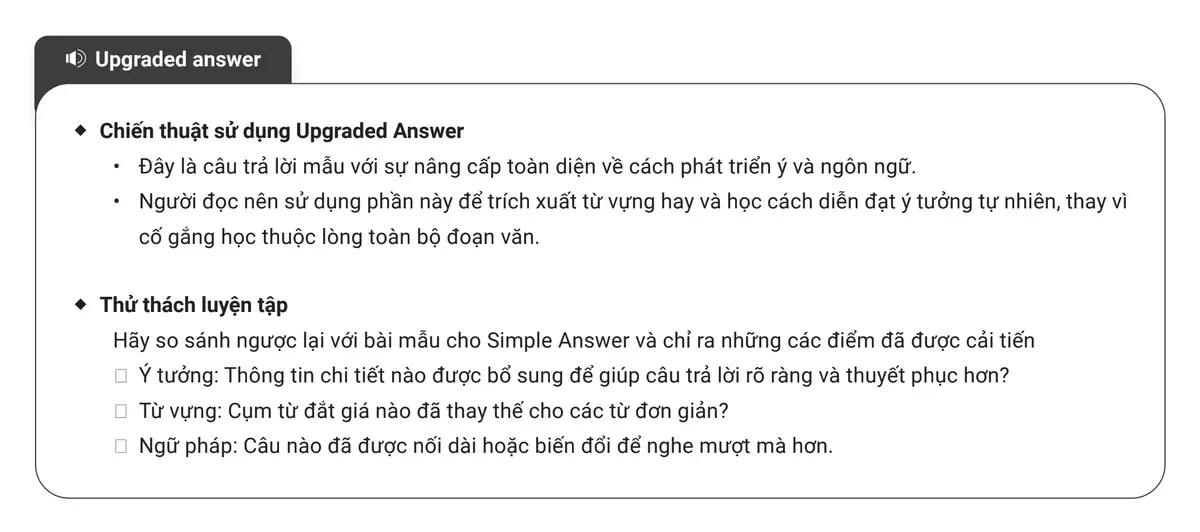
Upgraded answer
1. Do you think governments should introduce more laws to protect the environment? Why or why not?
|
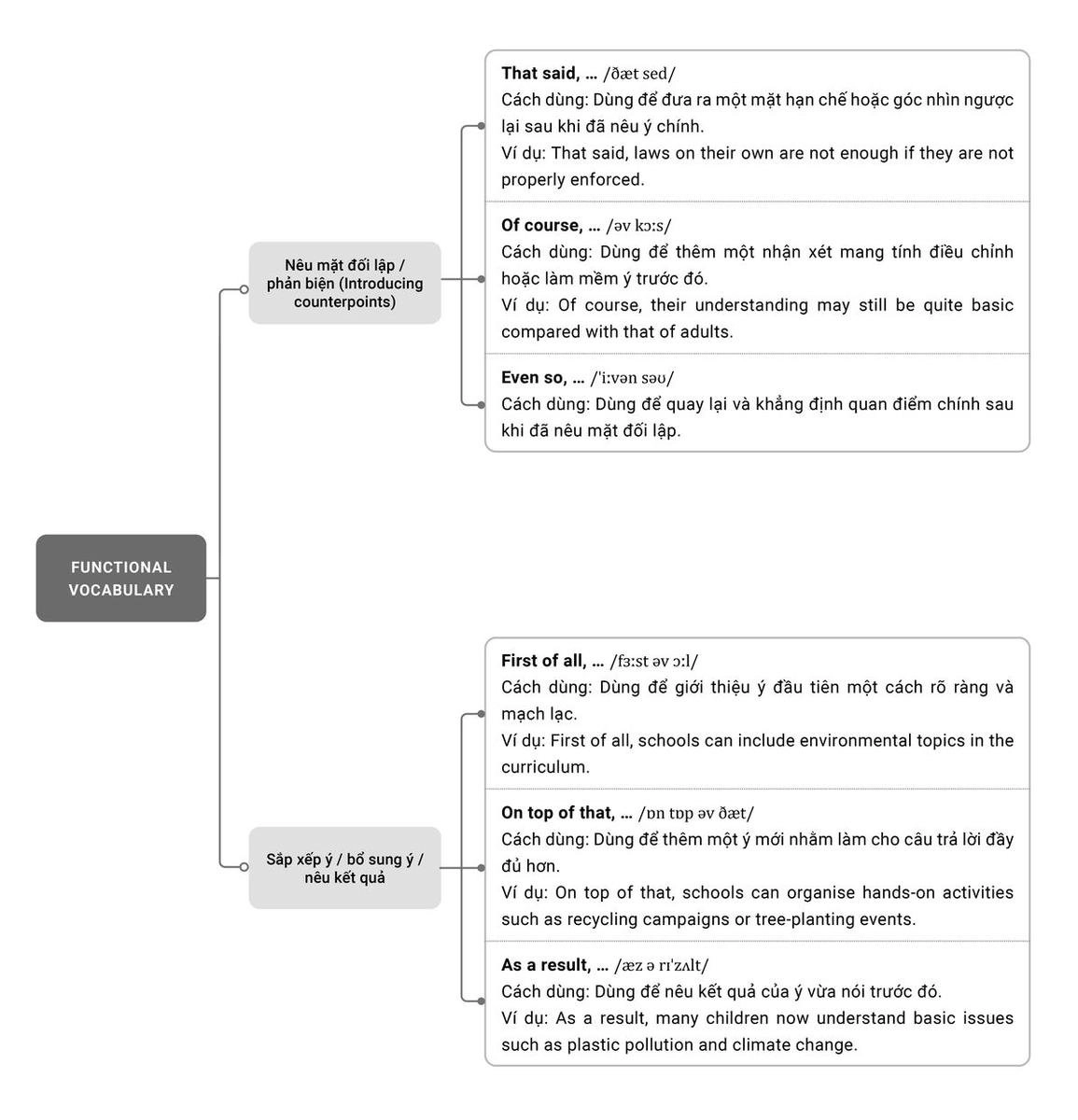
Yes, absolutely. I do think governments should introduce more laws to protect the environment, mainly because environmental damage affects the whole of society and cannot be solved by individual action alone. Problems such as air pollution, water contamination, deforestation, and plastic waste are far too large to be controlled without clear rules and strict enforcement. For example, governments can ban certain single-use plastics, impose heavier fines on companies that release toxic waste, or set stricter limits on vehicle emissions. That said, laws on their own are not enough if they are not properly enforced or if the public does not support them. Even so, I still believe stronger environmental laws are essential, because they create a clear framework for long-term protection. |
2. Do you think children are aware of environmental issues today? Why or why not?
|
Yes, to a large extent, I think children today are more aware of environmental issues than previous generations. The main reason is that they are exposed to these topics much earlier through school lessons, social media, documentaries, and public campaigns. As a result, many children now understand basic issues such as plastic pollution, climate change, deforestation, and the importance of recycling. For instance, it is quite common to see young students reminding their parents not to waste water, to switch off lights, or to bring reusable bags when shopping. Of course, their understanding may still be quite basic compared with that of adults. Even so, I would say children today are far more environmentally aware than many people assume. |
3. What can schools do to raise students’ awareness of environmental protection?
|
I think schools can play a huge role in raising students’ awareness of environmental protection. First of all, they can include environmental topics in the curriculum so that students learn not only about the problems themselves, but also about practical solutions. On top of that, schools can organise hands-on activities such as recycling campaigns, tree-planting events, clean-up projects, or competitions about green living. For example, if a school sets up separate bins for paper, plastic, and food waste, students are more likely to develop environmentally friendly habits through daily practice rather than just theory. So, in my view, schools are in a very good position to shape responsible attitudes from an early age. |
4. How can individuals contribute to protecting the environment in their daily lives?
|
Well, I’d say individuals can make a real difference by changing small habits in their everyday lives. Although one person cannot solve global environmental problems alone, simple actions taken consistently can still have a meaningful impact over time. For example, people can reduce their use of plastic, recycle household waste, save electricity and water, use public transport, or choose reusable items instead of disposable ones. Someone who brings a reusable bottle to work every day, switches off unnecessary lights, and avoids wasting food is already contributing in a practical way. So, when you think about it, environmental protection is not only the responsibility of governments or companies; it also begins with ordinary daily choices. |
5. Do you think environmental problems are more serious now than in the past? Why?
|
Yes, definitely. I do think environmental problems are much more serious now than they were in the past, mainly because industrial activity, population growth, and modern consumption have all increased dramatically. Nowadays, there is far more traffic, plastic waste, energy use, and large-scale production than before, which puts enormous pressure on the natural environment. For instance, many countries are now dealing with severe air pollution, rising temperatures, water shortages, and extreme weather events such as floods, droughts, or heatwaves. By contrast, although environmental problems did exist in the past, they were often more local and less visible on a global scale. So overall, I would say environmental issues have become both more urgent and more difficult to ignore. |
Đọc thêm: 3 cách thức tư duy câu trả lời IELTS Speaking Part 3
Lọc và phân tích từ vựng
Đọc thêm: Từ vựng về môi trường (environment)
Nhật ký từ vựng & ý tưởng
Ghi chú sau khi luyện tập nói về chủ đề trên
Từ vựng/Ý tưởng (Chọn các từ vựng/ý tưởng mà bạn tâm đắc nhất) | Kỉ niệm cá nhân |
|---|---|
Ví dụ: make a real difference – tạo ra khác biệt thực sự | Người đọc tự đặt các câu hỏi cho bản thân, ví dụ:
→ I remember that in secondary school, I once joined a clean-up activity with my classmates around our neighbourhood. At first, I thought it was just a small school event, but after seeing so much plastic waste on the streets, I realised that environmental problems were much more serious than I had imagined. Since then, I have tried to make small changes in my everyday life, such as using a reusable bottle, saving water, and avoiding unnecessary plastic bags. I know these actions may seem small, but I believe they can still make a real difference over time. That experience also made me feel that environmental protection is not only the responsibility of governments, but also something individuals should take seriously. |
Khoảng trống diễn đạt (Phần khiến bạn ngập ngừng khi nói về chủ đề trên) | Giải pháp (Giải pháp cho các khoảng trống diễn đạt) |
Ví dụ:
| Ví dụ: Dùng từ điển của ZIM hoặc chép các cách diễn đạt từ bài mẫu ở các phần trên để có được cụm từ mà bạn cần. →Thay vì chỉ nói “government should act” → dùng introduce more laws / create a clear framework / strict enforcement / ban single-use plastics |
Người đọc có thể tìm từ vựng bằng từ điển ZIM Dictionary.
Các lỗi ngữ pháp/từ vựng thường gặp
1. Dùng sai giữa “environment”, “environmental” và “environmentally”
❌ Lỗi thường gặp:
We need more environment laws.
Children are environment aware nowadays.
✅ Cách dùng đúng:
environment = môi trường (danh từ)
environmental = thuộc về môi trường (tính từ)
environmentally = về mặt môi trường (trạng từ)
✔ Câu đúng:
We need more environmental laws.
Children are environmentally aware nowadays.
📌 Lý do sai: Người học thường nhầm loại từ. “Environment” là danh từ, còn khi đứng trước “laws”, “issues”, “problems”, phải dùng tính từ “environmental”.
2. Dùng sai cấu trúc của từ “protect”
❌ Lỗi thường gặp:
Governments should protect for the environment.
People need to protect environment more.
✅ Cách dùng đúng:
protect + tân ngữ
protect the environment
✔ Câu đúng:
Governments should protect the environment.
People need to protect the environment more.
📌 Lý do sai: Sau “protect” không có giới từ “for”. Ngoài ra, trong cụm quen thuộc này thường cần mạo từ “the”: protect the environment.
3. Dùng sai cấu trúc sau “contribute to”
❌ Lỗi thường gặp:
Individuals can contribute protecting the environment.
Everyone should contribute for environmental protection.
✅ Cách dùng đúng:
contribute to + danh từ / cụm danh từ
contribute to + V-ing
✔ Câu đúng:
Individuals can contribute to protecting the environment.
Everyone should contribute to environmental protection.
📌 Lý do sai: Sau “contribute” phải có giới từ “to”. Vì vậy người học dễ quên “to” hoặc dùng sai giới từ khác như “for”.
Mini practice |
|---|
Dùng đúng cấu trúc trong ngoặc
(Dùng: environmental laws / environmentally aware)
(Dùng: protect the environment)
(Dùng: contribute to + danh từ / contribute to + V-ing) |
Các chủ đề liên quan
Chủ đề liên quan để sử dụng từ vựng & ý tưởng:
Climate change and global problems (Biến đổi khí hậu & các vấn đề toàn cầu)
School education and social awareness (Giáo dục học đường & nhận thức xã hội)
Daily habits and responsible living (Thói quen hằng ngày & lối sống có trách nhiệm)
Người đọc có thể sử dụng:
Từ vựng:
environmental laws, protect the environment, strict enforcement, air pollution, plastic waste, climate change, raise awareness, hands-on activities, recycling campaigns, make a real difference, reusable items, …
Ý tưởng:
Chính phủ cần có luật nghiêm ngặt hơn vì các vấn đề môi trường ảnh hưởng đến toàn xã hội và không thể giải quyết chỉ bằng nỗ lực cá nhân.
Trẻ em ngày nay có nhận thức tốt hơn về môi trường vì các em được tiếp xúc sớm với những chủ đề này qua trường học, mạng xã hội và các chiến dịch cộng đồng.
Trường học có thể giúp học sinh hình thành thói quen tốt bằng cách đưa các chủ đề môi trường vào bài học và tổ chức hoạt động thực tế.
Mỗi cá nhân đều có thể góp phần bảo vệ môi trường bằng những thay đổi nhỏ như tiết kiệm điện nước, giảm dùng nhựa và sử dụng đồ tái sử dụng.
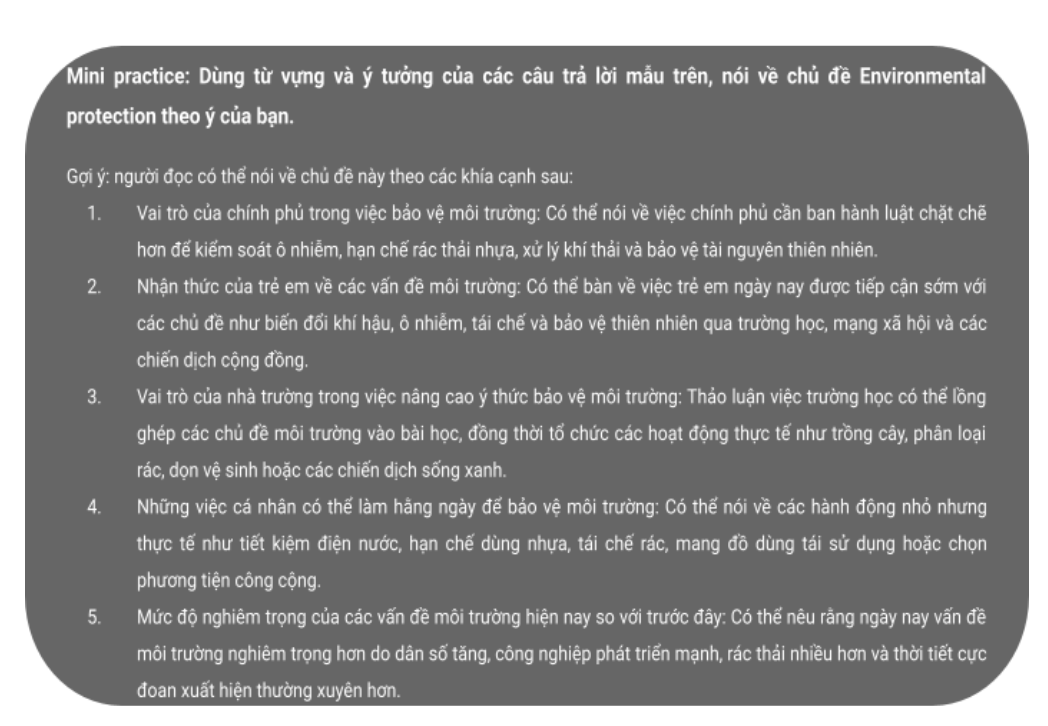
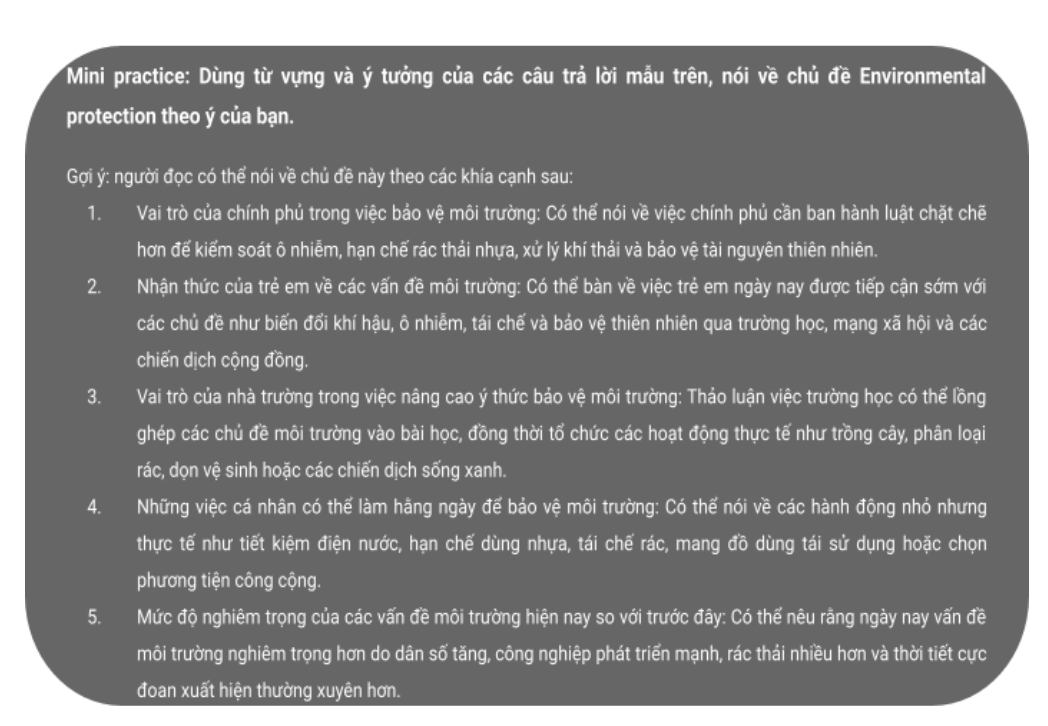
Mini practice |
|---|
Sử dụng từ vựng và ý tưởng ở trên để trả lời các câu hỏi sau
|
Tìm hiểu thêm: Bài mẫu IELTS Speaking Part 3 Topic “Learning about animals”
Tổng kết
Hy vọng rằng qua việc phân tích hai cấp độ trả lời từ Simple Answer để đảm bảo sự trôi chảy đến Upgraded Answer để ghi điểm ấn tượng, bạn đã nắm vững được lộ trình để chinh phục chủ đề IELTS Speaking Part 3 Topic Environmental Protection. Bằng cách cá nhân hóa các câu trả lời thông qua "Nhật ký Từ vựng & Ý tưởng", bạn sẽ xây dựng được sự tự tin. Đừng quên thực hành các bài tập nhỏ (mini practice) để khắc phục những lỗi ngữ pháp thường gặp và làm chủ ngôn ngữ của mình nhé!
Nếu bạn muốn nâng cao kỹ năng IELTS Speaking theo lộ trình cá nhân hóa, Hệ thống giáo dục ZIM cung cấp các khóa luyện thi IELTS cam kết đầu ra, giúp bạn tối ưu hiệu quả học tập và tiết kiệm đến 80% thời gian tự học. Để được tư vấn chi tiết, vui lòng liên hệ hotline 1900-2833 (nhánh 1) hoặc truy cập Khóa học IELTS.
Nguồn tham khảo
1
“Bài mẫu IELTS Speaking Part 3.” OpenAI, chatgpt.com/share/e/6961b6c8-4368-8002-995c-cd65b4729b18. Accessed 17 May 2026.
Bình luận - Hỏi đáp