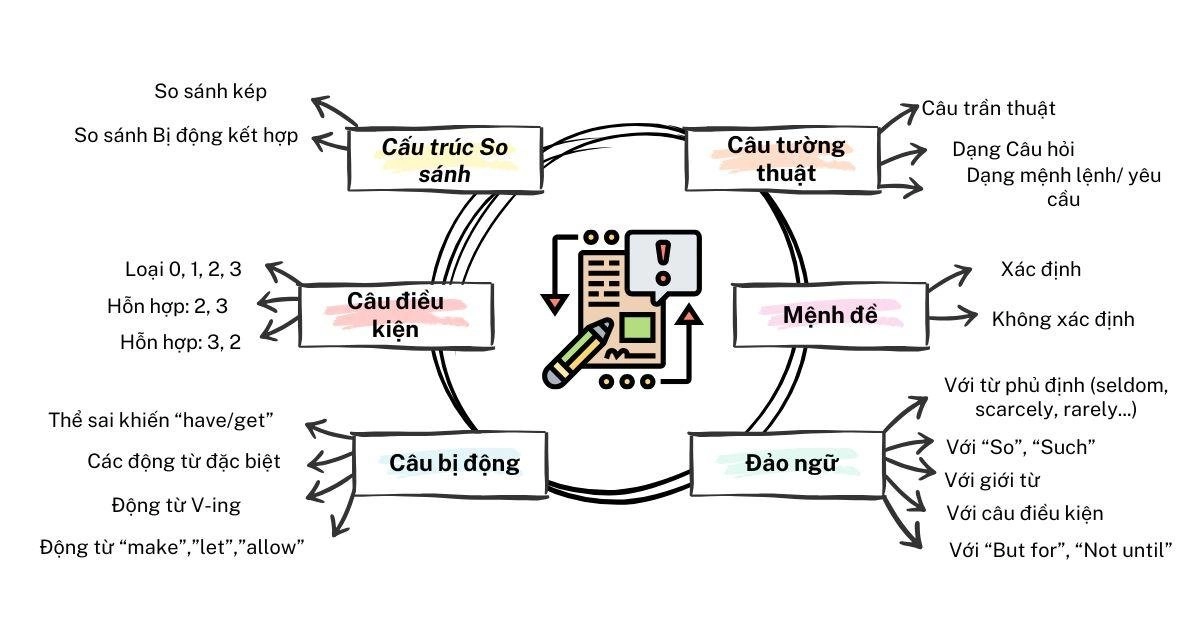
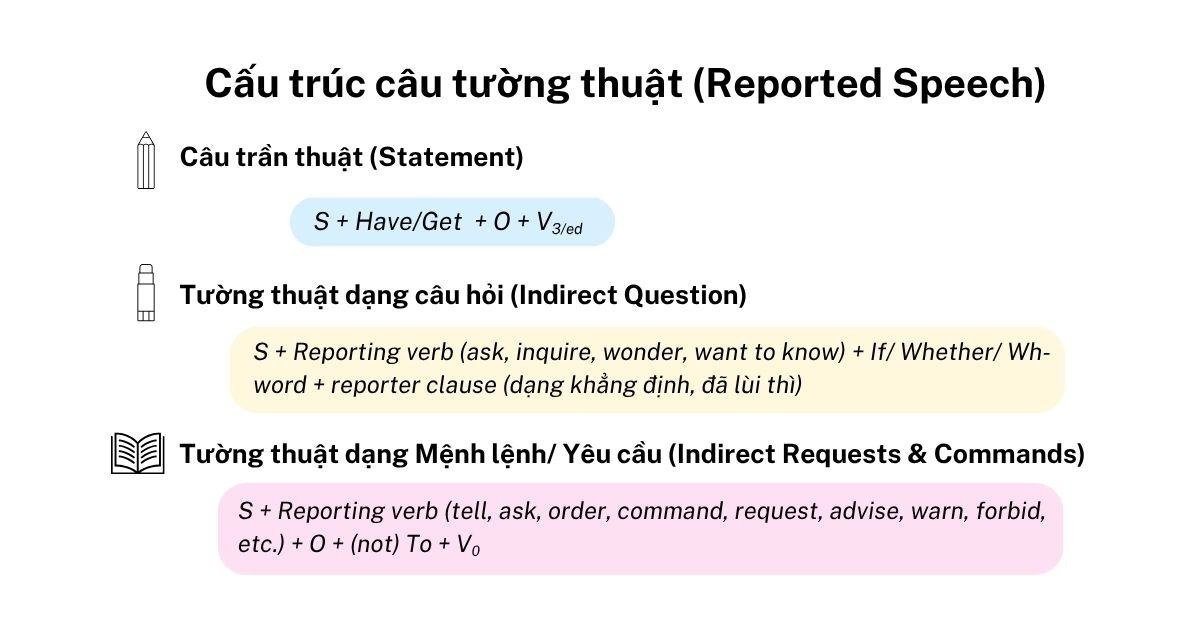
Các cấu trúc viết lại thường gặp: Cấu trúc so sánh, Câu điều kiện, Câu bị động, Câu tường thuật, Mệnh đề quan hệ, Đảo ngữ và một số cấu trúc khác như “It’s high/about time”, “Hardly had”.
Những lỗi sai thường thấy khi viết lại câu:
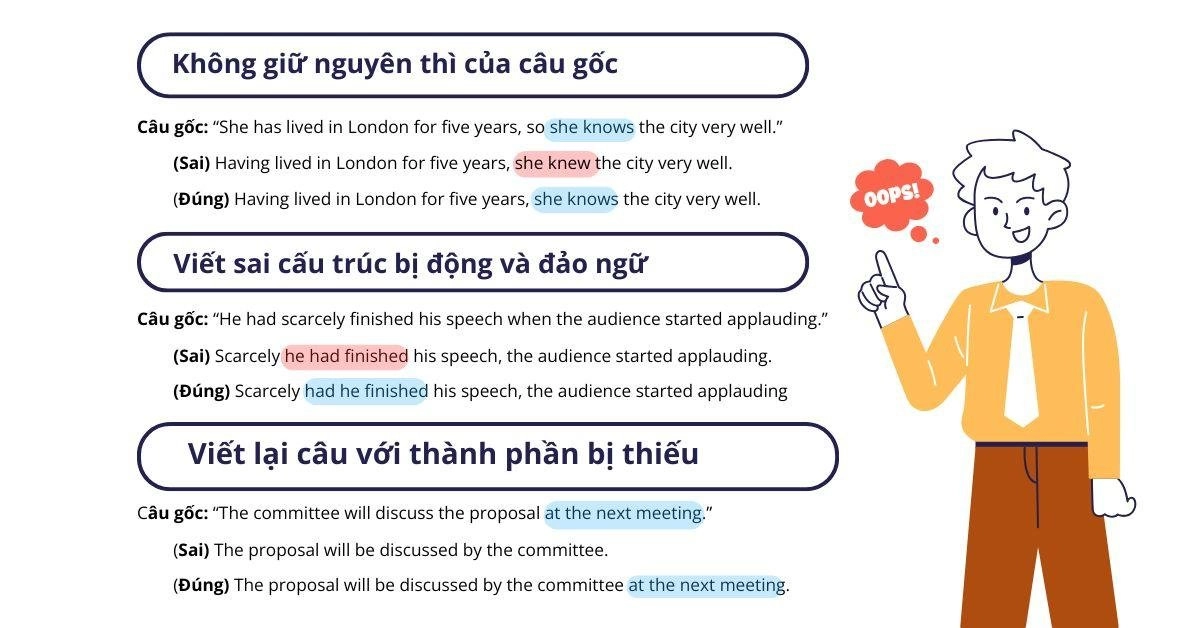
Không giữ nguyên thì của câu gốc
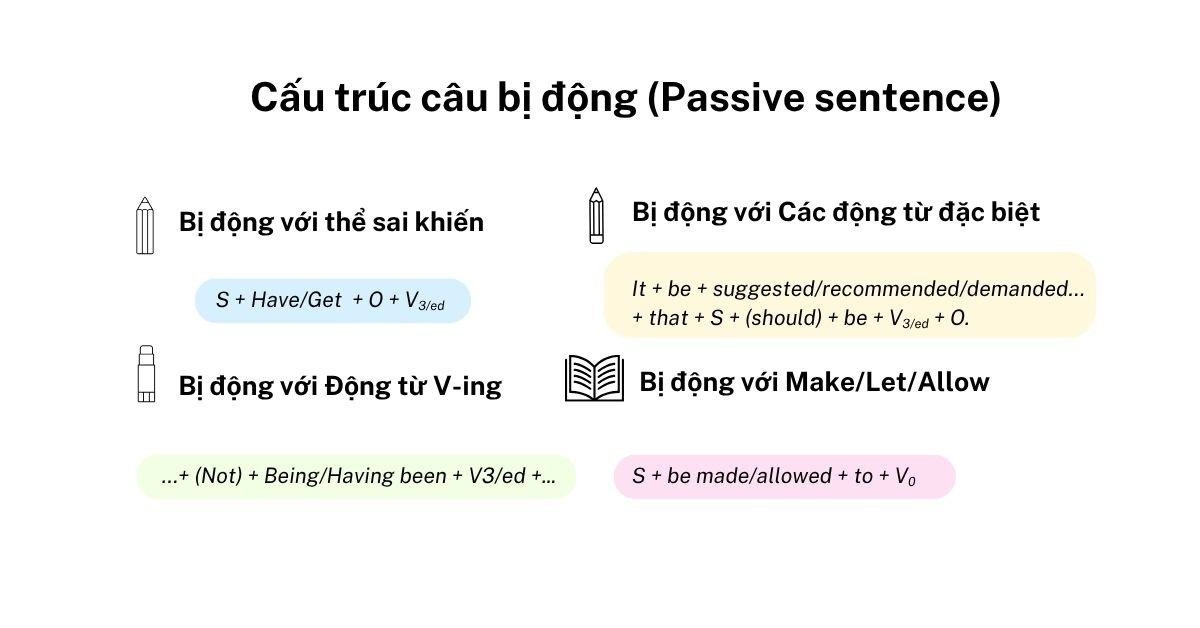
Viết sai cấu trúc bị động và đảo ngữ
Viết lại câu với thành phần bị thiếu
Các cấu trúc viết lại câu thi học sinh giỏi lớp 9 là vô cùng quan trọng và phổ biến trong phần Writing của đề thi Học sinh giỏi tiếng Anh lớp 9. Trong đó, đề thi viết lại câu giữ nguyên nghĩa thường xuất hiện với khoảng 5 câu, chiếm khoảng 20% số điểm Writing. Đây là dạng câu hỏi dễ nhận biết với đề bài: “Finish each of the following sentences in such a way that it means exactly the same as the sentence printed before it.” (Hoàn thành những câu sau với nghĩa không đổi.)
Bài viết này sẽ tổng hợp các cấu trúc viết lại câu thi học sinh giỏi lớp 9 phổ biến và nâng cao, phát hiện những lỗi sai mà thí sinh thường mắc phải và giải một số câu hỏi viết lại được trích từ các đề thi HSG tiếng Anh 9 của một số khu vực.
Các cấu trúc viết lại câu thi học sinh giỏi lớp 9 thường gặp
6+ các cấu trúc viết lại câu thi học sinh giỏi lớp 9
Cấu trúc So sánh (Comparison)
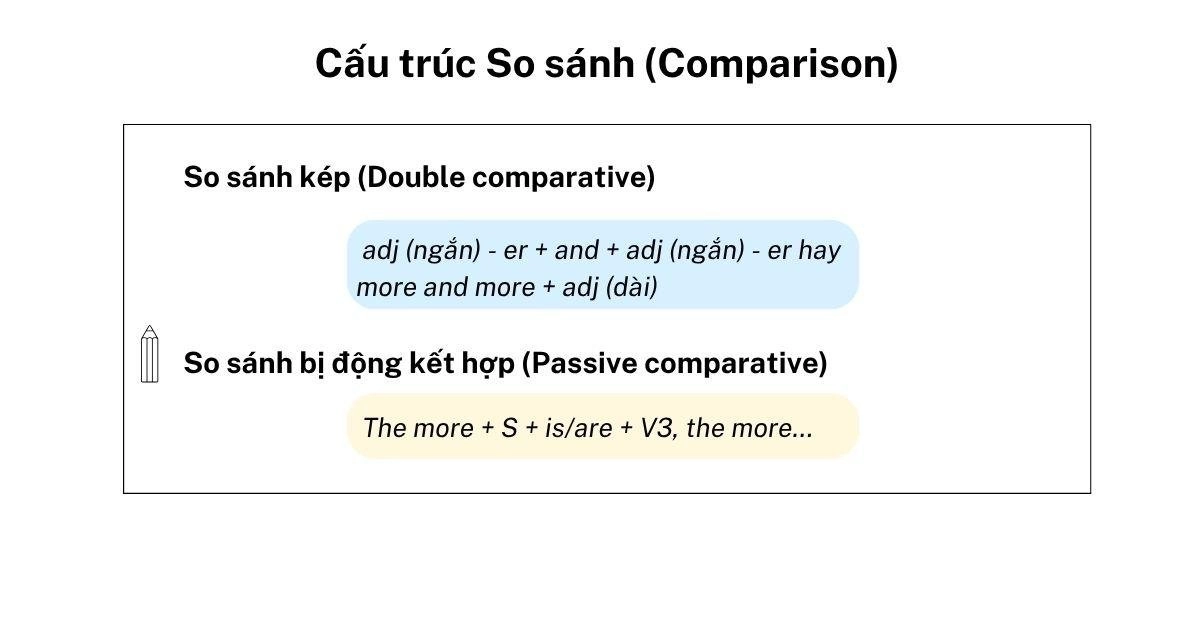
Cấu trúc so sánh (Comparison)
Cấu trúc So sánh kép (Double comparative): adj (ngắn) - er + and + adj (ngắn) - er hay more and more + adj (dài)
Ví dụ: She becomes more confident as she practices more.
→ The more she practices, the more confident she becomes.
Cấu trúc So sánh bị động kết hợp (Passive comparative): The more + S + is/are + V3, the more…
Ví dụ: If the machines are adjusted more precisely, the results become more accurate.
→ The more precisely the machines are adjusted, the more accurate the results are.
Cấu trúc câu Điều kiện (Conditional sentence)
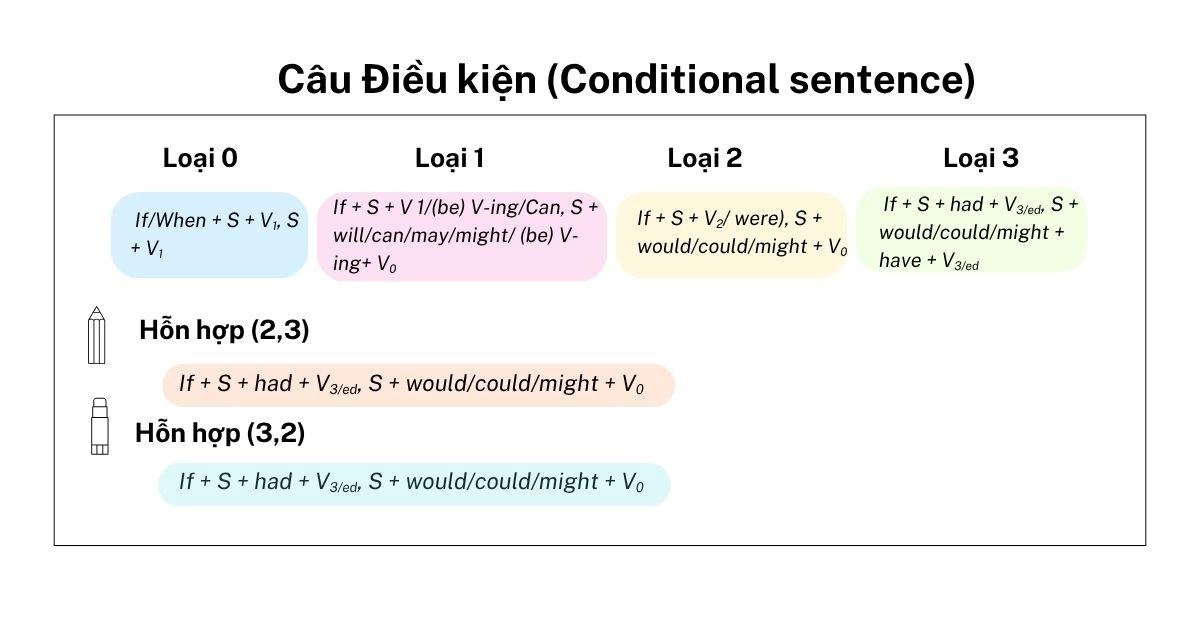
Cấu trúc câu điều kiện (Conditional sentence)
Câu điều kiện loại 0 (Zero)
Dùng điều kiện loại 0 để nói về sự thật hiển nhiên, quy luật tự nhiên, thói quen, hoặc kết quả luôn xảy ra khi điều kiện được đáp ứng.
Cấu trúc: If/When + S + V (hiện tại đơn), S + V (hiện tại đơn)
VD: If/When you press this kerf, the game starts, and when you click here, it stops.
Câu điều kiện loại 1
Cấu trúc: If + S + V (present simple/present continuous)/Can, S + will/can/may/might/ (present continuous) + V (infinitive)
VD: If we can finish this project by Friday, we can take the weekend off.
Câu điều kiện loại 2
Cấu trúc: If + S + V (past simple/ were), S + would/could/might + V (infinitive)
VD: If Mike rang the travel agent tomorrow, he might get a cancellation.
Đôi khi người viết/nói có thể dùng “should…”/ “were to…” ở mệnh đề if để nhấn mạnh khả năng không thể xảy ra. Ví dụ: If you were to listen more carefully, you might understand a little more.
Câu điều kiện loại 3
Cấu trúc: If + S + had + V3/ed, S + would/could/might + have + V3/ed
VD: If the spy had intercepted the message, he could have averted the crisis.
Câu điều kiện hỗn hợp (Mixed conditional)
Cấu trúc 1 (Past condition, Present result):
If + S + had + V3/ed, S + would/could/might + V (infinitive)
VD: If Fleming hadn't discovered penicillin, there would be far more fatalities every year than there actually are.
Cấu trúc 2 (Present/Future condition, Past result):
If + S + V (quá khứ đơn/were), S + would/could/might + have + V3/ed
VD: If the island were still a tourist attraction, last week’s earthquake would have caused more destructions to people.
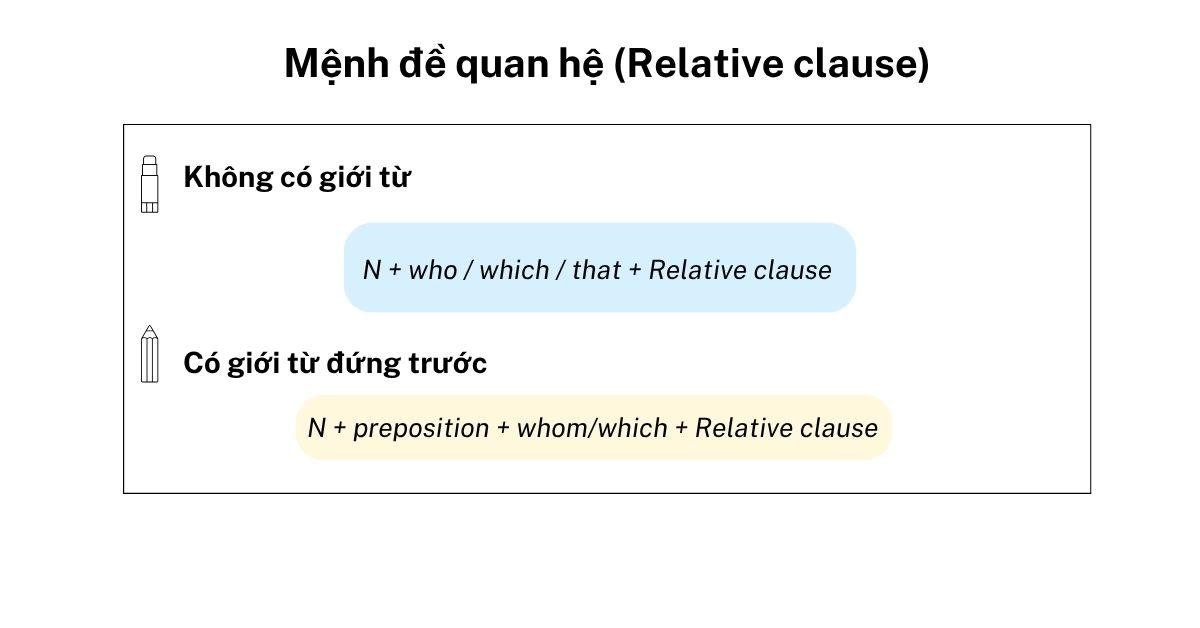
Có hai dạng là Mệnh đề xác định (Defining clause) và Mệnh đề không xác định (Non-defining clause). Viết lại câu với mệnh đề quan hệ có cấu trúc chung như sau [1]:
N + who / which / that + Relative clause
Nếu có giới từ (on, in, at, for, about, with,...) phía trước từ Wh- thì câu sẽ có cấu trúc là:
N + preposition + whom/which + Relative clause
Ví dụ: The hotel was very comfortable. We stayed in it last summer.
→ The hotel in which/where we stayed last summer was very comfortable.
Đảo ngữ (Inversion) có nghĩa là đảo ngược trật tự từ thông thường của chủ ngữ – động từ trong một câu (british). Sau đây là một trong các cấu trúc viết lại câu thi học sinh giỏi lớp 9 thường gặp nhất:
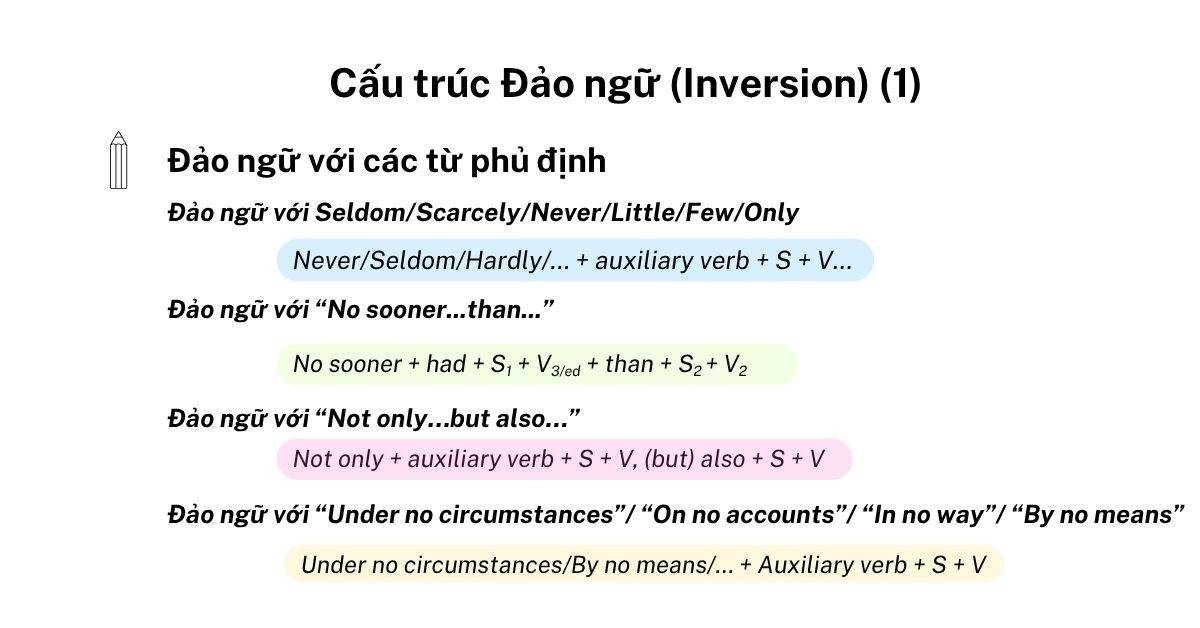
Đảo ngữ với các từ phủ định
Đảo ngữ với “Never”/“Seldom”/“Rarely”/“Hardly”/“Scarcely”/”Little”/”Few”/”Only”
Cấu trúc: Never/Seldom/Hardly/… + auxiliary verb + S + V…
Ví dụ: The government has hardly ever suffered such an overwhelming defeat.
→ Seldom has the government suffered such an overwhelming defeat.
Đảo ngữ với “No sooner…than”
Cấu trúc: No sooner + had + S1 + V3 + than + S2 + V2
Ví dụ: As soon as we arrived they announced that the show was cancelled.
→ No sooner had we arrived than they announced that the show was cancelled.
Đảo ngữ với “Not only…but also…”
Cấu trúc: Not only + auxiliary verb + S + V, (but) also + S + V
Ví dụ: Rap jumping was more exciting and a lot more dangerous than bungee jumping.
→ Not only was rap jumping more exciting than bungee jumping, it was also a lot more dangerous.
Đảo ngữ với “Under no circumstances”/ “On no accounts”/ “In no way”/ “By no means”
Cấu trúc: Under no circumstances/By no means/… + Auxiliary verb + S + V
Ví dụ: You absolutely must not disclose this confidential information.
→ Under no circumstances should you disclose this confidential information.
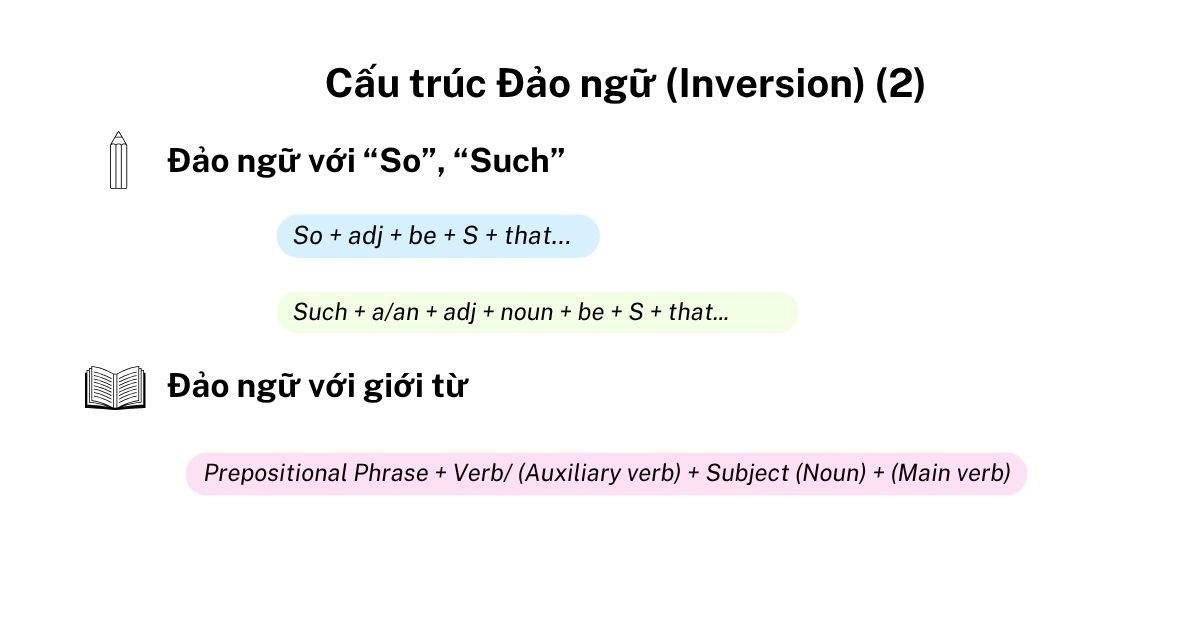
Cấu trúc đảo ngữ (Inversion) (2)
Đảo ngữ với “So”, “Such”
Cấu trúc 1: So + adj + be + S + that…
Cấu trúc 2: Such + a/an + adj + noun + be + S + that...
Ví dụ: It was such delicious food that we couldn’t stop eating.
→ Such delicious food that we couldn’t stop eating.
Ví dụ: A tiny kitten was hiding under the old wooden table.
→ Under the old wooden table was hiding a tiny kitten.
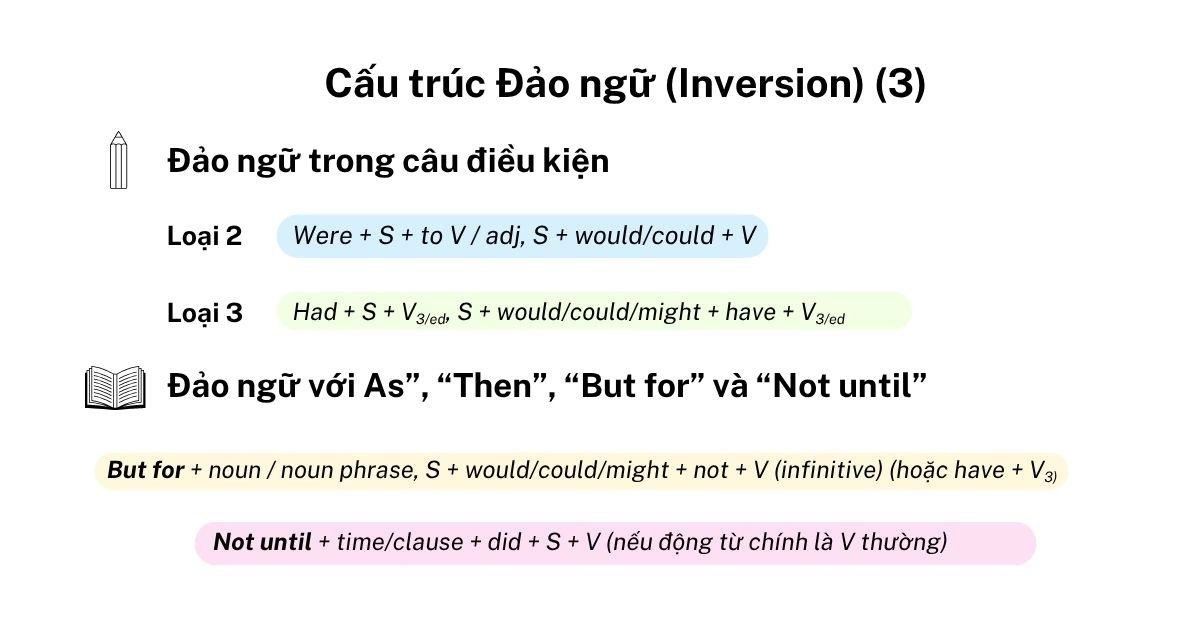
Cấu trúc đảo ngữ (Inversion) (3)
Đảo ngữ trong câu điều kiện (Conditional)
Đảo ngữ trong câu điều loại 2
Cấu trúc: Were + S + to V / adj, S + would/could + V
Ví dụ: How would the environment be affected if everyone reduced their meat consumption?
→ How would the environment be affected were everyone to reduce their meat consumption?
Đảo ngữ trong câu điều loại 3
Cấu trúc: Had + S + V3/ed, S + would/could/might + have + V3/ed
Ví dụ: If I had known that, I would have acted differently
→ Had I known that, I would have acted differently
Đảo với ngữ với “As”, “Then”, “But for” và “Not until”
Cấu trúc chung khi sử dụng “As”, “Then” trong câu đảo ngữ là dùng tính từ (trạng từ) có so sánh hơn (nếu có) đứng đầu câu + “as”/ “than” + các phần còn lại của câu (chỉ đổi vị trị trí của tính từ, các thành phần khác không đổi).
Ví dụ: Although he is talented, he’s still humble
→ Talented as he is, he’s still humble.
Đảo ngữ với “But for…” (Nếu không vì…):
Cấu trúc: But for + noun / noun phrase, S + would/could/might + not + V (infinitive) (hoặc have + V3)
Ví dụ: Richard only took over the family business because his father decided to retire early → But for his father’s early retirement, Richard wouldn’t have taken over his family business.
Đảo ngữ với “Not until…” (Cho đến khi…):
Cấu trúc: Not until + time/clause + did + S + V (nếu động từ chính là V thường)
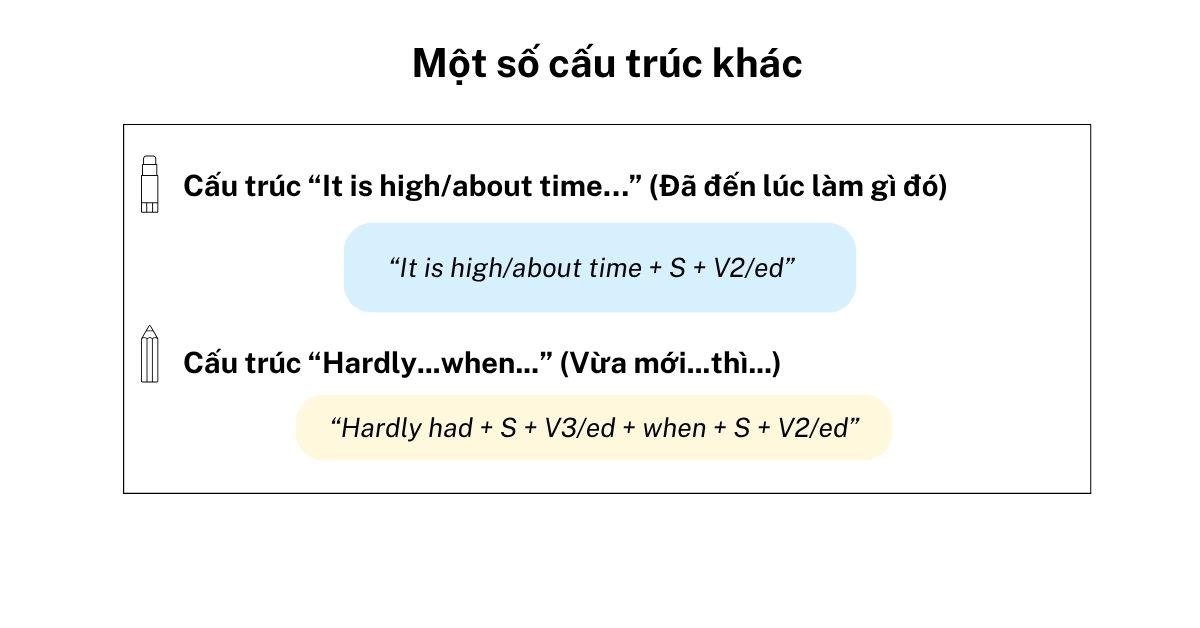
Một số các cấu trúc viết lại câu thi học sinh giỏi lớp 9 khác
Một số các cấu trúc viết lại câu thi học sinh giỏi lớp 9 khác
Cấu trúc “It is high/about time…” (Đã đến lúc làm gì đó)
“It is high/about time + S + V2/ed”.
Ví dụ: You ought to start doing your homework
→ It’s high time you started doing/ did your homework.
Cấu trúc “Hardly had… when…” (Vừa mới…thì…)
“Hardly had + S + V3/ed + when + S + V2/ed”
Ví dụ: I had hardly left the house when it started to rain.
→ Hardly had I left the house when it started to rain.
Những lỗi học sinh dễ mắc phải khi làm bài viết lại câu thi học sinh giỏi lớp 9
Những lỗi thường gặp với các cấu trúc viết lại thi học sinh giỏi lớp 9
Không giữ nguyên thì của câu gốc: Đây là lỗi phổ biến nhất khi học sinh cố gắng áp dụng các quy tắc lùi thì một cách máy móc hoặc không hiểu rõ ngữ cảnh. Lùi thì chỉ áp dụng trong câu tường thuật (reported speech) hoặc một số trường hợp đặc biệt, không phải cho mọi dạng viết lại câu với nghĩa không đổi. Ví dụ như:
Câu gốc: “She has lived in London for five years, so she knows the city very well.”
(Sai): Having lived in London for five years, she knew the city very well (thí sinh vô ý lùi thì của mệnh đề chính mà không xem kỹ ngữ cảnh).
(Đúng): Having lived in London for five years, she knows the city very well.
Viết sai cấu trúc bị động và đảo ngữ: Với đảo ngữ, quy tắc trợ động từ + chủ ngữ + động từ chính là rất quan trọng. Việc quên trợ động từ, dùng sai thì của trợ động từ, hoặc đặt sai vị trí các thành phần sẽ dẫn đến câu sai ngữ pháp. Ví dụ như:
Câu gốc: “He had scarcely finished his speech when the audience started applauding.”
(Sai): Scarcely he had finished his speech, the audience started applauding.
(Đúng): Scarcely had he finished his speech, the audience started applauding.
Viết lại câu với thành phần bị thiếu: Lỗi này thường xảy ra khi học sinh tập trung quá mức vào việc biến đổi động từ chính hoặc chủ ngữ mà quên đi các thành phần phụ quan trọng khác của câu (tân ngữ, giới từ, trạng từ, mạo từ...). Ví dụ như:
Câu gốc: The committee will discuss the proposal at the next meeting.
(Sai): The proposal will be discussed by the committee. (Thí sinh nghĩ rằng đã có “will” thì sẽ không cần “the next meeting” để nhấn mạnh nữa. Dẫn đến lỗi thiếu thành phần câu.)
(Đúng): The proposal will be discussed by the committee at the next meeting.
Finish the second sentence in such a way that is similar to the original one, using the given words. (Trích Đề thi HSG Môn Tiếng Anh 9 Sở GD Quảng Nam 2020-2021[2])
As people use a lot of wood-pulp, many trees are cut down.
→ The more……………………………………………………………………………………….
Immediately after his arrival home, a water-heater exploded.
→ Hardly……………………………………………………………………………………………..
My bank manager and I get on together very well.
→ I am on………………………………………………………………………………...…………
They could be arrested for not giving a breath sample to the police.
→ Refusal……………………………………………………………………………………………
What put me off the idea was simply how expensive it was going to be.
→ The sheer…………………………………………………….…………….……………………
ĐÁP ÁN & GIẢI THÍCH
→ The more wood-pulp people use, the more trees are cut down
Giải thích:Đây là cấu trúc so sánh kép "The more... the more..." (càng... càng...).
→ Hardly had he arrived home when a water-heater exploded.
Giải thích: Đây là cấu trúc đảo ngữ với "Hardly... when" (hầu như không... thì). Với mệnh đề chính là “a water-heater exploded” và mệnh đề đảo ngữ là “Immediately after his arrival home”. Đồng thời, chuyển đổi cụm danh từ “his arrival home” thành mệnh đề mới với S + V + O (he arrived home).
→ I am on very good terms with my bank manager.
Giải thích: Cụm từ “Get on (well) with someone” (có quan hệ tốt với ai đó) sẽ được viết lại là “be on good terms with someone”.
→ Refusal to give a breath sample to the police could lead to their arrest..
Giải thích: Mệnh đề bắt đầu từ động từ được biến đổi sẽ trở thành mệnh đề đảo ngữ, hay “not giving a breath sample to the police” sẽ thành “refusal to give a breath sample to the police”. Đồng thời mệnh đề còn lại “they could be arrested” sẽ chuyển thành chủ động “could lead to their arrest”.
→ The sheer expense was what put me off the idea
Giải thích: Đây là cấu trúc “sheer + adj + auxiliary verb +...” để nhấn mạnh độ lớn, mức độ của danh từ, mà ở đây là “expense” (chi tiêu).
Exercise 2:
Finish each of the following sentences in such a way that it means the same as the sentence printed before it. (Trích Đề thi HSG Tiếng Anh 9 cấp huyện 2024-2025 từ Phòng GD&ĐT huyện Tân Sơn )
1. Although he was exhausted, he agreed to join the team to do the task.
→ Exhausted……………………………………………………………………
2. The value of these goods has fallen considerably in the past week.
→ There…………………………………………………………………………….
3. The outcome of the election was never in doubt.
→ At no time…………………………………………………………………….
4. Martin may not be very well, but he still manages to enjoy life.
→ Martin’s poor………………………………………………………………..
5. When the Minister was asked about the strike, he declined to comment.
→ On………………………………………………………………………………….
ĐÁP ÁN & GIẢI THÍCH
→ Exhausted as he was, he agreed to join the team to do the task.
Giải thích: Đây là đảo ngữ với "as" (dùng để nhấn mạnh tính từ), với tính từ chính là “exhausted” (chỉ thay đổi vị trí của tính từ, các thành phần khác giữ nguyên.)
→ There has been a considerable fall in the value of these goods in the past week.
Giải thích: Dùng cấu trúc "There has been + noun" để thay cho câu có động từ chính là "has fallen". Đồng thời cũng sẽ đổi trạng từ “considerably” thành “considerable” để bổ trợ cho danh từ “fall”. Các thành phần khác không đổi.
→ At no time was the outcome of the election in doubt.
Giải thích: Đây là đảo ngữ với trạng từ phủ định đầu câu "At no time” với cấu trúc: “At no time + auxiliary verb + S + V (infinitive)”.
→ Martin’s poor health doesn’t stop him (from) enjoying life.
Giải thích: Đây là dạng kết hợp, chuyển từ mệnh đề sang câu danh từ hóa chủ ngữ. Với danh từ chính được ngầm hiểu là sức khỏe (not be very well). Đồng thời “manage to V (infinitive)” được thay thế bằng “doesn’t stop/prevent someone from V-ing”.
→ On being asked about the strike, the Minister declined to comment.
Giải thích: Đây là câu rút gọn dạng bị động với "On + being + V3" với động từ của câu rút gọn là “Ask” và chủ ngữ chính là “The minister”.
Trên đây là bài viết tổng hợp các cấu trúc viết lại câu thi học sinh giỏi lớp 9 thường gặp và nâng cao. Các cấu trúc được đề cập gồm có cấu trúc so sánh, câu điều kiện, câu bị động, câu tường thuật, mệnh đề quan hệ và đảo ngữ.
Bên cạnh đó, học sinh THCS từ 11-15 tuổi có mong muốn được tiếp cận với nhiều tài liệu và chương trình nâng cao toàn diện hơn thì có thể tham gia khóa luyện thi IELTS Junior. Khóa học được thiết kế với chương trình IELTS toàn diện kỹ năng và lộ trình học rõ ràng, cam kết đầu ra thậm chí với trình độ C2 CEFR. Song song kiến thức nâng cao về các cấu trúc viết lại câu thi học sinh giỏi lớp 9 thì chương trình còn giúp học sinh đạt kết quả cao trong các kỳ thi tiếng Anh khác, bao gồm kỳ thi học sinh giỏi tiếng anh các cấp.
Triết lý giáo dục: "Không ai bị bỏ lại phía sau" (Leave no one behind). Mọi học viên đều cần có cơ hội học tập và phát triển phù hợp với mức độ tiếp thu và tốc độ học tập riêng của mình.
Nguồn tham khảo
1
M. Foley and D. Hall. “Longman Advanced Learners’ Grammar.” Harlow, UK: Pearson Education Limited, 2003. ,https://bayanebartar.org/file-dl/library/IELTS1/Advanced-Learners-Grammar.pdf. Accessed 30 July 2025.
2
“Đề chọn HSG môn Tiếng Anh 9 Sở GD Quảng Nam 2020-2021 (có đáp án).” thuvienhoclieu.com,https://thuvienhoclieu.com/de-chon-hsg-mon-tieng-anh-9-so-gd-quang-nam-2020-2021-co-dap-an/. Accessed 30 July 2025.
3
“Đề thi HSG Tiếng Anh 9 cấp huyện 2024-2025 Chương trình mới.” tailieudieuky.com,https://tailieudieuky.com/baiviet/document/de-thi-hsg-tieng-anh-9-cap-huyen-2024-2025-chuong-trinh-moi/. Accessed 30 July 2025.


Bình luận - Hỏi đáp