

Bài thi VSTEP Writing C1 gồm 2 phần thời lượng 60 phút: Task 1 - viết thư/email, và task 2 viết bài luận.
Trong đó:
Task 1 có thể yêu cầu viết thư về tình huống formal/ informal.
Task 2 viết bài luận thường vào các dạng: opinion, problem - solution, advantages - disadvantages, và discussion.
VSTEP Writing C1: Cấu trúc đề, dạng bài, tiêu chí và bài mẫu chi tiết
Bài viết giới thiệu VSTEP Writing C1: cấu trúc đề thi, tiêu chí chấm điểm, cùng bài mẫu luyện tập hiệu quả cho thí sinh ôn thi C1.
Key takeaways
Trong kỳ thi VSTEP C1, kỹ năng Writing giữ vai trò đặc biệt quan trọng bởi đây là phần thi riêng biệt, đánh giá trực tiếp khả năng tư duy logic, diễn đạt ý tưởng và sử dụng ngôn ngữ học thuật ở trình độ cao. Kết quả phần Writing không chỉ ảnh hưởng lớn đến tổng điểm mà còn phản ánh năng lực viết luận, báo cáo và phân tích vấn đề của người học. Bài viết này sẽ giới thiệu toàn diện về Writing VSTEP C1, bao gồm cấu trúc đề thi, các dạng bài thường gặp, tiêu chí chấm điểm, định hướng luyện tập hiệu quả và bài mẫu tham khảo. Đây sẽ là tài liệu hữu ích giúp người học rèn luyện và nâng cao kỹ năng viết để đạt chuẩn C1.
Cấu trúc đề thi VSTEP Writing C1
Trong bài thi VSTEP C1, kỹ năng Writing được bố trí ở phần thi thứ ba, sau Listening và Reading. Đây là một trong bốn kỹ năng then chốt, giữ vai trò quan trọng trong việc đánh giá năng lực sử dụng tiếng Anh học thuật ở trình độ cao. Writing không chỉ phản ánh khả năng diễn đạt ý tưởng mạch lạc mà còn thể hiện sự chính xác trong ngữ pháp, độ phong phú của từ vựng và khả năng lập luận logic.
Phần thi VSTEP Writing C1 có thời lượng 60 phút, bao gồm hai nhiệm vụ:
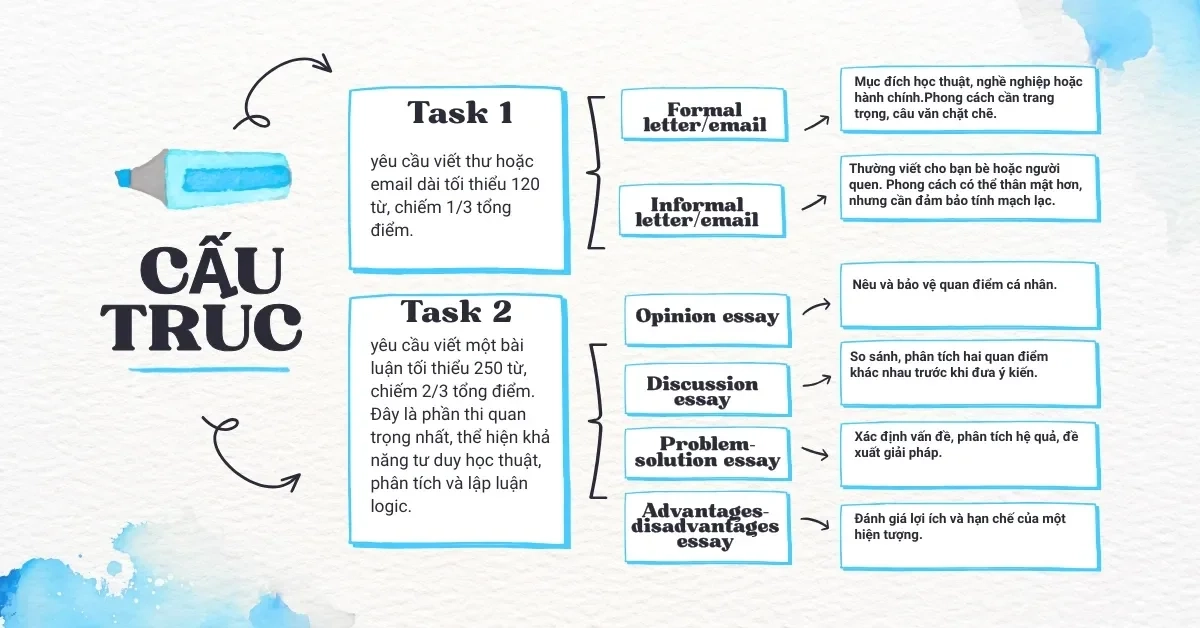
Task 1 – Viết thư/email: yêu cầu viết một bức thư hoặc email dài tối thiểu 120 từ. Nội dung có thể mang tính formal (gửi tổ chức, cơ quan) hoặc informal (gửi bạn bè, người quen). Nhiệm vụ này chiếm 1/3 tổng điểm.
Task 2 – Viết luận học thuật: yêu cầu viết một bài luận dài tối thiểu 250 từ, thuộc các dạng phổ biến như opinion essay, discussion essay, problem–solution essay hoặc advantages–disadvantages essay. Task 2 chiếm 2/3 tổng điểm và có vai trò quyết định đến kết quả cuối cùng.
Về thời gian, Task 1 nên dành khoảng 15–20 phút, còn Task 2 khoảng 40–45 phút để đảm bảo có đủ không gian phát triển ý, đưa ví dụ minh họa và hoàn thiện cấu trúc bài.
Tham khảo thêm: Formal là gì? Định nghĩa và cách phân biệt với Informal
Giao diện thi trên máy tính
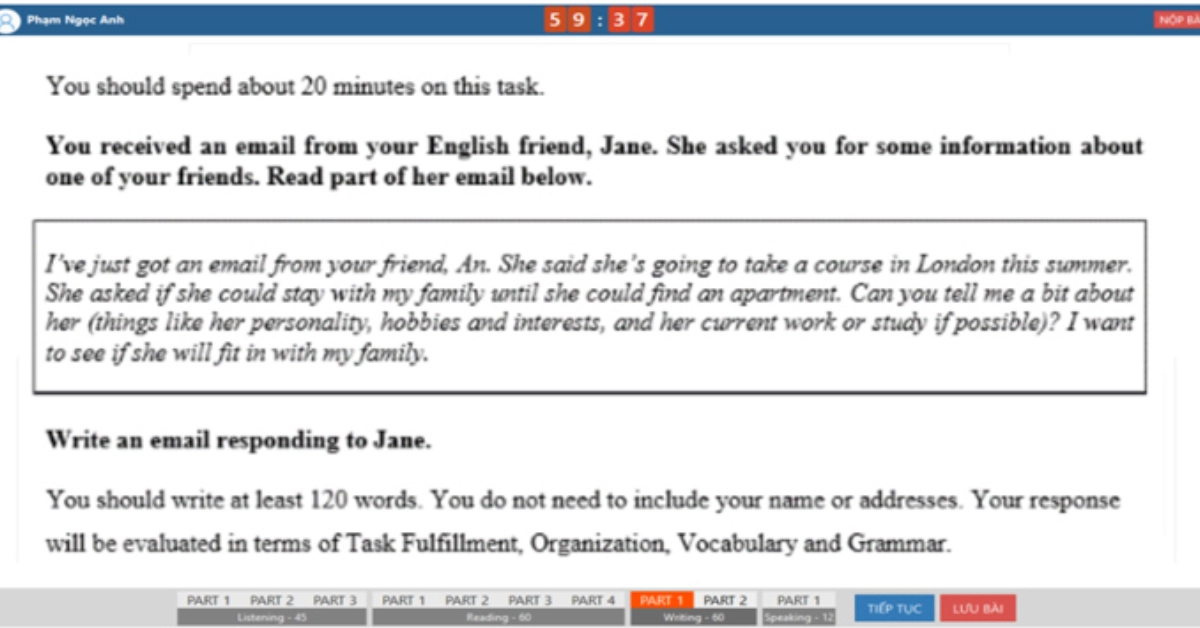
Các dạng bài trong đề thi VSTEP Writing C1
Phần Writing trong kỳ thi VSTEP C1 bao gồm hai nhiệm vụ với yêu cầu và tiêu chí khác nhau. Người học cần nắm rõ đặc điểm từng dạng để áp dụng chiến lược phù hợp.
Phần viết thư (Task 1)
Task 1 VSTEP Writing C1 yêu cầu viết thư hoặc email dài tối thiểu 120 từ, chiếm 1/3 tổng điểm. Đề thi thường mô tả một tình huống cụ thể, yêu cầu người viết phản hồi bằng văn bản formal hoặc informal.
Formal letter/email: viết cho mục đích học thuật, nghề nghiệp hoặc hành chính, ví dụ: thư khiếu nại dịch vụ, đơn xin học bổng, thư ứng tuyển. Phong cách cần trang trọng, câu văn chặt chẽ, tránh viết tắt.
Informal letter/email: thường viết cho bạn bè hoặc người quen, ví dụ: mời tham gia sự kiện, chia sẻ trải nghiệm, xin lời khuyên. Phong cách có thể thân mật hơn, nhưng vẫn cần đảm bảo tính mạch lạc.
Điểm quan trọng: xác định đúng người nhận → chọn phong cách phù hợp; đảm bảo bố cục 3 phần (mở đầu, nội dung chính, kết thúc); sử dụng từ nối hợp lý để chuyển ý.
Phần viết luận (Task 2)
Task 2 VSTEP Writing C1 yêu cầu viết một bài luận tối thiểu 250 từ, chiếm 2/3 tổng điểm. Đây là phần thi quan trọng nhất vì thể hiện khả năng tư duy học thuật, phân tích và lập luận logic.
Các dạng bài thường gặp:
Opinion essay: nêu và bảo vệ quan điểm cá nhân.
Discussion essay: so sánh, phân tích hai quan điểm khác nhau trước khi đưa ý kiến.
Problem–solution essay: xác định vấn đề, phân tích nguyên nhân, đề xuất giải pháp.
Advantages–disadvantages essay: đánh giá lợi ích và hạn chế của một hiện tượng.
Điểm quan trọng: lập dàn ý nhanh trước khi viết, triển khai luận điểm trong 2–3 đoạn thân bài, dùng từ vựng học thuật và cấu trúc câu phức để đạt chuẩn VSTEP Writing C1.
Đọc thêm: Ngữ pháp VSTEP: Phân loại chi tiết & hướng dẫn học dễ hiểu
Tổng hợp bài mẫu thi viết Writing VSTEP C1

Task 1 VSTEP Writing C1 – Viết thư/email
Đề 1 – Formal Letter/VSTEP Writing C1
You recently stayed at a hotel during an international conference. Unfortunately, several facilities did not meet the promised standard. Write a formal email to the hotel manager, explaining the issues, their impact on your stay, and requesting appropriate compensation.
Bài mẫu (Formal Letter)
Dear Sir or Madam,
I am writing to express my dissatisfaction regarding my recent stay at your hotel from 10 to 13 September during the International Education Conference. Despite the reputation of your establishment, several aspects of my experience were highly unsatisfactory.
Firstly, the air conditioning in Room 412 was malfunctioning, which made it extremely difficult to rest, particularly after long conference sessions. In addition, the Wi-Fi connection was unstable, forcing me to use mobile data to deliver my presentation. Lastly, the breakfast buffet, which had been advertised as “continental and varied,” consisted of only a limited selection and frequently ran out of essential items.
These shortcomings significantly disrupted both my comfort and my professional responsibilities. Given the circumstances, I would like to request either a partial refund or a complimentary stay in order to restore my confidence in your service.
Yours faithfully,
Tran Minh
Phân tích bài mẫu:
Tiêu chí | Điểm mạnh | Điểm cần cải thiện |
|---|---|---|
Task fulfillment (Mức độ hoàn thành bài viết) | Bài viết trả lời đầy đủ yêu cầu: nêu vấn đề, ảnh hưởng, yêu cầu bồi thường. Giọng văn formal phù hợp email gửi quản lý khách sạn. Ví dụ minh họa cụ thể, rõ ràng. | Có thể thêm một câu mở đầu thể hiện mục đích thư rõ hơn (ví dụ: “I am writing to formally complain about…”). |
Organization (Tổ chức bài viết) | Cấu trúc rõ ràng: mở bài – thân bài – kết bài. Các đoạn logic, liên kết mạch lạc nhờ từ nối như “Firstly”, “In addition”, “Lastly”, “Given the circumstances”. | Một vài câu hơi dài, có thể tách nhỏ để tăng độ tự nhiên và dễ đọc. |
Vocabulary (Từ vựng) | Dùng từ vựng formal, phong phú, ít lặp, tự nhiên; các cụm từ trình độ C1 như “significantly disrupted”, “restore my confidence”. | Có thể bổ sung thêm 1–2 cụm mạnh hơn về cảm xúc hoặc yêu cầu để bài sắc nét hơn, ví dụ: “extremely disappointed” hay “prompt action”. |
Grammar (Ngữ pháp) | Cấu trúc câu đa dạng (câu đơn, câu phức, câu ghép). Hầu hết câu đúng ngữ pháp, các cấu trúc “forcing me to…”, “which made it…”, “in order to…” sử dụng chính xác. | Thiếu một số cấu trúc nâng cao (vd. mệnh đề quan hệ hoặc câu bị động rút gọn) để thể hiện độ linh hoạt C1 rõ hơn. |
Đề 2 - Informal email/VSTEP Writing C1
Your friend has invited you to spend two weeks at their home abroad. Write an email accepting the invitation, asking about daily activities, and suggesting what you could bring as a gift.
Bài mẫu
Hi Julia,
I was thrilled to receive your invitation, and I would be delighted to spend two weeks with you in Spain. It has been far too long since we last saw each other, so I’m certain this will be a wonderful opportunity to catch up.
Could you tell me more about the daily routine there? For example, do you usually go hiking in the mountains, or is it more common to spend time at the beach? I would love to know so that I can pack the right clothes. Also, would you prefer that I bring something from Vietnam as a small gift? I was considering traditional tea or handmade crafts, but I’d be happy to bring anything you’d particularly like.
I honestly can’t wait to see you again. Spending time in your hometown will definitely be both relaxing and culturally enriching.
Warm regards,
Linh
Phân tích bài mẫu:
Tiêu chí | Điểm mạnh | Điểm cần cải thiện |
|---|---|---|
Task fulfillment (Mức độ hoàn thành bài viết) | Trả lời đầy đủ cả ba yêu cầu của đề: chấp nhận lời mời, hỏi về hoạt động hàng ngày, và gợi ý quà. | Có thể thêm một vài chi tiết cụ thể hơn về mong muốn trải nghiệm hoặc hoạt động để bài sinh động hơn. |
Organisation (Tổ chức bài viết) | Cấu trúc rõ ràng: mở đầu (vui mừng khi nhận lời mời), thân bài (hỏi về thói quen hàng ngày, gợi ý quà), kết bài (kỳ vọng gặp lại). Các câu liên kết mạch lạc. | Chuyển đoạn hơi đột ngột giữa câu hỏi và phần quà; có thể thêm cụm chuyển nhẹ (“By the way,” hoặc “Speaking of gifts,”). Ngoài ra, đoạn hỏi về cuộc sống hàng ngày và chuẩn bị quà đang ở cùng một đoạn, có thể tách ra để rõ ràng hơn. |
Vocabulary (Từ vựng) | Từ vựng tự nhiên, đa dạng và phù hợp ngữ cảnh thân mật (“thrilled”, “catch up”, “can’t wait”, “relaxing and culturally enriching”). | Một số cụm có thể thay đổi để tránh đơn giản quá (“I would love to know” → “I’m curious to hear more about”). |
Grammar (Ngữ pháp) | Cấu trúc câu đa dạng, dùng chính xác các thì và câu hỏi; không lỗi ngữ pháp. | Chưa sử dụng nhiều cấu trúc nâng cao (như mệnh đề quan hệ rút gọn hay đảo ngữ) để thể hiện độ phức tạp ở mức C1. |

Đọc thêm: Bài mẫu VSTEP Writing Task theo các dạng bài kèm phân tích
Task 2 VSTEP Writing C1 - Dạng essay
Đề 1 - Opinion Essay/VSTEP Writing C1
Some people believe that universities should focus more on preparing students for the job market, while others argue that the primary role of higher education is to provide academic knowledge. To what extent do you agree or disagree?
Bài mẫu
In recent years, there has been an ongoing debate about whether universities should focus on job-related skills or academic knowledge. In my opinion, while both contribute to students’ development, higher education should prioritize preparing learners for the job market.
The primary reason is that university is the final structured learning stage before students begin full-time employment. Immediately after graduating, most young people enter the workforce and are expected to function effectively from their first day. Since the university period is limited, institutions must use this time to help students build essential workplace competencies—such as communication, teamwork, problem-solving, and digital literacy. Without targeted preparation, graduates may find themselves overwhelmed by the practical demands of modern jobs, despite possessing strong theoretical understanding.
Furthermore, the value of academic knowledge can only be realized when it is applied to real-world contexts. By integrating practical training into their programs, universities enable students to connect theory with authentic practice in their chosen fields. For example, a finance major who can apply theoretical models to analyze market trends or evaluate corporate performance will be far more competitive than one who only understands these concepts in the abstract. Therefore, emphasizing job readiness does not diminish academic learning; instead, it ensures that knowledge becomes functional, relevant, and transferable to professional settings.
In conclusion, universities should prioritize preparing students for the job market because it is the immediate stage following graduation and because academic knowledge becomes meaningful only when applied. This approach makes higher education more practical, responsive, and beneficial to students’ long-term career success.
Phân tích bài mẫu:
Tiêu chí | Điểm mạnh | Điểm yếu |
|---|---|---|
Task fulfillment (Mức độ hoàn thành bài viết) | - Trả lời đúng yêu cầu đề. | - Có thể nêu rõ mức độ đồng ý ngay ở câu mở đầu (ví dụ: “I strongly believe…”) để tăng sự thuyết phục. |
Organisation (Tổ chức bài viết) | - Mạch lập luận rõ ràng: từ lý do “đại học là giai đoạn cuối” → “nhu cầu thị trường” → “ứng dụng học thuật vào thực tế”. | Chuyển đoạn 2 → 3 có thể thêm một câu nối chỉ ra mối liên hệ (“Another essential consideration is…”). Hiện tại nối tự nhiên nhưng có thể mạnh hơn. |
Vocabulary (Từ vựng) | Dùng từ học thuật linh hoạt: structured stage, competencies, overwhelmed, practical demands, transferable, real-world contexts. | - Một vài cụm có thể nâng cấp thêm để tăng tính học thuật, ví dụ thay “function effectively” bằng “perform competently and independently”. |
Grammar (Ngữ pháp) | - Cấu trúc phức linh hoạt: mệnh đề nguyên nhân – hệ quả, mệnh đề quan hệ, so sánh, đảo cụm. | - Có thể thêm variety bằng cách sử dụng thêm non-finite clauses, ví dụ “Given the limited duration of university study…”. |
Đề 2 - Discussion essay/VSTEP Writing C1
Some people think governments should invest more in public transport, while others believe road infrastructure for private vehicles is more important. Discuss both views and give your opinion.
Bài mẫu
Opinions differ regarding whether governments should allocate more resources to public transport or to road infrastructure for private vehicles. While both perspectives have merits, I personally believe that investing in public transport should take precedence.
Supporters of private vehicle infrastructure argue that cars provide unmatched convenience and flexibility. For residents in rural or remote areas, private vehicles are often essential for commuting, accessing healthcare, and managing daily responsibilities efficiently. In such locations, public transport may be limited or unavailable, making cars indispensable. Adequate road networks ensure that these populations can function independently and maintain productivity, which cannot always be guaranteed through mass transit systems alone.
Conversely, prioritising public transport offers long-term social, environmental, and economic benefits. Efficient buses, metro lines, and trains reduce traffic congestion, lower carbon emissions, and provide accessible and affordable mobility for all citizens. For example, Singapore’s significant investment in public transport has resulted in one of the world’s most sustainable and inclusive urban mobility systems. By focusing on public transit, governments can ensure equitable access while promoting sustainable development, ultimately benefiting society as a whole.
In conclusion, although private vehicles remain important in certain contexts, governments should prioritise public transport because of its wider societal advantages. Reliable and accessible mass transit systems not only enhance environmental sustainability but also foster social equity, making modern cities more liveable and efficient.
Phân tích bài mẫu:
Tiêu chí | Điểm mạnh | Điểm yếu |
|---|---|---|
Task fulfillment (Mức độ hoàn thành bài viết) | - Bàn cả hai quan điểm (private vehicles vs public transport). | - Có thể nhấn mạnh hơn mức độ đồng thuận cá nhân ở câu mở đầu: ví dụ “I strongly believe…” để tăng thuyết phục. |
Organisation (Tổ chức bài viết) | - Bố cục 4 đoạn rõ ràng: mở bài → private vehicles → public transport → kết luận. | - Có thể thêm câu dẫn nối mượt hơn đoạn 2 → 3: “While private vehicles serve certain needs, public transport offers broader societal advantages.” |
Vocabulary (Từ vựng) | - Từ vựng học thuật và chủ đề phù hợp: allocate resources, unparalleled convenience, accessible mobility, inclusive urban mobility, societal advantages. | - Một vài từ có thể đa dạng hóa: ví dụ thay “advantages” bằng benefits, merits để tránh lặp. |
Grammar (Ngữ pháp) | - Sử dụng câu phức, mệnh đề nguyên nhân-hệ quả, mệnh đề quan hệ linh hoạt: “…making cars indispensable.” | - Một số câu dài (đoạn 2 câu cuối) có thể chia nhỏ để đọc dễ hơn, tăng tính tự nhiên. |

Đề 3 - Problem-solution essay/VSTEP Writing C1
Many major cities around the world are facing serious housing shortages. What problems does this cause, and what measures could be taken to tackle them?
Bài mẫu:
Many major cities worldwide are facing severe housing shortages, which create a series of social and economic problems. Rapid urbanisation, population growth, and limited land supply exacerbate this issue, demanding coordinated action from governments, private developers, and urban planners.
The shortage of housing leads to several significant consequences. Firstly, property prices and rents soar, particularly in high-demand cities, making affordable housing inaccessible for low- and middle-income families. For example, in London, average rents have risen faster than wages over the past decade, forcing many residents into shared or substandard accommodation, with negative effects on health and wellbeing. Secondly, inadequate housing deepens social inequality, as wealthier citizens can secure decent accommodation while vulnerable groups are marginalised. Thirdly, limited housing availability restricts labour mobility. Workers may reject employment opportunities in cities where living costs are prohibitive, which can slow economic growth and reduce the efficiency of the urban labour market.
To address these challenges, governments should invest in affordable housing schemes, using public funds or tax incentives to stimulate construction. Implementing stricter regulations on speculative property investment can stabilise prices and reduce inequality. Urban planning should also encourage sustainable, high-density housing models, such as mixed-use developments, to optimise land use. Collaboration with private developers, coupled with targeted rent subsidies for low-income residents, would further relieve pressure on the housing market.
In conclusion, housing shortages result in rising living costs, social inequality, and constrained labour mobility. A comprehensive approach involving regulation, strategic investment, and innovative urban planning is essential to ensure equitable access to adequate and affordable housing.
Phân tích bài mẫu
Tiêu chí | Điểm mạnh | Điểm yếu |
|---|---|---|
Task fulfillment (Mức độ hoàn thành bài viết) | - Bài trả lời đầy đủ yêu cầu đề: nêu hệ quả, giải pháp. | - Có thể bổ sung thêm số liệu và ví dụ cho lí lẽ khác để tăng tính thuyết phục. |
Organisation (Tổ chức bài viết) | - Bố cục rõ ràng: mở bài → hệ quả → giải pháp → kết luận. | - Một vài luận điểm trong đoạn “hệ quả” có thể triển khai sâu hơn, giải thích mối liên hệ giữa vấn đề và hậu quả (ví dụ: tại sao thiếu nhà ở lại hạn chế khả năng di chuyển lao động) để logic bài viết mạnh hơn. |
Vocabulary (Từ vựng) | - Từ vựng học thuật, chính xác: housing shortages, high-demand cities, labour mobility, affordable housing schemes, optimise land use. | - Một vài từ như problems/consequences có thể đa dạng hóa: challenges/obstacles/issues để tránh lặp. |
Grammar (Ngữ pháp) | - Sử dụng câu phức, mệnh đề nguyên nhân-hệ quả linh hoạt: “…forcing many residents into shared or substandard accommodation, with negative effects on health and wellbeing.”. | - Một số câu dài có thể chia nhỏ để mạch lạc hơn, giúp đọc trôi chảy. |
Đề 4 - Advantages-Disadvantages essay/VSTEP Writing C1
Some companies allow employees to work remotely. Discuss the advantages and disadvantages of this arrangement and give your opinion.
Bài mẫu:
Remote work has become increasingly prevalent in the digital era. While it offers several advantages, there are also notable disadvantages that need to be considered.
On the positive side, remote work enhances flexibility and supports work–life balance. Employees save time and reduce stress by avoiding long commutes, which can improve overall productivity. Moreover, companies benefit from lower operational costs, such as reduced office space, and gain access to a wider talent pool unrestricted by geographic location. For instance, during the COVID-19 pandemic, many multinational corporations successfully maintained operations by implementing remote work policies, demonstrating its practical viability.
Nevertheless, remote work also presents challenges. It can hinder collaboration, as in-person interaction often fosters creativity, problem-solving, and team cohesion. Employees may struggle with blurred boundaries between work and personal life, which can lead to burnout and reduced motivation. Additionally, organisations face difficulties in monitoring performance, ensuring data security, and maintaining corporate culture when staff are dispersed.
In my opinion, remote work is advantageous if applied in moderation. A hybrid approach that combines office-based collaboration with flexible home-working arrangements allows companies to leverage the benefits while minimising the risks associated with isolation, reduced teamwork, and overwork.
In conclusion, remote work offers considerable benefits in terms of flexibility, productivity, and cost savings. However, potential drawbacks related to collaboration, employee wellbeing, and organisational oversight must be carefully managed. A balanced, hybrid model is therefore the most sustainable solution for modern workplaces.
Phân tích bài mẫu:
Tiêu chí | Điểm mạnh | Điểm yếu |
|---|---|---|
Task fulfillment (Mức độ hoàn thành bài viết) | - Đầy đủ yêu cầu đề bài: nêu lợi ích, bất lợi, và quan điểm cá nhân. | - Có thể bổ sung số liệu thực tế về năng suất, stress, hoặc chi phí để tăng tính thuyết phục. |
Organisation (Tổ chức bài viết) | Bố cục rõ ràng: mở bài → lợi ích → bất lợi → quan điểm → kết luận. | - Một số luận điểm trong đoạn “bất lợi” có thể chia tách thành câu ngắn hơn để làm rõ mối liên hệ giữa collaboration, burnout, organisational oversight. |
Vocabulary (Từ vựng) | - Từ vựng học thuật, chuyên môn: remote work, hybrid approach, team cohesion, organisational oversight, productivity, cost savings. | Nên thêm vài collocation học thuật hơn (employee autonomy, organisational cohesion). |
Grammar (Ngữ pháp) | - Sử dụng câu phức, mệnh đề nguyên nhân-hệ quả linh hoạt: “…allows companies to leverage the benefits while minimising the risks associated with isolation, reduced teamwork, and overwork.”. | - Một số câu dài vẫn có thể chia nhỏ để tăng độ mượt đọc, đặc biệt đoạn “bất lợi”. |

Gợi ý bài tập vận dụng VSTEP Writing C1
Bài 1: Viết mở bài cho đề bài sau: Some people argue that online education will soon replace traditional classroom learning. To what extent do you agree or disagree?
Gợi ý:
Mở bằng bối cảnh giáo dục thay đổi nhờ công nghệ.
Nêu quan điểm chung (đồng ý, phản đối hoặc trung lập).
Mở bài mẫu:
The expansion of digital platforms has revolutionized the way students access education, leading some to predict that online courses will eventually replace classroom learning. While it is undeniable that virtual education provides greater flexibility and accessibility, I believe traditional classes continue to play a crucial role in fostering interaction and discipline that technology alone cannot ensure.
Tổng kết
Bài viết đã khái quát 5 nội dung cốt lõi của phần VSTEP Writing C1: cấu trúc đề thi, các dạng bài, tiêu chí chấm điểm, định hướng luyện tập cùng với bài mẫu tham khảo. Kỹ năng Writing ở cấp độ này không chỉ yêu cầu vốn từ vựng học thuật và cấu trúc ngữ pháp đa dạng mà còn đòi hỏi khả năng phát triển ý tưởng, lập luận logic và trình bày mạch lạc. Để đạt chuẩn C1, thí sinh cần duy trì luyện tập đều đặn, áp dụng chiến lược làm bài hiệu quả và tham khảo các bài mẫu chất lượng. Sự chuẩn bị nghiêm túc và có hệ thống sẽ tạo nền tảng vững chắc cho kết quả cao trong kỳ thi VSTEP.
Thí sinh mong muốn nâng cao kỹ năng tiếng Anh và chinh phục kỳ thi VSTEP sẽ tìm thấy giải pháp toàn diện tại Khóa học VSTEP của ZIM Academy. Với chương trình đào tạo chuyên sâu từ cấp độ A1 đến C1, khóa học giúp thí sinh phát triển toàn diện 4 kỹ năng ngôn ngữ và chiến lược làm bài thi. Liên hệ Hotline 1900-2833 (nhánh số 1) để được tư vấn chi tiết về chương trình học.
Tham vấn chuyên môn
Là một người từng nhiều lần chật vật trên hành trình học tập, cô thấu hiểu rằng thành công không đến từ tài năng bẩm sinh, mà từ sự kiên trì và kỷ luật mỗi ngày. Cô tin rằng ai cũng mang trong mình một tiềm năng riêng, chỉ cần được khơi gợi đúng cách sẽ có thể tỏa sáng theo cách của chính mình.
Phương châm giảng dạy của cô là lấy cảm hứng làm điểm khởi đầu, và sự thấu hiểu làm kim chỉ nam. Cô không dạy để học sinh ghi nhớ, mà để các em đặt câu hỏi, khám phá và tự nhìn thấy giá trị của việc học. Mỗi giờ học là một không gian mở – nơi các em được thử, được sai, và được trưởng thành.
Bình luận - Hỏi đáp