

Giới thiệu một người đã tự học được một kỹ năng mới mà không cần giáo viên.
Mô tả người đó đã học gì và học bằng cách nào.
Giải thích lý do người đó có thể tự học thành công.
Thể hiện sự ngưỡng mộ hoặc suy nghĩ của bạn về quá trình và kết quả học tập của người đó.
Phân tích đề IELTS Speaking Part 2 tháng 07/2026 - Đề số 1
Phân tích đề bài, các bước lập dàn bài, bài mẫu IELTS Speaking Part 2 tháng 07/2026 - đề số 1 (kỳ thi trên máy tính) kèm từ vựng ghi điểm giúp thí sinh có sự chuẩn bị tốt hơn cho bài thi chính thức.
Key takeaways
Bài nói mẫu cho chủ đề "Describe a person who has learned something new without a teacher" tập trung khai thác hình ảnh một người đã tự học thành công một kỹ năng mới mà không cần sự hướng dẫn trực tiếp của giáo viên. Bài nói không chỉ giới thiệu người đó và kỹ năng họ học được mà còn làm rõ quá trình tự học, những khó khăn họ vượt qua và các yếu tố giúp họ thành công.
Thông qua việc kết hợp giữa việc kể lại trải nghiệm quan sát, cảm xúc cá nhân và những suy nghĩ về quá trình học tập của người được miêu tả, bài nói thể hiện khả năng phát triển ý tưởng mạch lạc theo yêu cầu của IELTS Speaking Part 2. Đồng thời, chủ đề cũng tạo cơ hội để người học chia sẻ quan điểm về tinh thần tự học, sự kiên trì, động lực cá nhân và vai trò của các nguồn tài nguyên trực tuyến trong việc học tập hiện nay.
Đề bài
Describe a person who has learned something new without a teacher.
You should say:
who this person is
what he or she learned
how he or she learned it
and explain why you think this person was able to learn it without a teacher.
Tham khảo: Tổng hợp bài mẫu IELTS Speaking 2026
Phân tích đề bài
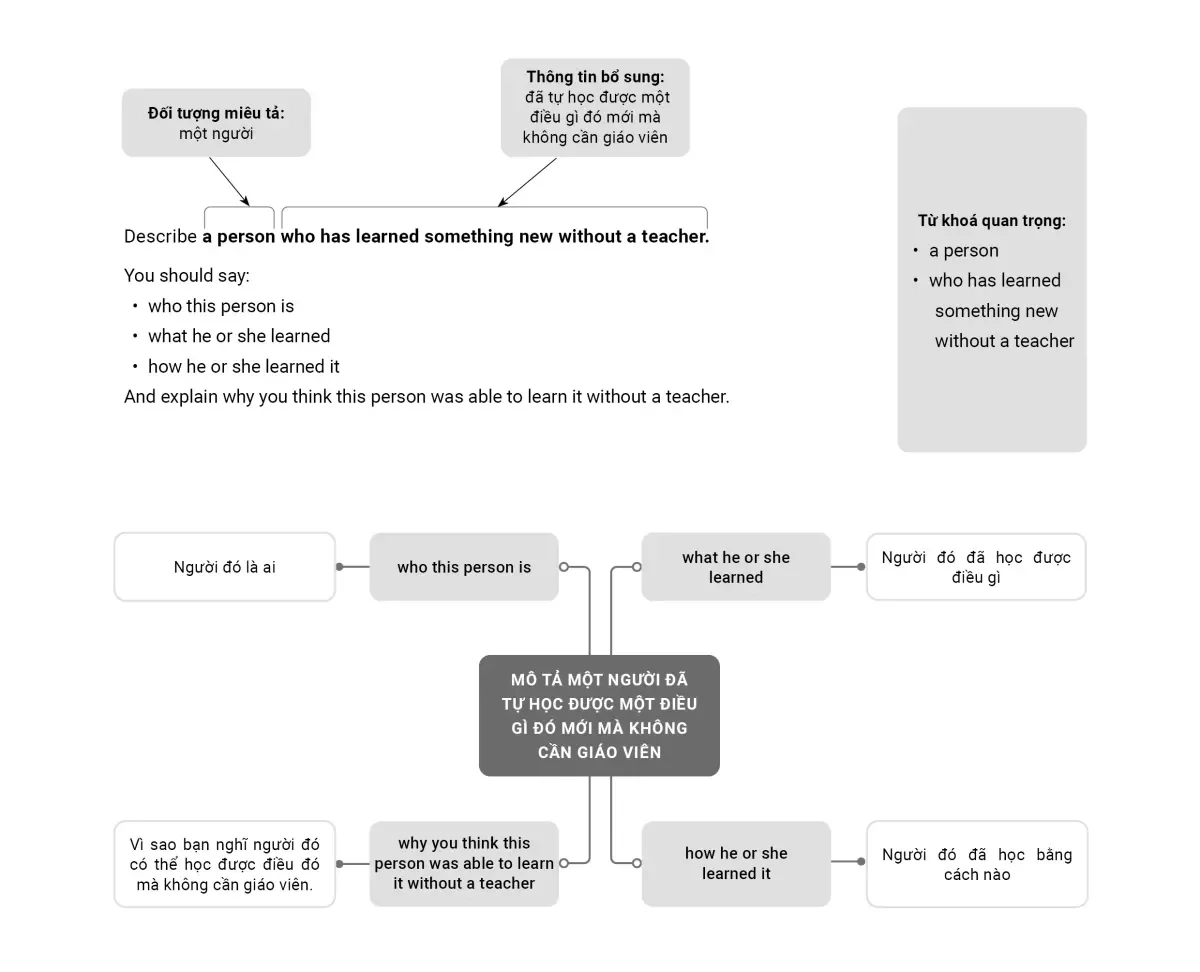
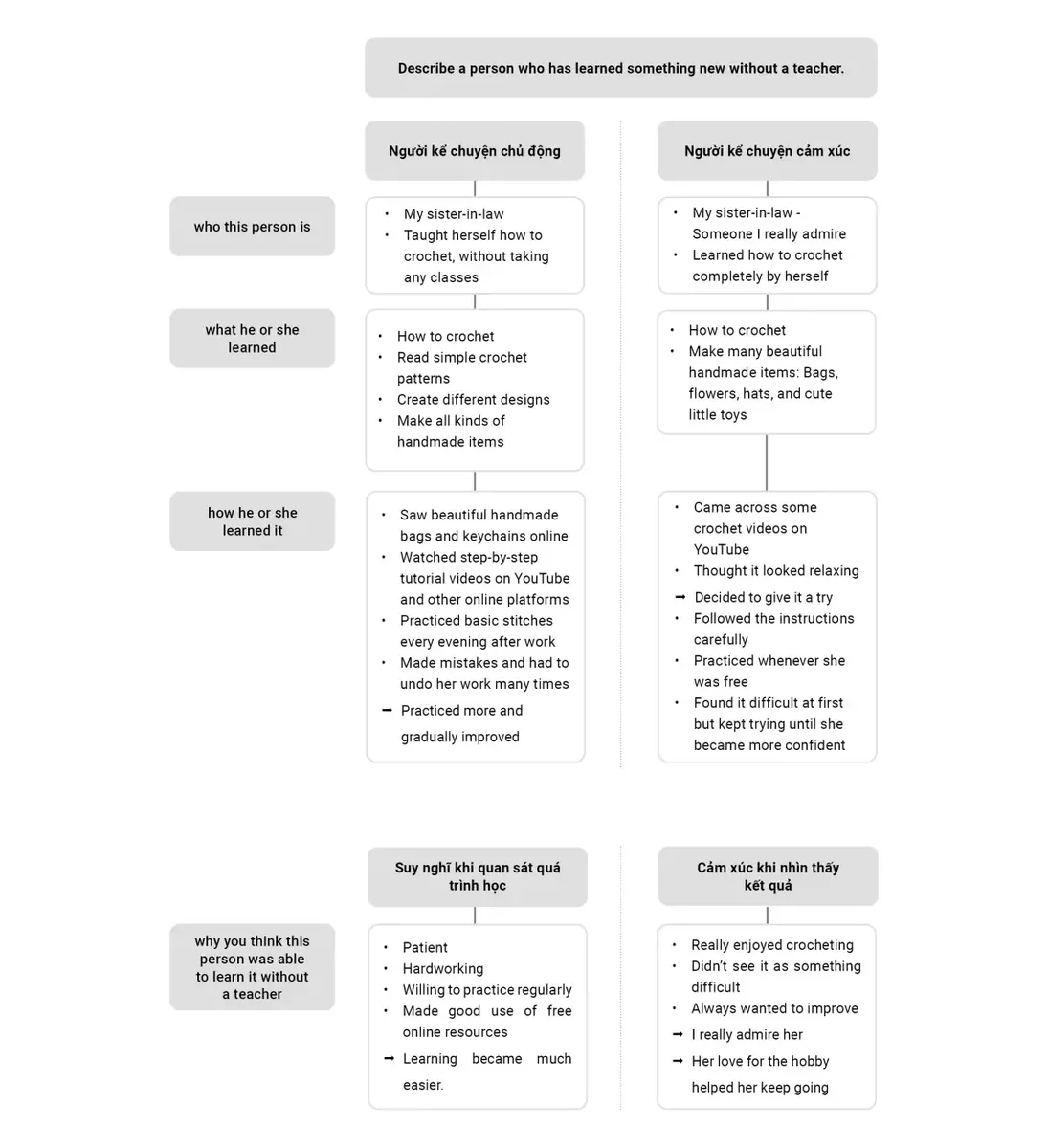
Lên ý tưởng & Ghi chú
Xem thêm bài viết cùng chủ đề:
Bài mẫu
Simple answer
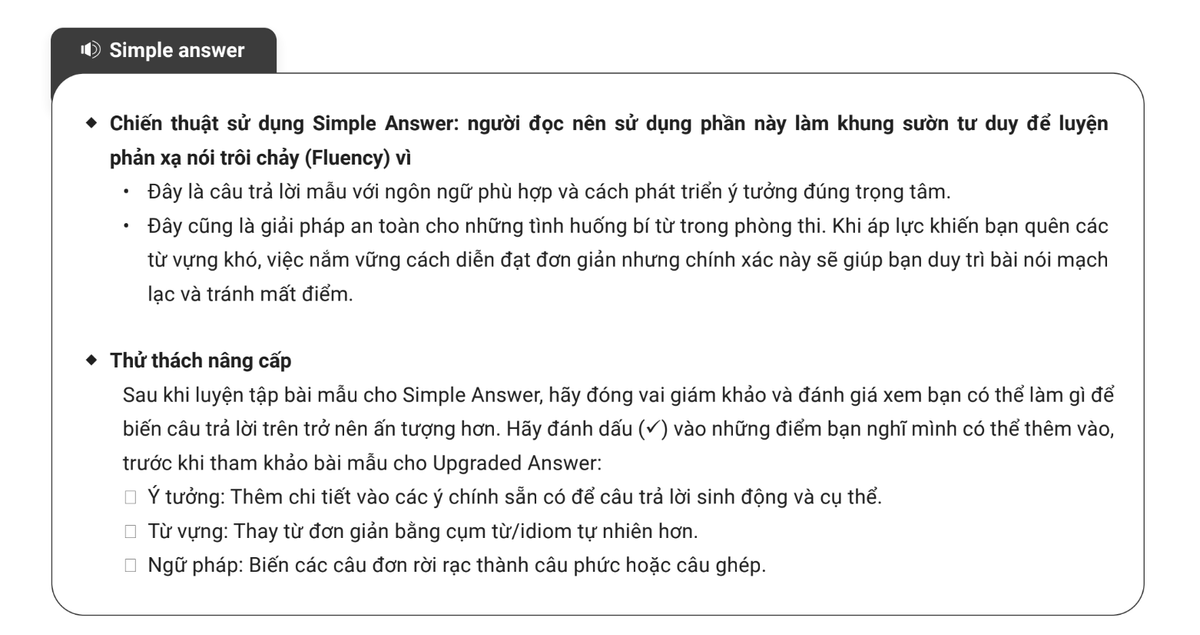
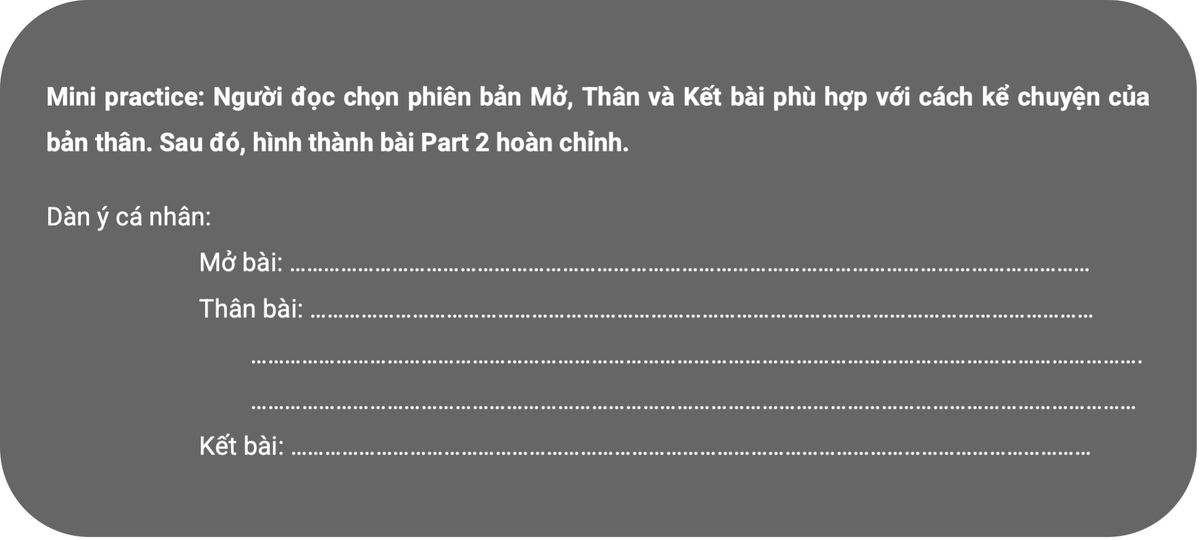
Người đọc có thể kết hợp các phiên bản tùy ý để tạo ra nhiều bài mẫu Part 2 khác nhau từ cùng một đề.
Mở bài và Thân bài | Ver. 1 Người kể chuyện chủ động | Ver. 2 Người kể chuyện cảm xúc |
|---|---|---|
I'd like to talk about my sister-in-law, who taught herself how to crochet without taking any classes. She became interested in it after seeing some beautiful handmade bags and keychains online. Instead of finding a teacher, she watched step-by-step tutorial videos on YouTube and other online platforms. At first, she practiced basic stitches every evening after work. She often made mistakes and had to undo her work many times, but she never gave up. As she practiced more, she gradually learned how to read simple crochet patterns and create different designs. Now, she can make all kinds of handmade items, such as tote bags, flowers, coasters, keychains, and even small dolls. In fact, she has given me several unique gifts that she crocheted herself, and I still use them today. | I'd like to talk about my sister-in-law, who learned how to crochet completely by herself. I really admire her because she had no experience at all when she started. One day, she came across some crochet videos on YouTube and thought it looked relaxing, so she decided to give it a try. She followed the instructions carefully and spent a little time practicing whenever she was free. Although she found it difficult at first, she kept trying until she became more confident. Over time, she became surprisingly good at it. She can now make many beautiful handmade items, such as bags, flowers, hats, and cute little toys. She has even given me several unique crochet gifts, and I always appreciate the time and effort she put into making them. Every time I use those gifts, I think of her. |
Kết bài | Ver. 1 Suy nghĩ khi quan sát quá trình học | Ver. 2 Cảm xúc khi nhìn thấy kết quả |
|---|---|---|
I think she was able to learn without a teacher because she is patient, hardworking, and willing to practice regularly. She also made good use of free online resources, which made learning much easier. | I really admire her because she was able to learn without a teacher. The reason behind this was that she really enjoyed crocheting and didn't see it as something difficult. She always wanted to improve, so she didn't need anyone to push her. Her love for the hobby helped her keep going, even when she made mistakes. |
Upgraded answer
Người đọc có thể kết hợp các phiên bản tùy ý để tạo ra nhiều bài mẫu Part 2 khác nhau từ cùng một đề.
Mở bài và Thân bài | Ver. 1 Người kể chuyện chủ động | Ver. 2 Người kể chuyện cảm xúc |
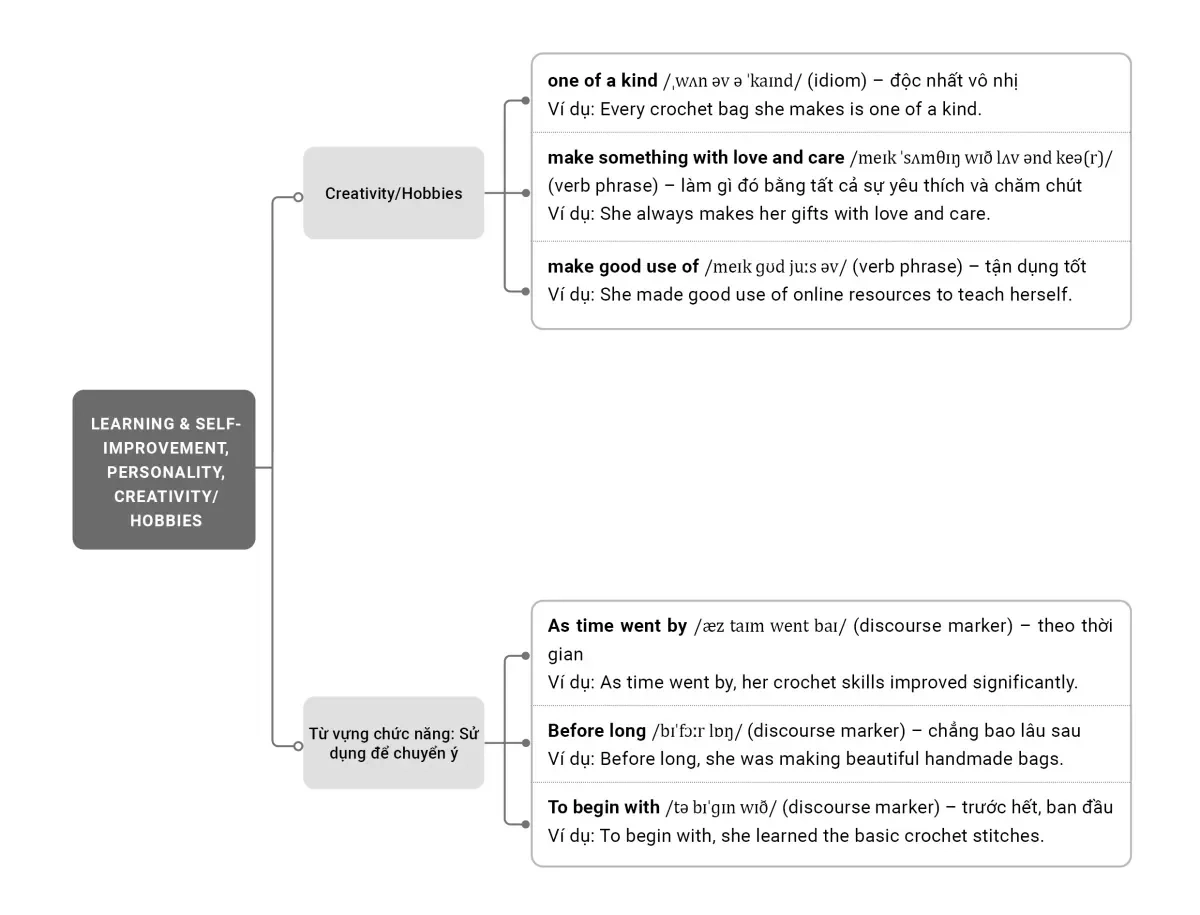
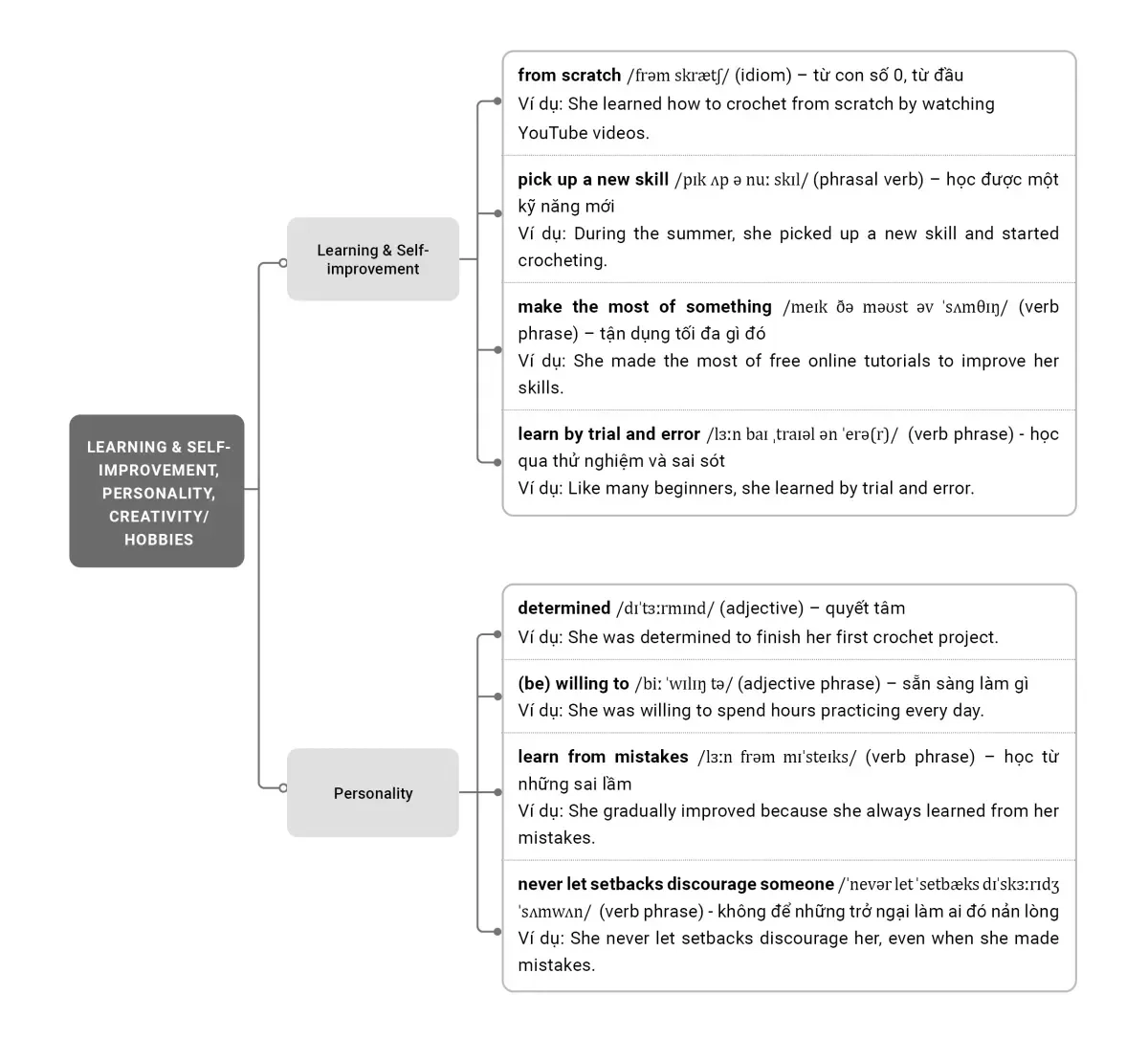
I'd like to talk about my sister-in-law, who managed to teach herself how to crochet without taking any formal classes. She first became interested in it after coming across some beautifully handmade bags and keychains on social media. Instead of enrolling in a course, she decided to pick up the skill from scratch by watching step-by-step tutorial videos on YouTube and other online platforms. To begin with, she learned the basic stitches and practiced them almost every evening after work. Like any beginner, she made plenty of mistakes and often had to undo her work and start all over again. However, rather than getting discouraged, she treated every mistake as a learning opportunity. By trial and error, she gradually became more confident and even figured out how to read crochet patterns, combine different colors, and create more detailed designs. Now, she can make all kinds of handmade items, ranging from tote bags and coasters to flowers, keychains, and even cute little dolls. In fact, she has given me several crochet gifts over the years, and they are among the most thoughtful presents I've ever received because every piece is one of a kind. | I'd like to describe my sister-in-law, who learned how to crochet entirely on her own. What impressed me most was that she had absolutely no experience when she first started, yet she eventually became surprisingly good at it. One day, she stumbled upon a few crochet videos on YouTube, found them incredibly relaxing to watch, and decided to give the hobby a go. At first, things didn't go smoothly at all. She struggled with even the simplest stitches, and many of her early projects didn't turn out the way she had expected. Even so, she never let those setbacks discourage her. Whenever she had some free time, she would watch tutorial videos, pause them to copy each step, and practice until she got it right. Little by little, her confidence grew, and what began as simple practice soon developed into a genuine passion. Before long, she was making beautiful bags, flowers, hats, keychains, and adorable little toys. She has also given me several handmade crochet gifts, and I honestly treasure every single one because they're unique and clearly made with love and care. |
Kết bài | Ver. 1 Suy nghĩ khi quan sát quá trình học | Ver. 2 Cảm xúc khi nhìn thấy kết quả |
I think she was able to learn without a teacher because she's extremely patient, self-disciplined, and determined. On top of that, she really knows how to make the most of free online resources, proving that with enough motivation and consistent practice, it's possible to master a new skill independently. | I believe she succeeded without a teacher because she genuinely enjoyed the learning process and was willing to learn from her mistakes. More importantly, she never gave up whenever she ran into difficulties, which, in my opinion, is the key to mastering any new skill. |
Lọc và phân tích từ vựng
Nhật ký Từ vựng & Ý tưởng
Ghi chú sau khi luyện tập nói về chủ đề trên
Từ vựng/Ý tưởng (Chọn các từ vựng/ý tưởng mà bạn tâm đắc nhất) | Kỉ niệm cá nhân (Gán các từ vựng/ý tưởng đã chọn với kỉ niệm của bản thân) |
|---|---|
Ví dụ: from scratch → từ con số 0, từ đầu | Người đọc tự đặt các câu hỏi cho bản thân, ví dụ:
→ I learned how to use Canva from scratch when I started creating study materials for my students. At first, I didn't even know how to use the basic tools, so I watched tutorial videos and practiced every day. Although it took quite a while, I gradually became more confident and can now design worksheets and presentations on my own. |
Khoảng trống diễn đạt (Phần khiến bạn ngập ngừng khi nói về chủ đề trên) | Giải pháp (Giải pháp cho các khoảng trống diễn đạt) | ||
|---|---|---|---|
Ví dụ: Tình huống diễn đạt: “Chẳng bao lâu sau, cô ấy đã có thể…” → Không tìm được trạng từ/cụm trạng từ mới, thích hợp để đặt ở đầu câu, mang nghĩa là “chẳng lâu sau”. | Ví dụ: Sử dụng AI với câu lệnh:
→ before long (adverbial phrase/discourse marker): chẳng bao lâu sau. |
Người đọc có thể tìm từ vựng bằng từ điển ZIM Dictionary.
Các lỗi ngữ pháp thường gặp
Lỗi thường gặp: Although she found it to be difficult at first, she kept trying until she became more confident.
Cách dùng đúng:
Although she found it difficult at first, she kept trying until she became more confident.
Lý do sai:
Xét về mặt ngữ pháp, cấu trúc “find something to be adj” không sai nhưng thiếu tự nhiên.
→ Dùng “find something + adj” → find it difficult
Lỗi thường gặp: I really admire her because she had no experiences at all when she started.
Cách dùng đúng:
I really admire her because she had no experience at all when she started.
Lý do sai:
Từ “experience” trong trường hợp này mang nghĩa “kinh nghiệm”
→ “Experience” trong câu được sử dụng ở dạng danh từ không đếm được, không có dạng số nhiều. → …she had no experience…
Lỗi thường gặp: As she practiced more, she gradually learned how to read simple crochet patterns and created different designs.
Cách dùng đúng:
As she practiced more, she gradually learned how to read simple crochet patterns and create different designs
Lý do sai:
Động từ theo sau “how to” được chia ở dạng nguyên mẫu
Động từ “create” trong câu nằm trong phép liệt kê với động từ “read” sau “how to” nên cần được chia ở dạng song song với động từ “read” → …she gradually learned how to read simple crochet patterns and create different designs
Tương tự đối với các trường hợp liệt kê động từ ở dạng danh động từ, quá khứ phân từ,...
Các chủ đề liên quan
Chủ đề liên quan để sử dụng từ vựng và ý tưởng
Describe a skill you learned
(Liên quan đến learning process, self-improvement, online learning, practice)Describe a person you admire
(Liên quan đến personality, determination, perseverance, independence)Describe something you learned from the Internet
(Liên quan đến online resources, self-study, tutorial videos, technology)
Từ vựng có thể ứng dụng: from scratch, pick up a new skill, make the most of, make good use of, learn by trial and error, be self-taught, determined, be willing to, learn from mistakes,...
Ý tưởng
Tôi muốn nói về chị dâu của mình, người đã tự học móc len mà không cần bất kỳ giáo viên nào hướng dẫn.
Chị bắt đầu hứng thú với việc móc len sau khi vô tình xem được một vài video hướng dẫn trên YouTube.
Những sản phẩm đầu tiên của chị trông không đẹp lắm, thậm chí nhiều lần chị phải tháo ra và làm lại từ đầu vì mắc lỗi.
Thay vì nản lòng, chị kiên nhẫn xem lại video, luyện tập nhiều lần và học từ chính những sai lầm của mình.
Sau một thời gian, kỹ năng của chị tiến bộ rõ rệt. Chị không chỉ làm được những món đồ đơn giản mà còn biết đọc các mẫu móc và tự sáng tạo thêm nhiều thiết kế mới.
Hiện nay, chị có thể làm rất nhiều sản phẩm thủ công như túi xách, móc khóa, hoa, thú bông nhỏ và đồ trang trí.
Chị đã tặng tôi khá nhiều món quà do chính tay chị làm. Tôi đặc biệt thích chúng vì mỗi món đều rất độc đáo và thể hiện sự tỉ mỉ cũng như tâm huyết của chị.
Theo tôi, chị có thể tự học thành công vì chị rất kiên trì, kỷ luật và luôn sẵn sàng dành thời.
Tổng kết
Trên đây là phân tích đề Describe a person who has learned something new without a teacher, giúp người học hình dung cách triển khai ý tưởng và sử dụng ngôn ngữ học thuật hiệu quả. Hy vọng những phân tích và gợi ý trong bài viết sẽ hỗ trợ người học nâng cao kỹ năng viết, từ đó tự tin hơn khi bước vào phòng thi. Nếu người học mong muốn nâng cao kỹ năng IELTS với lộ trình học tập cá nhân hóa, Hệ thống giáo dục ZIM cung cấp các khóa học luyện thi IELTS cam kết đầu ra 4 kỹ năng, giúp tiết kiệm đến 80% thời gian tự học. Để được tư vấn chi tiết, liên hệ hotline 1900-2833 (nhánh số 1) hoặc truy cập Khóa học IELTS.
- Describe a person
- Describe a person who gave a clever solution to a problem
- Bài mẫu Describe someone who chose to work in the medical field
- Bài mẫu Describe a person who has strong opinions kèm audio
- Bài mẫu Describe an old person who has had an interesting life
- Bài mẫu Describe a famous person you follow regularly on social media
- Phân tích đề IELTS Speaking Part 2 Tháng 3/2026 - Đề số 1
- Phân tích đề IELTS Speaking Part 2 Tháng 4/2026 - Đề số 3
- Phân tích đề IELTS Speaking Part 2 tháng 07/2026 - Đề số 1
Bình luận - Hỏi đáp