

Bài thi SAT kiểm tra từ vựng học thuật Tier 2.
Chủ đề từ vựng SAT thông dụng: Growth, Decline & Quantity: outstrip, spread, substantial, span, moderate, saturate with, negligible, hoard, infrequent, replenish.
Cách học từ vựng hiệu quả: Học theo ngữ cảnh và học có nhắc lại.
SAT® Vocab Handbook Unit 3: Từ vựng chủ đề Growth, Decline & Quantity
Bài viết sau sẽ trình bày Từ vựng SAT chủ đề Growth, Decline & Quantity Unit 3 cùng với một số bài tập luyện tập cho người học.
Key takeaways
Trong quá trình ôn tập cho bài thi Digital SAT, không ít người học cảm thấy khó khăn với từ vựng học thuật được kiểm tra trong bài thi. Thực tế cho thấy bài thi Digital SAT sử dụng nhiều từ vựng học thuật với mật độ dày đặc hơn so với các bài thi chuẩn hóa ngôn ngữ thông thường. Do đó, người học cần đầu tư không ít thời gian để ôn luyện nếu muốn tích lũy từ vựng và cải thiện hiệu quả làm bài. Nắm được nhu cầu đó của người học, Anh ngữ ZIM triển khai chuỗi bài viết về các từ vựng SAT học thuật thường xuất hiện trong bài thi nhằm cung cấp cho người học tài nguyên luyện tập chất lượng cao. Trong phạm vi bài viết này, tác giả sẽ trình bày từ vựng SAT chủ đề Growth, Decline & Quantity, một chủ đề thông dụng trong từ vựng SAT.
Từ vựng học thuật trong Digital SAT
Khác với các bài thi SAT cũ thường kiểm tra những từ vựng hiếm gặp hoặc quá chuyên sâu, Digital SAT tập trung vào một nhóm từ vựng khác: từ vựng học thuật có tính ứng dụng cao (High-utility academic words / Tier 2 vocabulary).
Bài thi nhắm vào các từ và cụm từ mà sinh viên thường xuyên bắt gặp trong các văn bản học thuật hoặc môi trường đại học, nhưng lại ít khi được sử dụng trong giao tiếp hằng ngày [1]. Ví dụ: convey, ambivalent, correlate, substantiate.[2][3]
Bên cạnh đó, bài thi Digital SAT cũng hạn chế trong việc kiểm tra các từ lóng thông thường (Tier 1) và cả những thuật ngữ kỹ thuật quá hẹp hoặc chuyên ngành (Tier 3) [1] [3].
Dạng bài Words in Context trong Digital SAT
Dạng bài Words in Context yêu cầu thí sinh xác định ý nghĩa của một từ/cụm từ học thuật có tính ứng dụng cao dựa trên ngữ cảnh mà nó xuất hiện, hoặc yêu cầu thí sinh lựa chọn một từ/cụm từ logic và chính xác nhất để điền vào chỗ trống trong một đoạn văn [1] [3]. Dạng bài này thường xuất hiện dưới 2 định dạng câu hỏi chính:
Điền từ vào chỗ trống: Câu hỏi thường có dạng "Which choice completes the text with the most logical and precise word or phrase?" [1][2]. Thí sinh sẽ đọc một đoạn văn bị thiếu một từ và cần chọn đáp án phù hợp nhất. Dạng bài này chỉ xuất hiện trong thể loại đoạn văn Informational text.
Tìm nghĩa của từ: Câu hỏi thường có dạng "As used in the text, what does the word 'x' most nearly mean?" [1][2]. Dạng bài này chỉ xuất hiện với thể loại đoạn văn Poem/Novel/Short story.
Chiến lược làm bài Words in Context trong Digital SAT
Để có thể đạt kết quả tốt với dạng bài Words in Context, người học có thể áp dụng các bước làm bài tham khảo sau:
Bước 1: Đọc toàn bộ đoạn văn và xác định các từ hoặc cụm từ khóa
Thay vì chỉ tập trung vào câu chứa khoảng trống hoặc từ gạch chân, người đọc cần xem xét chúng trong ngữ cảnh của toàn bộ đoạn văn. Tại bước này, người đọc thực hiện thao tác rà quét để tìm kiếm các "manh mối ngữ cảnh". Các manh mối này thường xuất hiện dưới dạng định nghĩa, sự diễn giải lại, từ đồng nghĩa hoặc từ trái nghĩa.
Bên cạnh đó, người đọc cũng cần chú ý đến các từ chuyển ý đóng vai trò báo hiệu logic cú pháp, bao gồm 3 nhóm chính: nhóm từ nối tiếp ý (also, furthermore), nhóm nguyên nhân - kết quả (because, therefore), và nhóm từ tương phản ( although, however).
Bước 2: Tự dự đoán từ của riêng mình
Trước khi nhìn vào các lựa chọn đáp án, người đọc tổng hợp các manh mối ngữ cảnh đã phân tích ở Bước 1 để tự suy luận ra một từ hoặc một cụm từ định nghĩa đơn giản nhất, sao cho vừa vặn với cấu trúc logic của câu.
Từ đó, người đọc có thể chọn từ khớp với chỗ trống hoặc từ đồng nghĩa với từ được gạch chân. Thao tác này giúp người đọc chủ động hơn trong câu trả lời, tránh bị phân tâm bởi các phương án được thiết kế để nghe có vẻ hợp lý nhưng thực chất sai lệch về ngữ cảnh.
Bước 3: Đánh giá sắc thái tích cực / tiêu cực
Trong trường hợp văn bản quá phức tạp và người đọc không thể dự đoán chính xác một từ cụ thể, người đọc cần chuyển sang chiến thuật đánh giá sắc thái ý nghĩa. Bằng cách dựa vào các từ tương phản hoặc từ nối, người đọc xác định xem từ cần điền mang sắc thái tích cực, tiêu cực hay trung tính. Sau khi gán nhãn sắc thái, người đọc đối chiếu với các phương án A, B, C, D và loại bỏ những từ mang sắc thái trái ngược với ngữ cảnh.
Bước 4: Ghép phương án vào câu và loại trừ
Người đọc đối chiếu các phương án với "từ dự đoán" ở Bước 2 để tìm ra lựa chọn tốt nhất. Trong quá trình ra quyết định, người đọc cần ghi nhớ nguyên tắc: từ đúng phải là từ logic và chính xác nhất, phù hợp với ngữ cảnh đã được cung cấp. Bên cạnh đó, người đọc cũng cần lưu ý cách kết hợp các từ để có thêm một yếu tố giúp xác nhận đáp án.
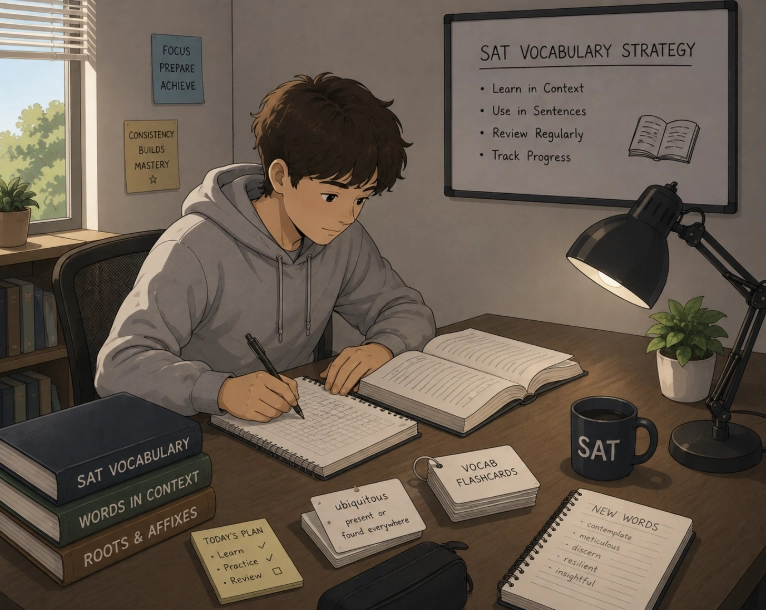
Từ vựng SAT chủ đề Growth, Decline & Quantity
Có thể nói, trong quá trình học và tích lũy từ vựng SAT, người học sẽ tiếp nhận một khối lượng từ vựng học thuật đồ sộ. Do đó, để tránh rơi vào tình trạng học thiếu hệ thống, việc phân loại từ vựng SAT theo quy luật là điều rất cần thiết.
Có nhiều chiến lược khác nhau để phân loại từ vựng cho kỳ thi SAT. Người học có thể phân loại từ vựng theo lĩnh vực, theo độ khó của từ, hoặc theo độ khó của câu hỏi SAT chuẩn trong đó từ vựng được kiểm tra. Trong chuỗi bài viết về từ vựng SAT này, nhóm tác giả chọn cách phân loại theo chức năng của từ. Chức năng của từ có thể được phân loại thành 15 nhóm lớn. Một vài trong số đó bao gồm từ vựng miêu tả sự vận động và biến đổi, từ vựng miêu tả thái độ và cảm xúc, hoặc từ vựng miêu tả các giá trị đạo đức.
Trong các nhóm chức năng đó, nhóm Growth, Decline & Quantity gồm các từ học thuật mô tả sự thay đổi về quy mô, mức độ và số lượng của các hiện tượng, dữ liệu hoặc quá trình trong ngữ cảnh học thuật. Nhóm từ vựng này giúp phản ánh các giai đoạn của một sự biến đổi về lượng:
Mức độ và số lượng: Diễn tả việc đo lường, đếm, thu thập hoặc xác định số lượng, quy mô và mức độ của đối tượng trong nghiên cứu hoặc phân tích.
Sự gia tăng: Diễn tả quá trình tăng trưởng, mở rộng hoặc tích lũy của dữ liệu, nguồn lực, quần thể hoặc các hiện tượng theo thời gian.
Sự suy giảm: Diễn tả quá trình giảm bớt, thu hẹp hoặc đánh giá mức độ bao quát của một hiện tượng, đồng thời nhấn mạnh quy mô hoặc mức độ toàn diện của dữ liệu và nghiên cứu.
Dưới đây là một số từ vựng học thuật về chủ đề Growth, Decline & Quantity thường được sử dụng trong các câu hỏi SAT Reading và Writing [2].
Words | IPA Pronunciation | Part of speech | Etymological analysis | Word family | Vietnamese meaning | Near synonyms | Common collocations | Example |
|---|---|---|---|---|---|---|---|---|
outstrip | /aʊtˈstrɪp/ | v | Old English compound ūt = out + strīpan = strip, originally “surpass by going beyond” | outstripping (n), outstripped (adj) | Bỏ xa | surpass, exceed, outpace, overtake | outstrip competitors, outstrip demand, outstrip expectations, rapidly outstrip | The growth of renewable energy has begun to outstrip the expansion of traditional fossil-fuel infrastructure in several regions. |
spread | /spred/ | v, n | Old English sprǣdan = stretch out, scatter, distribute | spreader (n), spreading (n), widespread (adj), spreadable (adj) | Trải rộng / có phạm vi lớn | extend, expand, distribute, disseminate | spread across, spread throughout, spread rapidly, widespread adoption | The researchers investigated how rapidly the innovation spread across different sectors of the economy. |
substantial | /səbˈstænʃəl/ | adj | Latin substantialis = relating to substance, from substantia = substance, essence | substance (n), substantially (adv), substantiate (v), substantiation (n) | Đáng kể | significant, considerable, sizeable | substantial increase, substantial evidence, substantial amount, substantial difference | The intervention produced a substantial improvement in students' performance compared with the control group. |
span | /spæn/ | n, v | Old English spann = distance between the thumb and little finger when extended; later “extent” or “duration” | spanning (adj), spanned (adj), spanwise (adv) | Kéo dài qua | extend across, cover, encompass, range over | span several decades, span a period, attention span, wide span | The longitudinal study spans several decades, allowing researchers to examine changes in population behavior over time. |
moderate | /ˈmɒdərət/ (adj), /ˈmɒdəreɪt/ (v) | adj, v | Latin moderatus = restrained, controlled, from moderari = regulate, govern | moderation (n), moderately (adv), moderator (n), moderateness (n) | Vừa phải | reasonable, limited, restrained, average | moderate increase, moderate level, moderate growth, moderate effect | The analysis revealed a moderate increase in productivity following the introduction of the new system. |
saturate with | /ˈsætʃəreɪt wɪð/ | v | Latin saturare = fill full, from satur = full, satisfied | saturation (n), saturated (adj), saturating (adj), saturation point (n) | Bão hòa với | fill with, permeate with, overload with | saturate with information, saturated market, saturated with chemicals, become saturated | Once the market became saturated with similar products, companies faced increasing pressure to reduce prices. |
negligible | /ˈneɡlɪdʒəbəl/ | adj | Latin negligere = disregard, neglect (nec = not + legere = pick, gather) | neglect (n/v), negligibly (adv), negligence (n), negligent (adj), neglected (adj) | Không đáng kể | insignificant, minimal, trivial, inconsequential | negligible effect, negligible difference, negligible amount, negligible impact | The difference between the two measurements was negligible and therefore unlikely to affect the overall conclusion. |
hoard | /hɔːrd/ | v, n | Old English hord = hidden store, treasure, from Proto-Germanic huzdą = treasure | hoarder (n), hoarding (n), hoarded (adj) | Tích trữ | stockpile, accumulate, store, amass | hoard resources, hoard supplies, hoard food, hoard wealth | During periods of economic uncertainty, some consumers may hoard essential goods, creating temporary shortages in local markets. |
infrequent | /ɪnˈfriːkwənt/ | adj | Latin infrequens = not often, from in- = not + frequens = crowded, frequent | frequency (n), frequently (adv), infrequently (adv), frequent (adj/v) | Không thường xuyên | occasional, sporadic, rare, intermittent | infrequent occurrence, infrequent visits, infrequent use, infrequent changes | Because observations were infrequent, the researchers had difficulty identifying short-term fluctuations in the population. |
replenish | /rɪˈplenɪʃ/ | v | Old French repleniss- = fill again, from Latin re- = again + plenus = full | replenishment (n), replenishable (adj), replenished (adj) | Bổ sung | restore, renew, refill, replace | replenish resources, replenish supplies, replenish stocks, replenish reserves | Governments must develop sustainable strategies to replenish natural resources that are being depleted faster than they can recover. |
Xem thêm: 5 website luyện thi SAT® online miễn phí
Bài tập vận dụng từ vựng SAT
Sau đây là một số bài tập giúp người học luyện tập các từ vựng thuộc chủ đề Growth, Decline & Quantity. (Unit 3).
Exercise 1: Matching vocabulary & Word families to definitions
Match each word or word family form in Column A (1–10) with its correct definition in Column B (A–J).
1. Replenishment | A. Occurring at relatively long intervals, rather than regularly or frequently. | |
2. Moderately | B. Having extended across a particular period, range, distance, or set of conditions. | |
3. Negligibly | C. Someone who stores items in large quantities for future use, often without immediate practical necessity. | |
4. Saturation | D. Occurring or increasing to a considerable degree or amount. | |
5. Infrequency | E. Occurring to such a small degree that the effect is practically insignificant. | |
6. Outstrip | F. To exceed another quantity, rate, or level in growth, development, or performance | |
7. Substantially | G. The process of filling something completely or causing a system to reach its maximum capacity | |
8. Hoarder | H. Occurring or developing across a wider area, population, or range. | |
9. Spreading | I. To a reasonable or intermediate degree, without being excessive. | |
10. Spanned | J. The process of restoring a supply or quantity to its previous or required level. |
Key: 1. J | 2. I | 3. E | 4. G | 5. A | 6. F | 7. D | 8. C | 9. H | 10. B
Exercise 2: Odd One Out
In each group of four academic terms below, three words share a similar meaning, category, or logical tone, while one word does not belong. Identify the odd word out.
1. replenish — B. restore — C. deplete — D. renew
2. A. substantial — B. considerable — C. negligible — D. significant
3. A. infrequent — B. occasional — C. sporadic — D. continuous
4. A. disperse — B. accumulate — C. hoard — D. stockpile
5. A. span — B. duration — C. interval — D. saturation
6. A. moderately — B. excessively — C. adequately — D. reasonably
7. A. outstrip — B. surpass — C. exceed — D. fall behind
8. A. spreading — B. contracting — C. expanding — D. disseminating
9. A. conserve — B. permeate — C. immerse — D. saturate
10. A. negligible — B. substantial — C. trivial — D. insignificant
Key
1. C. deplete — The others refer to restoring or renewing a supply or resource.
2. C. negligible — The others describe something considerable or significant in size, degree, or importance.
3. D. continuous — The others describe something that occurs irregularly or at relatively long intervals.
4. A. disperse — The others refer to accumulating or storing something, whereas disperse means to distribute it over a wider area.
5. D. saturation — The others refer to a period, range, or length of time, whereas saturation refers to reaching a state of maximum concentration or capacity.
6. B. excessively — The others indicate a reasonable or intermediate degree, whereas excessively indicates a degree beyond what is appropriate or necessary.
7. D. fall behind — The others indicate exceeding another quantity, rate, level, or standard.
8. B. contracting — The others refer to becoming more widespread or increasing in geographical or social extent.
9. A. conserve — The others involve filling, penetrating, or completely occupying a substance or space, whereas conserve means to preserve or avoid using something unnecessarily.
10. B. substantial — The others describe something very small, insignificant, or lacking practical importance.
Exercise 3: Word Family Table
Fill in the blank with the correct form of the word in the bracket:
1. The researchers observed a gradual _________ (spread) of the invasive species across previously unaffected ecosystems.
2. The government introduced stricter regulations to prevent the excessive _________ (hoard) of essential medical supplies during emergencies.
3. The study found that the difference between the two experimental groups was statistically _________ (neglect) and therefore unlikely to affect the overall conclusion.
4. The researchers examined the _________ (moderate) of temperature fluctuations throughout the growing season.
5. The _________ (replenish) of groundwater reserves depends largely on seasonal rainfall and the permeability of the surrounding soil.
6. The rapid growth of the urban population has resulted in the _________ (outstrip) of available housing resources.
7. The report examined the geographical _________ (spanwise) of the agricultural project, which extended across several distinct climatic regions.
8. The _________ (saturate) of the market with similar products made it increasingly difficult for smaller companies to attract new customers.
9. The researchers noted the _________ (infrequent) of extreme weather events during the study period.
10. The experiment produced a _________ (substance) increase in crop yields compared with the control group.
Key:
1. spread
2.hoarding
3. negligible
4. moderation
5. replenishment
6. outstripping
7. span
8. saturation
9. infrequency
10. substantial
Exercise 4: Matching Sentence Halves
Match the first half of each sentence in Column A (1 - 10) with its logically matching second half in Column B (A - J) to complete the sentence.
1. Compared with the control group, the experimental group showed a substantial increase in memory performance... | A. ...because the difference was too small to have practical significance for patients. | |
2. After months of intensive fieldwork, the research team had to replenish its supply of water,... | B. ...to avoid exposing the samples to unusually high or low temperatures. | |
3. Although the treatment produced a measurable change, its overall effect was negligible... | C. ... additional rainfall began to accumulate on the surface rather than being absorbed. | |
4. Extreme weather conditions were infrequent during the observation period, ... | D. ...halting the process of collecting samples before obtaining enough additional supplies. | |
5. Across the northern region, the rapid spread of the invasive plant continued... | E. ...as seeds and pollen were carried by wind into previously unaffected areas. | |
6. Once the soil reached saturation after several hours of heavy rainfall, ... | F. ...meaning that demand was growing faster than the company could manufacture and distribute the products. | |
7. As demand for the new technology continued to rise, the company's production capacity was eventually outstripped, ... | G. ...so researchers had enough evidence to conclude that the improvement was unlikely to be caused by chance alone. | |
8. Rather than distributing the collected samples among the participating laboratories, one lab was accused of hoarding them... | H. ...allowing the researchers to compare students who had only recently entered university with those who had studied for several years. | |
9. To understand how experience influenced research performance, the study examined the span of each participant's academic career, ... | I. ...which prevented the researchers from collecting enough evidence to determine whether the results would have been different under more challenging conditions. | |
10. To minimize the influence of environmental variables, the experiment was conducted under moderate conditions... | J. ...because other laboratories were unable to obtain enough material for their own experiments. |
Key:
1. G — Substantial means large or significant in amount, so a substantial increase provides strong evidence of a meaningful improvement.
2. D — To replenish a supply means to replace what has been used, restoring the quantity needed for continued research.
3. A — Negligible describes an effect that is so small that it has little practical importance.
4. I — Infrequent means occurring rarely or at relatively long intervals, so unusual weather provided limited evidence about its effects.
5. E — The spread of a species refers to its movement or expansion into new geographical areas.
6. C — Saturation occurs when soil has absorbed as much water as it can, causing additional water to accumulate on the surface.
7. F — If production capacity is outstripped, demand has exceeded the amount the company is able to produce or supply.
8. J — Hoarding involves collecting and keeping a large amount of something rather than distributing or using it as intended.
9. H — The span of an academic career refers to the period or range of time covered by that experience.
10. B — Moderate conditions are neither extreme nor excessive, making them useful when researchers want to control environmental variables.
Gợi ý phương pháp học từ vựng hiệu quả
Để tiếp thu từ vựng một cách hiệu quả, người học cần xác định rõ mục tiêu học tập cũng như khả năng học tập của bản thân. Để hỗ trợ người học ôn luyện từ vựng hiệu quả, tác giả bài viết gợi ý phương pháp tự đánh giá để người học tự chọn hướng ôn tập phù hợp.
Xem thêm: Những phương pháp học từ vựng tiếng Anh hiệu quả
Để biết bản thân phù hợp với kiểu học từ vựng nào, người học cần đánh giá theo các tiêu chí sau: mục tiêu học tập, số lượng từ cần học, năng lực đầu vào, thời gian và mức độ cam kết.
Bản thân tác giả cho rằng cách học từ hiệu quả chính là học qua ngữ cảnh và học có lặp lại. Để đạt được hai điều này, người học cần thấy được cách dùng từ trong ngữ cảnh cụ thể, sau đó tìm cách để sử dụng từ trong các ngữ cảnh tương tự (đọc, viết, nói) để nắm rõ mục đích sử dụng từ. Người học cũng không nên chỉ học một lần mà cần phải nhắc lại và củng cố từ vựng.
Người học nên ôn lại từ mới mỗi 2-3 ngày để bù đắp cho phần trí nhớ ngắn hạn bị hao hụt. Nếu từ vựng được nhắc lại nhiều lần, kiến thức về từ sẽ được khắc sâu vào “kho từ vựng” của người học.
Như vậy, bài viết SAT Vocab đã cung cấp cho người học một số từ vựng SAT học thuật về chủ đề Growth, Decline & Quantity, cùng một số bài tập luyện tập cơ bản để hỗ trợ người học ôn luyện. Việc học tập và ôn luyện cho kỳ thi Digital SAT không hề đơn giản và cần nhiều thời gian và nỗ lực. Hy vọng bài viết có thể hỗ trợ người học trong hành trình luyện tập và thi cử của bản thân.
- SAT Vocab Handbook - Từ vựng SAT theo chủ đề
- SAT® Vocab Handbook Unit 1: Từ vựng chủ đề Growth, Decline & Quantity
- SAT® Vocab Handbook Unit 4: Từ vựng chủ đề Growth, Decline & Quantity
- SAT® Vocab Handbook Unit 3: Từ vựng chủ đề Truth, Evidence & Proof
- SAT® Vocab Handbook Unit 2: Từ vựng chủ đề Truth, Evidence & Proof
- SAT® Vocab Handbook Unit 2: Từ vựng chủ đề Growth, Decline & Quantity
- SAT® Vocab Handbook Unit 5: Từ vựng chủ đề Knowledge, Learning & Thinking
- SAT® Vocab Handbook Unit 3: Từ vựng chủ đề Growth, Decline & Quantity
- SAT® Vocab Handbook Unit 1: Từ vựng chủ đề Truth, Evidence & Proof
- SAT® Vocab Handbook Unit 3: Từ vựng chủ đề Knowledge, Learning & Thinking
- SAT® Vocab Handbook Unit 2: Từ vựng chủ đề Knowledge, Learning & Thinking
Tham vấn chuyên môn
Học là hành trình tích lũy kiến thức lâu dài và bền bỉ. Điều quan trọng là tìm thấy động lực và niềm vui từ việc học. Phương pháp giảng dạy tâm đắc: Lấy người học làm trung tâm, đi từ nhận diện vấn đề đến định hướng người học tìm hiểu và tự giải quyết vấn đề.
Nguồn tham khảo
1
“Digital SAT Suite of Assessments Technical Manual.” College Board, Accessed 24 August 2026.
2
“SAT Suite Question Bank.” College Board, https://satsuitequestionbank.collegeboard.org/. Accessed 24 August 2026.
3
“The Official Digital SAT Study Guide.” College Board, Accessed 24 August 2026.
4
“Unit 3 - Growth, Decline & Quantity.” ChatGPT, https://chatgpt.com/share/6a81f373-2ad4-83ec-ba62-7d33ddb9436c. Accessed 16 August 2026.
Bình luận - Hỏi đáp