

Bài thi SAT kiểm tra từ vựng học thuật Tier 2.
Chủ đề từ vựng SAT thông dụng: Cause, Effect & Influence: influence, inspire, motivation for, overcome, popularize, preventable, produce, stimulated, construct, distraction.
Cách học từ vựng hiệu quả: Học theo ngữ cảnh và học có nhắc lại.
SAT® Vocab Handbook Unit 4: Từ vựng SAT chủ đề Cause, Effect & Influence
Bài viết sau sẽ trình bày Từ vựng SAT chủ đề Cause, Effect & Influence Unit 4 cùng một số bài tập luyện tập cho người học.
Key takeaways
Trong quá trình ôn tập cho bài thi Digital SAT, không ít người học cảm thấy khó khăn với từ vựng học thuật được kiểm tra trong bài thi. Thực tế cho thấy bài thi Digital SAT sử dụng nhiều từ vựng SAT học thuật với mật độ dày đặc hơn so với các bài thi chuẩn hóa ngôn ngữ thông thường. Do đó, người học cần đầu tư không ít thời gian để ôn luyện nếu muốn tích lũy từ vựng và cải thiện hiệu quả làm bài. Nắm được nhu cầu đó của người học, Anh ngữ ZIM triển khai chuỗi bài viết về các từ vựng học thuật thường xuất hiện trong bài thi nhằm cung cấp cho người học tài nguyên luyện tập chất lượng cao. Trong phạm vi bài viết này, tác giả sẽ trình bày từ vựng SAT chủ đề Cause, Effect & Influence, một chủ đề thông dụng trong từ vựng SAT.
Từ vựng học thuật trong Digital SAT

Khác với các bài thi SAT cũ thường kiểm tra những từ vựng hiếm gặp hoặc quá chuyên sâu, Digital SAT tập trung vào một nhóm từ vựng khác: Từ vựng học thuật có tính ứng dụng cao (High-utility academic words / Tier 2 vocabulary). Bài thi nhắm vào các từ và cụm từ mà sinh viên thường xuyên bắt gặp trong các văn bản học thuật hoặc môi trường đại học, nhưng lại ít khi được sử dụng trong giao tiếp hằng ngày [1].
Ví dụ: convey, ambivalent, correlate, substantiate [2][3]. Bên cạnh đó, bài thi Digital SAT cũng hạn chế trong việc kiểm tra các từ lóng thông thường (Tier 1) và cả những thuật ngữ kỹ thuật quá hẹp hoặc chuyên ngành (Tier 3).[1][3]
Dạng bài Words in Context trong Digital SAT
Dạng bài Words in Context yêu cầu thí sinh xác định ý nghĩa của một từ/cụm từ học thuật có tính ứng dụng cao dựa trên ngữ cảnh mà nó xuất hiện, hoặc yêu cầu thí sinh lựa chọn một từ/cụm từ logic và chính xác nhất để điền vào chỗ trống trong một đoạn văn [1][3]. Dạng bài này thường xuất hiện dưới 2 định dạng câu hỏi chính:
Điền từ vào chỗ trống: Câu hỏi thường có dạng "Which choice completes the text with the most logical and precise word or phrase?" [1][2]. Thí sinh sẽ đọc một đoạn văn bị thiếu một từ và cần chọn đáp án phù hợp nhất. Dạng bài này chỉ xuất hiện trong thể loại đoạn văn Informational text.
Tìm nghĩa của từ: Câu hỏi thường có dạng "As used in the text, what does the word 'x' most nearly mean?" [1][2]. Dạng bài này chỉ xuất hiện với thể loại đoạn văn Poem/Novel/Short story.
Chiến lược làm bài Words in Context trong Digital SAT

Để có thể đạt kết quả tốt với dạng bài Words in Context, người học có thể áp dụng các bước làm bài tham khảo sau:
Bước 1: Đọc toàn bộ đoạn văn và xác định các từ hoặc cụm từ khóa
Thay vì chỉ tập trung vào câu chứa khoảng trống hoặc từ gạch chân, người đọc cần xem xét chúng trong ngữ cảnh của toàn bộ đoạn văn. Tại bước này, người đọc thực hiện thao tác rà quét để tìm kiếm các "manh mối ngữ cảnh". Các manh mối này thường xuất hiện dưới dạng định nghĩa, sự diễn giải lại, từ đồng nghĩa hoặc từ trái nghĩa.
Bên cạnh đó, người đọc cũng cần chú ý đến các từ chuyển ý đóng vai trò báo hiệu logic cú pháp, bao gồm 3 nhóm chính: nhóm từ nối tiếp ý (also, furthermore), nhóm nguyên nhân - kết quả (because, therefore), và nhóm từ tương phản (although, however).
Bước 2: Tự dự đoán từ của riêng mình
Trước khi nhìn vào các lựa chọn đáp án, người đọc tổng hợp các manh mối ngữ cảnh đã phân tích ở Bước 1 để tự suy luận ra một từ hoặc một cụm từ định nghĩa đơn giản nhất, sao cho vừa vặn với cấu trúc logic của câu. Từ đó, người đọc có thể chọn từ khớp với chỗ trống hoặc từ đồng nghĩa với từ được gạch chân. Thao tác này giúp người đọc chủ động hơn trong câu trả lời, tránh bị phân tâm bởi các phương án được thiết kế để nghe có vẻ hợp lý nhưng thực chất sai lệch về ngữ cảnh.
Bước 3: Đánh giá sắc thái tích cực / tiêu cực
Trong trường hợp văn bản quá phức tạp và người đọc không thể dự đoán chính xác một từ cụ thể, người đọc cần chuyển sang chiến thuật đánh giá sắc thái ý nghĩa. Bằng cách dựa vào các từ tương phản hoặc từ nối, người đọc xác định xem từ cần điền mang sắc thái tích cực, tiêu cực hay trung tính. Sau khi gán nhãn sắc thái, người đọc đối chiếu với các phương án A, B, C, D và loại bỏ những từ mang sắc thái trái ngược với ngữ cảnh.
Bước 4: Ghép phương án vào câu và loại trừ
Người đọc đối chiếu các phương án với "từ dự đoán" ở Bước 2 để tìm ra lựa chọn tốt nhất. Trong quá trình ra quyết định, người đọc cần ghi nhớ nguyên tắc: từ đúng phải là từ logic và chính xác nhất, phù hợp với ngữ cảnh đã được cung cấp. Bên cạnh đó, người đọc cũng cần lưu ý cách kết hợp các từ để có thêm một yếu tố giúp xác nhận đáp án.
Từ vựng SAT chủ đề Cause, Effect & Influence
Có thể nói, trong quá trình học và tích lũy từ vựng SAT, người học sẽ tiếp nhận một khối lượng từ vựng học thuật đồ sộ. Do đó, để tránh rơi vào tình trạng học thiếu hệ thống, việc phân loại từ vựng SAT theo quy luật là điều rất cần thiết.
Có nhiều chiến lược khác nhau để phân loại từ vựng SAT. Người học có thể phân loại từ vựng SAT theo lĩnh vực, theo độ khó của từ, hoặc theo độ khó của câu hỏi SAT chuẩn trong đó từ vựng được kiểm tra. Trong chuỗi bài viết về từ vựng SAT này, nhóm tác giả chọn cách phân loại theo chức năng của từ. Chức năng của từ có thể được phân loại thành 15 nhóm lớn. Một vài trong số đó bao gồm từ vựng miêu tả sự vận động và biến đổi, từ vựng miêu tả thái độ và cảm xúc, hoặc từ vựng miêu tả các giá trị đạo đức.
Trong các nhóm chức năng đó, nhóm Cause, Effect & Influence gồm các từ mô tả mối quan hệ nhân - quả, cơ chế tác động và mức độ ảnh hưởng giữa các yếu tố, hiện tượng hoặc chính sách trong ngữ cảnh nghiên cứu. Nhóm từ vựng này giúp phản ánh một thay đổi , một chuỗi phản ứng hoặc một hệ quả cụ thể:
Khởi phát và nguyên nhân: Diễn tả các yếu tố gốc rễ, chất xúc tác hoặc điều kiện xảy ra vấn đề, sự kiện hoặc xu hướng mới (ví dụ: cause, make, create, invent, depend on).
Cơ chế và tác động: Diễn tả một yếu tố can thiệp, cung cấp nguồn lực, hỗ trợ hoặc ngăn chặn, tác động lên một yếu tố khác trong quá trình vận động (ví dụ: provide, offer, prevent, avoid, useful).
Hệ quả và trạng thái tích lũy: Diễn tả kết quả trực tiếp hoặc gián tiếp, mức độ thành công, cũng như việc đưa ra câu trả lời hoặc trạng thái cuối cùng sau một chuỗi tác động (ví dụ: successful, answer).
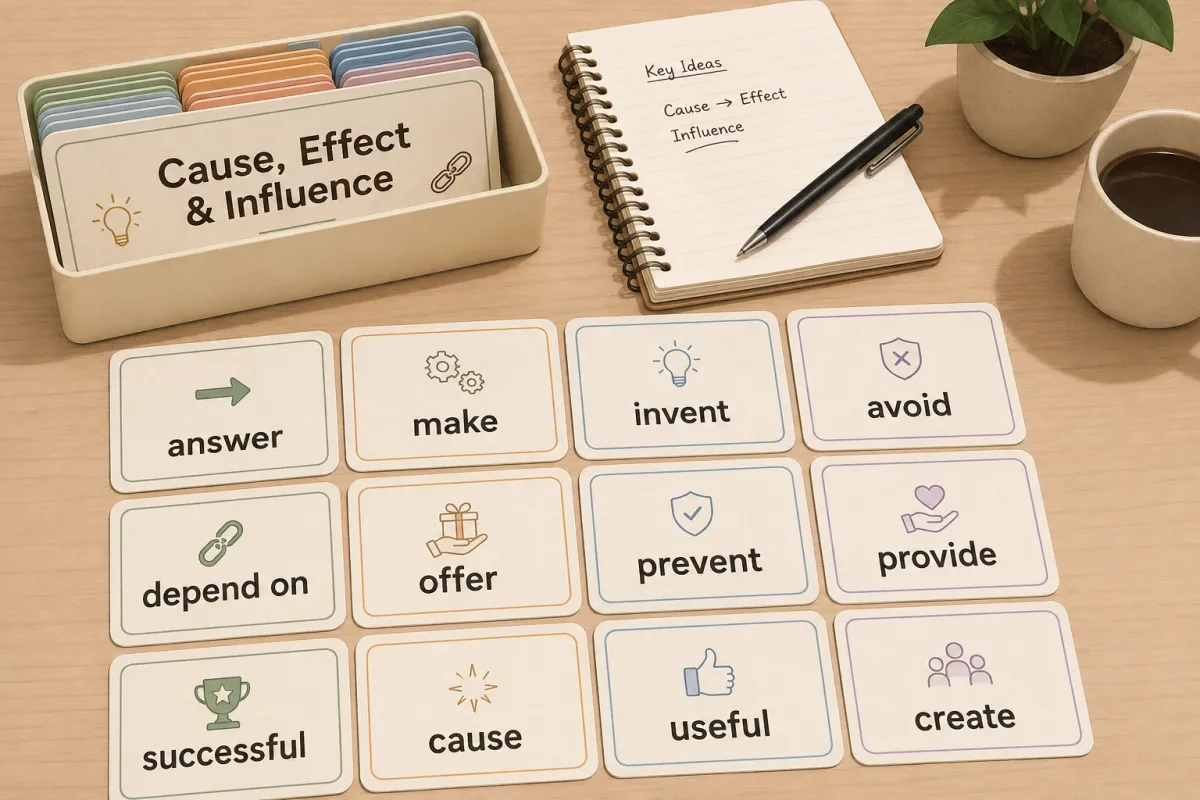
Dưới đây là một số từ vựng SAT học thuật về chủ đề Cause, Effect & Influence thường được sử dụng trong các câu hỏi SAT Reading và Writing.[2]
Words | IPA Pronunciation | Part of speech | Etymological analysis | Word family | Vietnamese meaning | Near synonyms | Common collocations | Example |
influence | /ˈɪn.flu.əns/ | n/v | Latin: in- (in, upon) + fluere (to flow). | influential (adj), influentially (adv), influencer (n), influenced (adj) | ảnh hưởng, tác động; ảnh hưởng đến cách một người, sự vật hoặc quá trình thay đổi | affect, impact, shape, sway | influence behavior; influence decisions; influence public opinion; cultural influence | Social conditions can influence how individuals respond to changes in their economic environment. |
inspire | /ɪnˈspaɪr/ | v | Latin: in- (in, into) + spirare (to breathe). | inspiration (n), inspirational (adj), inspired (adj), inspiring (adj) | truyền cảm hứng, khơi gợi ý tưởng hoặc động lực | motivate, encourage, stimulate, prompt | inspire creativity; inspire confidence; inspire change; inspire someone to act | The scientist's discoveries inspired a new generation of students to pursue careers in environmental science. |
motivation | /ˌmoʊ.t̬əˈveɪ.ʃən/ | n | Latin: movere (to move) + -tion (act or process). | motivate (v), motivated (adj), motivational (adj) | động lực; lý do thúc đẩy một hành động, lựa chọn hoặc mục tiêu | incentive, reason, drive, stimulus | motivation for change; motivation for learning; motivation to succeed; strong motivation | The desire to reduce energy consumption was a major motivation for developing more efficient building materials. |
overcome | /ˌoʊ.vɚˈkʌm/ | v | Old English: ofer (over, beyond) + cuman (to come). | overcoming (n), overcomer (n) | vượt qua, khắc phục khó khăn, trở ngại hoặc vấn đề | surmount, conquer, defeat, resolve | overcome obstacles; overcome challenges; overcome difficulties; overcome barriers | The community developed new irrigation systems to overcome severe water shortages during prolonged periods of drought. |
popularize | /ˈpɑː.pjə.ləˌraɪz/ | v | Latin: popularis (of the people, common) + -ize (to make or cause). | popular (adj), popularity (n), popularization (n), popularly (adv) | phổ biến hóa; làm cho một ý tưởng, sản phẩm hoặc lĩnh vực trở nên phổ biến | promote, disseminate, publicize, spread | popularize a theory; popularize an idea; popularize science; popularize a concept | The documentary helped popularize the theory by presenting its main concepts in clear and accessible language. |
preventable | /prɪˈven.t̬ə.bəl/ | adj | Latin: prae- (before) + venire (to come) + -able (capable of). | prevent (v), prevention (n), preventive (adj) | có thể phòng ngừa, ngăn chặn hoặc tránh được | avoidable, avertable, controllable | preventable disease; preventable error; preventable accident; preventable damage | Improved safety regulations could significantly reduce the number of preventable accidents in industrial workplaces. |
produce | /prəˈduːs/ (v); /ˈproʊ.duːs/ (n) | n/v | Latin: pro- (forward) + ducere (to lead) → producere (to bring forth). | production (n), productive (adj), productivity (n), producer (n) | tạo ra, sản sinh, tạo thành; sản phẩm, đặc biệt là nông sản | create, generate, yield, manufacture | produce results; produce evidence; produce energy; agricultural produce | Certain microorganisms produce chemicals that can be used to develop environmentally friendly industrial materials. |
stimulated | /ˈstɪm.jəˌleɪ.t̬ɪd/ | adj | Latin: stimulus (goad, pointed stick) + -ate (to make or cause). | stimulate (v), stimulation (n), stimulating (adj), stimulus (n) | được kích thích, thúc đẩy hoặc khơi gợi | prompted, encouraged, activated, aroused | stimulated growth; stimulated activity; stimulated interest; stimulated demand | Exposure to diverse cultural perspectives stimulated greater interest in the study of language and communication. |
construct | /kənˈstrʌkt/ (v); /ˈkɑːn.strʌkt/ (n) | n/v | Latin: con- (together) + struere (to build). | construction (n), constructive (adj), reconstruct (v), reconstruction (n) | xây dựng, hình thành, tạo lập; cấu trúc hoặc khái niệm được hình thành | build, create, formulate, establish | construct an argument; construct a model; construct a theory; construct a framework | Students were asked to construct an argument using evidence from historical documents and contemporary economic data. |
distraction | /dɪˈstræk.ʃən/ | n | Latin: dis- (apart) + trahere (to pull) → distrahere (to draw away). | distract (v), distracted (adj), distracting (adj) | sự xao nhãng; yếu tố làm phân tán sự chú ý | diversion, interruption, disturbance, disruption | source of distraction; major distraction; distraction from work; avoid distractions | Frequent notifications can become a significant distraction when students are completing complex academic tasks. |

Bài tập vận dụng từ vựng SAT
Sau đây là một số bài tập giúp người học luyện tập các từ vựng SAT thuộc chủ đề Cause, Effect & Influence (Unit 4) [4].
Exercise 1: Matching Words with Definitions
Match each word or word family form in Column A (1-10) with its correct definition in Column B (A-J).
1. Influence | A. To make an idea, practice, product, or form of knowledge more widely known and accepted among the public. | |
2. Inspire | B. A factor that diverts attention away from a task, activity, or subject that requires sustained concentration. | |
3. Motivation for | C. To create or generate something, particularly through a deliberate process, such as research, manufacturing, or creative activity. | |
4. Overcome | D. Able to be avoided or stopped through appropriate action, planning, or intervention. | |
5. Popularize | E. To encourage a person to develop a particular idea, attitude, or course of action by providing an example, idea, or emotional stimulus. | |
6. Preventable | F. The underlying reason or purpose that explains why an individual undertakes a particular action or pursues a specific goal. | |
7. Produce | G. To successfully deal with, manage, or move beyond a difficulty, limitation, or challenging circumstance. | |
8. Stimulated | H. Caused a person or process to become more active, responsive, or engaged as a result of an external factor or stimulus. | |
9. Construct | I. To build or develop something systematically by combining or arranging separate elements into a coherent whole. | |
10. Distraction | J. To affect the behavior, development, decisions, or characteristics of a person, group, or system. |
Key: 1. J | 2. E | 3. F | 4. G | 5. A | 6. D | 7. C | 8. H | 9. I | 10. B
Exercise 2: Synonym/Antonym
Answer the following questions.
1. Given the word “influence”, which word in the following has a similar meaning?
A. reinforce
B. affect
C. regulate
D. determine
2. Given the word “inspire”, which word in the following has an opposite meaning?
A. discourage
B. stimulate
C. encourage
D. motivate
3. Given the phrase “motivation for”, which phrase in the following has a similar meaning?
A. explanation of
B. consequence of
C. reason for
D. response to
4. Given the word “overcome”, which word in the following has an opposite meaning?
A. resolve
B. withstand
C. confront
D. succumb
5. Given the word “popularize”, which word in the following has a similar meaning?
A. disseminate
B. restrict
C. preserve
D. regulate
6. Given the word “preventable”, which word in the following has an opposite meaning?
A. avoidable
B. manageable
C. inevitable
D. controllable
7. Given the word “produce”, which word in the following has a similar meaning?
A. consume
B. generate
C. diminish
D. preserve
8. Given the word “stimulated”, which word in the following has an opposite meaning?
A. activated
B. prompted
C. energized
D. inhibited
9. Given the word “construct”, which word in the following has a similar meaning?
A. dismantle
B. assemble
C. eliminate
D. separate
10. Given the word “distraction”, which word in the following has an opposite meaning?
A. interruption
B. diversion
C. concentration
D. disturbance
Key
1. B. Explanation: Influence means to affect the behavior, development, or decisions of something or someone, similar in meaning to affect. The other words mean: reinforce (strengthen), regulate (control according to rules), determine(establish or decide).
2. A. Explanation: Inspire means to encourage a person to develop an idea, attitude, or course of action, opposite in meaning to discourage. The other words mean: stimulate (encourage activity), encourage (give support or confidence), motivate (provide a reason for action).
3. C. Explanation: Motivation for refers to the underlying reason or purpose for an action, similar in meaning to reason for. The other phrases mean: explanation of (account of something), consequence of (result of something), response to(reaction to something).
4. D. Explanation: Overcome means to successfully deal with or move beyond a difficulty, opposite in meaning to succumb. The other words mean: resolve (solve a difficulty), withstand (resist successfully), confront (face a problem directly).
5. A. Explanation: Popularize means to make an idea, practice, or product more widely known and accepted, similar in meaning to disseminate. The other words mean: restrict (limit), preserve (maintain in its existing state), regulate(control according to rules).
6. C. Explanation: Preventable describes something that can be avoided through appropriate action, opposite in meaning to inevitable. The other words mean: avoidable (able to be prevented), manageable (able to be controlled), controllable(able to be regulated).
7. B. Explanation: Produce means to create or generate something through a deliberate process, similar in meaning to generate. The other words mean: consume (use up), diminish (make or become smaller), preserve (maintain).
8. D. Explanation: Stimulated means made more active, responsive, or engaged by an external factor, opposite in meaning to inhibited. The other words mean: activated (made active), prompted (caused to act), energized (given energy).
9. B. Explanation: Construct means to build or develop something by combining separate elements, similar in meaning to assemble. The other words mean: dismantle (take apart), eliminate (remove completely), separate (divide into distinct parts).
10. C. Explanation: Distraction is something that diverts attention away from a task or subject, opposite in meaning to concentration. The other words mean: interruption (something that breaks continuity), diversion (something that turns attention elsewhere), disturbance (something that disrupts normal activity).

Exercise 3: Word Form
Complete the sentences using the correct form of the word in brackets.
1. The professor delivered a highly ________________ talk that encouraged students to pursue independent research. (inspire)
2. Researchers found that financial incentives could be used ________________ to encourage households to adopt energy-saving technologies. (produce)
3. The athlete’s ability to recover from repeated injuries demonstrated remarkable determination in ________________ physical and psychological challenges. (overcome)
4. The ________________ of scientific terminology into everyday language helped make complex research more accessible to the general public. (popularize)
5. The teacher used several experiments to act as a powerful ________________ for critical thinking in the classroom. (stimulate)
6. Modern techniques were used in the ________________ of the bridge to ensure it could withstand severe weather conditions. (construct)
7. The documentary proved highly ________________, shaping public attitudes toward environmental conservation and encouraging changes in consumer behavior. (influence)
8. Researchers estimated the ________________ of workplace accidents by examining safety procedures, employee training, and equipment maintenance records. (preventable)
9. The scholarship program successfully ________________ students to pursue research in fields addressing urgent social and environmental challenges. (motivate)
10. Students often become ________________ by constant notifications from digital devices, making it difficult to maintain concentration during demanding academic tasks. (distraction)
Key
1. inspirational/inspiring (note that these two adjectives are not entirely interchangeable, but they can be used in this context.)
2. productively
3. overcoming
4. popularization
5. stimulus
6. construction
7. influential
8. preventability
9. motivated
10. distracted
Exercise 4: Match the first half of each sentence in Column A with its logically matching second half in Column B to complete the sentence
1. Constant noise and sudden interruptions in open-plan offices create a serious distraction, ... | A. ...allowing urban transit authorities to expand subway routes without disturbing surface traffic. | |
2. Civil engineering teams collaborated to construct underground railway tunnels... | B. ...persuading the local government to establish dedicated bus lanes downtown. | |
3. Tax relief programs for small business owners successfully stimulated local hiring... | C. ...making diverse culinary traditions accessible and appealing to everyday diners. | |
4. Public health campaigns proved that foodborne illnesses in restaurant kitchens are largely preventable... | D. ...to launch their own eco-friendly ventures right after graduation. | |
5. Food bloggers and online streaming shows helped popularize international street food, ... | E. ...thereby reducing neighborhood unemployment rates within six months. | |
6. The small tech startup managed to overcome severe initial budget shortages... | F. ...at a high enough volume to supply grocery store chains across three states. | |
7. An engaging guest lecture by a successful founder inspired ambitious university graduates... | G. ...if kitchen staff strictly follow standard hygiene protocols and temperature controls. | |
8. Strong consumer petitions were organized to influence corporate policymakers, ... | H. … to secure additional funding for their community sports programs. | |
9. Early positive feedback from pilot testing and survey provided strong motivation for the public designers... | I. ...leading to frequent working errors and reduced overall productivity among employees. | |
10. Regional distribution centers were scaled up to produce packaged organic meals... | J. ...by focusing on specialized software solutions for niche business clients. |
Key
1. I (A distraction disrupts worker concentration, leading directly to higher error rates and lower productivity.)
2. A (To construct tunnels means to build underground paths, enabling transit authorities to expand subway networks safely.)
3. E (The past tense stimulated means encouraged or boosted economic activity, directly lowering local unemployment.)
4. G (A preventable condition can be stopped before occurring, directly linking disease prevention to hygiene and temperature rules.)
5. C (To popularize a trend means to make it well-known and accepted, bringing foreign foods to everyday diners.)
6. J (To overcome a financial shortfall means to solve or deal with a major obstacle, which the startup achieved by targeting niche markets.)
7. D (The past tense inspired means motivated someone to take positive action, driving students to start green businesses.)
8. B ( To influence decision-makers means to sway their policies, convincing the local council to add bus lanes.)
9. H (A motivation for a team provides the encouragement needed to push forward, prompting them to seek extra funding.)
10. F (To produce goods means to manufacture or process items on a large scale to supply regional supermarkets.)
Gợi ý phương pháp học từ vựng hiệu quả
Để tiếp thu từ vựng một cách hiệu quả, người học cần xác định rõ mục tiêu học tập cũng như khả năng học tập của bản thân. Để hỗ trợ người học ôn luyện từ vựng hiệu quả, tác giả bài viết gợi ý phương pháp tự đánh giá để người học tự chọn hướng ôn tập phù hợp.
Xem thêm: Những phương pháp học từ vựng tiếng Anh hiệu quả
Để biết bản thân phù hợp với kiểu học từ vựng nào, người học cần đánh giá theo các tiêu chí sau: mục tiêu học tập, số lượng từ cần học, năng lực đầu vào, thời gian và mức độ cam kết.
Bản thân tác giả cho rằng cách học từ hiệu quả chính là học qua ngữ cảnh và học có lặp lại. Để đạt được hai điều này, người học cần thấy được cách dùng từ trong ngữ cảnh cụ thể, sau đó tìm cách để sử dụng từ trong các ngữ cảnh tương tự (đọc, viết, nói) để nắm rõ mục đích sử dụng từ. Người học cũng không nên chỉ học một lần mà cần phải nhắc lại và củng cố từ vựng.
Người học nên ôn lại từ mới mỗi 2-3 ngày để bù đắp cho phần trí nhớ ngắn hạn bị hao hụt. Nếu từ vựng được nhắc lại nhiều lần, kiến thức về từ sẽ được khắc sâu vào “kho từ vựng” của người học.
Xem thêm: Ưu và nhược điểm của việc học tập trung vào mục tiêu
Như vậy, bài viết SAT Vocab đã cung cấp cho người học một số từ vựng SAT học thuật về chủ đề Cause, Effect & Influence, cùng một số bài tập luyện tập cơ bản để hỗ trợ người học ôn luyện. Việc học tập và ôn luyện cho kỳ thi Digital SAT không hề đơn giản và cần nhiều thời gian và nỗ lực. Hy vọng bài viết có thể hỗ trợ người học trong hành trình luyện tập và thi cử của bản thân.
Để xây dựng lộ trình học bài bản và đạt kết quả tốt nhất, học viên có thể tham khảo khóa học luyện thi SAT tại ZIM ngay hôm nay.
SAT® is a trademark registered by the College Board, which is not affiliated with, and does not endorse, this website.
- SAT Vocab Handbook - Từ vựng SAT theo chủ đề
- SAT® Vocab Handbook Unit 1: Từ vựng chủ đề Change & Transformation
- SAT® Vocab Handbook Unit 1: Từ vựng SAT chủ đề Cause, Effect & Influence
- SAT® Vocab Handbook Unit 1: Từ vựng chủ đề Growth, Decline & Quantity
- SAT® Vocab Handbook Unit 3: Từ vựng chủ đề Change & Transformation
- SAT® Vocab Handbook Unit 3: Từ vựng chủ đề Properties, Qualities & Characteristics
- SAT® Vocab Handbook Unit 4: Từ vựng chủ đề Growth, Decline & Quantity
- SAT® Vocab Handbook Unit 3: Từ vựng chủ đề Truth, Evidence & Proof
- SAT® Vocab Handbook Unit 2: Từ vựng chủ đề Truth, Evidence & Proof
- SAT® Vocab Handbook Unit 2: Từ vựng chủ đề Growth, Decline & Quantity
- SAT® Vocab Handbook Unit 5: Từ vựng chủ đề Knowledge, Learning & Thinking
Tham vấn chuyên môn
TRẦN HOÀNG THẮNGGiáo viên
Học là hành trình tích lũy kiến thức lâu dài và bền bỉ. Điều quan trọng là tìm thấy động lực và niềm vui từ việc học. Phương pháp giảng dạy tâm đắc: Lấy người học làm trung tâm, đi từ nhận diện vấn đề đến định hướng người học tìm hiểu và tự giải quyết vấn đề.
Nguồn tham khảo
1
“Digital SAT Suite of Assessments Technical Manual.” College Board , Accessed 14 September 2026.
2
“SAT Suite Question Bank.” College Board , https://satsuitequestionbank.collegeboard.org/. Accessed 14 September 2026.
3
“The Official Digital SAT Study Guide.” College Board , Accessed 14 September 2026.
4
“Vocabulary exercise.” OpenAI, https://chatgpt.com/share/6a9aaec6-0cf4-83ec-b998-6b50d48bb505 . Accessed 3 September 2026.


Bình luận - Hỏi đáp