

Bài thi SAT kiểm tra từ vựng học thuật Tier 2.
Chủ đề từ vựng SAT thông dụng: Growth, Decline & Quantity: surpass, depleted, diminish, curtail, dwindling, fecundity, paucity of, profusion of, ubiquitous
Cách học từ vựng hiệu quả: Học theo ngữ cảnh và học có nhắc lại.
SAT® Vocab Handbook Unit 4: Từ vựng chủ đề Growth, Decline & Quantity
Bài viết sau sẽ trình bày Từ vựng SAT chủ đề Growth, Decline & Quantity Unit 4 cùng một số bài tập luyện tập cho người học.
Key takeaways
Trong quá trình ôn tập cho bài thi Digital SAT, không ít người học cảm thấy khó khăn với từ vựng học thuật được kiểm tra trong bài thi. Thực tế cho thấy bài thi Digital SAT sử dụng nhiều từ vựng học thuật với mật độ dày đặc hơn so với các bài thi chuẩn hóa ngôn ngữ thông thường. Do đó, người học cần đầu tư không ít thời gian để ôn luyện nếu muốn tích lũy từ vựng và cải thiện hiệu quả làm bài. Nắm được nhu cầu đó của người học, Anh ngữ ZIM triển khai chuỗi bài viết về các từ vựng SAT học thuật thường xuất hiện trong bài thi nhằm cung cấp cho người học tài nguyên luyện tập chất lượng cao. Trong phạm vi bài viết này, tác giả sẽ trình bày từ vựng SAT chủ đề Growth, Decline & Quantity, một chủ đề thông dụng trong từ vựng SAT.
Từ vựng học thuật trong Digital SAT
Khác với các bài thi SAT cũ thường kiểm tra những từ vựng hiếm gặp hoặc quá chuyên sâu, Digital SAT tập trung vào một nhóm từ vựng khác: từ vựng học thuật có tính ứng dụng cao (High-utility academic words / Tier 2 vocabulary).
Bài thi nhắm vào các từ và cụm từ mà sinh viên thường xuyên bắt gặp trong các văn bản học thuật hoặc môi trường đại học, nhưng lại ít khi được sử dụng trong giao tiếp hằng ngày [1]. Ví dụ: convey, ambivalent, correlate, substantiate.[2][3]
Bên cạnh đó, bài thi Digital SAT cũng hạn chế trong việc kiểm tra các từ lóng thông thường (Tier 1) và cả những thuật ngữ kỹ thuật quá hẹp hoặc chuyên ngành (Tier 3) [1] [3].
Dạng bài Words in Context trong Digital SAT
Dạng bài Words in Context yêu cầu thí sinh xác định ý nghĩa của một từ/cụm từ học thuật có tính ứng dụng cao dựa trên ngữ cảnh mà nó xuất hiện, hoặc yêu cầu thí sinh lựa chọn một từ/cụm từ logic và chính xác nhất để điền vào chỗ trống trong một đoạn văn [1] [3]. Dạng bài này thường xuất hiện dưới 2 định dạng câu hỏi chính:
Điền từ vào chỗ trống: Câu hỏi thường có dạng "Which choice completes the text with the most logical and precise word or phrase?" [1][2]. Thí sinh sẽ đọc một đoạn văn bị thiếu một từ và cần chọn đáp án phù hợp nhất. Dạng bài này chỉ xuất hiện trong thể loại đoạn văn Informational text.
Tìm nghĩa của từ: Câu hỏi thường có dạng "As used in the text, what does the word 'x' most nearly mean?" [1][2]. Dạng bài này chỉ xuất hiện với thể loại đoạn văn Poem/Novel/Short story.
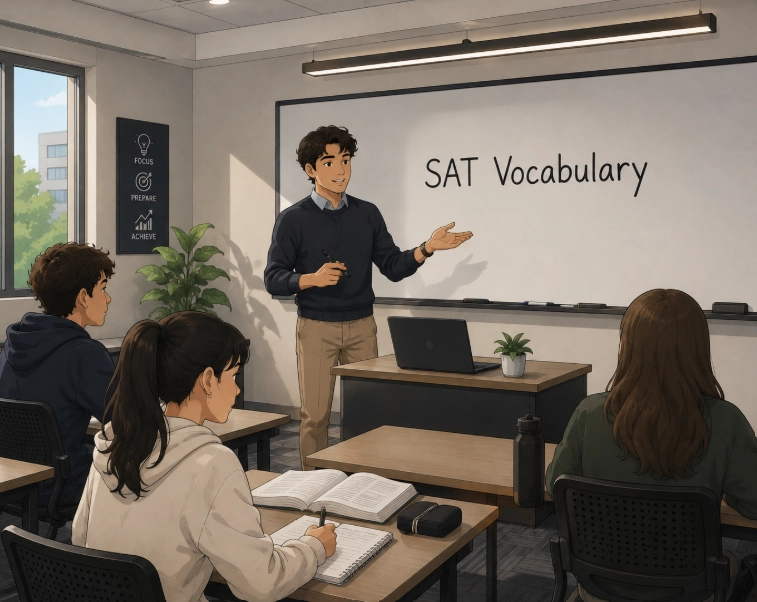
Chiến lược làm bài Words in Context trong Digital SAT
Để có thể đạt kết quả tốt với dạng bài Words in Context, người học có thể áp dụng các bước làm bài tham khảo sau:
Bước 1: Đọc toàn bộ đoạn văn và xác định các từ hoặc cụm từ khóa
Thay vì chỉ tập trung vào câu chứa khoảng trống hoặc từ gạch chân, người đọc cần xem xét chúng trong ngữ cảnh của toàn bộ đoạn văn. Tại bước này, người đọc thực hiện thao tác rà quét để tìm kiếm các "manh mối ngữ cảnh". Các manh mối này thường xuất hiện dưới dạng định nghĩa, sự diễn giải lại, từ đồng nghĩa hoặc từ trái nghĩa.
Bên cạnh đó, người đọc cũng cần chú ý đến các từ chuyển ý đóng vai trò báo hiệu logic cú pháp, bao gồm 3 nhóm chính: nhóm từ nối tiếp ý (also, furthermore), nhóm nguyên nhân - kết quả (because, therefore), và nhóm từ tương phản ( although, however).
Bước 2: Tự dự đoán từ của riêng mình
Trước khi nhìn vào các lựa chọn đáp án, người đọc tổng hợp các manh mối ngữ cảnh đã phân tích ở Bước 1 để tự suy luận ra một từ hoặc một cụm từ định nghĩa đơn giản nhất, sao cho vừa vặn với cấu trúc logic của câu.
Từ đó, người đọc có thể chọn từ khớp với chỗ trống hoặc từ đồng nghĩa với từ được gạch chân. Thao tác này giúp người đọc chủ động hơn trong câu trả lời, tránh bị phân tâm bởi các phương án được thiết kế để nghe có vẻ hợp lý nhưng thực chất sai lệch về ngữ cảnh.
Bước 3: Đánh giá sắc thái tích cực / tiêu cực
Trong trường hợp văn bản quá phức tạp và người đọc không thể dự đoán chính xác một từ cụ thể, người đọc cần chuyển sang chiến thuật đánh giá sắc thái ý nghĩa. Bằng cách dựa vào các từ tương phản hoặc từ nối, người đọc xác định xem từ cần điền mang sắc thái tích cực, tiêu cực hay trung tính. Sau khi gán nhãn sắc thái, người đọc đối chiếu với các phương án A, B, C, D và loại bỏ những từ mang sắc thái trái ngược với ngữ cảnh.
Bước 4: Ghép phương án vào câu và loại trừ
Người đọc đối chiếu các phương án với "từ dự đoán" ở Bước 2 để tìm ra lựa chọn tốt nhất. Trong quá trình ra quyết định, người đọc cần ghi nhớ nguyên tắc: từ đúng phải là từ logic và chính xác nhất, phù hợp với ngữ cảnh đã được cung cấp. Bên cạnh đó, người đọc cũng cần lưu ý cách kết hợp các từ để có thêm một yếu tố giúp xác nhận đáp án.

Từ vựng SAT chủ đề Growth, Decline & Quantity
Có thể nói, trong quá trình học và tích lũy từ vựng SAT, người học sẽ tiếp nhận một khối lượng từ vựng học thuật đồ sộ. Do đó, để tránh rơi vào tình trạng học thiếu hệ thống, việc phân loại từ vựng SAT theo quy luật là điều rất cần thiết.
Có nhiều chiến lược khác nhau để phân loại từ vựng cho kỳ thi SAT. Người học có thể phân loại từ vựng theo lĩnh vực, theo độ khó của từ, hoặc theo độ khó của câu hỏi SAT chuẩn trong đó từ vựng được kiểm tra. Trong chuỗi bài viết về từ vựng SAT này, nhóm tác giả chọn cách phân loại theo chức năng của từ. Chức năng của từ có thể được phân loại thành 15 nhóm lớn. Một vài trong số đó bao gồm từ vựng miêu tả sự vận động và biến đổi, từ vựng miêu tả thái độ và cảm xúc, hoặc từ vựng miêu tả các giá trị đạo đức.
Trong các nhóm chức năng đó, nhóm Growth, Decline & Quantity gồm các từ học thuật mô tả sự thay đổi về quy mô, mức độ và số lượng của các hiện tượng, dữ liệu hoặc quá trình trong ngữ cảnh học thuật. Nhóm từ vựng này giúp phản ánh các giai đoạn của một sự biến đổi về lượng:
Mức độ và số lượng: Diễn tả việc đo lường, đếm, thu thập hoặc xác định số lượng, quy mô và mức độ của đối tượng trong nghiên cứu hoặc phân tích.
Sự gia tăng: Diễn tả quá trình tăng trưởng, mở rộng hoặc tích lũy của dữ liệu, nguồn lực, quần thể hoặc các hiện tượng theo thời gian.
Sự suy giảm: Diễn tả quá trình giảm bớt, thu hẹp hoặc đánh giá mức độ bao quát của một hiện tượng, đồng thời nhấn mạnh quy mô hoặc mức độ toàn diện của dữ liệu và nghiên cứu.
Dưới đây là một số từ vựng học thuật về chủ đề Growth, Decline & Quantity thường được sử dụng trong các câu hỏi SAT Reading và Writing [2].
Words | IPA Pronunciation | Part of speech | Etymological analysis | Word family | Vietnamese meaning | Near synonyms | Common collocations | Example |
|---|---|---|---|---|---|---|---|---|
surpass | /sərˈpæs/ | v | Old French surpasser = go beyond, from sur- = over + passer = pass | surpassing (adj), surpassingness (n), surpasser(n), surpassingly (adv), surpassed (adj) | Vượt qua | exceed, outstrip, transcend, overtake | surpass expectations, surpass a limit, surpass competitors | The latest treatment surpassed existing therapies in terms of both effectiveness and long-term patient outcomes. |
depleted | /dɪˈpliːtɪd/ | adj | Latin deplere = empty out, from de- = completely + plere = fill | deplete (v), depletion (n), depletable (adj), depleting (adj) | Cạn kiệt | exhausted, diminished, drained, reduced | depleted resources, depleted reserves, depleted supplies, severely depleted | The prolonged drought left the region's freshwater reserves severely depleted, raising concerns about future agricultural production. |
diminish | /dɪˈmɪnɪʃ/ | v | Latin deminuere = make smaller, from de- = down + minuere = lessen | diminished (adj), diminishing (adj), diminution (n) | Giảm bớt | decrease, lessen, reduce, weaken | diminish the effect, diminish the impact, diminish in importance | As the distance from the source increased, the concentration of the pollutant gradually diminished. |
curtail | /kərˈteɪl/ | v | Old French court tailler = cut short, from court = short + tailler = cut | curtailment (n), curtailed (adj) | Cắt giảm | reduce, restrict, limit, decrease | curtail spending, curtail production, curtail activities, curtail access | The institution was forced to curtail its research activities after receiving substantially less funding than anticipated. |
dwindling | /ˈdwɪndlɪŋ/ | adj | Middle English dwinen = become smaller, fade away | dwindle (v), dwindled (adj), dwindlement (n) | Suy giảm | declining, diminishing, shrinking, decreasing | dwindling resources, dwindling population, dwindling supply, dwindling support | The region's dwindling water supply has prompted policymakers to introduce stricter conservation measures. |
fecundity | /fɪˈkʌndəti/ | n | Latin fecunditas = fertility, productivity, from fecundus = fertile, fruitful | fecund (adj), fecundly (adv), fecundate (v), fecundation (n) | Sự màu mỡ | fertility, productivity, prolificacy | soil fecundity, reproductive fecundity, high fecundity | Scientists examined how soil composition affected the fecundity of agricultural land over successive growing seasons. |
paucity of | /ˈpɔːsəti əv/ | n | Latin paucitas = smallness in number, from paucus = few | paucitous (adj), paucal (adj) | Sự khan hiếm | scarcity, shortage, insufficiency, lack, meagerness, dearth | paucity of evidence, paucity of data, paucity of resources | The paucity of reliable historical records makes it difficult for researchers to determine the population's exact size during that period. |
profusion of | /prəˈfjuːʒən əv/ | n | Latin profusio = pouring forth, from profundere = pour out | profuse (adj), profusely (adv), profuseness (n) | Sự dồi dào | abundance, wealth, multitude, excess | profusion of information, profusion of resources, profusion of evidence | The profusion of digital information available to researchers has increased both the possibilities and the challenges of academic analysis. |
ubiquitous | /juːˈbɪkwɪtəs/ | adj | Latin ubique = everywhere | ubiquity (n), ubiquitously (adv) | Có mặt khắp nơi | omnipresent, pervasive, widespread, universal | ubiquitous technology, ubiquitous presence, become ubiquitous | Smartphone technology has become ubiquitous, fundamentally altering how individuals access and exchange information. |
Xem thêm: Lỗi Redundancy trong SAT và cách khắc phục
Bài tập vận dụng từ vựng SAT
Sau đây là một số bài tập giúp người học luyện tập các từ vựng thuộc chủ đề Growth, Decline & Quantity (Unit 4). [4]
Exercise 1: Matching vocabulary & Word families to definitions
Match each word or word family form in Column A (1–9) with its correct definition in Column B (A–I).
1. Surpassingness | A. Characterised by producing, giving or flowing in a very large amount of great abundance. | |
2. Depletion | B. The state of being present, encountered, or observed in many places or among many groups. | |
3. Diminution | C. The reduction or exhaustion of a resource, supply, or quantity through use or consumption. | |
4. Dwindle | D. Exceptionally fertile or productive, especially in relation to biological reproduction. | |
5. Ubiquity | E. Characterised by being notably scarce, rare or insufficient in quantity. | |
6. Curtailment | F. The process of reducing in size, extent, intensity, or significance, as well as becoming weaker. | |
7. Profuse | G. To become progressively smaller, weaker, or less numerous. | |
8. Paucitous | H. The ability to exceed a specified standard, level, or degree in quality, quantity, or performance | |
9. Fecund | I. The planned and intentional act or process of reducing the scope, duration, or extent of something. |
Key: 1. H | 2. C | 3. F | 4. G | 5. B | 6. I | 7. A | 8. E | 9. D
Exercise 2: Word Family Table
Complete the table by writing the correct noun (person/thing), verb, adjective, or adverb form of each target word. If no common form exists, write "—"
No. | Noun (Person/Thing) | Verb | Adjective | Adverb |
1 | __________ | surpass | __________ | __________ |
2 | depletion | __________ | __________ | __________ |
3 | __________ | __________ | diminishing | __________ |
4 | __________ | curtail | __________ | __________ |
5 | __________ | dwindle | dwindling | __________ |
6 | fecundity | __________ | __________ | __________ |
7 | paucity | __________ | __________ | __________ |
8 | __________ | __________ | profuse | __________ |
9 | ubiquity | __________ | __________ | __________ |
Key:
No. | Noun (Person/Thing) | Verb | Adjective | Adverb |
1 | surpasser, surpassingness | surpass | surpassing, (un)surpassed | surpassingly, (un)surpassedly |
2 | depletion | deplete | (un)depleted, (non)depletable, (un)depleting | — |
3 | diminution | diminish | (un)diminishing, (un)diminished | (un)diminishingly |
4 | curtailment | curtail | (un)curtailed | — |
5 | dwindlement | dwindle | (un)dwindling | — |
6 | fecundity | fecundate | (un)fecund, (un)fecundated | (un)fecundly |
7 | paucity | — | paucitous, paucal | — |
8 | profusion | — | (un)profuse | (un)profusely |
9 | ubiquity | — | (un)ubiquitous | (un)ubiquitously |

Exercise 3: Matching Sentence Halves
Match the first half of each sentence in Column A (1 - 9) with its logically matching second half in Column B (A - I) to complete the sentence.
1. After several months of intensive farming, the depletion of essential nutrients in the soil... | A. ...students can now easily access scientific databases and educational resources anywhere without visiting a physical library. | |
2. When the river experienced a prolonged drought, its water level began dwindling, ... | B. ...means that farmers may need to use fertilizers to restore the productivity of the land. | |
3. By introducing stricter emission standards, the government managed to achieve a significant diminution in air pollution... | C. ... so the experiment was extended to make use of the plants’ unnaturally high seed count. | |
4. Because the island has a paucity of freshwater resources... | D. ...the research team can easily examine samples from forests, wetlands, grasslands, and coastal regions. | |
5. As the university's botanical garden contains a profusion of plant species,... | E. …it was used in order to create tools and machines that could last through wear and tear. | |
6. Scientists were surprised by the fecundity of the newly introduced crop variety... | F. ...local authorities have introduced strict regulations on agricultural and residential water use. | |
7. As the research budget was reduced and the laboratory had to curtail its fieldwork,... | G. ...the laboratory could no longer visit as many remote sites to collect environmental samples as before. | |
8. As the newly developed material demonstrated surpassing strength and durability,... | H. ...eventually falling to a level that threatened several species living along its banks. | |
9. Due to the ubiquity of digital technology in modern classrooms,... | I. …leading to the number of respiratory illnesses reported in the area decreasing over the following two years. |
Key:
1. B (The depletion of nutrients means that essential substances in the soil have been used up or significantly reduced, so fertilizers may be needed to restore soil productivity.)
2. H (A dwindling water level is gradually becoming smaller or lower; a prolonged decline could threaten species dependent on the river.)
3. I (A diminution is a reduction in the amount or intensity of something; here, it refers to the decrease in air pollution.)
4. F (A paucity means a very small or insufficient amount; limited freshwater resources would therefore require restrictions on water use.)
5. D (A profusion means a large or abundant quantity; the garden's many plant species allow researchers to study samples from numerous environments.)
6. C (Fecundity refers to the ability to produce offspring or seeds in large numbers; the unusually high seed production explains why the experiment was extended.)
7. G (To curtail something means to reduce or limit it; a smaller research budget would therefore force the laboratory to reduce its fieldwork.)
8. E (Surpassing means exceeding another standard or level; the material's greater strength and durability allowed it to be used to create durable tools.)
9. A (Ubiquity refers to being widespread or found almost everywhere; widespread digital technology allows students to access resources in many classroom settings.)
Exercise 4: SAT contextual word choice
Read each sentence carefully. Choose the most precise and logical word from the bracketed options [ Option A / Option B ] to complete the sentence based on its academic context.
1. Following several months of inadequate rainfall, the reservoir's water level began [ dwindling / stabilizing ] after finally getting a few days of consecutive rain.
2. The researchers observed a significant [ depletion / accumulation ] of nitrogen in the soil after years of intensive agricultural cultivation.
3. The revised procedure produced [ inferior / surpassing ] results, with surprisingly more measurement errors than the original method.
4. The region's [ paucity / abundance ] of reliable rainfall has historically helped it in agricultural planning.
5. Scientists recorded a marked increase in the reproductive [ fecundity / longevity ] of the species after the environmental conditions were improved.
6. The university announced a temporary [ curtailment / expansion ] of laboratory operations while the ventilation system was being replaced.
7. The researchers noted a gradual [ diminution / intensification ] in the concentration of airborne pollutants every year since the commonization of cars.
8. The study revealed the [ ubiquity / complexity ] of microplastic particles, which were detected in samples collected from ecosystems across several continents.
9. The museum's collection only contains a small [ profusion / selection ] of artifacts from the period, since many were destroyed during wartime.
Key:
1. stabilizing (The water level is finally becoming steady and normal; "dwindling" means slowly becoming smaller in size, amount, or number over time.
2. depletion (The sentence describes the reduction or exhaustion of nitrogen in the soil; "accumulation" refers to the gradual gathering or increase of something.)
3. inferior (The revised procedure performed worse than the original; "surpassing" indicates exceeding another standard.)
4. abundance (The region has a notably high amount of reliable rainfall; "paucity" refers to a severe lack of something.”
5. fecundity (Fecundity refers specifically to reproductive capacity, which is the ability to produce offspring; "longevity" refers to the length of time an organism or phenomenon persists.)
6. curtailment (The university temporarily reduced the scope of its laboratory operations; "expansion" means an increase in size, scope, or extent.)
7. intensification (The concentration of pollutants increased after cars became common; "diminution" means a reduction in strength, severity, or degree.)
8. ubiquity (The particles were found across numerous and widely separated ecosystems, indicating their widespread presence; "complexity" refers to the number and interrelationship of components within a system.)
9. Selection (The collection contains a small collection of artifacts as many were destroyed; "profusion” refers to an abundance of something.)
Gợi ý phương pháp học từ vựng hiệu quả
Để tiếp thu từ vựng một cách hiệu quả, người học cần xác định rõ mục tiêu học tập cũng như khả năng học tập của bản thân. Để hỗ trợ người học ôn luyện từ vựng hiệu quả, tác giả bài viết gợi ý phương pháp tự đánh giá để người học tự chọn hướng ôn tập phù hợp.
Xem thêm: Những phương pháp học từ vựng tiếng Anh hiệu quả
Để biết bản thân phù hợp với kiểu học từ vựng nào, người học cần đánh giá theo các tiêu chí sau: mục tiêu học tập, số lượng từ cần học, năng lực đầu vào, thời gian và mức độ cam kết.
Bản thân tác giả cho rằng cách học từ hiệu quả chính là học qua ngữ cảnh và học có lặp lại. Để đạt được hai điều này, người học cần thấy được cách dùng từ trong ngữ cảnh cụ thể, sau đó tìm cách để sử dụng từ trong các ngữ cảnh tương tự (đọc, viết, nói) để nắm rõ mục đích sử dụng từ. Người học cũng không nên chỉ học một lần mà cần phải nhắc lại và củng cố từ vựng.
Người học nên ôn lại từ mới mỗi 2-3 ngày để bù đắp cho phần trí nhớ ngắn hạn bị hao hụt. Nếu từ vựng được nhắc lại nhiều lần, kiến thức về từ sẽ được khắc sâu vào “kho từ vựng” của người học.
Như vậy, bài viết SAT Vocab đã cung cấp cho người học một số từ vựng SAT học thuật về chủ đề Growth, Decline & Quantity, cùng một số bài tập luyện tập cơ bản để hỗ trợ người học ôn luyện. Việc học tập và ôn luyện cho kỳ thi Digital SAT không hề đơn giản và cần nhiều thời gian và nỗ lực. Hy vọng bài viết có thể hỗ trợ người học trong hành trình luyện tập và thi cử của bản thân.
Tham khảo chương trình luyện thi SAT cam kết đầu ra tại ZIM Academy để được hướng dẫn chuyên sâu và bứt phá điểm số.
SAT® is a trademark registered by the College Board, which is not affiliated with, and does not endorse, this website.
- SAT Vocab Handbook - Từ vựng SAT theo chủ đề
- SAT® Vocab Handbook Unit 1: Từ vựng chủ đề Growth, Decline & Quantity
- SAT® Vocab Handbook Unit 3: Từ vựng chủ đề Change & Transformation
- SAT® Vocab Handbook Unit 4: Từ vựng chủ đề Growth, Decline & Quantity
- SAT® Vocab Handbook Unit 3: Từ vựng chủ đề Truth, Evidence & Proof
- SAT® Vocab Handbook Unit 2: Từ vựng chủ đề Truth, Evidence & Proof
- SAT® Vocab Handbook Unit 2: Từ vựng chủ đề Growth, Decline & Quantity
- SAT® Vocab Handbook Unit 5: Từ vựng chủ đề Knowledge, Learning & Thinking
- SAT® Vocab Handbook Unit 5: Từ vựng chủ đề Change & Transformation
- SAT® Vocab Handbook Unit 4: Từ vựng chủ đề Change & Transformation
- SAT® Vocab Handbook Unit 3: Từ vựng chủ đề Growth, Decline & Quantity
Tham vấn chuyên môn
Học là hành trình tích lũy kiến thức lâu dài và bền bỉ. Điều quan trọng là tìm thấy động lực và niềm vui từ việc học. Phương pháp giảng dạy tâm đắc: Lấy người học làm trung tâm, đi từ nhận diện vấn đề đến định hướng người học tìm hiểu và tự giải quyết vấn đề.
Nguồn tham khảo
1
“[1] Digital SAT Suite of Assessments Technical Manual.” College Board, Accessed 24 August 2026.
2
“[2] SAT Suite Question Bank.” College Board, https://satsuitequestionbank.collegeboard.org/. Accessed 24 August 2026.
3
“[3] The Official Digital SAT Study Guide.” College Board, Accessed 24 August 2026.
4
“[4] Unit 4 - Growth, Decline & Quantity.” ChatGPT, https://chatgpt.com/share/6a85d406-5a60-83ec-95e5-530fe30a8a6c. Accessed 18 August 2026.
Bình luận - Hỏi đáp