


Bài thi SAT kiểm tra từ vựng học thuật Tier 2.
Chủ đề từ vựng SAT thông dụng: Change & Transformation: newfound, fluctuation, defunct, disengage, disperse, reconstitute, redefine, supersede, transpose.
Cách học từ vựng hiệu quả: Học theo ngữ cảnh và học có nhắc lại.
SAT® Vocab Handbook Unit 5: Từ vựng chủ đề Change & Transformation
Bài viết sau sẽ trình bày các Từ vựng SAT chủ đề Change & Transformation Unit 5 cùng 1 số bài tập luyện tập cho người học.
Key takeaways
Trong quá trình ôn tập cho bài thi Digital SAT, không ít người học cảm thấy khó khăn với từ vựng học thuật được kiểm tra trong bài thi. Thực tế cho thấy bài thi Digital SAT sử dụng nhiều từ vựng học thuật với mật độ dày đặc hơn so với các bài thi chuẩn hóa ngôn ngữ thông thường. Do đó, người học cần đầu tư không ít thời gian để ôn luyện nếu muốn tích lũy từ vựng và cải thiện hiệu quả làm bài. Nắm được nhu cầu đó của người học, Anh ngữ ZIM triển khai chuỗi bài viết về các từ vựng học thuật thường xuất hiện trong bài thi nhằm cung cấp cho người học tài nguyên luyện tập chất lượng cao. Trong phạm vi bài viết này, tác giả sẽ trình bày từ vựng SAT chủ đề Change & Transformation, một chủ đề thông dụng trong từ vựng SAT.
Từ vựng học thuật trong Digital SAT
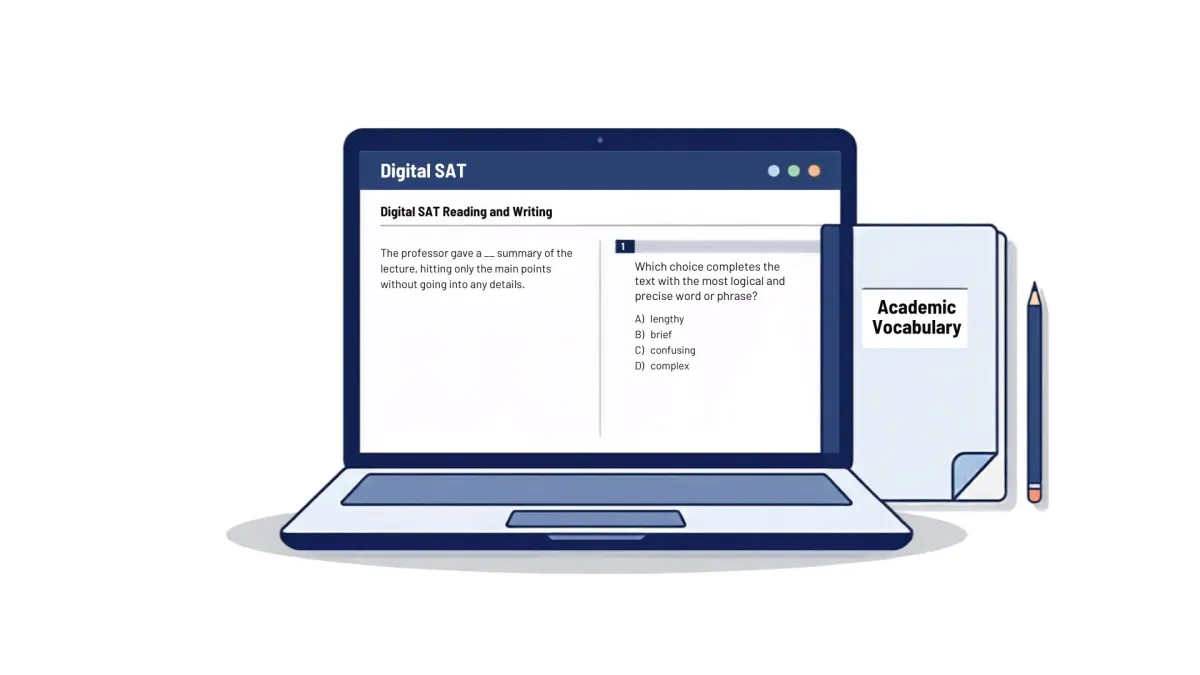
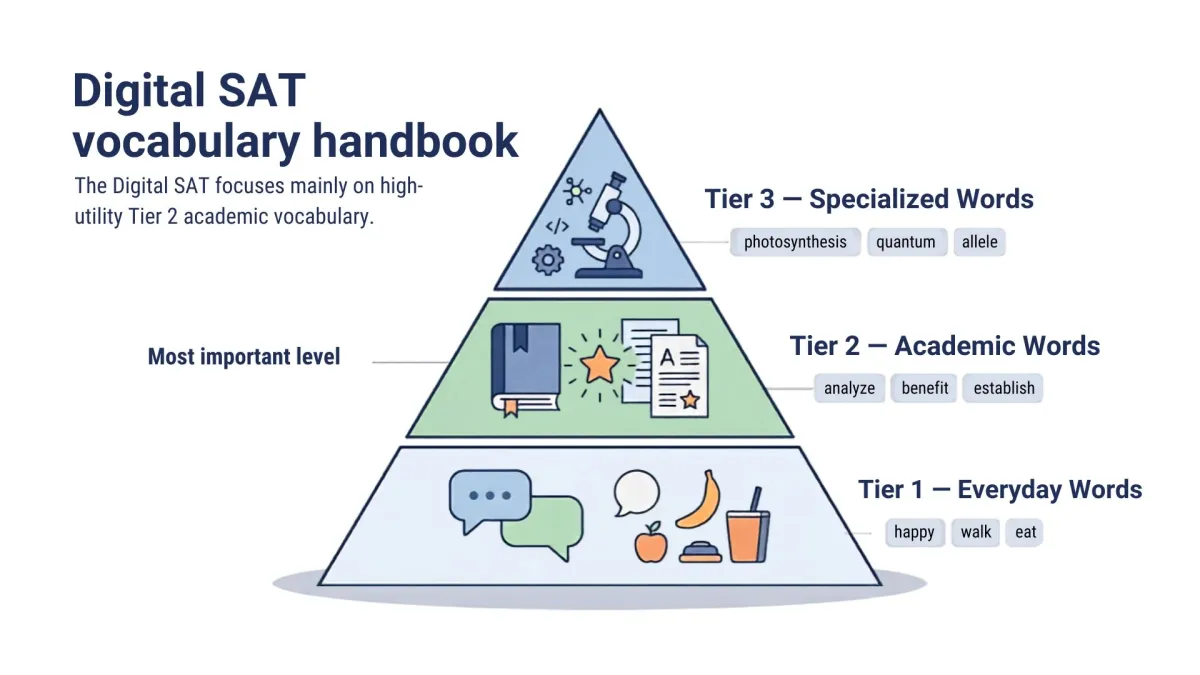
Khác với các bài thi SAT cũ thường kiểm tra những từ vựng hiếm gặp hoặc quá chuyên sâu, Digital SAT tập trung vào một nhóm từ vựng khác: từ vựng học thuật có tính ứng dụng cao (High-utility academic words / Tier 2 vocabulary).
Bài thi nhắm vào các từ và cụm từ mà sinh viên thường xuyên bắt gặp trong các văn bản học thuật hoặc môi trường đại học, nhưng lại ít khi được sử dụng trong giao tiếp hằng ngày [1]. Ví dụ: convey, ambivalent, correlate, substantiate.[2][3]
Bên cạnh đó, bài thi Digital SAT cũng hạn chế trong việc kiểm tra các từ lóng thông thường (Tier 1) và cả những thuật ngữ kỹ thuật quá hẹp hoặc chuyên ngành (Tier 3) [1] [3].
Dạng bài Words in Context trong Digital SAT
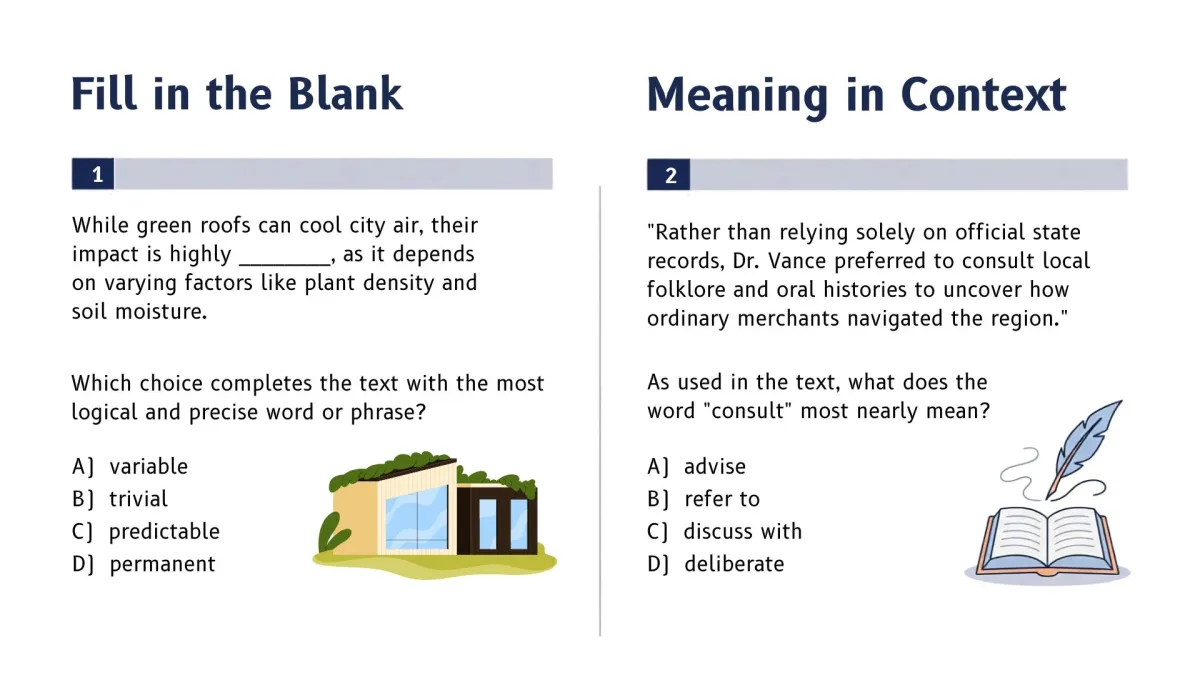
Dạng bài Words in Context yêu cầu thí sinh xác định ý nghĩa của một từ/cụm từ học thuật có tính ứng dụng cao dựa trên ngữ cảnh mà nó xuất hiện, hoặc yêu cầu thí sinh lựa chọn một từ/cụm từ logic và chính xác nhất để điền vào chỗ trống trong một đoạn văn [1] [3]. Dạng bài này thường xuất hiện dưới 2 định dạng câu hỏi chính:
Điền từ vào chỗ trống: Câu hỏi thường có dạng "Which choice completes the text with the most logical and precise word or phrase?" [1][2]. Thí sinh sẽ đọc một đoạn văn bị thiếu một từ và cần chọn đáp án phù hợp nhất. Dạng bài này chỉ xuất hiện trong thể loại đoạn văn Informational text.
Tìm nghĩa của từ: Câu hỏi thường có dạng "As used in the text, what does the word 'x' most nearly mean?" [1][2]. Dạng bài này chỉ xuất hiện với thể loại đoạn văn Poem/Novel/Short story.
Chiến lược làm bài Words in Context trong Digital SAT
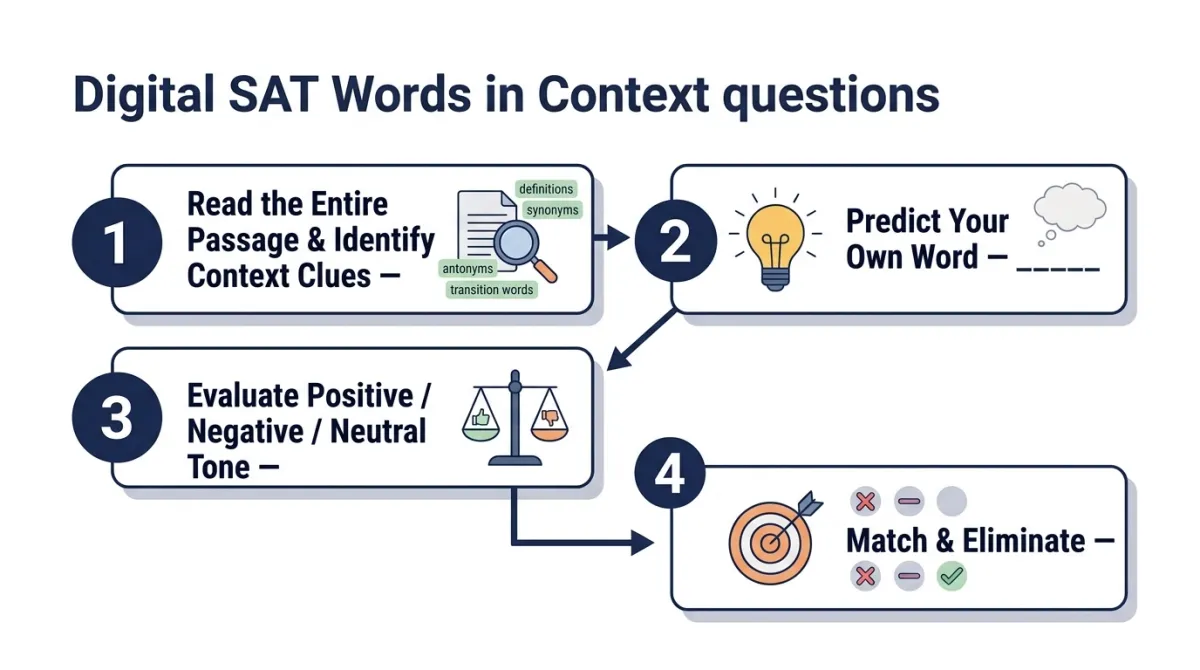
Để có thể đạt kết quả tốt với dạng bài Words in Context, người học có thể áp dụng các bước làm bài tham khảo sau:
Bước 1: Đọc toàn bộ đoạn văn và xác định các từ hoặc cụm từ khóa
Thay vì chỉ tập trung vào câu chứa khoảng trống hoặc từ gạch chân, người đọc cần xem xét chúng trong ngữ cảnh của toàn bộ đoạn văn. Tại bước này, người đọc thực hiện thao tác rà quét để tìm kiếm các "manh mối ngữ cảnh". Các manh mối này thường xuất hiện dưới dạng định nghĩa, sự diễn giải lại, từ đồng nghĩa hoặc từ trái nghĩa.
Bên cạnh đó, người đọc cũng cần chú ý đến các từ chuyển ý đóng vai trò báo hiệu logic cú pháp, bao gồm 3 nhóm chính: nhóm từ nối tiếp ý (also, furthermore), nhóm nguyên nhân - kết quả (because, therefore), và nhóm từ tương phản ( although, however).
Bước 2: Tự dự đoán từ của riêng mình
Trước khi nhìn vào các lựa chọn đáp án, người đọc tổng hợp các manh mối ngữ cảnh đã phân tích ở Bước 1 để tự suy luận ra một từ hoặc một cụm từ định nghĩa đơn giản nhất, sao cho vừa vặn với cấu trúc logic của câu.
Từ đó, người đọc có thể chọn từ khớp với chỗ trống hoặc từ đồng nghĩa với từ được gạch chân. Thao tác này giúp người đọc chủ động hơn trong câu trả lời, tránh bị phân tâm bởi các phương án được thiết kế để nghe có vẻ hợp lý nhưng thực chất sai lệch về ngữ cảnh.
Bước 3: Đánh giá sắc thái tích cực / tiêu cực
Trong trường hợp văn bản quá phức tạp và người đọc không thể dự đoán chính xác một từ cụ thể, người đọc cần chuyển sang chiến thuật đánh giá sắc thái ý nghĩa. Bằng cách dựa vào các từ tương phản hoặc từ nối, người đọc xác định xem từ cần điền mang sắc thái tích cực, tiêu cực hay trung tính. Sau khi gán nhãn sắc thái, người đọc đối chiếu với các phương án A, B, C, D và loại bỏ những từ mang sắc thái trái ngược với ngữ cảnh.
Bước 4: Ghép phương án vào câu và loại trừ
Người đọc đối chiếu các phương án với "từ dự đoán" ở Bước 2 để tìm ra lựa chọn tốt nhất. Trong quá trình ra quyết định, người đọc cần ghi nhớ nguyên tắc: từ đúng phải là từ logic và chính xác nhất, phù hợp với ngữ cảnh đã được cung cấp. Bên cạnh đó, người đọc cũng cần lưu ý cách kết hợp các từ để có thêm một yếu tố giúp xác nhận đáp án.
Từ vựng SAT chủ đề Change & Transformations
Có thể nói, trong quá trình học và tích lũy từ vựng SAT, người học sẽ tiếp nhận một khối lượng từ vựng học thuật đồ sộ. Do đó, để tránh rơi vào tình trạng học thiếu hệ thống, việc phân loại từ vựng SAT theo quy luật là điều rất cần thiết.
Có nhiều chiến lược khác nhau để phân loại từ vựng cho kỳ thi SAT. Người học có thể phân loại từ vựng theo lĩnh vực, theo độ khó của từ, hoặc theo độ khó của câu hỏi SAT chuẩn trong đó từ vựng được kiểm tra. Trong chuỗi bài viết về từ vựng SAT này, nhóm tác giả chọn cách phân loại theo chức năng của từ. Chức năng của từ có thể được phân loại thành 15 nhóm lớn. Một vài trong số đó bao gồm từ vựng miêu tả sự vận động và biến đổi, từ vựng miêu tả thái độ và cảm xúc, hoặc từ vựng miêu tả các giá trị đạo đức.
Trong các nhóm chức năng đó, nhóm Change & Transformation gồm các từ học thuật mô tả quá trình dịch chuyển, thích ứng và phát triển của các hiện tượng, sự việc hoặc ý tưởng trong ngữ cảnh học thuật. Nhóm từ vựng này giúp phản ánh các giai đoạn của một vận động:
Khởi đầu và tác động: Diễn tả sự xuất hiện của những phát hiện, năng lực mới hoặc hành động chủ động tách rời, ngắt kết nối khỏi các mô hình, quy chuẩn cũ để khởi đầu quá trình chuyển đổi.
Điều chỉnh và tiến hóa: Diễn tả sự biến động liên tục, sự phân tán nguồn lực hay dữ liệu, hoặc quá trình dịch chuyển ngữ cảnh, tái cơ cấu, định nghĩa lại bản chất và thay thế các mô hình lạc hậu bằng giải pháp tối ưu hơn.
Kết quả và trạng thái mới: Diễn tả trạng thái kết thúc, không còn hoạt động hay tồn tại của các lý thuyết, chính sách hoặc hệ thống cũ sau khi quá trình biến đổi hoàn tất.
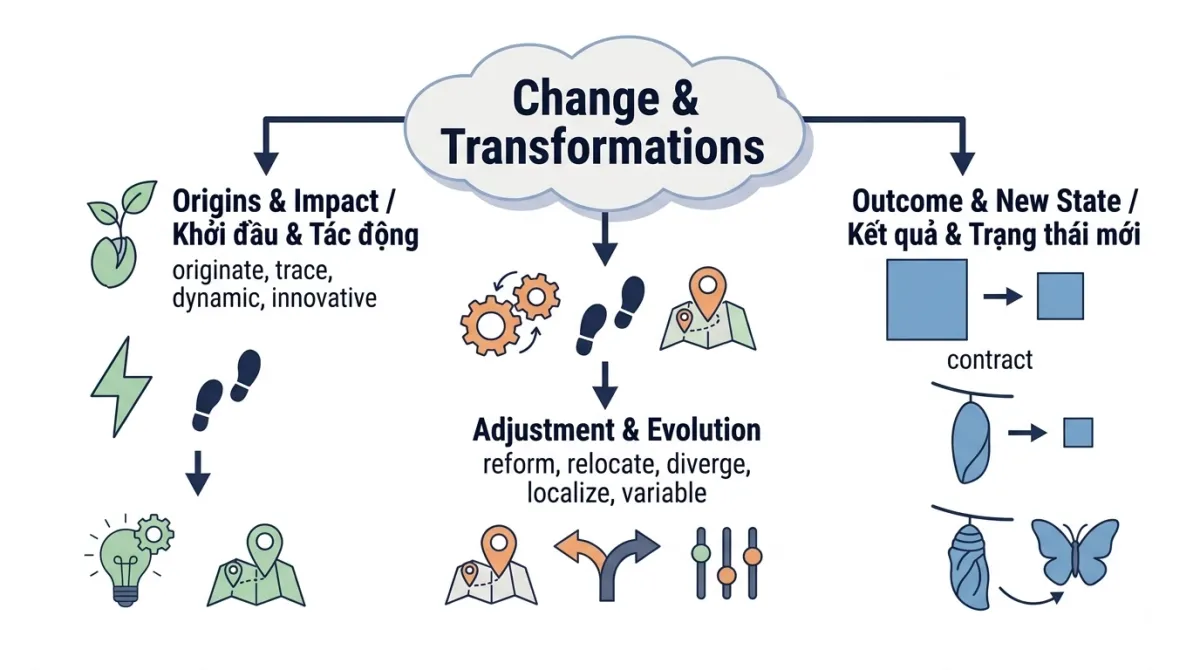
Dưới đây là một số từ vựng học thuật về chủ đề Change & Transformation thường được sử dụng trong các câu hỏi SAT Reading và Writing [2].
Words | Pronunciation | Part of speech | Etymological analysis | Word family | Vietnamese meaning | Near synonyms | Common collocations | Example |
|---|---|---|---|---|---|---|---|---|
newfound | /ˌnjuːˈfaʊnd/ | adj | Old English: neow (new) + findan (find). | N/A | vừa mới tìm ra, mới có được | recently acquired, fresh | newfound confidence, newfound status | The company's newfound international success allowed them to expand their operation across three different continents. |
fluctuation | /ˌflʌktʃuˈeɪʃn/ | n | Latin: fluctuare (to wave) from fluctus (wave). | fluctuate (v), fluctuant (adj) | sự biến động, sự dao động | variation, oscillation | price fluctuation, sharp fluctuation | The recent sharp fluctuation in global oil prices has forced several major airlines to adjust ticket fares. |
defunct | /dɪˈfʌŋkt/ | adj | Latin: defunctus (dead, finished) from de- + fungi (perform). | defunction (n) | không còn hoạt động, ngưng tồn tại | obsolete, extinct | defunct system, defunct policy | Engineers repurposed the defunct factory building into a modern creative studio for local artists and tech startups. |
disengage | /ˌdɪsɪnˈɡeɪdʒ/ | v | Old French: dis- (away) + engager (pledge). | disengagement (n), disengaged (adj) | tách ra, rút khỏi, ngắt kết nối | detach, withdraw | disengage from, disengage military force | The diplomat attempted to disengage from the heated debate before it could damage relations between both nations. |
disperse | /dɪˈspɜːs/ | v | Latin: dispergere (scatter) from dis- + spargere (strew). | dispersion (n), dispersal (n) | phân tán, giải tán, gieo rắc | scatter, dissipate | disperse crowds, disperse seeds | Local authorities used water cannons to disperse the illegal crowd that had gathered near the central plaza. |
reconstitute | /ˌriːˈkɒnstɪtjuːt/ | v | Latin: re- (again) + constituere (establish). | reconstitution (n) | tái lập, tái cơ cấu, tổ chức lại | restructure, reorganize | reconstitute a committee, reconstitute a board | The board of directors met late last night to reconstitute the executive committee after several sudden resignations. |
redefine | /ˌriːdɪˈfaɪn/ | v | Latin: re- (again) + definire (limit, set bounds). | redefinition (n) | định nghĩa lại, tái định hình | re-evaluate, reshape | redefine a concept, redefine roles | Breakthroughs in artificial intelligence technology continue to redefine how modern businesses manage daily operations and customer support. |
supersede | /ˌsuːpəˈsiːd/ | v | Latin: supersedere (sit above, refrain) from super- + sedere. | supersession (n) | thế chỗ, thay thế (mô hình cũ) | replace, supplant | supersede old technology, supersede laws | Modern cloud computing platforms will soon supersede traditional physical servers in most large enterprise corporate infrastructure networks. |
transpose | /trænˈspəʊz/ | v | Latin: transponere (change position) from trans- + ponere. | transposition (n) | hoán đổi, chuyển đổi ngữ cảnh | transfer, swap | transpose a model, transpose concepts | Researchers tried to transpose the successful urban planning model from Singapore into several rapidly growing Southeast Asian cities. |
Xem thêm: Kinh nghiệm học và thi SAT hiệu quả cho người mới bắt đầu
Bài tập vận dụng
Sau đây là một số bài tập giúp người học luyện tập các từ vựng thuộc chủ đề Change & Transformation (Unit 5).
Exercise 1: Matching definitions
Match each word or word family form in Column A (1–9) with its correct definition in Column B (A–I)
1. Newfound | A. To take an idea, law, or system from one context and apply it in a different environment. | |
2. Fluctuation | B. Having ceased to function, exist, or be useful in modern administrative or academic frameworks. | |
3. Defunct | C. To separate oneself emotionally, physically, or intellectually from a prior commitment or established structure. | |
4. Disengage | D. To organize or rebuild an institution, substance, or theory into a fresh structural format. | |
5. Disperse | E. To scatter, spread widely, or cause to vanish across a broad geographical or conceptual space. | |
6. Reconstitute | F. An irregular movement or continuous alteration in levels, numbers, or environmental conditions. | |
7. Redefine | G. Recently acquired, discovered, or developed, particularly regarding status, belief, or capacity. | |
8. Supersede | H. To change the fundamental meaning, boundaries, or conceptual scope of a term or paradigm. | |
9. Transpose | I. To replace or supplant a previous method, law, or mechanism due to superior innovation. |
Key: 1 - G | 2 - F | 3 - B | 4 - C | 5 - E | 6 - D | 7 - H | 8 - I | 9 - A

Exercise 2: Synonyms & Antonyms
Choose the word from the options that is CLOSEST (Synonym) or OPPOSITE (Antonym) in meaning to the underlined word.
Question 1. Given the word “fluctuation”, which word in the following has a similar meaning?
A. stability B. variation C. equilibrium D. stagnation
Question 2. Given the word “supersede”, which word in the following has a similar meaning?
A. preserve B. supplant C. reinforce D. emulate
Question 3. Given the word “disperse”, which word in the following has a similar meaning?
A. dissipate B. aggregate C. consolidate D. accumulate
Question 4. Given the word “reconstitute”, which word in the following has a similar meaning?
A. dismantle B. restructure C. discard D. overlook
Question 5. Given the word “redefine”, which word in the following has a similar meaning?
A. reshape B. maintain C. suppress D. ignore
Question 6. Given the word “transpose”, which word in the following has a similar meaning?
A. transfer B. freeze C. conceal D. destroy
Question 7. Given the word “newfound”, which word in the following has an opposite meaning?
A. recently acquired B. long-established C. newly emerged D. freshly discovered
Question 8. Given the word “defunct”, which word in the following has an opposite meaning?
A. obsolete B. operational C. extinct D. invalid
Question 9. Given the word “disengage”, which word in the following has an opposite meaning?
A. detach B. participate C. withdraw D. sever
Key:
1. B. variation: Fluctuation (n) means an irregular movement or continuous alteration in levels, numbers, or conditions, similar in meaning to variation (n). The other words have the following meanings: stability (n): the state of being steady and unchanging; equilibrium (n): a state of physical or emotional balance; stagnation (n): a state of not changing, developing, or making progress.
2. B. supplant: Supersede (v) means to replace or take the place of a previous method, law, or mechanism, similar in meaning to supplant (v). The other words have the following meanings: preserve (v): to maintain something in its original state; reinforce (v): to strengthen or support; emulate (v): to match or imitate a person or achievement.
3. A. dissipate: Disperse (v) means to scatter, spread widely, or cause to vanish across an area, similar in meaning to dissipate (v). The other words have the following meanings: aggregate (v): to collect or combine into a single mass; consolidate (v): to combine several things into a single more effective whole; accumulate (v): to gather or build up over time.
4. B. restructure: Reconstitute (v) means to organize or rebuild an institution, substance, or theory into a fresh structural format, similar in meaning to restructure (v). The other words have the following meanings: dismantle (v): to take apart or destroy a structure; discard (v): to get rid of something no longer useful; overlook (v): to fail to notice or ignore something.
5. A. reshape: Redefine (v) means to change the fundamental meaning, boundaries, or conceptual scope of a term, similar in meaning to reshape (v). The other words have the following meanings: maintain (v): to cause something to continue in the same state; suppress (v): to forcibly put an end to something; ignore (v): to refuse to take notice of.
6. A. transfer: Transpose (v) means to take an idea, law, or system from one context and apply it in a different environment, similar in meaning to transfer (v). The other words have the following meanings: freeze (v): to stop moving or changing at a specific level; conceal (v): to keep something hidden from sight; destroy (v): to end the existence of something by damaging it.
7. B. long-established: Newfound (adj) means recently acquired, discovered, or developed, opposite in meaning to long-established (adj). The other words have the following meanings: recently acquired (adj): newly obtained; newly emerged (adj): having just come into existence; freshly discovered (adj): found or noticed for the first time recently.
8. B. operational: Defunct (adj) means having ceased to function, exist, or be useful, opposite in meaning to operational (adj). The other words have the following meanings: obsolete (adj): no longer produced or used; extinct (adj): having no living members or active status; invalid (adj): not officially recognized or legally binding.
9. B. participate: Disengage (v) means to separate oneself or withdraw from a prior commitment or structure, opposite in meaning to participate (v). The other words have the following meanings: detach (v): to disconnect or remove; withdraw (v): to pull back or discontinue involvement; sever (v): to break off a connection or relationship entirely.
Exercise 3: Word Form
Complete each sentence by writing the correct form of the word in brackets.
Fill in the blank with the correct form of the word in the bracket:
1. Economic analysts warned that the local currency value might _________ (fluctuation) unpredictably during the upcoming international trade negotiations next month.
2. A complete _________ (disengage) from traditional fossil fuel reliance remains a complex challenge for energy-dependent developing nations worldwide.
3. Environmental scientists noted that the rapid _________ (disperse) of airborne microplastics across urban regions poses a severe public health risk.
4. Following a thorough institutional audit, the university Senate underwent a full _________ (reconstitute) to improve administrative transparency and efficiency.
5. The historical _________ (supersede) of manual production lines by automated industrial robotics significantly boosted global manufacturing productivity.
6. Philosophers suggested a fundamental _________ (redefine) of social equity to address modern technological advancements and climate crises properly.
7. The mathematical _________ (transpose) of intricate physics formulas into computing algorithms requires extreme precision and rigorous testing.
8. The unexpected _________ (defunct) of the primary data server created temporary operational confusion across multiple academic departments.
9. After years of isolation, the research team published their findings with _________ (newfound) confidence during the international science convention.
Key:
1: fluctuate
2: disengagement
3: dispersion/dispersal
4: reconstitution
5: supersession/supersedence
6: redefinition
7: transposition
8: defunction
9: newfound
Exercise 4: Matching Sentence Halves
Match the first half of each sentence (1–9) with the most logical second half (A–I).
1. Scholars attempted to transpose the European economic framework … | A. … after modern environmental laws about pollution were strictly implemented across the region. | |
2. The research team gained newfound institutional credibility … | B. … traditional boundaries between physical science and computational technology. | |
3. Industrial factories became completely defunct …. | C. … into a developing market context, expecting similar structural growth outcomes. | |
4. Interdisciplinary researchers collaborated extensively to redefine …. | D. … from emotional biases during complex ethical evaluations. | |
5. Global market prices experienced sharp fluctuations … | E. … which helped them secure substantial government grants for future exploration. | |
6. The agricultural ministry decided to reconstitute … | F. … because supply chain disruptions caused widespread instability throughout the region. | |
7. Scientific experts trained young researchers to disengage …. | G. … traditional broadcast channels as the primary source of news. | |
8. Digital communication platforms began to supersede … | H. … the advisory board to include experts specializing in climate adaptation strategies. | |
9. Wind currents across the valley helped disperse … | I. … toxic industrial emissions before they could accumulate near residential farming communities. |
Key:
1 - C: The verb transpose means to apply an idea or framework into a different context (into a developing market context).
2 - E: Having newfound institutional credibility logically leads to securing government grants (secure substantial government grants).
3 - A: Factories becoming defunct means they ceased operating, which relates to the enforcement of environmental laws (environmental laws were strictly implemented).
4 - B: Using redefine requires an object representing concepts or boundaries being reshaped (traditional boundaries between physical science and computational technology).
5 - F: Experiencing sharp fluctuations in prices is logically explained by supply chain disruptions (supply chain disruptions caused widespread economic instability).
6 - H: To reconstitute a board means to reorganize its membership (the advisory board to include experts).
7 - D: Training researchers to disengage implies detaching or withdrawing from personal biases (from emotional biases).
8 - G: Digital platforms that supersede older methods replace traditional broadcast channels (traditional broadcast channels).
9 - I: Wind currents helping to disperse pollutants means scattering emissions before they accumulate (toxic industrial emissions before they could accumulate).
Gợi ý phương pháp học từ vựng hiệu quả
Để tiếp thu từ vựng một cách hiệu quả, người học cần xác định rõ mục tiêu học tập cũng như khả năng học tập của bản thân. Để hỗ trợ người học ôn luyện từ vựng hiệu quả, tác giả bài viết gợi ý phương pháp tự đánh giá để người học tự chọn hướng ôn tập phù hợp.
Xem thêm: Những phương pháp học từ vựng tiếng Anh hiệu quả
Để biết bản thân phù hợp với kiểu học từ vựng nào, người học cần đánh giá theo các tiêu chí sau: mục tiêu học tập, số lượng từ cần học, năng lực đầu vào, thời gian và mức độ cam kết.
Bản thân tác giả cho rằng cách học từ hiệu quả chính là học qua ngữ cảnh và học có lặp lại. Để đạt được hai điều này, người học cần thấy được cách dùng từ trong ngữ cảnh cụ thể, sau đó tìm cách để sử dụng từ trong các ngữ cảnh tương tự (đọc, viết, nói) để nắm rõ mục đích sử dụng từ. Người học cũng không nên chỉ học một lần mà cần phải nhắc lại và củng cố từ vựng.
Người học nên ôn lại từ mới mỗi 2-3 ngày để bù đắp cho phần trí nhớ ngắn hạn bị hao hụt. Nếu từ vựng được nhắc lại nhiều lần, kiến thức về từ sẽ được khắc sâu vào “kho từ vựng” của người học.
Như vậy, bài viết SAT Vocab đã cung cấp cho người học một số từ vựng học thuật về chủ đề Change & Transformation, cùng một số bài tập luyện tập cơ bản để hỗ trợ người học ôn luyện. Việc học tập và ôn luyện cho kỳ thi Digital SAT không hề đơn giản và cần nhiều thời gian và nỗ lực. Hy vọng bài viết có thể hỗ trợ người học trong hành trình luyện tập và thi cử của bản thân.
Để xây dựng lộ trình học bài bản và đạt kết quả tốt nhất, học viên có thể tham khảo khóa học luyện thi SAT tại ZIM ngay hôm nay.
SAT® is a trademark registered by the College Board, which is not affiliated with, and does not endorse, this website.
- SAT Vocab Handbook - Từ vựng SAT theo chủ đề
- SAT® Vocab Handbook Unit 1: Từ vựng chủ đề Growth, Decline & Quantity
- SAT® Vocab Handbook Unit 3: Từ vựng chủ đề Change & Transformation
- SAT® Vocab Handbook Unit 4: Từ vựng chủ đề Growth, Decline & Quantity
- SAT® Vocab Handbook Unit 3: Từ vựng chủ đề Truth, Evidence & Proof
- SAT® Vocab Handbook Unit 2: Từ vựng chủ đề Truth, Evidence & Proof
- SAT® Vocab Handbook Unit 2: Từ vựng chủ đề Growth, Decline & Quantity
- SAT® Vocab Handbook Unit 5: Từ vựng chủ đề Knowledge, Learning & Thinking
- SAT® Vocab Handbook Unit 5: Từ vựng chủ đề Change & Transformation
- SAT® Vocab Handbook Unit 4: Từ vựng chủ đề Change & Transformation
- SAT® Vocab Handbook Unit 3: Từ vựng chủ đề Growth, Decline & Quantity
Tham vấn chuyên môn
Học là hành trình tích lũy kiến thức lâu dài và bền bỉ. Điều quan trọng là tìm thấy động lực và niềm vui từ việc học. Phương pháp giảng dạy tâm đắc: Lấy người học làm trung tâm, đi từ nhận diện vấn đề đến định hướng người học tìm hiểu và tự giải quyết vấn đề.
Nguồn tham khảo
1
“Digital SAT Suite of Assessments Technical Manual.” College Board, Accessed 20 August 2026.
2
“SAT Suite Question Bank.” College Board, https://satsuitequestionbank.collegeboard.org/. Accessed 20 August 2026.
3
“The Official Digital SAT Study Guide.” J. Patterson and D. Carling, Accessed 20 August 2026.
Bình luận - Hỏi đáp