

Bài thi SAT kiểm tra từ vựng học thuật Tier 2.
Chủ đề từ vựng SAT thông dụng: Change & Transformations: shift, stretch toward, transform, acquire, evolve, restore, derive from, settle, assume, reach.
Cách học từ vựng hiệu quả: Học theo ngữ cảnh và học có nhắc lại.
SAT® Vocab Handbook Unit 3: Từ vựng chủ đề Change & Transformation
Bài viết trình bày từ vựng SAT chủ đề Change & Transformation cùng một số bài tập ôn luyện giúp người học làm quen với từ vựng mới.
Key takeaways
Trong quá trình ôn tập cho bài thi Digital SAT, không ít người học cảm thấy khó khăn với từ vựng học thuật được kiểm tra trong bài thi. Thực tế cho thấy bài thi Digital SAT sử dụng nhiều từ vựng SAT học thuật với mật độ dày đặc hơn so với các bài thi chuẩn hóa ngôn ngữ thông thường. Do đó, người học cần đầu tư không ít thời gian để ôn luyện nếu muốn tích lũy từ vựng và cải thiện hiệu quả làm bài. Nắm được nhu cầu đó của người học, Anh ngữ ZIM triển khai chuỗi bài viết về các từ vựng học thuật thường xuất hiện trong bài thi nhằm cung cấp cho người học tài nguyên luyện tập chất lượng cao. Trong phạm vi bài viết này, tác giả sẽ trình bày từ vựng SAT chủ đề Change & Transformation, một chủ đề thông dụng trong từ vựng SAT.
Từ vựng học thuật trong Digital SAT
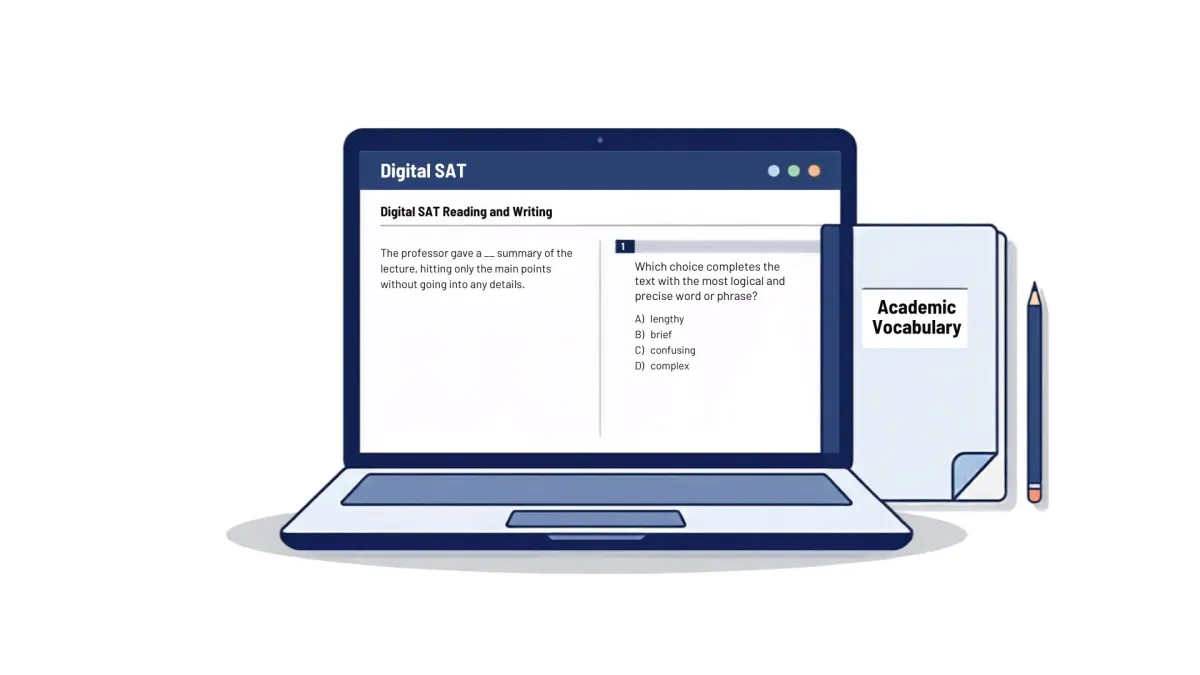
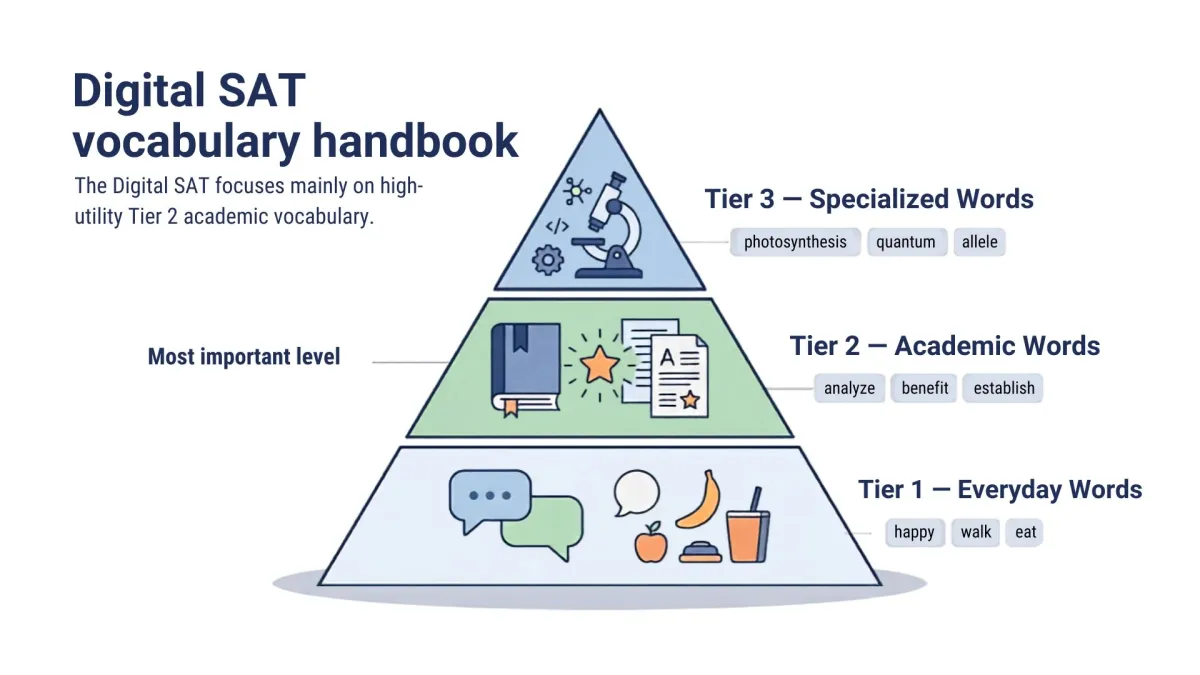
Khác với các bài thi SAT cũ thường kiểm tra những từ vựng hiếm gặp hoặc quá chuyên sâu, Digital SAT tập trung vào một nhóm từ vựng khác: từ vựng học thuật có tính ứng dụng cao (High-utility academic words / Tier 2 vocabulary).
Bài thi nhắm vào các từ và cụm từ mà sinh viên thường xuyên bắt gặp trong các văn bản học thuật hoặc môi trường đại học, nhưng lại ít khi được sử dụng trong giao tiếp hằng ngày [1]. Ví dụ: convey, ambivalent, correlate, substantiate.[2][3]
Bên cạnh đó, bài thi Digital SAT cũng hạn chế trong việc kiểm tra các từ lóng thông thường (Tier 1) và cả những thuật ngữ kỹ thuật quá hẹp hoặc chuyên ngành (Tier 3) [1] [3].
Dạng bài Words in Context trong Digital SAT
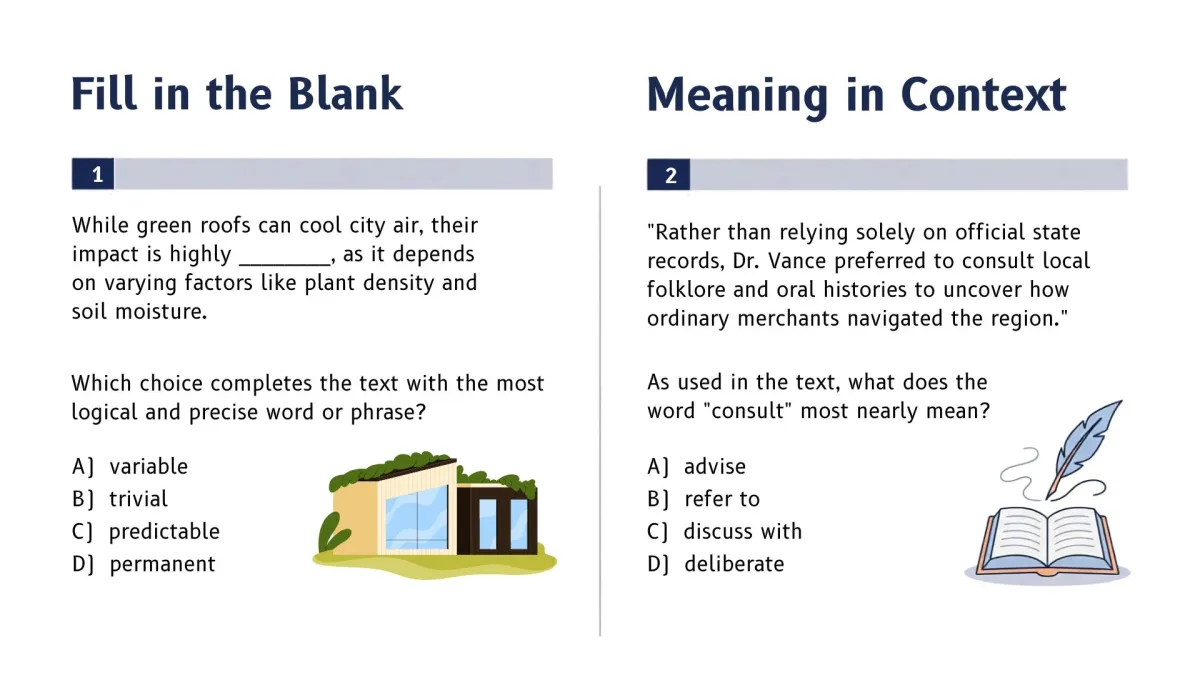
Dạng bài Words in Context yêu cầu thí sinh xác định ý nghĩa của một từ/cụm từ học thuật có tính ứng dụng cao dựa trên ngữ cảnh mà nó xuất hiện, hoặc yêu cầu thí sinh lựa chọn một từ/cụm từ logic và chính xác nhất để điền vào chỗ trống trong một đoạn văn [1] [3]. Dạng bài này thường xuất hiện dưới 2 định dạng câu hỏi chính:
Điền từ vào chỗ trống: Câu hỏi thường có dạng "Which choice completes the text with the most logical and precise word or phrase?" [1][2]. Thí sinh sẽ đọc một đoạn văn bị thiếu một từ và cần chọn đáp án phù hợp nhất. Dạng bài này chỉ xuất hiện trong thể loại đoạn văn Informational text.
Tìm nghĩa của từ: Câu hỏi thường có dạng "As used in the text, what does the word 'x' most nearly mean?" [1][2]. Dạng bài này chỉ xuất hiện với thể loại đoạn văn Poem/Novel/Short story.
Chiến lược làm bài Words in Context trong Digital SAT
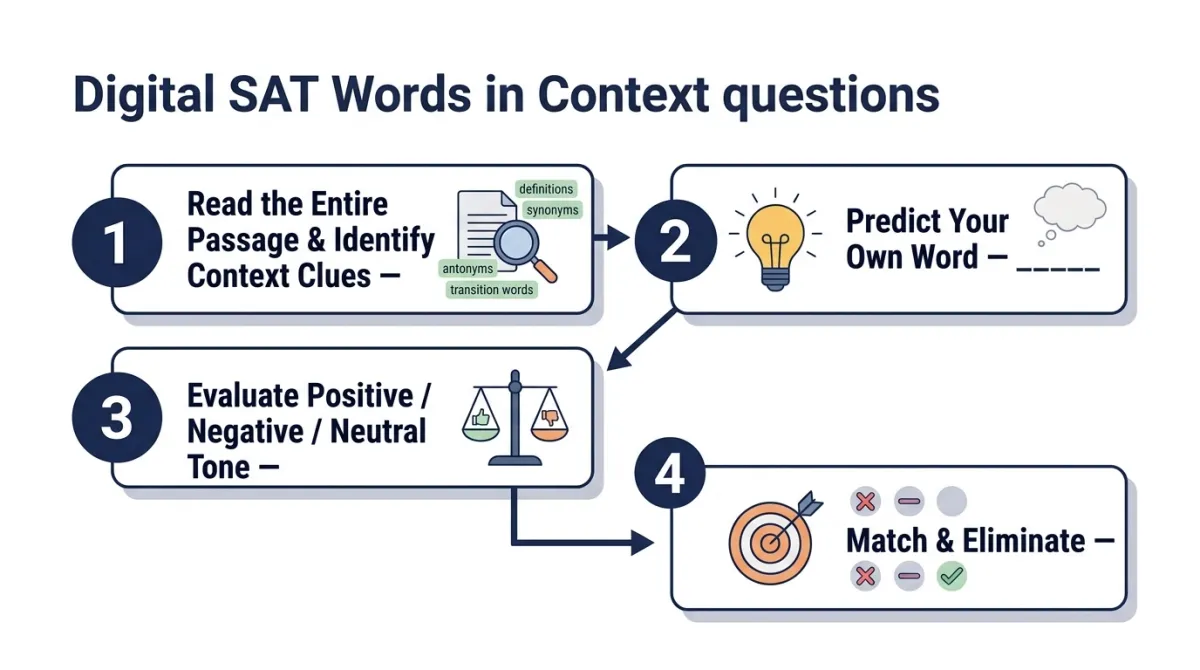
Để có thể đạt kết quả tốt với dạng bài Words in Context, người học có thể áp dụng các bước làm bài tham khảo sau:
Bước 1: Đọc toàn bộ đoạn văn và xác định các từ hoặc cụm từ khóa
Thay vì chỉ tập trung vào câu chứa khoảng trống hoặc từ gạch chân, người đọc cần xem xét chúng trong ngữ cảnh của toàn bộ đoạn văn. Tại bước này, người đọc thực hiện thao tác rà quét để tìm kiếm các "manh mối ngữ cảnh". Các manh mối này thường xuất hiện dưới dạng định nghĩa, sự diễn giải lại, từ đồng nghĩa hoặc từ trái nghĩa.
Bên cạnh đó, người đọc cũng cần chú ý đến các từ chuyển ý đóng vai trò báo hiệu logic cú pháp, bao gồm 3 nhóm chính: nhóm từ nối tiếp ý (also, furthermore), nhóm nguyên nhân - kết quả (because, therefore), và nhóm từ tương phản ( although, however).
Bước 2: Tự dự đoán từ của riêng mình
Trước khi nhìn vào các lựa chọn đáp án, người đọc tổng hợp các manh mối ngữ cảnh đã phân tích ở Bước 1 để tự suy luận ra một từ hoặc một cụm từ định nghĩa đơn giản nhất, sao cho vừa vặn với cấu trúc logic của câu.
Từ đó, người đọc có thể chọn từ khớp với chỗ trống hoặc từ đồng nghĩa với từ được gạch chân. Thao tác này giúp người đọc chủ động hơn trong câu trả lời, tránh bị phân tâm bởi các phương án được thiết kế để nghe có vẻ hợp lý nhưng thực chất sai lệch về ngữ cảnh.
Bước 3: Đánh giá sắc thái tích cực / tiêu cực
Trong trường hợp văn bản quá phức tạp và người đọc không thể dự đoán chính xác một từ cụ thể, người đọc cần chuyển sang chiến thuật đánh giá sắc thái ý nghĩa. Bằng cách dựa vào các từ tương phản hoặc từ nối, người đọc xác định xem từ cần điền mang sắc thái tích cực, tiêu cực hay trung tính. Sau khi gán nhãn sắc thái, người đọc đối chiếu với các phương án A, B, C, D và loại bỏ những từ mang sắc thái trái ngược với ngữ cảnh.
Bước 4: Ghép phương án vào câu và loại trừ
Người đọc đối chiếu các phương án với "từ dự đoán" ở Bước 2 để tìm ra lựa chọn tốt nhất. Trong quá trình ra quyết định, người đọc cần ghi nhớ nguyên tắc: từ đúng phải là từ logic và chính xác nhất, phù hợp với ngữ cảnh đã được cung cấp. Bên cạnh đó, người đọc cũng cần lưu ý cách kết hợp các từ để có thêm một yếu tố giúp xác nhận đáp án.
Từ vựng SAT chủ đề Change & Transformations
Có thể nói, trong quá trình học và tích lũy từ vựng SAT, người học sẽ tiếp nhận một khối lượng từ vựng học thuật đồ sộ. Do đó, để tránh rơi vào tình trạng học thiếu hệ thống, việc phân loại từ vựng SAT theo quy luật là điều rất cần thiết.
Có nhiều chiến lược khác nhau để phân loại từ vựng cho kỳ thi SAT. Người học có thể phân loại từ vựng theo lĩnh vực, theo độ khó của từ, hoặc theo độ khó của câu hỏi SAT chuẩn trong đó từ vựng được kiểm tra. Trong chuỗi bài viết về từ vựng SAT này, nhóm tác giả chọn cách phân loại theo chức năng của từ. Chức năng của từ có thể được phân loại thành 15 nhóm lớn. Một vài trong số đó bao gồm từ vựng miêu tả sự vận động và biến đổi, từ vựng miêu tả thái độ và cảm xúc, hoặc từ vựng miêu tả các giá trị đạo đức.
Trong các nhóm chức năng đó, nhóm Change & Transformation gồm các từ học thuật mô tả quá trình dịch chuyển, thích ứng và phát triển của các hiện tượng, sự việc hoặc ý tưởng trong ngữ cảnh học thuật. Nhóm từ vựng này giúp phản ánh các giai đoạn của một vận động:
Khởi đầu và tác động: Diễn tả sự xuất hiện của những phát hiện, năng lực mới hoặc hành động chủ động tách rời, ngắt kết nối khỏi các mô hình, quy chuẩn cũ để khởi đầu quá trình chuyển đổi.
Điều chỉnh và tiến hóa: Diễn tả sự biến động liên tục, sự phân tán nguồn lực hay dữ liệu, hoặc quá trình dịch chuyển ngữ cảnh, tái cơ cấu, định nghĩa lại bản chất và thay thế các mô hình lạc hậu bằng giải pháp tối ưu hơn.
Kết quả và trạng thái mới: Diễn tả trạng thái kết thúc, không còn hoạt động hay tồn tại của các lý thuyết, chính sách hoặc hệ thống cũ sau khi quá trình biến đổi hoàn tất.
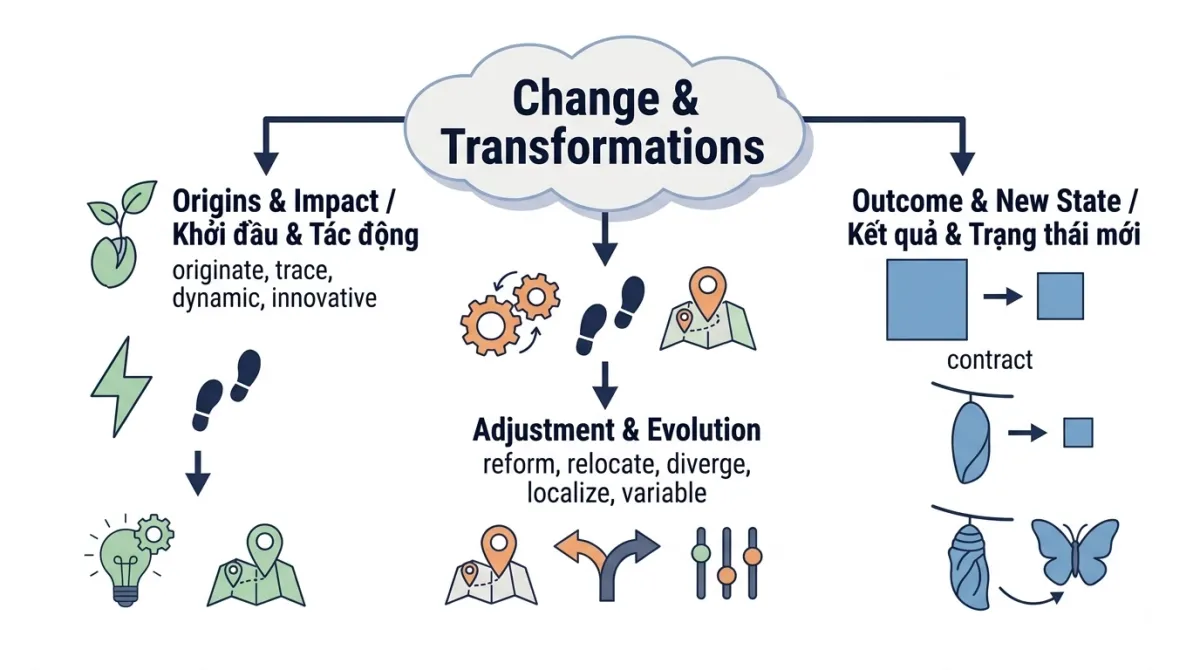
Dưới đây là một số từ vựng học thuật về chủ đề Change & Transformation thường được sử dụng trong các câu hỏi SAT Reading và Writing [2].
Words | IPA Pronunciation | Part of speech | Etymological analysis | Word family | Vietnamese meaning | Near synonyms | Common collocations | Example |
|---|---|---|---|---|---|---|---|---|
shift | /ʃɪft/ | v | Old English: sciftan (to divide, arrange). | shift (n.), shifting (adj.), shifter (n.) | thay đổi, chuyển dịch | change, move, alter, transfer | a paradigm shift a shift in perspective a demographic shift | The research team surveyed public opinion before and after the policy announcement. Their data revealed a clear shift in perspective regarding environmental regulation. |
stretch toward | /stretʃ tɔːrd/ | v | Old English: streccan (to extend) + toweard (in the direction of). | stretch (n./v.), stretchy (adj.), outstretched (adj.) | vươn tới, hướng đến | extend toward, reach toward, expand towards | stretch toward a resolution stretch toward equilibrium | Negotiators from both sides met weekly for several months to address their disagreements. Gradually, their positions stretched toward a compromise acceptable to all parties. |
transform | /trænsˈfɔːrm/ | v | Latin: trans-(across) + formare (to shape). | transformation (n.), transformative (adj.), transformer (n.), transformable (a) | biến đổi, chuyển hóa | change, convert, alter, revolutionize | transform into undergo a transformation | Engineers introduced automated systems across the manufacturing plant over a two-year period. This shift transformed production efficiency and significantly reduced operational costs. |
acquire | /əˈkwaɪər/ | v | Latin: ad-(to) + quaerere (to seek). | acquisition (n.), acquired (adj.), acquirer (n.), acquiring (adj) | đạt được, thu nhận | obtain, gain, attain, secure | acquire expertise acquire proficiency | Graduate students spent three years conducting fieldwork under close faculty supervision. Through this process, they acquired the technical expertise needed for independent research. |
evolve | /ɪˈvɑːlv/ | v | Latin: e-(out) + volvere (to roll). | evolution (n.), evolutionary (adj.), evolved (adj.) | tiến hóa, phát triển dần dần | develop, progress, advance, mature | evolve gradually evolve into a discipline | Early theories of disease transmission relied largely on observation and anecdote. Over the following century, these ideas evolved into the modern field of epidemiology. |
restore | /rɪˈstɔːr/ | v | Latin: re-(again) + staurare (to set up). | restoration (n.), restorative (adj.), restorer (n.) | khôi phục, phục hồi | revive, renew, rebuild, reinstate | restore equilibrium restore confidence restore stability | Following the financial crisis, regulators introduced a series of new banking policies. These measures gradually restored stability and public confidence in the system. |
derive from | /dəˈraɪv frʌm/ | v | Latin: de-(down) + rivus (stream). | derivative (n./adj.), derivation (n.), derived (adj.) | bắt nguồn từ, có nguồn gốc từ | originate from, stem from, come from, arise from | derive from empirical data derive a conclusion from evidence | Scientists collected observational data from over two hundred ecosystems worldwide. Their central hypothesis was derived from patterns identified across this extensive dataset. |
settle | /ˈsetl/ | v | Old English: setlan (to seat, place). | settlement (n.), settler (n.), settled (adj.), settling (adj), unsettling (adj) | giải quyết, định cư, ổn định | resolve, establish, calm, decide | settle a controversy settle a dispute amicably | Two research teams published conflicting findings on the same phenomenon last year. A follow-up study using larger samples ultimately settled the controversy between them. |
assume | /əˈsuːm/ | v | Latin: ad-(to) + sumere (to take). | assumption (n.), assumed (adj.), assuming (conj.) | giả định, cho rằng, đảm nhận | presume, suppose, take on, believe | assume a hypothesis assume responsibility | Economic models often simplify complex human behavior to make analysis manageable. Many of these models assume that individuals act rationally when making decisions. |
reach | /riːtʃ/ | V, n | Old English: ræcan (to stretch out). | reachable (adj.), unreachable (adj), outreach (n.), far-reaching (adj.), reachability (n) | đạt tới, vươn tới, tầm với | attain, achieve, arrive at, extend to | reach a consensus reach a milestone | Committee members reviewed dozens of studies before finalizing their recommendations. After extensive deliberation, they reached a consensus on the new guidelines. |
Xem thêm: Kinh nghiệm học và thi SAT hiệu quả cho người mới bắt đầu
Bài tập vận dụng từ vựng SAT
Sau đây là một số bài tập giúp người học luyện tập các từ vựng thuộc chủ đề Change & Transformation (Unit 3).
Exercise 1: Matching vocabulary & Word families to definitions
Match each word or word family form in Column A (1–10) with its correct definition in Column B (A–J).
1. shift | A. To take on a duty, role, or belief without formal confirmation. | |
2. transformation | B. To gradually change and develop over a long period, often becoming more complex or better adapted. | |
3. acquisition | C. A change in position, direction, or emphasis, often occurring gradually or unexpectedly. | |
4. evolve | D. To bring something back to its original, sound, or better condition. | |
5. restoration | E. The act of gaining possession of something, typically through one's own effort or skill. | |
6. derivation | F. A thorough or dramatic change in the form, nature, or appearance of something. | |
7. settlement | G. An official agreement that resolves a disagreement or establishes a fixed arrangement. | |
8. assumption | H. The action of obtaining something from a source or origin | |
9. reachable | I. Able to be attained, contacted, or accessed. | |
10. stretching toward | J. The act of extending effort or resources in the direction of a specific goal. |
Key: 1. C | 2. F | 3. E | 4. B | 5. D | 6. H | 7. G | 8. A | 9. I | 10. J
Exercise 2: Synonym / Antonym
1. Given the word "shift", which word in the following has a similar meaning?
A. entrench
B. ossify
C. veer
D. calcify
2. Given the phrase "stretch toward", which phrase in the following has an opposite meaning?
A. recoil from
B. gravitate toward
C. incline toward
D. verge toward
3. Given the word "transform", which word in the following has a similar meaning?
A. perpetuate
B. entrench
C. immobilize
D. metamorphose
4. Given the word "acquire", which word in the following has an opposite meaning?
A. procure
B. forfeit
C. amass
D. garner
5. Given the word "evolve", which word in the following has a similar meaning?
A. atrophy
B. regress
C. burgeon
D. stagnate
6. Given the word "restore", which word in the following has an opposite meaning?
A. deplete
B. rejuvenate
C. reinstate
D. revitalize
7. Given the phrase "derive from", which phrase in the following has a similar meaning?
A. detract from
B. digress from
C. encroach upon
D. emanate from
8. Given the word "settle", which word in the following has an opposite meaning?
A. reconcile
B. exacerbate
C. adjudicate
D. arbitrate
9. Given the word "assume", which word in the following has a similar meaning?
A. corroborate
B. authenticate
C. postulate
D. substantiate
10. Given the word "reach", which word in the following has an opposite meaning?
A. flounder
B. attain
C. procure
D. accomplish
Key:
1. Key: C.
Explanation: Shift (v) means to change position or direction, similar in meaning to veer (v). The other words have the following meanings:
Entrench (v): to establish firmly and unlikely to change.
Ossify (v): to become rigid and stop developing.
Calcify (v): to harden and become inflexible.
2. Key: A.
Explanation: Stretch toward means to extend gradually in a direction, the opposite of recoil from (v phrase), which means to pull back sharply. The other phrases have the following meanings:
Gravitate toward: to be naturally attracted to.
Incline toward: to have a tendency or preference for.
Verge toward: to approach or border on.
3. Key: D.
Explanation: Transform (v) means to change completely in form or nature, similar in meaning to metamorphose (v). The other words have the following meanings:
Perpetuate (v): to cause something to continue indefinitely.
Entrench (v): to establish firmly.
Immobilize (v): to prevent from moving or functioning.
4. Key: B.
Explanation: Acquire (v) means to gain possession of something, the opposite of forfeit (v), which means to lose or give up as a penalty. The other words have the following meanings:
Procure (v): to obtain through effort.
Amass (v): to gather a large quantity of.
Garner (v): to collect or acquire, often gradually.
5. Key: C.
Explanation: Evolve (v) means to develop gradually, similar in meaning to burgeon (v), which means to grow or develop rapidly. The other words have the following meanings:
Atrophy (v): to waste away or decline from disuse.
Regress (v): to return to an earlier, less developed state.
Stagnate (v): to stop developing or making progress.
6. Key: A.
Explanation: Restore (v) means to bring back to a former condition, the opposite of deplete (v), which means to reduce or exhaust a supply. The other words have the following meanings:
Rejuvenate (v): to make young or vigorous again.
Reinstate (v): to restore to a former position or condition.
Revitalize (v): to imbue with new life and energy.
7. Key: D.
Explanation: Derive from means to originate or arise from a source, similar in meaning to emanate from. The other phrases have the following meanings:
Detract from: to reduce the value or worth of.
Digress from: to depart from the main subject.
Encroach upon: to intrude gradually on someone's territory or rights.
8. Key: B.
Explanation: Settle (v) means to bring a dispute or matter to resolution, the opposite of exacerbate (v), which means to make a problem worse. The other words have the following meanings:
Reconcile (v): to restore harmony between conflicting parties.
Adjudicate (v): to make a formal judgment on a disputed matter.
Arbitrate (v): to reach a settlement between disputing parties.
9. Key: C.
Explanation: Assume (v) means to accept something as true without proof, similar in meaning to postulate (v). The other words have the following meanings:
Corroborate (v): to confirm or give supporting evidence for.
Authenticate (v): to prove the genuineness of something.
Substantiate (v): to provide evidence to support a claim.
10. Key: A.
Explanation: Reach (v) means to arrive at or attain a goal, the opposite of flounder (v), which means to struggle and fail to make progress. The other words have the following meanings:
Attain (v): to succeed in achieving something.
Procure (v): to obtain through effort.
Accomplish (v): to complete something successfully.
Exercise 3: Word Family Table
Complete the table by writing the correct noun (person/thing), verb, adjective, or adverb form of each target word. If no common form exists, write "—".
No. | Noun (Person/Thing) | Verb | Adjective | Adverb |
1 | __________ | shift | __________ | __________ |
2 | __________ | stretch | __________ | __________ |
3 | __________ | __________ | transformative | __________ |
4 | __________ | acquire | __________ | __________ |
5 | evolution | __________ | __________ | __________ |
6 | __________ | restore | __________ | __________ |
7 | derivation | __________ | __________ | __________ |
8 | __________ | __________ | settled | __________ |
9 | __________ | assume | __________ | __________ |
10 | reach | __________ | __________ | __________ |
Key
No. | Noun (Person/Thing) | Verb | Adjective | Adverb |
1 | shift (thing), shifter (person) | shift | shifting, shifted | — |
2 | stretch (thing), stretcher (person/thing) | stretch | stretchy, stretched, outstretched | — |
3 | transformation (thing), transformer (person/thing) | transform | transformative, transformed, transformable, transforming | transformatively |
4 | acquisition (thing), acquirer (person) | acquire | acquired, acquisitive | acquisitively |
5 | evolution (thing) | evolve | evolutionary, evolved, evolving | — |
6 | restoration (thing), restorer (person) | restore | restorative, restored, restorable | — |
7 | derivation (thing), derivative (thing) | derive (from) | derivative, derived | — |
8 | settlement (thing), settler (person) | settle | settled, settling, unsettling | — |
9 | assumption (thing) | assume | assumed, assuming | assumingly |
10 | reach (thing), reachability | reach | reachable, unreachable, far-reaching, reaching | — |
Exercise 4: SAT contextual word choice
Read each sentence carefully. Choose the most precise and logical word from the bracketed options [ Option A / Option B ] to complete the sentence based on its academic context.
1. Despite growing criticism, the committee refused to [ shift / drift ] its stance on the controversial policy proposal.
2. Lacking a clear direction, the debate began to [ stretch toward / drift toward ] unrelated and increasingly tangential topics.
3. Rather than intervening, conservationists chose to [ preserve / transform ] the wetland's fragile ecosystem for future generations.
4. The genetic mutation was [ acquired / inherited ] directly from the patient's parents rather than developed later in life.
5. The proposal failed to [ conform / evolve ] to the university's established academic standards, prompting immediate rejection.
6. To cut costs, the company chose to [ restore / reduce ] its workforce rather than invest in new equipment.
7. The professor argued that most modern grammatical structures [ derive from / depart from ] older, now-obsolete linguistic forms.
8. Rather than reaching a compromise, both sides allowed the dispute to [ settle / escalate ] into a prolonged legal battle.
9. Contrary to popular belief, researchers cannot simply [ assume / verify ] a hypothesis without rigorous experimental testing.
10. Due to unforeseen complications, the expedition team was unable to [ reach / abandon ] the summit before nightfall.
Key:
1. shift (Context describes the committee changing its position under pressure; "drift" implies gradual, passive movement without deliberate resistance, which contradicts "refused.")
2. drift toward (Context describes the debate losing focus and wandering toward unrelated topics; "stretch toward" implies purposeful extension, which does not fit a lack of direction.)
3. preserve (Context describes conservationists deliberately protecting the ecosystem rather than altering it; "transform" would imply changing its nature, contradicting the goal of conservation.)
4. inherited (The phrase "directly from the patient's parents" indicates genetic transmission at birth; "acquired," by contrast, refers to something obtained after birth, which contradicts this clause.)
5. conform ("Conform to standards" is the correct fixed collocation; "evolve" does not logically pair with the preposition "to" in this context, since evolving is a process of change rather than compliance.)
6. reduce (Context describes cost-cutting through workforce reduction; "restore" means to bring back to a former state, which contradicts the cost-cutting motive.)
7. derive from (Context describes modern structures originating from older forms; "depart from" would imply a break from tradition, contradicting the idea of origin.)
8. escalate (Context describes conflict intensifying instead of resolving; "settle" would imply resolution, which contradicts "rather than reaching a compromise.")
9. verify (Context emphasizes the need for rigorous testing before accepting a hypothesis; "assume" would contradict the requirement for experimental verification.)
10. reach (Context describes the team being unable to arrive at their destination; "abandon" would imply a deliberate choice to give up, which is not indicated by "unforeseen complications.")
Gợi ý phương pháp học từ vựng SAT hiệu quả
Để tiếp thu từ vựng một cách hiệu quả, người học cần xác định rõ mục tiêu học tập cũng như khả năng học tập của bản thân. Để hỗ trợ người học ôn luyện từ vựng hiệu quả, tác giả bài viết gợi ý phương pháp tự đánh giá để người học tự chọn hướng ôn tập phù hợp.
Xem thêm: Những phương pháp học từ vựng tiếng Anh hiệu quả
Để biết bản thân phù hợp với kiểu học từ vựng nào, người học cần đánh giá theo các tiêu chí sau: mục tiêu học tập, số lượng từ cần học, năng lực đầu vào, thời gian và mức độ cam kết.
Bản thân tác giả cho rằng cách học từ hiệu quả chính là học qua ngữ cảnh và học có lặp lại. Để đạt được hai điều này, người học cần thấy được cách dùng từ trong ngữ cảnh cụ thể, sau đó tìm cách để sử dụng từ trong các ngữ cảnh tương tự (đọc, viết, nói) để nắm rõ mục đích sử dụng từ. Người học cũng không nên chỉ học một lần mà cần phải nhắc lại và củng cố từ vựng.
Người học nên ôn lại từ mới mỗi 2-3 ngày để bù đắp cho phần trí nhớ ngắn hạn bị hao hụt. Nếu từ vựng được nhắc lại nhiều lần, kiến thức về từ sẽ được khắc sâu vào “kho từ vựng” của người học.
Xem thêm: Ưu và nhược điểm của việc học tập trung vào mục tiêu
Như vậy, bài viết SAT Vocab đã cung cấp cho người học một số từ vựng SAT học thuật về chủ đề Change & Transformation, cùng một số bài tập luyện tập cơ bản để hỗ trợ người học ôn luyện. Việc học tập và ôn luyện cho kỳ thi Digital SAT không hề đơn giản và cần nhiều thời gian và nỗ lực. Hy vọng bài viết có thể hỗ trợ người học trong hành trình luyện tập và thi cử của bản thân.
Để xây dựng lộ trình học bài bản và đạt kết quả tốt nhất, học viên có thể tham khảo khóa học luyện thi SAT tại ZIM ngay hôm nay.
SAT® is a trademark registered by the College Board, which is not affiliated with, and does not endorse, this website.
- SAT Vocab Handbook - Từ vựng SAT theo chủ đề
- SAT® Vocab Handbook Unit 1: Từ vựng chủ đề Growth, Decline & Quantity
- SAT® Vocab Handbook Unit 3: Từ vựng chủ đề Change & Transformation
- SAT® Vocab Handbook Unit 4: Từ vựng chủ đề Growth, Decline & Quantity
- SAT® Vocab Handbook Unit 3: Từ vựng chủ đề Truth, Evidence & Proof
- SAT® Vocab Handbook Unit 2: Từ vựng chủ đề Truth, Evidence & Proof
- SAT® Vocab Handbook Unit 2: Từ vựng chủ đề Growth, Decline & Quantity
- SAT® Vocab Handbook Unit 5: Từ vựng chủ đề Knowledge, Learning & Thinking
- SAT® Vocab Handbook Unit 5: Từ vựng chủ đề Change & Transformation
- SAT® Vocab Handbook Unit 4: Từ vựng chủ đề Change & Transformation
- SAT® Vocab Handbook Unit 3: Từ vựng chủ đề Growth, Decline & Quantity
Tham vấn chuyên môn
Học là hành trình tích lũy kiến thức lâu dài và bền bỉ. Điều quan trọng là tìm thấy động lực và niềm vui từ việc học. Phương pháp giảng dạy tâm đắc: Lấy người học làm trung tâm, đi từ nhận diện vấn đề đến định hướng người học tìm hiểu và tự giải quyết vấn đề.
Bình luận - Hỏi đáp