


LS là chìa khóa để chuyển “biết nghĩa” thành nhận diện được từ trong lời nói, đặc biệt ở bối cảnh tuyển dụng.
Kết hợp học từ vựng theo chủ đề với các nhiệm vụ nhắm đích LS giúp nâng trực tiếp hiệu suất IELTS Listening.
Từ vựng IELTS Listening chủ đề tuyển dụng kèm luyện tập
Bài viết tập trung xây dựng vốn từ vựng IELTS Listening qua chủ đề minh họa “tuyển dụng”. Lộ trình Vocabulary → LS Ear Training → Exam Focus giúp người học vừa nắm nghĩa, vừa nhận diện được từ ở tốc độ tự nhiên nhờ các nhiệm vụ như word counting, word-position spotting và partial dictation. Mục tiêu là tăng độ chính xác nhận diện từ, từ đó cải thiện hiệu suất làm bài nghe theo định dạng IELTS, không phải luyện kỹ năng nghề tuyển dụng.
Key takeaways
Nhiều thí sinh IELTS “biết nghĩa nhưng không nghe ra” từ vựng quen thuộc. Bài viết này cung cấp bộ từ vựng trọng tâm cho IELTS Listening và chuỗi luyện phân đoạn từ - Ear Training để người học nhận diện từ ở tốc độ tự nhiên. Chủ đề “tuyển dụng” đóng vai trò khung ngữ cảnh giúp từ vựng xuất hiện chân thực, sát đề thi.
Nền tảng khoa học
Người học IELTS band 5.0–6.0 không chỉ gặp khó khăn với từ mới mà còn thường xuyên “biết nghĩa nhưng không nghe ra được” từ quen thuộc trong dòng lời nói liên tục. Vấn đề này liên quan trực tiếp đến lexical segmentation (LS) – khả năng xác định ranh giới từ trong chuỗi âm thanh tự nhiên [1]. Khi LS chưa được tự động hoá, người học dễ bỏ lỡ “khối xây” cơ bản, khiến các bước xử lý cao hơn như phân tích cú pháp, xây dựng diễn ngôn và suy luận ý nghĩa bị gián đoạn [2].
Nhiều nghiên cứu cho thấy aural vocabulary (nhận diện từ ở dạng nghe) dự báo điểm nghe tốt hơn written vocabulary. Vốn từ vựng nhìn chung có tương quan mạnh với thành tích nghe, nhưng năng lực nghe ra từ mới là biến số dự báo gần nhất với kết quả bài thi [3], [4]. Các nhiệm vụ nhắm đích LS như paused transcription hay partial dictation cũng cho thấy hiệu quả cao, bởi người học thường chỉ xác định đúng khoảng 2/3 số từ quen thuộc nếu chưa được huấn luyện LS [5], [6].
Từ góc độ nhận thức, khi LS trở nên tự động, lượng tài nguyên trí nhớ làm việc cần thiết cho giải mã giảm xuống, từ đó giải phóng năng lực để dự đoán, suy luận và theo dõi mạch diễn ngôn. Theo lý thuyết tải nhận thức, dòng lời nói tự nhiên với hiện tượng nối âm và rút gọn dễ gây quá tải nếu người học chưa tách được ranh giới từ [7], [8]. LS hiệu quả làm đầu vào “sạch” hơn, cho phép kết hợp xử lý từ dưới lên và từ trên xuống, cuối cùng nâng cao hiểu biết tổng thể [1], [2].
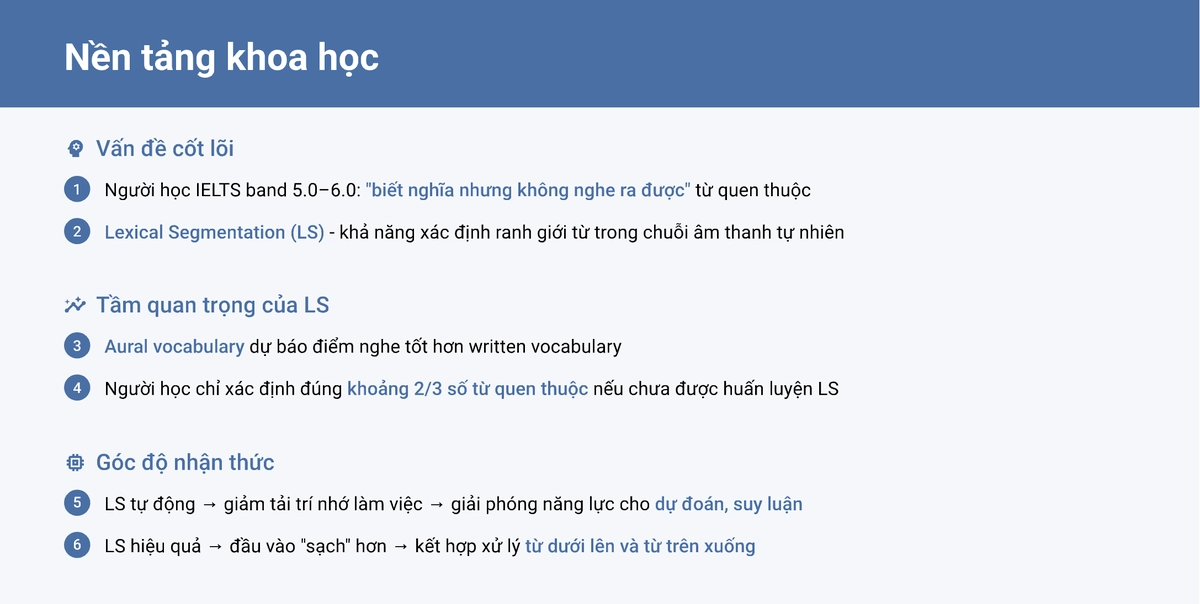
Chuỗi bài viết được thiết kế theo mô hình ba bước: Vocabulary → LS Ear Training → Exam Focus. Trước hết, học viên được mở rộng vốn từ vựng theo chủ đề IELTS ở mức B1–B1+ và sử dụng lại các từ này trong các bài tập LS như word counting (đếm từ để cảm nhận ranh giới), word-position spotting (xác định vị trí từ mục tiêu trong dòng âm thanh) và partial dictation (chép chính tả khuyết từ để buộc nhận diện từ ở dạng nghe) [5]. Cách tiếp cận này giúp người học không chỉ “biết nghĩa” mà còn nghe ra từ ở tốc độ tự nhiên [6] trước khi áp dụng vào các bài luyện Exam Focus được thiết kế theo định dạng IELTS.
Để tối ưu hóa hiệu quả tiếp thu, người học nên có kiến thức cơ bản về IPA hoặc khả năng phân biệt âm vị và âm tiết ở mức B1. Các chủ đề được lựa chọn gần gũi, độ khó vừa phải, nhằm tạo “thử thách hợp lý” – không quá dễ khiến nhàm chán, cũng không quá khó gây nản chí [7]. Đối với giáo viên, cấu trúc nhiệm vụ được xây dựng thành các bước rõ ràng, giúp họ dễ dàng điều chỉnh tốc độ, độ dài và tần suất đầu vào phù hợp với từng lớp học [8].
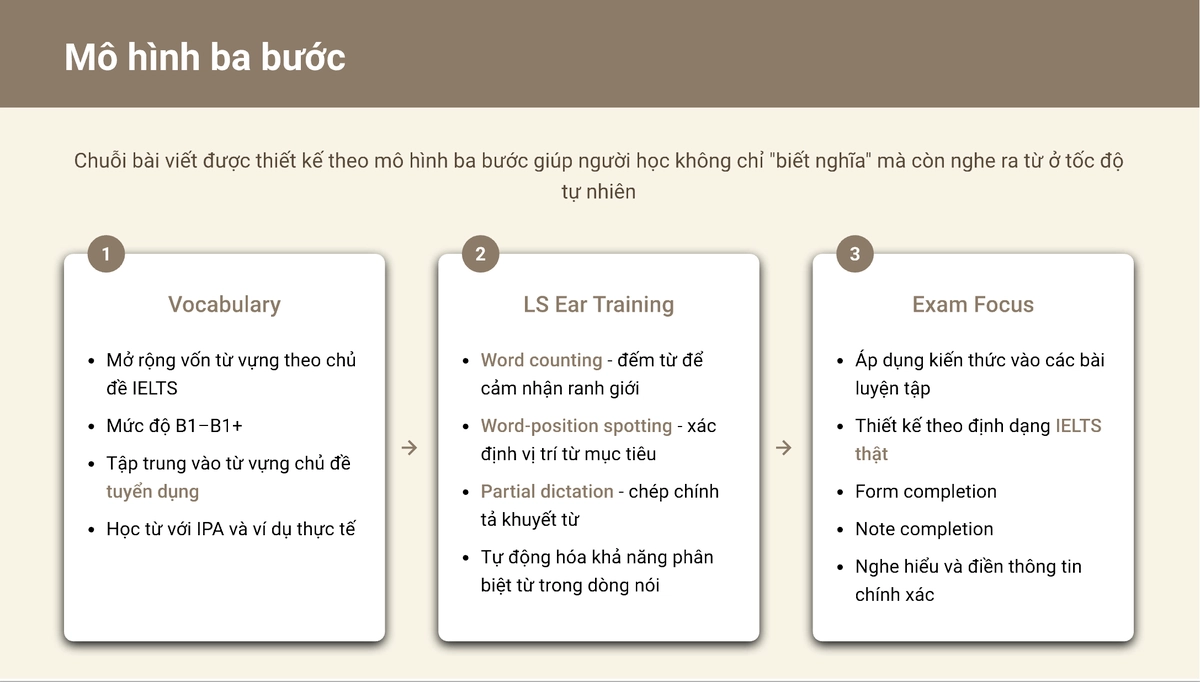
Từ vựng chủ đề Tuyển dụng và xin việc
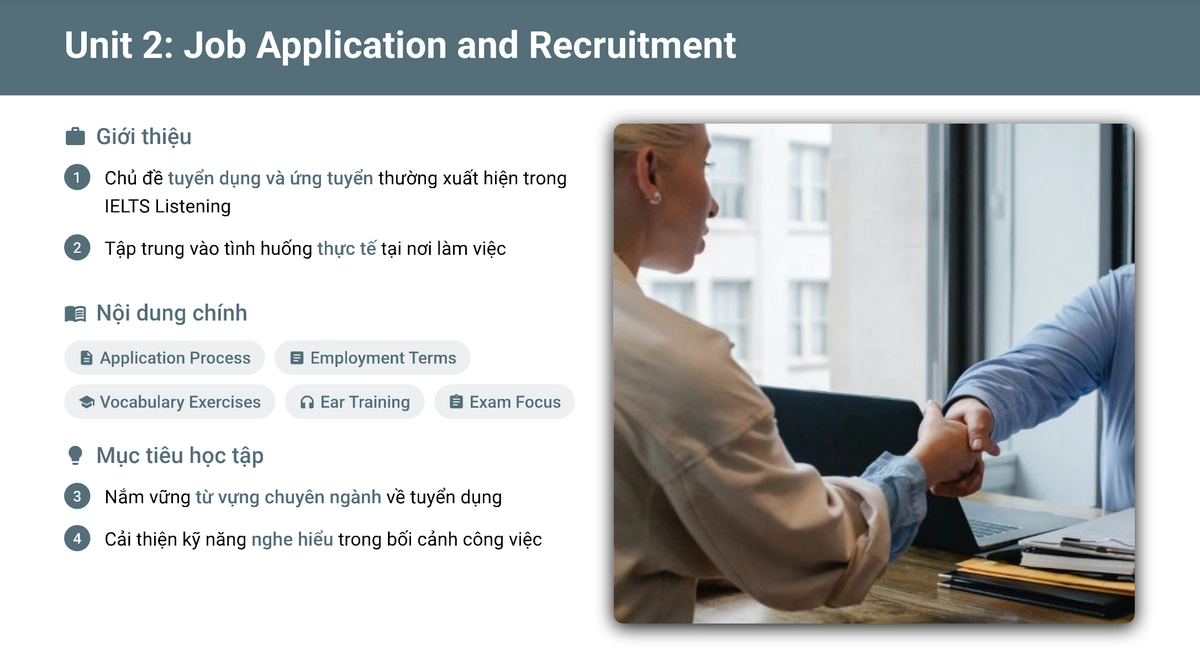
A: Application Process
Từ vựng /IPA/ (loại từ) | Nghĩa tiếng Việt | Câu ví dụ tiếng Anh (dịch nghĩa tiếng Việt) |
|---|---|---|
application /ˌæplɪˈkeɪʃn/ (n) | đơn xin việc | My name’s Charlotte and I’m starting a new job, but first I have to submit my application details at the front desk. (Tên tôi là Charlotte và tôi đang bắt đầu công việc mới, nhưng trước tiên tôi phải nộp chi tiết đơn xin việc tại quầy lễ tân.) |
apply /əˈplaɪ/ (v) | nộp đơn | You have to apply for the position by showing your letter of appointment and picking up your badge from the front desk. (Bạn phải nộp đơn cho vị trí bằng cách xuất trình thư bổ nhiệm và nhận huy hiệu từ quầy lễ tân.) |
required /rɪˈkwaɪərd/ (adj) | yêu cầu | The HR department has required me to bring my passport so they can take a note of the number in it for verification. (Phòng nhân sự yêu cầu tôi mang theo hộ chiếu để họ ghi chú số trong đó nhằm xác minh.) |
interview /ˈɪntərvjuː/ (n/v) | phỏng vấn | After you've finished at the front desk, I'll take you to the staffroom before you attend the interview with Tiffany in HR. (Sau khi bạn hoàn tất tại quầy lễ tân, tôi sẽ đưa bạn đến phòng nhân viên trước khi bạn tham dự phỏng vấn với Tiffany ở phòng nhân sự.) |
attend /əˈtend/ (v) | tham dự | You need to attend the training session in the staffroom where we'll discuss your tasks for the day at the supermarket. (Bạn cần tham dự buổi đào tạo trong phòng nhân viên nơi chúng ta sẽ thảo luận về nhiệm vụ của bạn trong ngày tại siêu thị.) |
submit /səbˈmɪt/ (v) | nộp | Submit your uniform size to Tiffany in HR, as they have lots in different sizes so you can tell her what you need. (Nộp kích cỡ đồng phục của bạn cho Tiffany ở phòng nhân sự, vì họ có nhiều kích cỡ khác nhau nên bạn có thể cho cô ấy biết bạn cần gì.) |
references /ˈrefrənsɪz/ (n) | người tham chiếu | Make sure to provide references from previous employers when you go to HR to see Tiffany for your onboarding process. (Đảm bảo cung cấp người tham chiếu từ nhà tuyển dụng trước khi bạn đến phòng nhân sự gặp Tiffany cho quy trình onboarding.) |
qualified /ˈkwɑːlɪfaɪd/ (adj) | đủ điều kiện | I've recently qualified as a supervisor, which means I have the ultimate responsibility for the team in the bakery section. (Tôi gần đây đã đủ điều kiện làm giám sát viên, nghĩa là tôi chịu trách nhiệm cuối cùng cho đội nhóm ở khu vực bakery.) |
confident /ˈkɑːnfɪdənt/ (adj) | tự tin | Be confident when you go to the HR department, as Tiffany is really helpful and will guide you through the process. (Hãy tự tin khi bạn đến phòng nhân sự, vì Tiffany rất hữu ích và sẽ hướng dẫn bạn qua quy trình.) |
skills /skɪlz/ (n) | kỹ năng | The training we get is a continuous process, focusing on technical competence and safe handling skills for all new staff. (Đào tạo chúng tôi nhận được là quy trình liên tục, tập trung vào năng lực kỹ thuật và kỹ năng xử lý an toàn cho tất cả nhân viên mới.) |
experience /ɪkˈspɪriəns/ (n) | kinh nghiệm | My background in IT has been useful here, and I can use my experience to help other volunteers with the technology involved. (Nền tảng của tôi trong IT đã hữu ích ở đây, và tôi có thể sử dụng kinh nghiệm để giúp các tình nguyện viên khác với công nghệ liên quan.) |
communication /kəˌmjuːnɪˈkeɪʃn/ (n) | giao tiếp | Strong communication is key in team environments, especially when organizing tasks for the day in the supermarket. (Giao tiếp mạnh mẽ là chìa khóa trong môi trường đội nhóm, đặc biệt khi tổ chức nhiệm vụ cho ngày tại siêu thị.) |
select /sɪˈlekt/ (v) | chọn | We will select suitable candidates based on their skills and experience during the recruitment process at the store. (Chúng tôi sẽ chọn ứng viên phù hợp dựa trên kỹ năng và kinh nghiệm của họ trong quy trình tuyển dụng tại cửa hàng.) |
suitable /ˈsuːtəbl/ (adj) | phù hợp | Tiffany will give you a uniform in a suitable size, as they have lots available for new staff members. (Tiffany sẽ đưa bạn đồng phục kích cỡ phù hợp, vì họ có nhiều sẵn cho nhân viên mới.) |
organize /ˈɔːrɡənaɪz/ (v) | tổ chức | I'll take you to the staffroom where we can organize your locker and key before starting the day. (Tôi sẽ đưa bạn đến phòng nhân viên nơi chúng ta có thể tổ chức tủ đồ và chìa khóa của bạn trước khi bắt đầu ngày.) |
operate /ˈɑːpəreɪt/ (v) | vận hành | There's a problem with a bread slicer, so I have to go and operate it to check if it's working properly. (Có vấn đề với máy cắt bánh mì, nên tôi phải đi vận hành nó để kiểm tra xem có hoạt động đúng không.) |
store /stɔːr/ (v/n) | lưu trữ | Put your coat and rucksack in one of the lockers to store them securely during your shift. (Đặt áo khoác và balo của bạn vào một trong các tủ để lưu trữ an toàn trong ca làm việc.) |
assess /əˈses/ (v) | đánh giá | We assess new staff on their ability to handle tasks like cleaning and stocking during the first week. (Chúng tôi đánh giá nhân viên mới về khả năng xử lý nhiệm vụ như dọn dẹp và xếp hàng trong tuần đầu tiên.) |
background /ˈbækɡraʊnd/ (n) | nền tảng | Check the candidate's background including their passport number when they visit the HR department. (Kiểm tra nền tảng của ứng viên bao gồm số hộ chiếu khi họ đến phòng nhân sự.) |
training /ˈtreɪnɪŋ/ (n) | đào tạo | You have to do some training before you're allowed to touch sharp objects like knives in the kitchen. (Bạn phải hoàn thành một số đào tạo trước khi được phép chạm vào vật sắc nhọn như dao trong bếp.) |
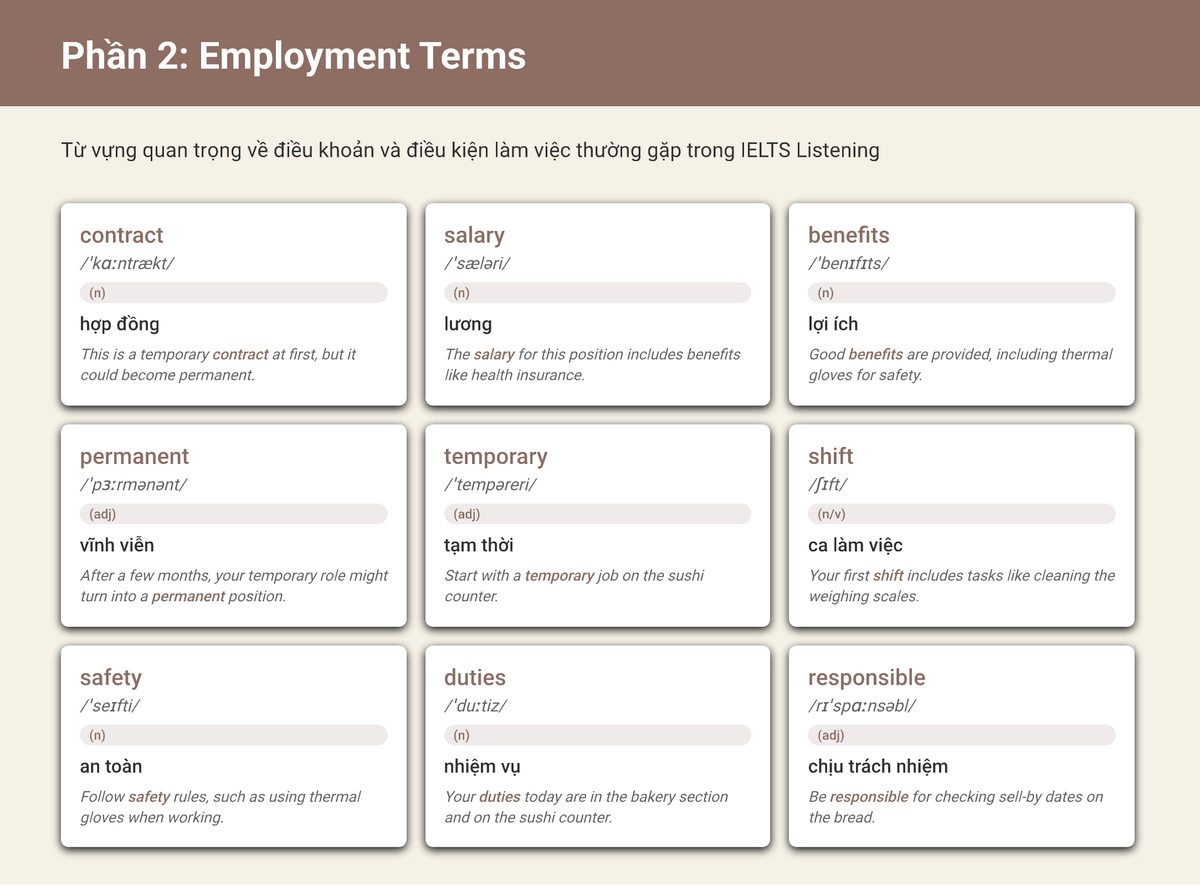
B: Employment Terms
Từ vựng /IPA/ (loại từ) | Nghĩa tiếng Việt | Câu ví dụ tiếng Anh (dịch nghĩa tiếng Việt) |
|---|---|---|
contract /ˈkɑːntrækt/ (n) | hợp đồng | This is a temporary contract at first, but it could become permanent if you perform well in the role. (Đây là hợp đồng tạm thời ban đầu, nhưng có thể trở thành vĩnh viễn nếu bạn thực hiện tốt trong vị trí.) |
salary /ˈsæləri/ (n) | lương | The salary for this position includes benefits like health insurance and staff discounts at the store. (Lương cho vị trí này bao gồm lợi ích như bảo hiểm y tế và giảm giá cho nhân viên tại cửa hàng.) |
benefits /ˈbenɪfɪts/ (n) | lợi ích | Good benefits are provided, including thermal gloves for safety when working in the cold-room. (Lợi ích tốt được cung cấp, bao gồm găng tay cách nhiệt để an toàn khi làm việc trong phòng lạnh.) |
accept /əkˈsept/ (v) | chấp nhận | Accept the terms before you sign the contract and start your shift in the bakery section today. (Chấp nhận các điều khoản trước khi ký hợp đồng và bắt đầu ca làm việc ở khu vực bakery hôm nay.) |
permanent /ˈpɜːrmənənt/ (adj) | vĩnh viễn | After a few months, your temporary role might turn into a permanent position with full benefits. (Sau vài tháng, vai trò tạm thời của bạn có thể trở thành vị trí vĩnh viễn với đầy đủ lợi ích.) |
temporary /ˈtempəreri/ (adj) | tạm thời | Start with a temporary job on the sushi counter, and we'll see if it leads to something more stable. (Bắt đầu với công việc tạm thời ở quầy sushi, và chúng ta sẽ xem liệu có dẫn đến điều gì ổn định hơn không.) |
workplace /ˈwɜːrkpleɪs/ (n) | nơi làm việc | Ensure safety in the workplace by wearing the uniform and following procedures in all areas. (Đảm bảo an toàn tại nơi làm việc bằng cách mặc đồng phục và tuân thủ quy trình ở mọi khu vực.) |
shift /ʃɪft/ (n/v) | ca làm việc | Your first shift includes tasks like cleaning the weighing scales and stocking the fish counter. (Ca làm việc đầu tiên của bạn bao gồm nhiệm vụ như lau chùi cân và xếp hàng ở quầy cá.) |
safety /ˈseɪfti/ (n) | an toàn | Follow safety rules, such as using thermal gloves when taking items out of the cold-room. (Tuân thủ quy tắc an toàn, chẳng hạn như sử dụng găng tay cách nhiệt khi lấy đồ từ phòng lạnh.) |
ensure /ɪnˈʃʊr/ (v) | đảm bảo | Ensure all equipment is in working order before starting your duties on the meat and fish counters. (Đảm bảo tất cả thiết bị hoạt động tốt trước khi bắt đầu nhiệm vụ ở quầy thịt và cá.) |
duties /ˈduːtiz/ (n) | nhiệm vụ | Your duties today are in the bakery section, on the sushi counter, and on the meat and fish counters. (Nhiệm vụ của bạn hôm nay là ở khu vực bakery, quầy sushi, và quầy thịt cá.) |
perform /pərˈfɔːrm/ (v) | thực hiện | Perform the cleaning tasks carefully, including wiping the weighing scales on the food counters. (Thực hiện nhiệm vụ dọn dẹp cẩn thận, bao gồm lau chùi cân ở quầy thực phẩm.) |
manage /ˈmænɪdʒ/ (v) | quản lý | I have to manage the problem with the bread slicer before showing you around the supermarket. (Tôi phải quản lý vấn đề với máy cắt bánh mì trước khi hướng dẫn bạn quanh siêu thị.) |
handle /ˈhændl/ (v) | xử lý | Handle the cleaning of the sink and preparation area, but don't touch sharp objects without training. (Xử lý việc lau chùi bồn rửa và khu vực chuẩn bị, nhưng đừng chạm vào vật sắc nhọn mà không có đào tạo.) |
responsible /rɪˈspɑːnsəbl/ (adj) | chịu trách nhiệm | Be responsible for checking sell-by dates on the bread and cakes in the bakery section. (Chịu trách nhiệm kiểm tra ngày hết hạn trên bánh mì và bánh ngọt ở khu vực bakery.) |
demanding /dɪˈmændɪŋ/ (adj) | đòi hỏi cao | The job can be demanding, especially when stocking ice for the fish counter during busy hours. (Công việc có thể đòi hỏi cao, đặc biệt khi xếp đá cho quầy cá trong giờ cao điểm.) |
conditions /kənˈdɪʃənz/ (n) | điều kiện | Check the working conditions in the cold-room to avoid frostbite from touching items without gloves. (Kiểm tra điều kiện làm việc trong phòng lạnh để tránh bỏng lạnh khi chạm vào đồ mà không đeo găng.) |
equipment /ɪˈkwɪpmənt/ (n) | thiết bị | Clean the equipment like the weighing scales before ending your shift on the meat counter. (Lau chùi thiết bị như cân trước khi kết thúc ca làm việc ở quầy thịt.) |
system /ˈsɪstəm/ (n) | hệ thống | The locker system in the staffroom is simple; just take whichever one is free and leave the key. (Hệ thống tủ đồ trong phòng nhân viên đơn giản; chỉ lấy cái nào trống và để chìa khóa lại.) |
skilled /skɪld/ (adj) | lành nghề | We need skilled staff to operate the dishwasher, but you'll get training before handling sharp tools. (Chúng tôi cần nhân viên lành nghề để vận hành máy rửa chén, nhưng bạn sẽ được đào tạo trước khi xử lý công cụ sắc |
Đọc thêm:
Chủ đề từ vựng thường xuất hiện trong IELTS Listening - Mini series 1: Section 1
Chủ đề từ vựng thường xuất hiện trong IELTS Listening - Mini series 2: Section 2
Chủ đề từ vựng thường xuất hiện trong IELTS Listening - Mini series 3: Section 3
Chủ đề từ vựng thường xuất hiện trong IELTS Listening - Mini series 4: Section 4
Luyện tập
Bài tập từ vựng
Exercise 1 – Nối định nghĩa
Set 1: Application Process
Từ vựng | Định nghĩa |
|---|---|
| a. to officially ask for a job by sending documents b. feeling sure of yourself and your abilities c. a meeting where someone is asked questions for a job d. the act of choosing someone or something e. official paper submitted to request a job f. people who can recommend you for a job g. having the training or education necessary h. correct or appropriate for a purpose |
Set 2: Employment Terms
Từ vựng | Định nghĩa |
|---|---|
| a. the pay you receive regularly from your job b. legal document outlining the terms of employment c. lasting only a limited period of time d. lasting for a long time or without change e. the condition of being protected from harm f. being in charge of something or having a duty g. additional advantages provided with a job h. a period of work during the day or night |
Exercise 2: Điền từ
Complete the sentences using the correct word from the list.
application, attend, confident, skills, experience, training, contract, demanding, manage, system
Every candidate must submit an online __________ before the deadline.
Please __________ the orientation session tomorrow morning in the staffroom.
You should feel __________ when speaking during the interview.
The job requires technical __________ as well as teamwork ability.
Previous work __________ in customer service will be an advantage.
All new staff must complete safety __________ before starting work.
She signed a one-year __________ with the company.
Working in the bakery during peak hours can be quite __________.
Supervisors are expected to __________ both staff and equipment.
The locker __________ is easy to use and keeps belongings secure.
Exercise 3 – Nối kết hợp từ
Match the words in Column A with their most natural collocation in Column B.
Column A | Column B |
|---|---|
| a. conditions b. references c. staff d. application e. shift f. candidate g. interview h. tasks i. position j. locker |
Part B. Ear Training
Task 1 – Nghe và đếm từ
Listen and count how many words are in each sentence.
___ words
___ words
___ words
___ words
___ words
___ words
___ words
___ words
___ words
___ words
Task 2 – Xác định vị trí từ
Listen and identify the position of the target word.
Target word: application
Target word: interview
Target word: training
Target word: contract
Target word: safety
Target word: shift
Target word: confident
Target word: suitable
Target word: responsible
Target word: skilled
Task 3 – Nghe và xác định từ
Listen and follow the specific instruction for each sentence.
Write the last NOUN you hear.
Write the second VERB you hear.
Write all the ADJECTIVES you hear.
Write the first NOUN you hear.
Write the third VERB you hear.
Write all the ADJECTIVES you hear.
Write the first VERB you hear.
Write the last NOUN you hear.
Write the second NOUN you hear.
Write the third ADJECTIVE you hear.
Task 4 – Chép chính tả một phần
Fill in the missing words.
“Please complete the ___ ___ before Friday.”
“You must provide at least ___ ___.”
“All staff must attend the ___ ___.”
“Be sure to sign the ___ ___.”
“Always follow the ___ ___.”
“I’m working the ___ ___ this week.”
“Supervisors will ___ your ___.”
“Only ___ ___ can handle this.”
“Everyone must attend the ___ ___.”
“We want you to ___ ___ at work.”
Part C. Exam Focus
Section 1
Questions 1–10
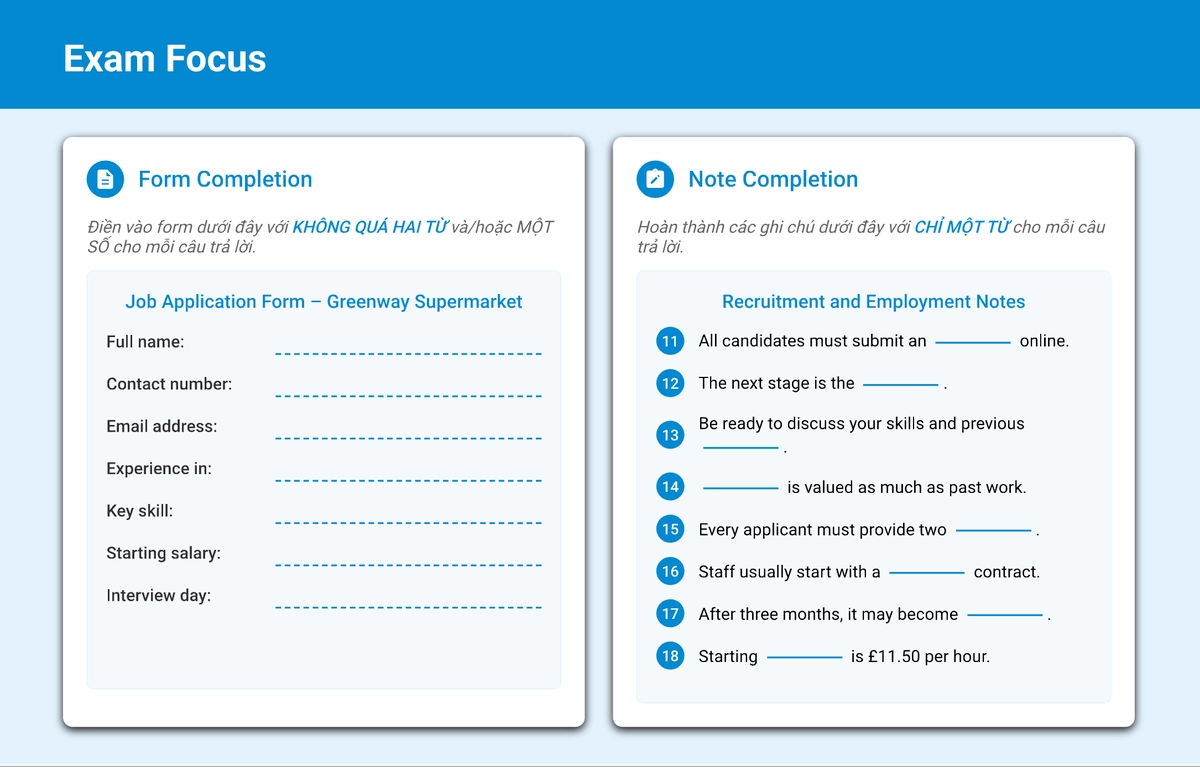
Complete the form below.
Write NO MORE THAN TWO WORDS AND/OR A NUMBER for each answer.
Job Application Form – Greenway Supermarket
Full name: __________
Contact number: __________
Email address: __________
Previous work experience in: __________
Key skill highlighted: __________
References will be sent by: __________
Candidate can work evening __________
Starting salary is £________ per hour
Interview day: __________
Interview time: __________
Section 2
Questions 11–20
Complete the notes below.
Write ONE WORD ONLY for each answer.
Recruitment and Employment Notes
All candidates must submit an __________ online.
The next stage is the __________.
Be ready to discuss your skills and previous __________.
__________ is valued as much as past work.
Every applicant must provide two __________.
Staff usually start with a __________ contract.
After three months, it may become __________.
Starting __________ is £11.50 per hour.
Staff receive store discounts and protective clothing as __________.
During probation, __________ is closely assessed.
Answer Keys
Vocabulary Exercises
Exercise 1 – Matching Definitions
Set A – Application Process
application → h. đơn xin việc
interview → b. buổi phỏng vấn
references → j. người tham chiếu
qualified → f. đủ điều kiện
confident → g. tự tin
skills → c. khả năng/kỹ năng
experience → d. kinh nghiệm
communication → i. sự giao tiếp
Set B – Employment Terms
contract → e. hợp đồng
salary → a. lương
benefits → h. quyền lợi
permanent → f. lâu dài
temporary → g. tạm thời
workplace → j. nơi làm việc
shift → c. ca làm việc
safety → d. an toàn
Exercise 2 – Gap-Fill Sentences
application
interview
required
attend
submit
references
qualified
confident
communication
training
Exercise 3 – Collocations
submit an application
attend an interview
provide references
highly qualified
confident manner
relevant experience
strong communication skills
permanent contract
safety equipment
demanding job
Ear Training
Task 1 – Word Counting
8
6
8
7
8
8
6
5
7
8
Task 2 – Word-Position Spotting
application → 3rd word
interview → 2nd word
training → 6th word
contract → 6th word
safety → 5th word
shift → 4th word
confident → 2nd word
suitable → 6th word
responsible → 3rd word
skilled → 6th word
Task 3 – Targeted Spot & Position
last noun → position
second verb → attend
adjectives → permanent, temporary
first noun → contract
third verb → manage
adjectives → suitable, confident
first verb → apply
last noun → equipment
second noun → training
third adjective → demanding
Task 4 – Partial Dictation
application form
two references
training session
employment contract
safety rules
evening shift
supervise tasks
skilled staff
induction training
feel confident
Exam Focus
Section 1 (Form Completion)
Carter
0792485614
amelia.carter92@gmail.com
bookstore
communication
email
shifts
£11.50
Wednesday
10 a.m.
Section 2 (Note Completion)
application
interview
experience
training
references
temporary
permanent
salary
benefits
communication
Audio Scripts
Part B. Ear Training
Task 1 – Word Counting
“I filled in the application form last night.”
“She attended the interview with confidence.”
“All new staff must complete their training programme.”
“The temporary contract will last three months.”
“Always follow the safety rules in the workplace.”
“You will work the afternoon shift this week.”
“He felt confident during the assessment.”
“Candidates must provide suitable references.”
“Each employee is responsible for their duties.”
“We need skilled workers to operate the equipment.”
Task 2 – Word-Position Spotting
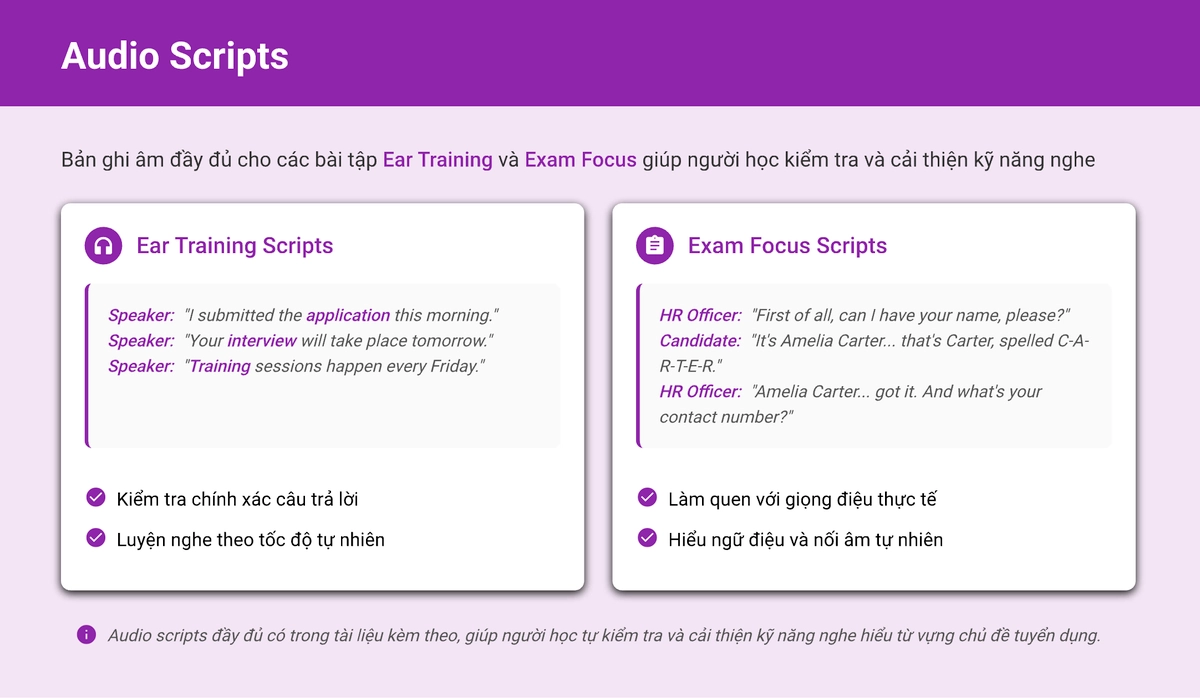
“I submitted the application this morning.”
“Your interview will take place tomorrow.”
“Training sessions happen every Friday.”
“The permanent contract was signed yesterday.”
“Please follow the safety instructions carefully.”
“This is your first evening shift.”
“She is very confident when speaking.”
“They offered me a suitable position.”
“I am responsible for checking the stock.”
“The skilled technician repaired the machine.”
Task 3 – Targeted Spot & Position
“She applied for the position yesterday.”
“You must attend the training session.”
“The permanent and temporary contracts are available.”
“The contract starts next Monday.”
“Managers assess and manage staff performance.”
“Only suitable and confident candidates are selected.”
“We usually apply online first.”
“New equipment was installed last week.”
“The training course lasts two weeks.”
“It is a very demanding job.”
Task 4 – Partial Dictation
“Please complete the application form before Friday.”
“You must provide at least two references.”
“All staff must attend the training session.”
“Be sure to sign the employment contract.”
“Always follow the safety rules.” ()
“I’m working the evening shift this week.” ()
“Supervisors will supervise your tasks.”
“Only skilled staff can handle this.” ()
“Everyone must attend the induction training.” ()
“We want you to feel confident at work.” ()
Part C. Exam Focus
Section 1 – Form Completion (Q1–10)
Audio Script (~1500 words)
HR OFFICER: Good morning, Human Resources at Greenway Supermarket, Martin speaking. How can I help you today?
CANDIDATE: Hi Martin. Yes, I saw the job vacancy for customer service assistants on your website, and I’d like to apply.
HR: Wonderful. You’ve come through to the right place. Before we can schedule an interview, I’ll just need to collect a few details for your application. And don’t worry, this only takes a few minutes.
CANDIDATE: Sure, that’s fine.
HR: Great. First of all, can I have your name, please?
CANDIDATE: It’s Amelia Carter… that’s Carter, spelled C-A-R-T-E-R. (Q1)
HR: Amelia Carter… got it. And what’s your contact number?
CANDIDATE: It’s 0792 485 613. Oh—wait, sorry! That’s my old number. I recently changed it. The correct one is 0792 485 614. (Q2)
HR: No problem at all, it happens all the time. So, ending in 614, yes?
CANDIDATE: That’s right.
HR: Perfect. And your email address?
CANDIDATE: Yes, it’s amelia.carter92@gmail.com. (Q3)
HR: Let me repeat it back: amelia dot carter nine two at gmail dot com.
CANDIDATE: Correct.
HR: Lovely. Now, Amelia, could you tell me a little about your work background? For instance, have you had any previous jobs in customer service or retail?
CANDIDATE: Yes. I worked in a bookstore for about 18 months… actually, let me correct myself—it was 16 months, but close enough. Anyway, it was a busy environment, so I learned how to handle queues, stock shelves, and operate the till. So yes, mainly in a bookstore. (Q4)
HR: Excellent. That sort of experience is definitely relevant. And what specific skills would you say you bring to the role?
CANDIDATE: I’d highlight problem-solving and good communication with customers, especially when they’re upset or stressed. (Q5)
HR: Communication is key in this role, you’re right. Now, part of our recruitment process requires at least two references—usually from past employers or supervisors.
CANDIDATE: Yes, I can provide two. I’ll send them later by email. (Q6)
HR: Perfect. Moving on—our shifts can vary. Some are mornings, others evenings. Are you willing to work evening shifts?
CANDIDATE: Yes, I’m flexible. I don’t mind evenings or weekends either. (Q7)
HR: That’s very useful. Customers often shop late, so we rely on evening staff. Now, let’s talk about pay. The starting salary is £11.50 per hour. Does that work for you?
CANDIDATE: Yes, that’s fine. Honestly, I was expecting £12, but £11.50 is acceptable. (Q8)
HR: (chuckles) Some candidates say the same, but pay is reviewed after six months. Now, for the interview, would Wednesday suit you?
CANDIDATE: Yes, Wednesday is good. (Q9)
HR: Great. We usually run interviews at ten in the morning.
CANDIDATE: That works perfectly—10 a.m. Wednesday. (Q10)
HR: Excellent. Please remember to bring your passport for identification and your national insurance number.
CANDIDATE: Sure, I’ll make a note.
HR: Oh, one more thing—did you want to mention any availability restrictions?
CANDIDATE: Not really. I’m free most weekdays, except Thursday evenings when I have a class.
HR: That’s fine. We can accommodate that. Now, let me just check—so, Amelia Carter, phone ending in 614, email with carter92, bookstore experience, skills in communication, references by email, available evenings and weekends, starting salary £11.50, interview Wednesday 10 a.m. Yes, all recorded.
CANDIDATE: Great, thank you so much.
HR: My pleasure. Looking forward to meeting you in person. Have a nice day!
CANDIDATE: You too. Bye.
Section 2 – Note Completion (Q11–20)
Audio Script (~1500 words, HR Officer briefing new staff)
HR OFFICER: Good afternoon, everyone. Welcome officially to Greenway Supermarket. I can see a few new faces, and I know starting a new job can feel a bit overwhelming, so today I’ll walk you through the recruitment and employment process here. Some of you have already completed the earlier steps, but it’s important that you all understand how the system works.
Now, the very first step in joining us is the application. (Q11) All candidates must submit this form online. Occasionally people drop off paper CVs at the store counter, or even try to hand them to managers in the aisles—believe it or not—but those don’t get processed. Everything has to go through our online system, otherwise it can’t be tracked.
Once the application is reviewed, the next stage is, of course, the interview. (Q12) These are generally conducted in the small conference rooms upstairs. They usually last around twenty minutes, although if we have a lot of questions, it can stretch to half an hour. During the interview, you’ll be asked to talk about your skills and your previous experience. (Q13) Now, don’t panic if you haven’t had a formal job before—we consider training (Q14) to be equally valuable. Volunteer work, community projects, even school-based activities where you had responsibilities can count.
After the interview, references are checked. Each candidate must provide at least two references. (Q15) Ideally, these are from former employers. But if that isn’t possible—for example, if you’ve never had a paid job—we also accept references from teachers or leaders of volunteer organisations. What matters most is that the referee can comment honestly on your reliability and work ethic.
Once references are approved, you move into the employment stage. At first, you’ll usually be given a temporary contract. (Q16) This might be just for a few months. It allows us to see how you’re settling in, and it gives you a chance to decide whether the job suits you. If everything goes well, and it usually does, the contract is then extended and becomes permanent. (Q17)
Now, let’s talk about pay. The starting salary is £11.50 per hour. (Q18) I should clarify: people sometimes hear rumours of higher amounts—£12 or even £13—but those figures apply only in London branches. Here, the standard is £11.50, with a pay review every six months. During that review, supervisors consider attendance, punctuality, performance, and overall contribution to the team. If you’ve shown consistent effort, an increase is very possible.
Alongside salary, we provide a range of benefits. (Q19) These include a ten percent staff discount across most items in the store, protective clothing such as thermal gloves and aprons, and free refreshments in the staffroom during breaks. Now, you might think a free cup of tea is trivial, but during a long shift it can be very welcome. The protective clothing, however, is not optional—it’s part of our safety equipment, especially for those working in the cold-room or on the fish counter.
Now, let me turn to your day-to-day responsibilities. Each shift includes a mixture of tasks. One day you might be stocking shelves; another, you might be on the tills or helping customers at the service desk. Some roles are more physically demanding than others—for example, lifting crates of fruit or handling heavy trolleys—but don’t worry, you’ll get training on safe lifting techniques. Supervisors are always present to assess performance, provide guidance, and step in if any problems arise.
We also stress the importance of being responsible. Each of you is personally responsible for keeping your workspace tidy, for following health and safety guidelines, and for reporting issues promptly. It may seem minor, but things like a spillage on the floor can cause accidents if not reported.
Finally—and this is something I really want to emphasise—communication is central to our culture. We expect you to be confident when interacting with customers. Even if you’re unsure about an answer, it’s better to respond politely and then find someone who can help, rather than leaving the customer frustrated. Good communication (Q20) is also essential with colleagues; misunderstandings about stock or schedules can create real problems. During your probationary period, supervisors will be paying close attention to how you interact, both with the public and with your teammates.
So, to summarise: the process starts with an application, then an interview, followed by reference checks, a temporary contract, and hopefully a permanent one. Salary is £11.50 an hour, with benefits such as discounts and protective clothing. Each shift involves varied duties, and communication and responsibility are key to success here.
That’s the overview. We’ll go into more detail about specific roles later, but for now, does anyone have any questions?
Đọc tiếp:
Tổng kết
Khi luyện từ vựng gắn liền với LS, người học có thể tối ưu hóa việc nhận diện âm thanh, giảm bớt áp lực xử lý và cải thiện khả năng theo dõi thông tin. Với sự kết hợp hệ thống giữa học từ và luyện LS, kỹ năng nghe của thí sinh sẽ tiến bộ bền vững, tạo nền tảng vững chắc để đạt điểm cao trong IELTS Listening.
Để tối ưu hóa lộ trình ôn luyện, người học có thể tham khảo các khóa học IELTS tại ZIM. Với hệ thống học tập cá nhân hóa và chính sách cam kết đầu ra 4 kỹ năng, chương trình giúp học viên đạt kết quả kỳ vọng và tiết kiệm tới 80% thời gian tự học.
Tham vấn chuyên môn
Triết lý giáo dục: "Không ai bị bỏ lại phía sau" (Leave no one behind). Mọi học viên đều cần có cơ hội học tập và phát triển phù hợp với mức độ tiếp thu và tốc độ học tập riêng của mình.
Nguồn tham khảo
1
“Lexical Segmentation in Listening.” The TESOL Encyclopedia of English Language Teaching, 01/01/2018. Accessed 29 September 2025.
2
“Development of the sub-skills of listening.” IH Journal of Education & Development, 31/12/2007. Accessed 29 September 2025.
3
“Vocabulary knowledge and advanced listening comprehension in English as a foreign language.” Studies in Second Language Acquisition, 01/01/2009. Accessed 29 September 2025.
4
“Explaining L2 learners’ listening comprehension: The role of aural vocabulary knowledge.” International Journal of Applied Linguistics, 01/01/2018. Accessed 29 September 2025.
5
“The Paused Transcription Task: A method of assessing second language learners’ segmentation skills.” System, 01/01/2017. Accessed 29 September 2025.
6
“Perception of native English reduced forms in Chinese learners.” International Journal of Applied Linguistics, 01/01/2017. Accessed 29 September 2025.
7
“Whyzit importan’ ta teach reduced forms?.” Proceedings of the JALT Pan-SIG Conference, 01/01/2006. Accessed 29 September 2025.
8
“Cognitive load during problem solving: Effects on learning.” Cognitive Science, 01/01/1988. Accessed 29 September 2025.
Bình luận - Hỏi đáp