


Các chủ điểm kiến thức thường gặp trong đề thi học sinh giỏi Tiếng Anh 11 là câu chẻ, câu điều kiện, v.v
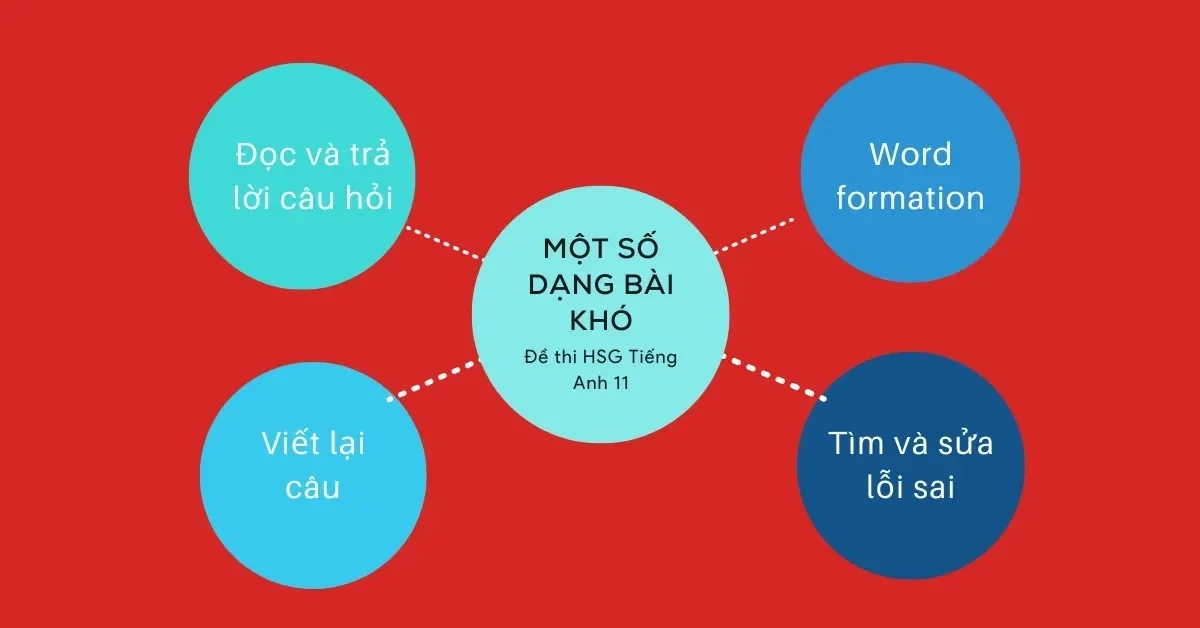
Một số dạng bài khó thường gặp trong đề thi học sinh giỏi Tiếng Anh 11 là word formation, tìm và sửa lỗi sai, viết lại câu, đọc và trả lời câu hỏi
Đề thi học sinh giỏi Tiếng Anh 11 | Các chủ điểm, dạng bài và đề thi
Bài viết giới thiệu về đề thi học sinh giỏi Tiếng Anh 11, các chủ điểm thường gặp, các dạng bài khó và đi kèm 2 đề thi với đáp án
Key takeaways
Bài viết mong muốn đưa tới bạn đọc những kiến thức thường gặp trong đề thi học sinh giỏi tiếng Anh lớp 11 cũng như giới thiệu một số dạng bài khó và hai đề thi học sinh giỏi tiếng Anh 11.
Những chủ điểm kiến thức thường gặp đề thi HSG tiếng Anh lớp 11
Xem thêm: Tổng hợp ngữ pháp Tiếng Anh lớp 11
Các thì ngữ pháp
Liên quan: Các thì tiếng Anh
Đề thi sẽ hỏi tất cả các thì ngữ pháp trong Tiếng Anh vì vậy các thí sinh nên chú ý cần học kĩ các dấu hiệu nhận biết các thì ngữ pháp và học thuộc các động từ bất qui tắc để tránh việc gặp vướng mắc trong phòng thi.
Câu chẻ (cleft sentences)
Câu chẻ là cấu trúc ngữ pháp để nhấn mạnh, bao gồm 2 mệnh đề (chính và phụ) được liên kết bởi đại từ quan hệ.
Câu chẻ thường sử dụng chủ ngữ giả “It”.
Có một số cấu trúc câu chẻ đặc biệt khác, như Câu chẻ với từ để hỏi (Wh-question), There, All, Bị động cách,…
Xem thêm: Câu chẻ
Câu điều kiện
Là câu phức, được sử dụng để suy đoán về những gì có thể xảy ra, hoặc những gì có thể đã xảy ra và những gì chúng ta mong muốn sẽ xảy ra.
Câu điều kiện được chia làm bốn dạng:
Câu điều kiện loại 0 (Zero Conditional) – Sự thật hiển nhiên, quy luật tự nhiên
Cấu trúc: If + S + V (hiện tại đơn), S + V (hiện tại đơn).
Câu điều kiện loại 1– Khả năng xảy ra trong tương lai
Cấu trúc: If + S + V (hiện tại đơn), S + will + V (nguyên mẫu).
Câu điều kiện loại 2– Giả định không có thật ở hiện tại hoặc tương lai
Cấu trúc: If + S + V (quá khứ đơn), S + would/could/might + V (nguyên mẫu).
Câu điều kiện loại 3– Giả định không có thật trong quá khứ
Cấu trúc: If + S + had + V3/ed, S + would/could/might + have + V3/ed.
Câu điều kiện hỗn hợp– Kết hợp giữa loại 2 và loại 3
Cấu trúc:
If + S + had + V3/ed, S + would + V (nguyên mẫu). (Loại 3 + Loại 2)
If + S + V (quá khứ đơn), S + would have + V3/ed. (Loại 2 + Loại 3)
Liên quan: Viết lại câu điều kiện
Một số dạng bài khó trong đề thi HSG tiếng Anh 11
Word formation (Dạng bài biến đổi từ sang các dạng danh từ, động từ, tính từ phù hợp)
Khó do yêu cầu cao về kiến thức từ vựng.
Có thể học theo các mẹo, tuy nhiên trong kì thi học sinh giỏi không thường hỏi các từ vựng tuân theo quy tắc (ví dụ như thêm -tion để trở thành danh từ).
Tìm hiểu thêm: Word form
Bài tập tìm và sửa lỗi sai
Khó do cần phải nắm rất chắc các kiến thức về ngữ pháp cũng như từ vựng để có thể nhận diện được lỗi sai.
Đôi khi một số đề sẽ còn yêu cầu thí sinh phải có khả năng sửa lỗi sai của đề, làm tăng độ khó của đề thi lên rất nhiều.
Liên quan: Sửa lỗi sai
Bài tập viết lại câu
Khó do cần phải nắm rất chắc các dạng câu khác nhau, cũng như các cấu trúc câu và cụm từ khác nhau để có thể vận dụng chính xác.
Do là phần viết lại nên thí sinh thường dễ mắc lỗi hơn so với các câu hỏi trắc nghiệm.
Bài tập đọc và trả lời câu hỏi
Khó do thử thách kĩ năng đọc hiểu cũng như lượng từ vựng của thí sinh. Các đoạn văn thường có dung lượng khá dài, gây khó khăn cho thí sinh trong việc đọc và tìm kiếm thông tin, nếu không giỏi quản lí thời gian sẽ dễ bị tốn thời gian với dạng bài này.
Đặc biệt các dạng câu hỏi như tìm tiêu đề phù hợp nhất hay nội dung chính của đoạn văn là gì thường đòi hỏi kĩ năng đọc hiểu cao, dễ sai đối với thí sinh không có kĩ năng đọc tốt.
Bộ đề thi học sinh giỏi tiếng Anh lớp 11 có đáp án
Đề số 1

Part I: Vocabulary and Grammar
I. Choose the best option to complete each sentence
While the team’s efforts were commendable, their strategy ultimately ___ under the weight of its own complexity.
A. collapsed B. unraveled C. dissolved D. flounderedHaving been offered a lucrative position abroad, she found herself ___ between loyalty to her family and ambition.
A. torn B. teetering C. fluctuating D. waveringDespite his extensive experience, he failed to ___ the importance of delegating tasks effectively.
A. comprehend B. fathom C. internalize D. gaugeThe company’s ___ adherence to outdated methods placed it at a distinct disadvantage in a rapidly evolving market.
A. rigid B. relentless C. unyielding D. doggedThe legislation aimed to curb the ___ influence of monopolistic corporations on small businesses.
A. overbearing B. overarching C. overwhelming D. overarchingIf she ___ her time more efficiently, she would have completed the project earlier.
A. managed B. manages C. had managed D. managesNot only ___ to understand the theory, but he also failed to apply it in practice.
A. he was able B. was he able C. he is able D. was he able toBy the time they ___ the solution, the issue had escalated to a crisis.
A. find B. have found C. will find D. foundHad I known that the company was on the brink of collapse, I ___ my investment.
A. would have withdrawn B. will withdraw C. would withdraw D. would withdrawI have never encountered a situation as challenging ___ this one.
A. as B. like C. than D. to
II. Transform the words in bold to fit the sentence
The Ethics of Artificial Intelligence
The rise of artificial intelligence (AI) has ignited debates across multiple disciplines, from technology to philosophy. At its core, AI embodies a ___ (1) (REVOLUTION) in computational capacity, capable of performing tasks once deemed exclusive to human intelligence. However, as the technology becomes more ___ (2) (OMNIPRESENT), ethical considerations take center stage.
One of the primary concerns is the potential for ___ (3) (BIAS) algorithms. Despite their apparent objectivity, these systems often reflect the ___ (4) (PREJUDICE) embedded within the data on which they are trained. For instance, hiring algorithms can ___ (5) (SYSTEM) exclude certain demographics if historical data is discriminatory.
Another critical issue is the ___ (6) (ACCOUNT) of developers and corporations deploying AI. Many argue that the lack of robust oversight allows companies to evade ___ (7) (RESPONSIBLE) for the consequences of their innovations. Without proper safeguards, AI systems might act in ways that are entirely ___ (8) (FORESEE).
Furthermore, the rapid development of AI raises questions about the potential ___ (9) (DISPLACE) of human labor. Automation has already begun to render certain professions obsolete, exacerbating social and economic inequalities. Addressing this requires a ___ (10) (PRAGMATISM) approach that balances technological progress with human welfare.
III. Complete the sentences with the correct form of ONE of the phrasal verbs below
act on, break down, carry through, deal with, fall back on, follow through, iron out, narrow down, pull off, tie in with |
The company had to ___ alternative funding options after its primary investor withdrew.
If you want to achieve consistent results, you must ___ your commitments without delay.
Despite the complexities of the project, the team managed to ___ a remarkable success.
The detective was able to ___ the list of suspects to just three individuals.
The ambitious initiative would never have been ___ without her relentless determination.
It took weeks of negotiation to ___ the final details of the partnership agreement.
His conclusions failed to ___ the evidence presented in the report.
The policy changes were designed to ___ the rising concerns over public safety.
They decided to ___ the malfunctioning equipment rather than replace it entirely.
In moments of uncertainty, she always knew she could ___ her extensive experience.
IV. Find and correct the FIVE grammatical errors in the passage below
It’s high time that policymakers recognizes the growing importance of cybersecurity in the digital era. While significant progress has been made in implementing measures to safeguard sensitive data, much remains to be done. For example, many small businesses, who are disproportionately affected by cyberattacks, lacks the resources to adopt adequate protective measures. Furthermore, the public often remain unaware of best practices for securing their personal information. Bridging this gap require not only technological solutions but also a concerted effort to educate users and increase awareness.
Part II: Reading Comprehension
I. Read the passage and fill in each blank with ONE suitable word
The Role of Technology in Education
The integration of technology in education has been one of the most (1) developments of the 21st century. From interactive whiteboards to online learning platforms, technology has revolutionized the way we approach education. However, its influence is not without controversy. Critics argue that the reliance on digital tools may (2) the role of traditional teaching methods and undermine the development of essential skills such as critical thinking and problem-solving.
On the other hand, proponents of technological advancements in education contend that digital tools are merely (3) the traditional classroom environment, allowing for more personalized and engaging learning experiences. For instance, artificial intelligence (AI) and machine learning algorithms can adapt the pace of learning to suit the individual needs of each student, making education more (4) and accessible.
Despite these benefits, there are concerns about the (5) gap between students who have access to technology and those who do not. This digital divide can result in disparities in academic performance and limit opportunities for some students, especially those from lower-income backgrounds. Educational institutions must therefore (6) policies to ensure that all students have equal access to the necessary tools and resources.
Another challenge is the issue of privacy. With the increasing use of online platforms and educational apps, there is a growing (7) about how student data is collected, stored, and used. This has prompted educators and policymakers to reconsider how they handle sensitive information and establish (8) safeguards to protect the privacy of students.
In conclusion, while technology has the potential to greatly enhance the learning experience, it must be used (9) and responsibly. By addressing issues such as access and privacy, educational institutions can fully leverage the advantages of technology while minimizing its (10) effects.
II. Read the following passage and choose the best answer
The study of consumer behavior is a crucial field within marketing and economics. Understanding why people make purchasing decisions and how they respond to various stimuli is integral to developing effective marketing strategies. Behavioral psychology offers valuable insights into the psychological triggers that influence consumer choices, such as emotions, social influences, and cognitive biases.
One of the most significant findings in this field is the role of emotions in decision-making. Research has shown that consumers are often driven by their emotions rather than logic when making purchases. For instance, advertisements that evoke strong emotional responses are more likely to result in sales than those that focus solely on product features or benefits. Marketers use this knowledge to create advertisements that appeal to consumers' emotions, often using storytelling, humor, or nostalgia to forge a connection with the audience.
Another key factor influencing consumer behavior is social influence. People often look to others, particularly peers and influencers, when making decisions about what to buy. The concept of social proof, where individuals follow the actions of others, is a powerful driver of consumer behavior. Social media platforms have amplified this effect, as users are constantly exposed to the opinions and lifestyles of others.
Cognitive biases also play a role in shaping consumer behavior. One common bias is the "anchoring effect," where consumers rely too heavily on the first piece of information they receive, such as the initial price of a product, which then influences their perception of its value. Similarly, the "scarcity effect" leads consumers to believe that products in limited supply are more valuable, even if the product's actual worth is not higher.
In conclusion, the psychology of consumer behavior is a complex interplay of emotional, social, and cognitive factors. Marketers who can understand and leverage these psychological principles are better equipped to influence consumer choices and drive sales.
What is the main idea of the passage?
A. The emotional impact of advertisements
B. The psychological factors that influence consumer behavior
C. The role of social media in advertising
D. The relationship between marketing and economicsWhat would be the most suitable title for this passage?
A. "The Impact of Social Media on Marketing"
B. "Psychological Triggers in Consumer Behavior"
C. "The Economics of Consumer Choices"
D. "The Role of Logic in Advertising"Which sentence is referenced in the passage?
"The study of consumer behavior is a crucial field within marketing and economics."
A. "Research has shown that consumers are often driven by their emotions rather than logic."
B. "Marketers use this knowledge to create advertisements that appeal to consumers' emotions."
C. "Understanding why people make purchasing decisions and how they respond to various stimuli is integral to developing effective marketing strategies."
D. "Consumers are often driven by their emotions rather than logic when making purchases."According to the passage, what is a major factor in consumer purchasing decisions?
A. The price of the product
B. The opinions of peers and influencers
C. The quality of the product
D. The availability of the productHow do marketers use emotions in advertisements?
A. To provide detailed information about the product
B. To connect with consumers through storytelling, humor, or nostalgia
C. To showcase the features and benefits of a product
D. To make the product appear rare and valuableWhat is the "anchoring effect"?
A. When consumers rely on the first piece of information they receive about a product
B. When consumers base their decisions solely on product features
C. When consumers purchase a product because it is endorsed by a celebrity
D. When consumers believe that products in limited supply are more valuableWhat role does social influence play in consumer behavior?
A. It discourages consumers from making purchasing decisions
B. It has little impact on consumer behavior
C. It drives consumers to make purchases based on the opinions of others
D. It only affects high-end consumersWhat is the "scarcity effect"?
A. The belief that limited products are more valuable
B. The tendency to ignore the value of a product when it is available in abundance
C. The reliance on a single piece of information when making a decision
D. The preference for products with high ratings
Part III: Writing
I. Rewrite the sentences using the word given, maintaining the meaning
The committee decided to reject the proposal due to its lack of feasibility. (dismissed)
Without her timely intervention, the outcome would have been catastrophic. (had)
His habit of procrastination often causes him to miss critical deadlines. (prone)
The scientist’s groundbreaking discovery is likely to revolutionize the medical field. (poised)
Although the evidence was compelling, the jury remained unconvinced. (despite)
Đề số 2
Part I: Vocabulary and grammar
I. Choose the best option to complete each of the sentences
The CEO’s controversial statement ___ a heated debate about corporate ethics.
A. instigated B. provoked C. incited D. triggeredHer dedication to her research is ___; she spends countless hours in the lab.
A. relentless B. ceaseless C. unwavering D. interminableThe architect’s proposal was ___ because it lacked practicality, despite being visually stunning.
A. dismissed B. rejected C. refuted D. disregardedMany argue that true freedom is ___ only when basic needs are met.
A. attained B. achieved C. acquired D. fulfilledHis inability to ___ criticism constructively hindered his personal growth.
A. address B. assimilate C. internalize D. absorb___ she arrived at the venue, the guests had already started leaving.
A. Hardly B. No sooner C. Scarcely D. OnlyIt was only after a year ___ she realized the magnitude of her mistake.
A. when B. that C. in which D. whereI wouldn't have passed the exam ___ his guidance and support.
A. if not for B. unless C. without D. were it notIf you had listened more carefully, you ___ the details of the argument.
A. would catch B. would have caught C. catch D. caughtThe manager ___ the issue with the team before making the final decision.
A. had discussed B. discussed C. was discussing D. has discussed
II. Read the passage below. Use the word given in bold to form a word that fits in the numbered gap
Climate Change and Global Cooperation
Climate change represents one of the most pressing challenges of our time, demanding ___ (1) (COLLABORATE) on an unprecedented scale. Scientists have issued increasingly urgent warnings about the ___ (2) (ACCELERATE) of global warming, yet efforts to address it remain fragmented.
One major obstacle is the ___ (3) (DISPARITY) between developed and developing nations. Wealthier countries, which have historically contributed the most to greenhouse gas emissions, often demand equal participation from less ___ (4) (INDUSTRY) nations. This imbalance fosters mistrust and impedes ___ (5) (MEANING) progress.
Moreover, the ___ (6) (EXPLOIT) of natural resources continues unabated, driven by short-term economic interests. Forests, often referred to as the planet's lungs, are being destroyed at an ___ (7) (ALARM) rate. Such practices not only undermine ___ (8) (CONSERVE) efforts but also exacerbate biodiversity loss.
Another complicating factor is the lack of public ___ (9) (ENGAGE) with climate issues. While awareness has grown, significant segments of the population remain indifferent or outright ___ (10) (DENY). Bridging this gap requires targeted education campaigns that emphasize the individual and collective stakes in addressing climate change.
III. Complete each sentence with the correct form of ONE of the two-word verb
account for, back out of, break through, carry on with, come up against, cut down on, ease off, hold out for, lay out, step up |
The report was meticulously prepared to ___ every cent spent during the fiscal year.
They promised not to ___ their agreement, even under financial strain.
Despite numerous obstacles, the scientists managed to ___ significant discoveries in their field.
Faced with mounting challenges, the team resolved to ___ their efforts to meet the deadline.
She refused to accept the initial offer and chose to ___ a better deal.
The athlete’s rigorous training regimen helped him ___ competitors twice his age.
To maintain a healthier lifestyle, he decided to ___ his consumption of processed foods.
The road was icy, so traffic began to ___, allowing for a smoother commute.
They needed more time to ___ the complex design of the proposal before presenting it.
Despite the setback, she encouraged her team to ___ their work and remain focused.
IV. The passage below contains FIVE mistakes. Underline them and write the correct forms
The advent of blockchain technology has revolutionized the way transactions are executed, offering unprecedented levels of security and transparency. However, its widespread adoption have encountered several challenges, particularly in relation to scalability and regulation. Proponents of blockchain argue that its decentralization could potentially mitigate the necessity of intermediaries, thereby simplifying the financial system. Nonetheless, detractors contend that the complexity of blockchain systems is inherently convoluted, making them difficult to comprehend and utilize by the average user.
In addition, the rapid proliferation of cryptocurrencies has raised concerns regarding their volatility and potential to destabilize traditional markets. While some see cryptocurrencies as a financial panacea, others view them as speculative assets that could induce considerable economic turmoil. As the technology continues to mature, it remains to be seen whether blockchain and cryptocurrencies will emerge as viable alternatives to the current financial ecosystem or if their promises will ultimately be rendered superfluous.
Part II: READING COMPREHENSION
I. Read passage and fill in each of the blanks with ONE suitable word
Climate Change and Global Cooperation
Climate change represents a (1) challenge that transcends national borders. Scientists have repeatedly warned that if global temperatures continue to rise at the current rate, the consequences could be catastrophic for both the environment and humanity. The melting of polar ice caps, rising sea levels, and increasingly severe weather patterns are just some of the (2) effects of climate change that are already being witnessed worldwide.
Addressing this crisis requires (3) global cooperation, as no single country can tackle climate change in isolation. Governments, corporations, and individuals all have a role to play in reducing carbon emissions and promoting sustainable practices. One key issue is the reliance on fossil fuels, which continue to be the primary (4) of greenhouse gas emissions. While renewable energy sources like solar and wind power have made significant progress, there remains a substantial (5) towards a global transition to cleaner energy.
Another significant challenge is the economic impact of climate change. Countries that are most vulnerable to the effects of global warming, such as small island nations, often lack the financial resources to (6) the damage caused by rising sea levels and extreme weather events. International financial aid and technological support are therefore essential to help these countries adapt to the changing environment.
Furthermore, the role of developed countries in climate action is critical. Many argue that wealthier nations, which have historically been the biggest polluters, must (7) the majority of the responsibility for reducing emissions. This view has led to the call for (8) agreements that enforce binding commitments to reduce carbon footprints and allocate resources to help developing countries mitigate the effects of climate change.
Despite these challenges, there is still hope. Global initiatives, such as the Paris Agreement, have proven that international cooperation is possible. However, this momentum must be (9) with swift and decisive action at the national level. If countries work together and act (10), the future of the planet can still be secured.
II. Read the following passage and choose the best answer
Urbanization has been one of the defining phenomena of the modern age, transforming once small, agricultural settlements into sprawling metropolises. This rapid expansion has been facilitated by significant advancements in infrastructure, technology, and globalization. However, urbanization has not been without its challenges. While cities offer numerous opportunities for economic growth and social development, they also bring with them issues such as overcrowding, pollution, and social inequality.
The concentration of wealth and resources in urban areas has led to a marked disparity between rural and urban populations. In many parts of the world, rural areas remain economically underdeveloped, with limited access to education, healthcare, and basic amenities. This urban-rural divide has been exacerbated by the ongoing migration of people from rural regions to cities in search of better opportunities.
Furthermore, urbanization has also contributed to environmental degradation. The rapid expansion of cities has led to the depletion of natural resources, increased carbon emissions, and the loss of biodiversity. As urban areas continue to grow, there is an urgent need for sustainable development practices that can balance economic growth with environmental preservation.
While the future of urbanization remains uncertain, one thing is clear: cities will continue to play a central role in shaping the future of the global economy. As such, it is imperative that policymakers and urban planners work to create cities that are not only economically vibrant but also equitable and sustainable for all their inhabitants.
What is the main idea of the passage?
A. The historical development of rural areas
B. The challenges and benefits of urbanization
C. The role of technology in rural areas
D. The impact of urbanization on agricultureWhat would be the most suitable title for this passage?
A. "The Rise of Rural Areas"
B. "Urbanization: Challenges and Opportunities"
C. "Technological Advancements in Agriculture"
D. "The Depletion of Natural Resources"Which sentence is referenced in the passage?
"Urbanization has not been without its challenges."
A. "Cities offer numerous opportunities for economic growth and social development."
B. "The concentration of wealth and resources in urban areas has led to a marked disparity."
C. "While the future of urbanization remains uncertain, one thing is clear."
D. "The rapid expansion of cities has led to the depletion of natural resources."What is the primary challenge associated with urbanization mentioned in the passage?
A. Lack of economic development in cities
B. Overcrowding and pollution
C. The decline of rural areas
D. The loss of biodiversityAccording to the passage, what has exacerbated the urban-rural divide?
A. Environmental degradation
B. Globalization
C. Migration from rural to urban areas
D. The depletion of natural resourcesWhat does the author suggest is necessary for the future of urbanization?
A. The continued expansion of cities
B. A reduction in migration to urban areas
C. Sustainable development practices
D. The growth of rural populationsWhat does the author mean by "sustainable development practices"?
A. Practices that ignore environmental concerns
B. Practices that focus solely on economic growth
C. Practices that balance growth with environmental preservation
D. Practices that prioritize technological advancementWhat is implied about the future of cities in the passage?
A. Cities will become less important to the global economy.
B. Cities will only grow economically without addressing social issues.
C. Cities will continue to grow and play a key role in the global economy.
D. Cities will return to a more rural model of development.
Part III: WRITING
Complete each of the sentences so that it has similar meaning to the given one, using the word given in bold. Do NOT change the form of the word given
The manager’s insistence on perfection delayed the completion of the project. (insisted)
It is highly unusual for such an event to occur in this area. (rarely)
She regrets not having spoken up during the meeting. (expressed)
His behavior at the conference was unacceptable and shocked everyone present. (conduct)
The company’s success can be attributed to its innovative strategies. (stemmed)
Đáp án đề thi học sinh giỏi tiếng Anh lớp 11
Đề số 1
Part I: Vocabulary and grammar (7 points)
I.
B. unraveled
A. torn
C. internalize
A. rigid
C. overwhelming
C. had managed
B. was he able
D. found
A. would have withdrawn
A. as
II.
revolution
omnipresent
biased
prejudices
systematically
accountability
responsibility
unforeseeable
displacement
pragmatic
III.
fall back on
follow through
pull off
narrow down
carry through
iron out
tie in with
act on
deal with
fall back on
IV.
recognizes → recognize
who → which
lacks → lack
remain → remains
require → requires
Part II
I.
significant
diminish
complementing
individualized
socioeconomic
implement
concern
adequate
strategically
negative
II.
B
B
C
B
B
A
C
A
Part III
I.
The proposal was dismissed by the committee due to its lack of feasibility.
Had it not been for her timely intervention, the outcome would have been catastrophic.
He is prone to procrastination, which often causes him to miss critical deadlines.
The scientist’s groundbreaking discovery is poised to revolutionize the medical field.
Despite the compelling evidence, the jury remained unconvinced.
Đề số 2
Part I: Vocabulary and grammar (7 points)
I.
D. triggered
C. unwavering
A. dismissed
A. attained
C. internalize
B. No sooner
B. that
C. without
B. would have caught
A. had discussed
II.
collaboration
acceleration
disparities
industrialized
meaningful
exploitation
alarming
conservation
engagement
denial
III.
account for
back out of
break through
step up
hold out for
come up against
cut down on
ease off
lay out
carry on with
IV.
have → has
mitigate → reduce
convoluted → complicated
panacea → solution
rendered superfluous → rendered unnecessary
Part 2:
I.
monumental
detrimental
collective
source
obstacle
repair
assume
international
sustained
urgently
II.
B
B
B
B
C
C
C
C
Part 3:
The manager insisted on perfection, which delayed the completion of the project.
Rarely does such an event occur in this area.
She regrets not having expressed her thoughts during the meeting.
His conduct at the conference was unacceptable and shocked everyone present.
The company’s success stemmed from its innovative strategies.
Tác giả: Phạm Nam Phương
Tổng kết
Qua bài viết, tác giả đã tổng hợp một số dạng kiến thức sẽ có trong bài thi học sinh giỏi tiếng Anh lớp 11 cũng như cung cấp cho học viên 2 đề thi học sinh giỏi Tiếng Anh 11. Học viên có thể tham khảo các khóa học On Demand của Zim Academy với lộ trình học giúp học viên nâng cao trình độ Tiếng Anh của mình với đội ngũ giáo viên tận tâm, có chuyên môn cao và bài giảng được thiết kế khoa học.
Tham vấn chuyên môn
No pain, no gain – Tôi tin rằng quá trình học tập hiệu quả đòi hỏi sự nỗ lực nghiêm túc và có định hướng. Triết lý giáo dục của tôi tập trung vào việc nhận diện và phát huy năng lực cá nhân của từng học viên, từ đó hỗ trợ họ chinh phục mục tiêu. Tôi xây dựng môi trường học thân thiện, cởi mở nhưng có kỷ luật, kết hợp hài hòa giữa lý thuyết và thực hành, nhằm giúp người học hiểu sâu và ứng dụng linh hoạt kiến thức vào thực tế.
Bình luận - Hỏi đáp