


Chủ đề IELTS Speaking Part 3: Working abroad.
Bài mẫu cho nhóm câu hỏi:
Why work abroad for a short time?
Advantages of working abroad for a limited period?
Difficulties faced in a foreign country?
Young vs. Older people: Who is more willing to go?
Multinational vs. Local companies?
Nhóm từ vựng: Topic Vocabulary: Motivation & Personal Growth, Career Development, Challenges & Adaptation, và Independence.
Bài mẫu IELTS Speaking Part 3 Topic “Working Abroad” kèm từ vựng
Trong bài viết này, tác giả sẽ gợi ý bài mẫu cho Topic “Working Abroad” và phân tích các từ vựng ghi điểm cho phần thi IELTS Speaking Part 3.
Key takeaways
Bài viết sau đây sẽ cung cấp các câu trả lời mẫu cho IELTS Speaking Part 3 Topic Working Abroad theo khung sườn tư duy (Simple Answer) cùng các thử thách nâng cấp (Upgraded Answer) về cả ý tưởng, từ vựng và ngữ pháp để người học lựa chọn được câu trả lời phù hợp với bản thân, sẵn sàng cho các tình huống trong phòng thi. Bài phân tích này sẽ dẫn dắt người học đi qua các câu trả lời mẫu xoay quanh chủ đề Working Abroad, từ những động lực phát triển bản thân như “broaden one’s horizons”, “step outside one’s comfort zone” đến những thảo luận chuyên sâu về môi trường công sở quốc tế như “workplace hierarchy” hay “cultural adjustment”, giúp người học chinh phục giám khảo bằng sự mạch lạc và ngôn ngữ tự nhiên.
IELTS Speaking Part 3: Working abroad - Sample Answer
Simple answer

1. Why do some people want to work in another country for a short time?
|
I think many people want to work abroad for a short time to gain international experience. Working in another country helps them improve their language skills and understand a different work culture. For example, a Vietnamese marketing graduate might work in Singapore for six months to improve their English and learn how international companies run advertising campaigns. So overall, it’s a good way to develop both professionally and personally. |
2. What are the advantages of working abroad for a limited period?
|
One clear advantage is building independence. When people live alone in another country, they have to manage their own finances, housing, and daily life. For instance, someone working in Australia may need to open a bank account, rent an apartment, and handle work paperwork by themselves. This experience can make them more confident and responsible in the future. |
3. What difficulties might people face when working in a foreign country?
|
One major difficulty is communication problems. Even if someone can speak the language, they might not understand local accents or workplace expressions. For example, an employee working in the UK might struggle to understand informal slang used by colleagues. In addition, cultural differences, such as different working styles or expectations, can also cause misunderstandings at first. |
4. Do you think young people are more willing to work abroad than older people? Why?
|
Yes, I believe young people are generally more willing to work abroad. They usually don’t have as many family responsibilities. For example, a 23-year-old graduate can easily accept a one-year contract in Germany, while someone in their 40s may have children in school and a mortgage to pay. So younger people are often more flexible and open to change. |
5. Do you think multinational companies offer better opportunities than local companies? Why or why not?
|
Yes, I think multinational companies usually offer better opportunities. They often provide higher salaries and professional training programs. For example, large companies like Samsung or Nestlé may send employees to other countries for short-term training. This helps workers gain international experience and improve their skills. So overall, multinational companies can offer better career development opportunities. |
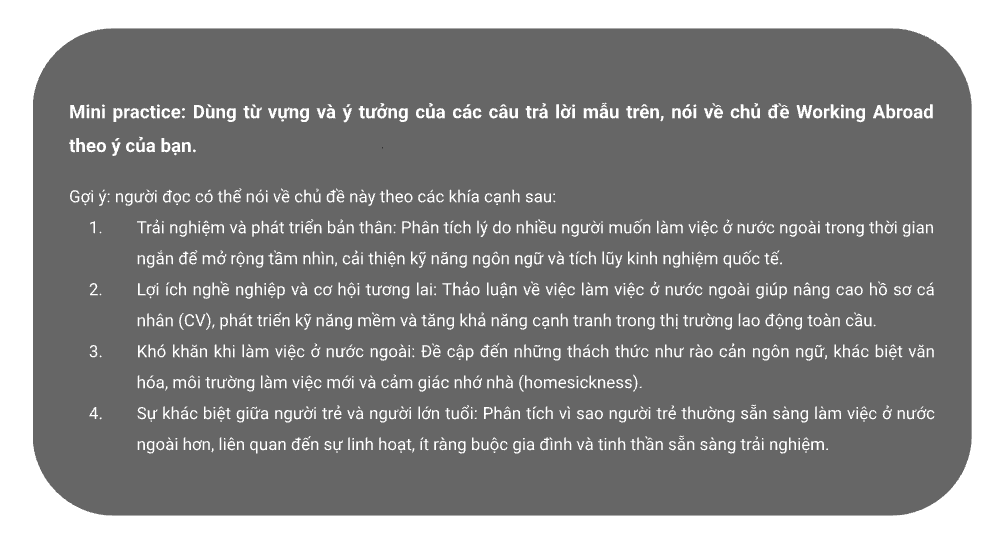
Tìm hiểu thêm: 3 cách phát triển câu trả lời IELTS Speaking Part 3
Upgraded answer
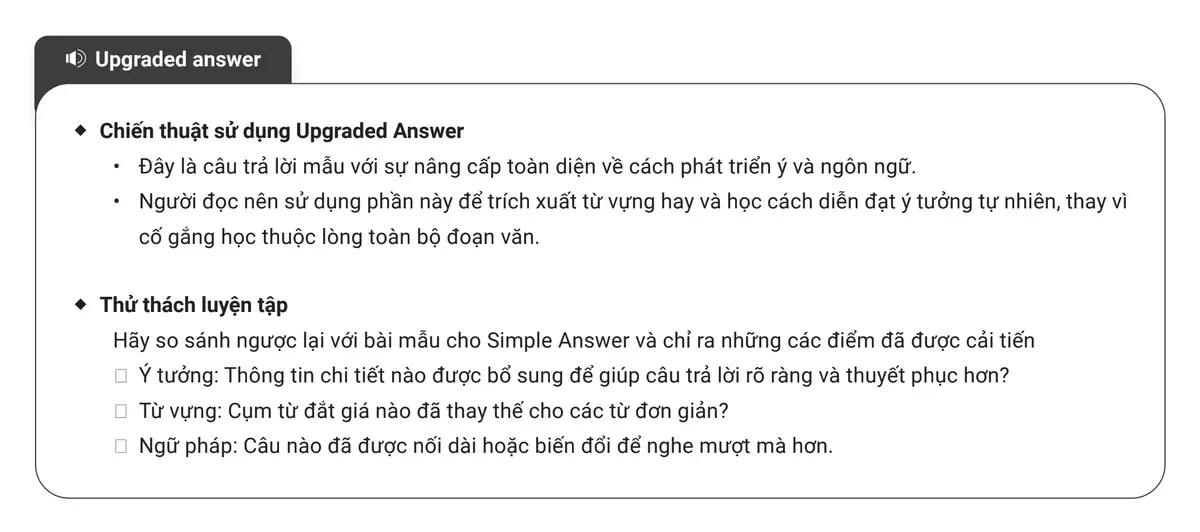
1. Why do some people want to work in another country for a short time?
|
Well, I’d say the main driving force is the desire to broaden one’s horizons. Working abroad, even temporarily, allows people to step outside their comfort zone and gain first-hand exposure to a different professional environment. For example, a young finance graduate might take a one-year contract in Singapore to experience a more competitive and fast-paced market. Not only does this strengthen their technical skills, but it also helps them develop cultural awareness and adaptability. In the long run, that kind of exposure can be a real game-changer for their career trajectory. |
2. What are the advantages of working abroad for a limited period?
|
One obvious advantage is accelerated personal growth. When people relocate to a foreign country, they’re forced to handle everything independently — from managing finances to navigating a new workplace culture. For instance, someone working in Australia for six months may have to deal with tax systems, rental contracts, and cross-cultural teamwork all at once. While it can be overwhelming at first, it often builds resilience and self-reliance. So, in many cases, even a short overseas experience can significantly boost both confidence and employability. |
3. What difficulties might people face when working in a foreign country?
|
Honestly, cultural adjustment can be one of the biggest hurdles. Even if someone is fluent in the local language, subtle differences in communication style or workplace hierarchy can create friction. For example, in some Western companies, employees are expected to speak up and challenge ideas openly, whereas in other cultures, that might be seen as disrespectful. That being said, many people gradually adapt and even learn to appreciate these differences. Still, the initial transition period can be quite stressful. |
4. Do you think young people are more willing to work abroad than older people? Why?
|
Generally speaking, yes, young people tend to be more willing to work abroad. At that stage of life, they often have fewer commitments, which makes it easier to pack up and move overseas. For example, a 24-year-old graduate may see a job in Germany as an exciting adventure, whereas someone in their 40s might hesitate due to family responsibilities. That said, older professionals sometimes bring more expertise and may be offered senior international roles. Even so, younger individuals are usually more open to taking risks and embracing uncertainty. |
5. Do you think multinational companies offer better opportunities than local companies? Why or why not?
|
In many cases, multinational companies do provide broader opportunities, particularly in terms of global exposure and structured career development. Employees often have access to international training programs and the possibility of internal transfers across countries. For instance, someone working at a global firm like Microsoft might collaborate with colleagues from multiple regions, which can significantly expand their professional network.However, local companies shouldn’t be underestimated. They may offer faster decision-making processes and closer mentorship due to their smaller scale. At the end of the day, it really boils down to an individual’s priorities — whether they value international mobility or a more intimate working environment. |
Tham khảo: Tổng hợp bài mẫu IELTS Speaking 2026
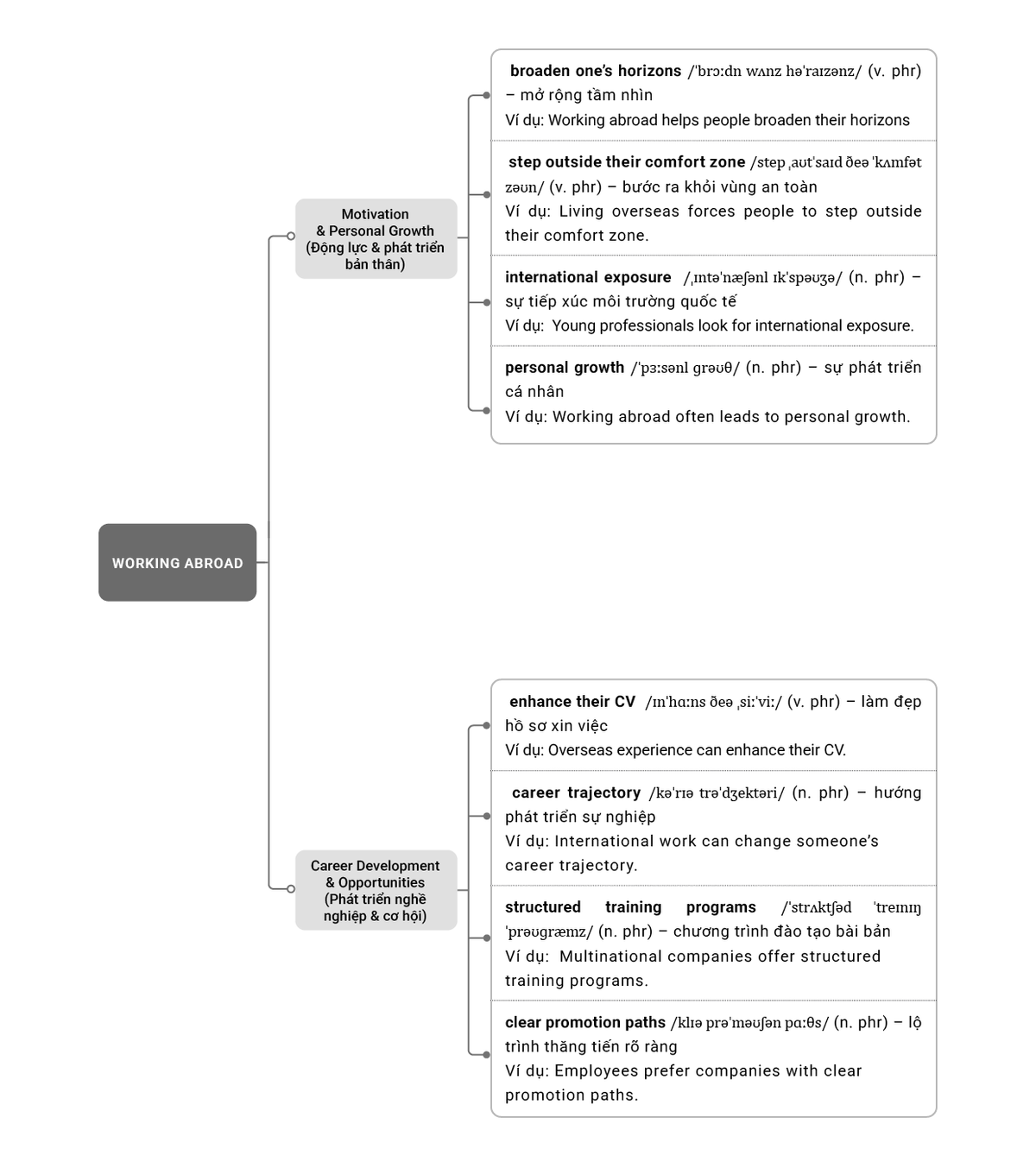
Lọc và phân tích từ vựng
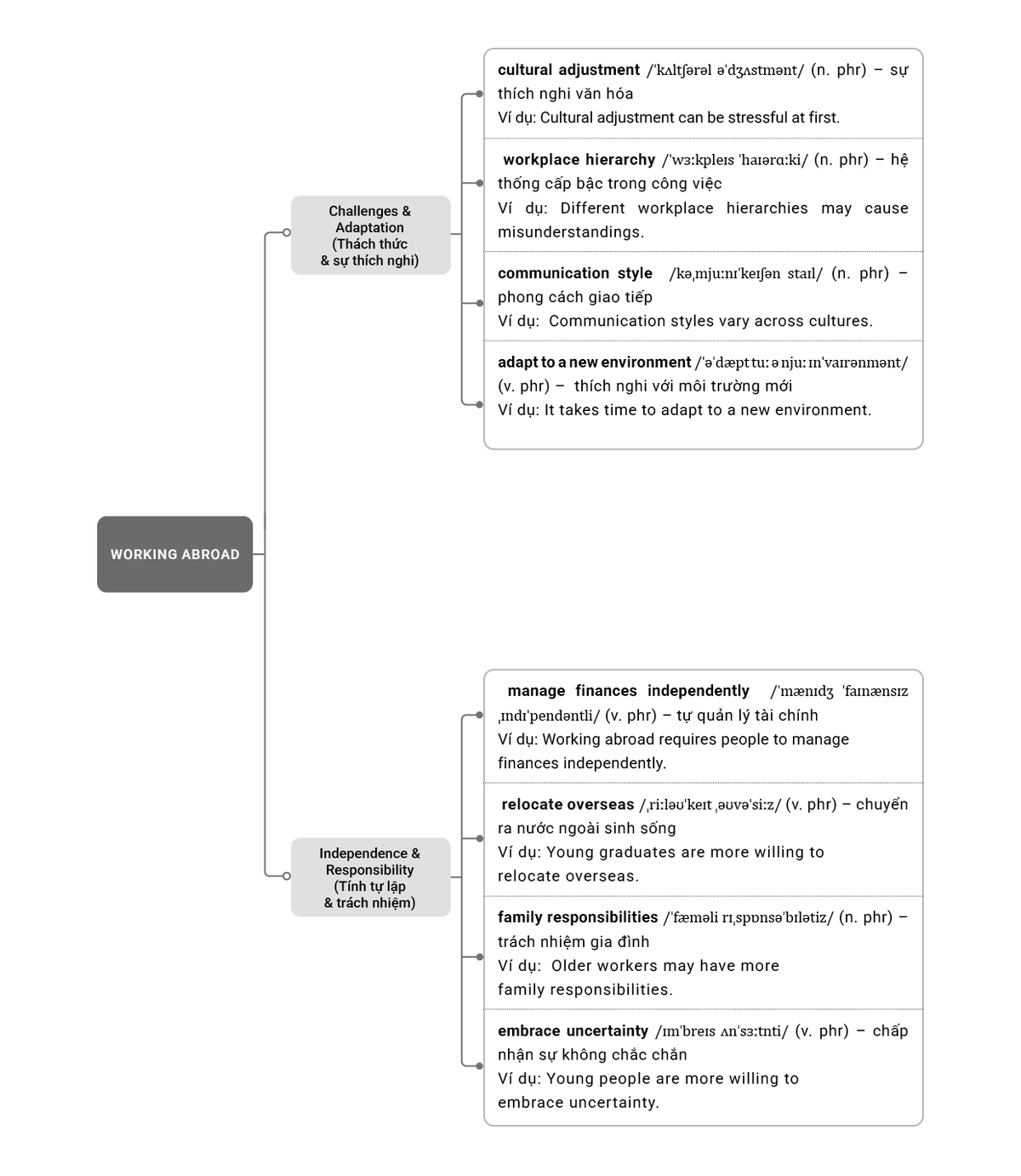
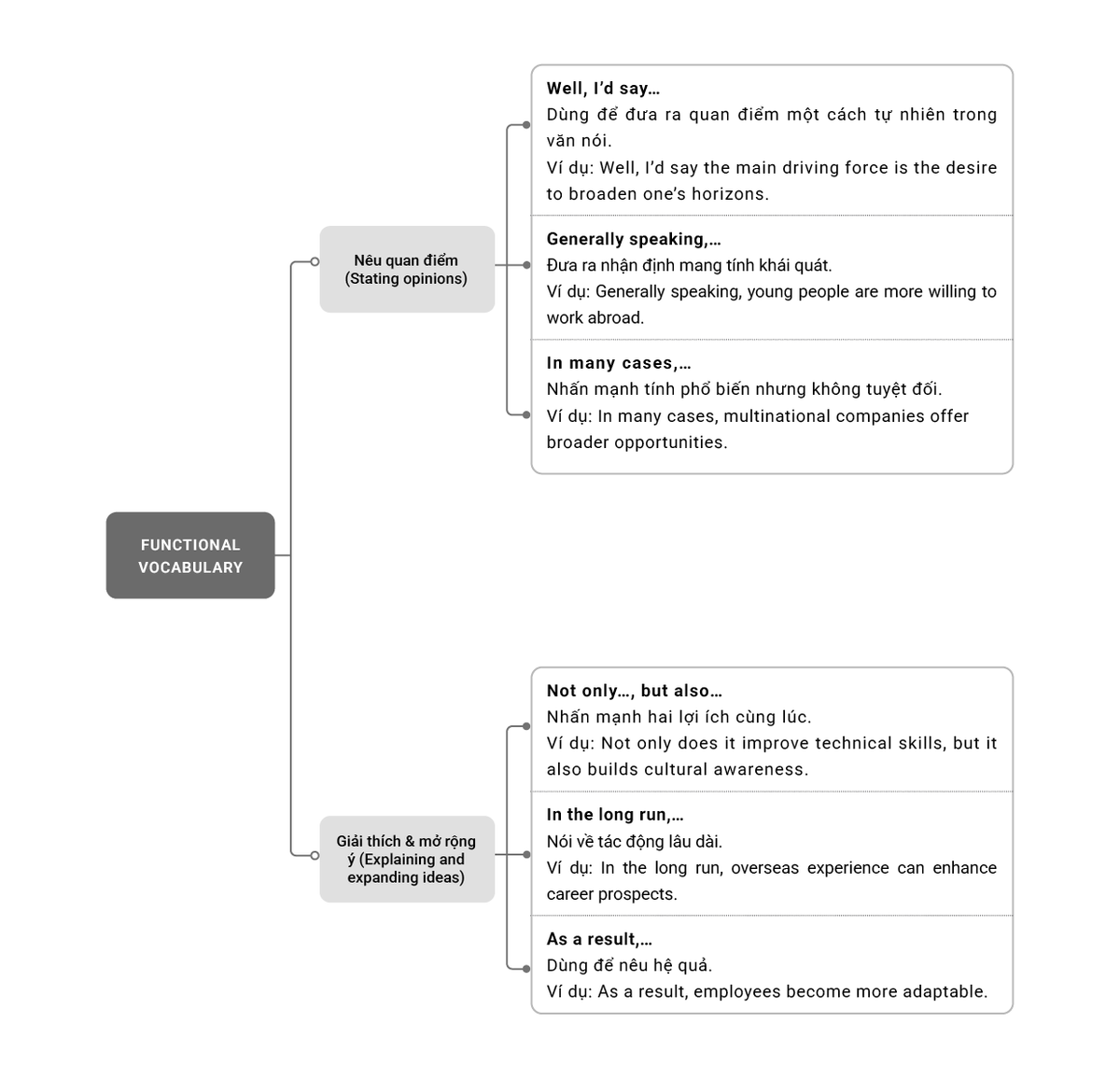
Đọc thêm: Từ vựng chủ đề Work
Nhật ký từ vựng & ý tưởng
Ghi chú sau khi luyện tập nói về chủ đề trên
Từ vựng/Ý tưởng (Chọn các từ vựng/ý tưởng mà bạn tâm đắc nhất) | Kỉ niệm cá nhân |
|---|---|
Ví dụ: broaden one’s horizons – mở rộng tầm nhìn | Người đọc tự đặt các câu hỏi cho bản thân, ví dụ:
→ If I had the chance, I would love to work abroad for a short time because I think it would really broaden my horizons. Living in another country would push me to step outside my comfort zone and adapt to a completely new environment. I imagine it would be challenging at first, especially in terms of cultural adjustment and communication style, but it could also be a valuable learning experience. In the long run, I believe that kind of international exposure would not only improve my professional skills, but also make me more independent, adaptable, and open-minded. For me, even a short overseas experience could be a real turning point in my personal growth and career development. |
Khoảng trống diễn đạt (Phần khiến bạn ngập ngừng khi nói về chủ đề trên) | Giải pháp (Giải pháp cho các khoảng trống diễn đạt) |
Ví dụ:
| Ví dụ: Dùng từ điển của ZIM hoặc chép các cách diễn đạt từ bài mẫu ở các phần trên để có được cụm từ mà bạn cần. → Thay vì chỉ nói “it is difficult” → dùng cultural adjustment / communication style / workplace hierarchy / adapt to a new environment |
Người đọc có thể tìm từ vựng bằng từ điển ZIM Dictionary.
Các lỗi ngữ pháp thường gặp
1.Dùng sai “work” và “job”
❌ Lỗi thường gặp: It’s hard to find a good work in another country. (người học muốn nói: tìm một công việc tốt)
✅ Cách dùng đúng:
work (không đếm được) → công việc nói chung
a job (đếm được) → một công việc cụ thể
✔ Câu đúng:
It’s hard to find a good job in another country.
Working abroad gives people more work experience.
📌 Lý do sai: “Work” là danh từ không đếm được nên không dùng với “a”.
2. Dùng sai thì khi nói về kinh nghiệm trong quá khứ ảnh hưởng hiện tại
❌ Lỗi thường gặp: I worked abroad for one year, so I become more independent. (người học muốn nói: vì thế tôi trở nên tự lập hơn)
✅ Cách dùng đúng:
Dùng thì quá khứ cho cả hai hành động
Hoặc dùng hiện tại hoàn thành nếu nhấn mạnh kết quả hiện tại
✔ Câu đúng:
I worked abroad for one year, so I became more independent.
I have worked abroad before, so I have become more independent.
📌 Lý do sai: Không thể kết hợp quá khứ “worked” với hiện tại “become”. Phải thống nhất thì.
3. Dùng sai cấu trúc “because” và “so”
❌ Lỗi thường gặp: Because salaries are higher, so many people want to work abroad. (người học muốn nói: vì lương cao nên nhiều người muốn ra nước ngoài)
✅ Cách dùng đúng:
Because + mệnh đề
Hoặc Mệnh đề + so + mệnh đề
✔ Câu đúng:
Because salaries are higher, many people want to work abroad.
Salaries are higher, so many people want to work abroad.
📌 Lý do sai: Không dùng “because” và “so” cùng lúc trong một cấu trúc
Mini practice |
|---|
Dùng đúng cấu trúc trong ngoặc 1. Hãy nói rằng nhiều người muốn tìm một công việc tốt ở nước ngoài. (Dùng: a job – không dùng a work) 2. Hãy nói rằng lương cao là lý do nhiều người muốn làm việc ở nước ngoài. (Dùng: Because… / …, so… – không dùng cả hai trong cùng một cấu trúc) 3. Hãy nói rằng mọi người cần thời gian để thích nghi với môi trường làm việc mới. (Dùng: adapt to – không dùng adapt with) |
Các chủ đề liên quan
Chủ đề liên quan để sử dụng từ vựng & ý tưởng:
Globalisation (Toàn cầu hoá)
Career development (Phát triển sự nghiệp)
Cultural differences (Khác biệt văn hoá)
Người đọc có thể sử dụng:
Từ vựng:
broaden one’s horizons, international exposure, career trajectory, structured training programs, clear promotion paths, personal growth, cultural adjustment, communication style, workplace hierarchy, relocate overseas, family responsibilities, adapt to a new environment, enhance their CV, global opportunities, competitive job market...
Ý tưởng:
Làm việc ở nước ngoài giúp mở rộng tầm nhìn và tăng cơ hội nghề nghiệp trong môi trường toàn cầu.
Trải nghiệm quốc tế có thể giúp nâng cao CV và thay đổi hướng phát triển sự nghiệp lâu dài.
Khác biệt văn hoá và phong cách giao tiếp có thể gây khó khăn ban đầu khi làm việc ở môi trường mới.
Người trẻ thường sẵn sàng chuyển ra nước ngoài vì ít ràng buộc gia đình hơn.
Các công ty đa quốc gia thường mang lại cơ hội đào tạo bài bản và môi trường làm việc chuyên nghiệp hơn.
Mini practice |
|---|
Sử dụng từ vựng và ý tưởng ở trên để trả lời các câu hỏi sau
(Gợi ý: broaden their horizons, international exposure, enhance their CV, career trajectory)
(Gợi ý: cultural adjustment, communication style, workplace hierarchy, adapt to a new environment)
(Gợi ý: structured training programs, clear promotion paths, global exposure, career development) |
Đọc thêm: Bài mẫu IELTS Speaking Part 3 Topic “Science in Life” kèm từ vựng
Tổng kết
Hy vọng rằng qua việc phân tích hai cấp độ trả lời từ Simple Answer để đảm bảo sự trôi chảy đến Upgraded Answer để ghi điểm ấn tượng, người học đã nắm vững được lộ trình để chinh phục IELTS Speaking Part 3 Topic Working Abroad. Bằng cách cá nhân hóa các câu trả lời thông qua “Nhật ký Từ vựng & Ý tưởng”, người học sẽ xây dựng được sự tự tin khi thảo luận về các chủ đề liên quan đến môi trường làm việc quốc tế và phát triển bản thân. Đừng quên thực hành các bài tập nhỏ (mini practice) để khắc phục những lỗi ngữ pháp thường gặp và làm chủ ngôn ngữ của mình nhé!
Nếu bạn muốn nâng cao kỹ năng IELTS Speaking theo lộ trình cá nhân hóa, Hệ thống giáo dục ZIM cung cấp các khóa luyện thi IELTS cam kết đầu ra, giúp bạn tối ưu hiệu quả học tập và tiết kiệm đến 80% thời gian tự học. Để được tư vấn chi tiết, vui lòng liên hệ hotline 1900-2833 (nhánh 1) hoặc truy cập Khóa học IELTS.
Nguồn tham khảo
1
“Bài mẫu IELTS Speaking Part 3.” OpenAI, chatgpt.com/share/e/6961bf62-bf88-8002-9512-8fe28a8cdcf4. Accessed 4 April 2026.
Bình luận - Hỏi đáp