


Bài thi SAT kiểm tra từ vựng học thuật Tier 2.
Chủ đề từ vựng SAT thông dụng: Change & Transformations: dynamic, originate, reform, relocate, trace, innovative, diverge, localize, variable, contract
Cách học từ vựng hiệu quả: Học theo ngữ cảnh và học có nhắc lại.
SAT® Vocab Handbook Unit 4: Từ vựng chủ đề Change & Transformation
Tổng hợp từ vựng SAT chủ đề Change & Transformations, bao gồm cách dùng, word family và bài tập vận dụng chi tiết.
Key takeaways
Trong quá trình ôn tập cho bài thi Digital SAT, không ít người học cảm thấy khó khăn với từ vựng học thuật được kiểm tra trong bài thi. Thực tế cho thấy bài thi Digital SAT sử dụng nhiều từ vựng học thuật với mật độ dày đặc hơn so với các bài thi chuẩn hóa ngôn ngữ thông thường. Do đó, người học cần đầu tư không ít thời gian để ôn luyện nếu muốn tích lũy từ vựng và cải thiện hiệu quả làm bài. Nắm được nhu cầu đó của người học, Anh ngữ ZIM triển khai chuỗi bài viết về các từ vựng học thuật thường xuất hiện trong bài thi nhằm cung cấp cho người học tài nguyên luyện tập chất lượng cao. Trong phạm vi bài viết này, tác giả sẽ trình bày từ vựng SAT chủ đề Change & Transformations, một chủ đề thông dụng trong từ vựng SAT.
Từ vựng học thuật trong Digital SAT
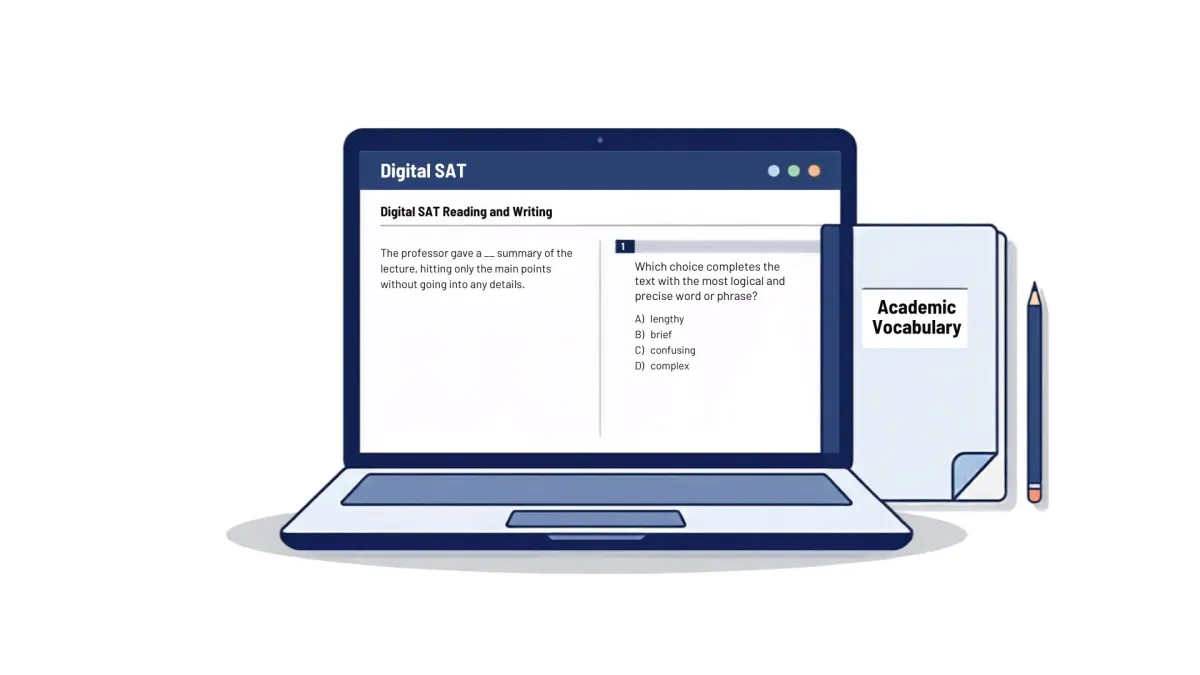
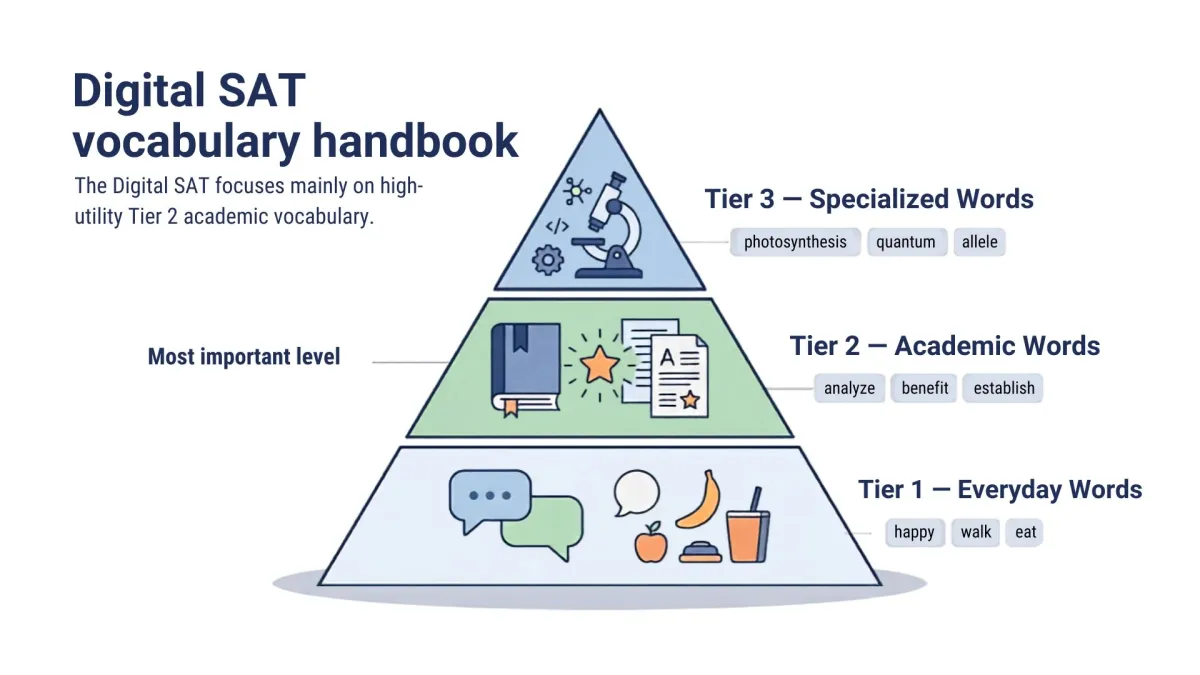
Khác với các bài thi SAT cũ thường kiểm tra những từ vựng hiếm gặp hoặc quá chuyên sâu, Digital SAT tập trung vào một nhóm từ vựng khác: từ vựng học thuật có tính ứng dụng cao (High-utility academic words / Tier 2 vocabulary).
Bài thi nhắm vào các từ và cụm từ mà sinh viên thường xuyên bắt gặp trong các văn bản học thuật hoặc môi trường đại học, nhưng lại ít khi được sử dụng trong giao tiếp hằng ngày [1]. Ví dụ: convey, ambivalent, correlate, substantiate.[2][3]
Bên cạnh đó, bài thi Digital SAT cũng hạn chế trong việc kiểm tra các từ lóng thông thường (Tier 1) và cả những thuật ngữ kỹ thuật quá hẹp hoặc chuyên ngành (Tier 3) [1] [3].
Dạng bài Words in Context trong Digital SAT
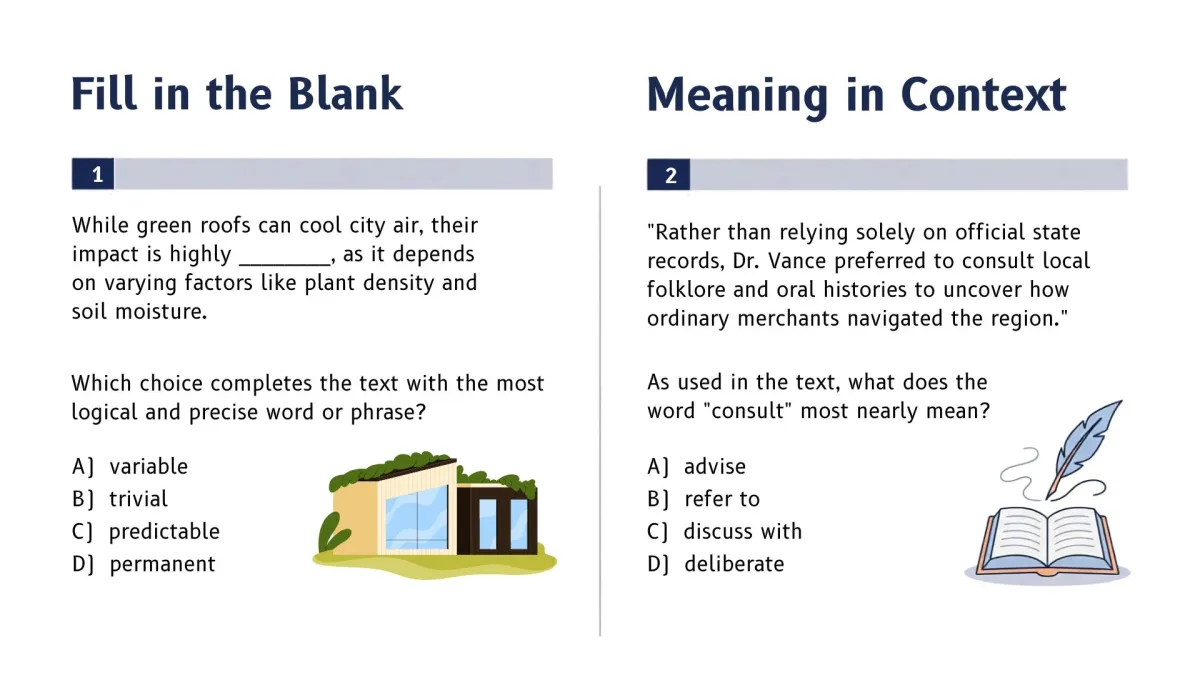
Dạng bài Words in Context yêu cầu thí sinh xác định ý nghĩa của một từ/cụm từ học thuật có tính ứng dụng cao dựa trên ngữ cảnh mà nó xuất hiện, hoặc yêu cầu thí sinh lựa chọn một từ/cụm từ logic và chính xác nhất để điền vào chỗ trống trong một đoạn văn [1] [3]. Dạng bài này thường xuất hiện dưới 2 định dạng câu hỏi chính:
Điền từ vào chỗ trống: Câu hỏi thường có dạng "Which choice completes the text with the most logical and precise word or phrase?" [1][2]. Thí sinh sẽ đọc một đoạn văn bị thiếu một từ và cần chọn đáp án phù hợp nhất. Dạng bài này chỉ xuất hiện trong thể loại đoạn văn Informational text.
Tìm nghĩa của từ: Câu hỏi thường có dạng "As used in the text, what does the word 'x' most nearly mean?" [1][2]. Dạng bài này chỉ xuất hiện với thể loại đoạn văn Poem/Novel/Short story.
Chiến lược làm bài Words in Context trong Digital SAT
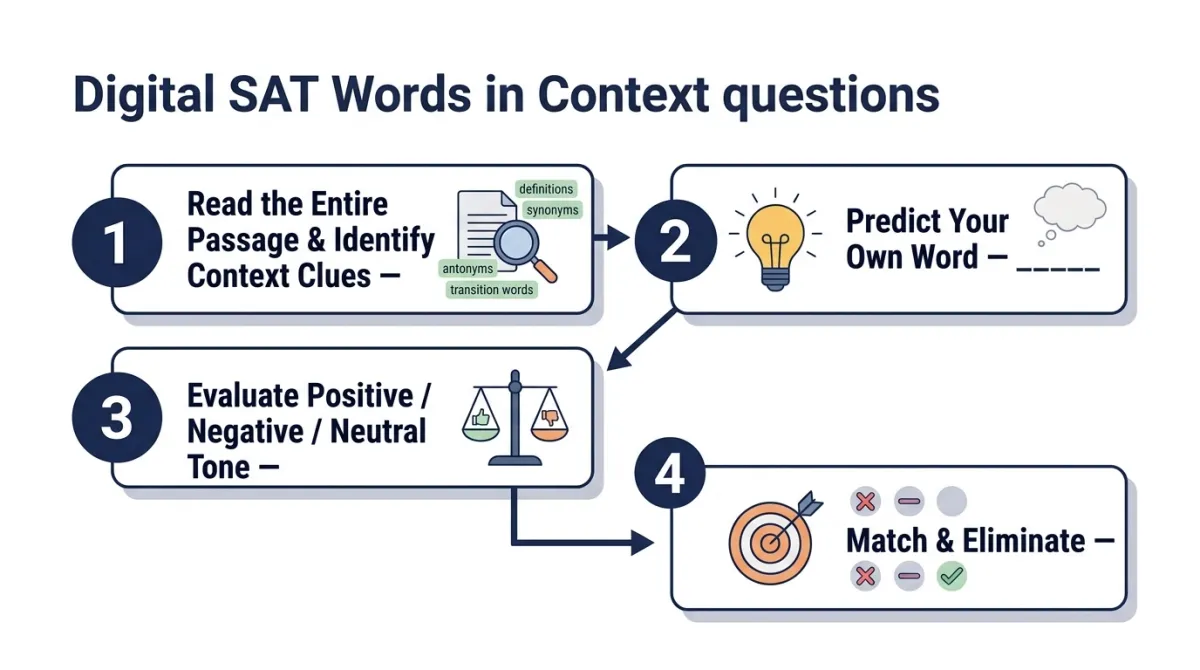
Để có thể đạt kết quả tốt với dạng bài Words in Context, người học có thể áp dụng các bước làm bài tham khảo sau:
Bước 1: Đọc toàn bộ đoạn văn và xác định các từ hoặc cụm từ khóa
Thay vì chỉ tập trung vào câu chứa khoảng trống hoặc từ gạch chân, người đọc cần xem xét chúng trong ngữ cảnh của toàn bộ đoạn văn. Tại bước này, người đọc thực hiện thao tác rà quét để tìm kiếm các "manh mối ngữ cảnh". Các manh mối này thường xuất hiện dưới dạng định nghĩa, sự diễn giải lại, từ đồng nghĩa hoặc từ trái nghĩa.
Bên cạnh đó, người đọc cũng cần chú ý đến các từ chuyển ý đóng vai trò báo hiệu logic cú pháp, bao gồm 3 nhóm chính: nhóm từ nối tiếp ý (also, furthermore), nhóm nguyên nhân - kết quả (because, therefore), và nhóm từ tương phản ( although, however).
Bước 2: Tự dự đoán từ của riêng mình
Trước khi nhìn vào các lựa chọn đáp án, người đọc tổng hợp các manh mối ngữ cảnh đã phân tích ở Bước 1 để tự suy luận ra một từ hoặc một cụm từ định nghĩa đơn giản nhất, sao cho vừa vặn với cấu trúc logic của câu.
Từ đó, người đọc có thể chọn từ khớp với chỗ trống hoặc từ đồng nghĩa với từ được gạch chân. Thao tác này giúp người đọc chủ động hơn trong câu trả lời, tránh bị phân tâm bởi các phương án được thiết kế để nghe có vẻ hợp lý nhưng thực chất sai lệch về ngữ cảnh.
Bước 3: Đánh giá sắc thái tích cực / tiêu cực
Trong trường hợp văn bản quá phức tạp và người đọc không thể dự đoán chính xác một từ cụ thể, người đọc cần chuyển sang chiến thuật đánh giá sắc thái ý nghĩa. Bằng cách dựa vào các từ tương phản hoặc từ nối, người đọc xác định xem từ cần điền mang sắc thái tích cực, tiêu cực hay trung tính. Sau khi gán nhãn sắc thái, người đọc đối chiếu với các phương án A, B, C, D và loại bỏ những từ mang sắc thái trái ngược với ngữ cảnh.
Bước 4: Ghép phương án vào câu và loại trừ
Người đọc đối chiếu các phương án với "từ dự đoán" ở Bước 2 để tìm ra lựa chọn tốt nhất. Trong quá trình ra quyết định, người đọc cần ghi nhớ nguyên tắc: từ đúng phải là từ logic và chính xác nhất, phù hợp với ngữ cảnh đã được cung cấp. Bên cạnh đó, người đọc cũng cần lưu ý cách kết hợp các từ để có thêm một yếu tố giúp xác nhận đáp án.
Từ vựng SAT chủ đề Change & Transformations
Có thể nói, trong quá trình học và tích lũy từ vựng SAT, người học sẽ tiếp nhận một khối lượng từ vựng học thuật đồ sộ. Do đó, để tránh rơi vào tình trạng học thiếu hệ thống, việc phân loại từ vựng SAT theo quy luật là điều rất cần thiết.
Có nhiều chiến lược khác nhau để phân loại từ vựng cho kỳ thi SAT. Người học có thể phân loại từ vựng theo lĩnh vực, theo độ khó của từ, hoặc theo độ khó của câu hỏi SAT chuẩn trong đó từ vựng được kiểm tra. Trong chuỗi bài viết về từ vựng SAT này, nhóm tác giả chọn cách phân loại theo chức năng của từ. Chức năng của từ có thể được phân loại thành 15 nhóm lớn. Một vài trong số đó bao gồm từ vựng miêu tả sự vận động và biến đổi, từ vựng miêu tả thái độ và cảm xúc, hoặc từ vựng miêu tả các giá trị đạo đức.
Trong các nhóm chức năng đó, nhóm Change & Transformation gồm các từ học thuật mô tả quá trình dịch chuyển, thích ứng và phát triển của các hiện tượng, sự việc hoặc ý tưởng trong ngữ cảnh học thuật. Nhóm từ vựng này giúp phản ánh các giai đoạn của một vận động:
Khởi đầu và tác động: Diễn tả sự xuất hiện của những phát hiện, năng lực mới hoặc hành động chủ động tách rời, ngắt kết nối khỏi các mô hình, quy chuẩn cũ để khởi đầu quá trình chuyển đổi.
Điều chỉnh và tiến hóa: Diễn tả sự biến động liên tục, sự phân tán nguồn lực hay dữ liệu, hoặc quá trình dịch chuyển ngữ cảnh, tái cơ cấu, định nghĩa lại bản chất và thay thế các mô hình lạc hậu bằng giải pháp tối ưu hơn.
Kết quả và trạng thái mới: Diễn tả trạng thái kết thúc, không còn hoạt động hay tồn tại của các lý thuyết, chính sách hoặc hệ thống cũ sau khi quá trình biến đổi hoàn tất.
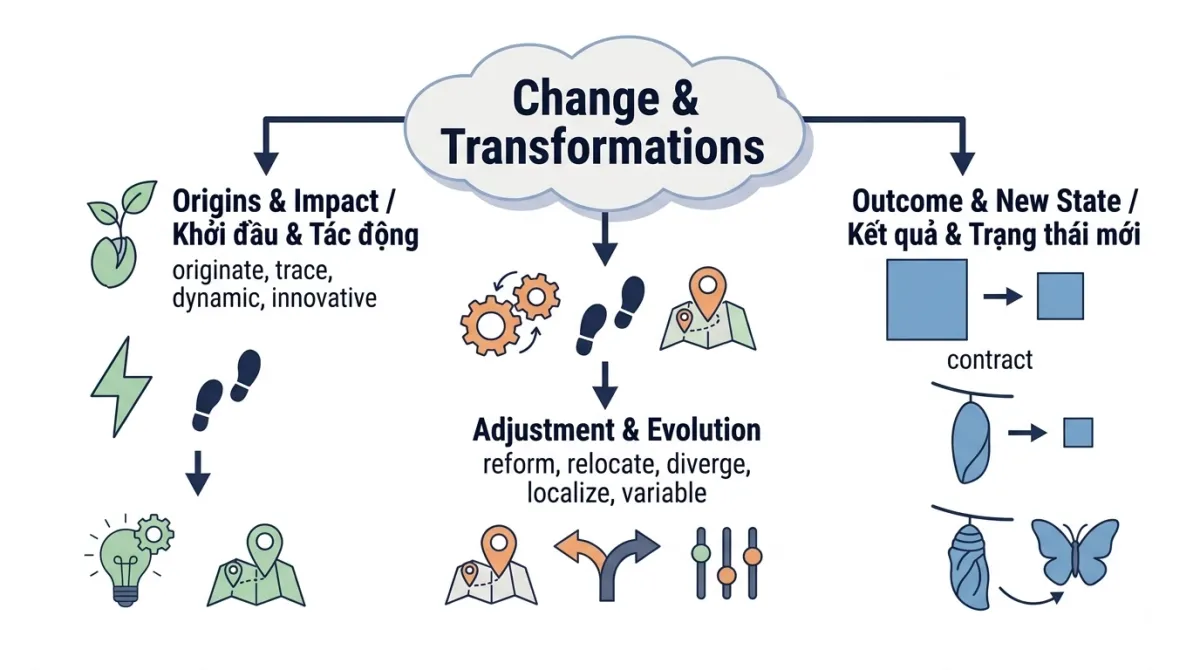
Dưới đây là một số từ vựng học thuật về chủ đề Change & Transformation thường được sử dụng trong các câu hỏi SAT Reading và Writing [2].
Words | IPA Pronunciation | Part of speech | Etymological analysis | Word family | Vietnamese meaning | Near synonyms | Common collocations | Example |
|---|---|---|---|---|---|---|---|---|
dynamic | /daɪˈnæmɪk/ | adj, n | Greek: dynamikos (powerful), from dynamis (power, force). | dynamics (n), dynamically (adv) | năng động, biến động, thay đổi liên tục | active, changing, flexible | dynamic environment dynamic relationship dynamic system | The technology sector operates in a dynamic environment, where companies must continuously adapt to changing consumer needs and emerging technologies. |
originate | /əˈrɪdʒɪneɪt/ | v | Latin: origo (beginning, source), from oriri (to rise, begin). | origin (n), original (adj), originally (adv), originality (n) | bắt nguồn, xuất phát, khởi nguồn | begin, arise, derive | originate from originate in originate a movement | The tradition is believed to originate from a small farming community in northern Vietnam. |
reform | /rɪˈfɔːrm/ | v, n | Latin: re- (again) + formare (to form, shape). | reformer (n), reformation (n), reformed (adj) | cải cách, cải tổ, sửa đổi | revise, restructure, transform | reform the education system implement reforms economic reform | The government introduced several measures to reform the education system and improve access to quality learning. |
relocate | /ˌriːləʊˈkeɪt/ | v | Latin: re- (again) + locare (to place), from locus (place). | relocation (n), relocated (adj), relocating (adj) | di dời, chuyển địa điểm, chuyển nơi ở/làm việc | move, transfer, resettle | relocate a business relocate to another city relocate operations | Rising production costs forced the company to relocate its manufacturing operations to a more affordable region. |
trace | /treɪs/ | v, n | Old French: tracier (to make a line or follow a path), from Latin tractus (a track/path). | tracing (n), traceable (adj), tracer (n), traceability (n), untraceable (a) | truy tìm, lần theo, dấu vết, truy nguyên | track, follow, identify | trace the origin of trace a connection trace back to | Researchers used historical documents to trace the origin of the city's rapid industrial development. |
innovative | /ˈɪnəveɪtɪv/ | adj | Latin: innovare (to renew, alter), from novus (new). | innovate (v), innovation (n), innovatively (adv), innovator (n) | đổi mới, sáng tạo, mang tính đổi mới | creative, pioneering, inventive | innovative approach innovative solution innovative technology | The researchers developed an innovative approach to reducing energy consumption in large-scale data centers. |
diverge | /daɪˈvɜːrdʒ/ | v | Latin: di- (apart) + vergere (to turn, bend). | divergence (n), divergent (adj), diverging (adj) | phân kỳ, khác nhau, đi theo hướng khác | differ, separate, deviate | diverge from a path diverge from expectations diverge significantly | The findings of the two studies diverged significantly because the researchers used different data collection methods. |
localize | /ˈləʊkəlaɪz/ | v | Latin: localis (of a place), from locus (place), + -ize (to make). | local (adj/n), localization (n), locally (adv), locality (n) | địa phương hóa, xác định vị trí, giới hạn trong một khu vực | adapt, regionalize, identify | localize a product localize content localize a problem | The software company decided to localize its products to better meet the language and cultural needs of Vietnamese users. |
variable | /ˈveəriəbəl/ | adj, n | Latin: variabilis (changeable), from variare (to change, alter). | vary (v), variation (n), variable (adj/n), variability (n), invariable (adj), variant (n) | biến đổi, biến số, không cố định | changing, fluctuating, inconsistent | variable factor dependent variable independent variable | Researchers controlled the temperature while measuring how this variable factor affected the chemical reaction. |
contract | /kənˈtrækt/ (v), /ˈkɒntrækt/ (n) | v | Latin: con- (together) + trahere (to draw, pull), meaning “draw together.” | contractual (adj), contractor (n), contracting (n/adj) | thu hẹp, co lại | shrink, reduce in size | begin to contract muscles contract contract rapidly | If a person is inactive for an extended period of time, muscles in the body might start to contract. |
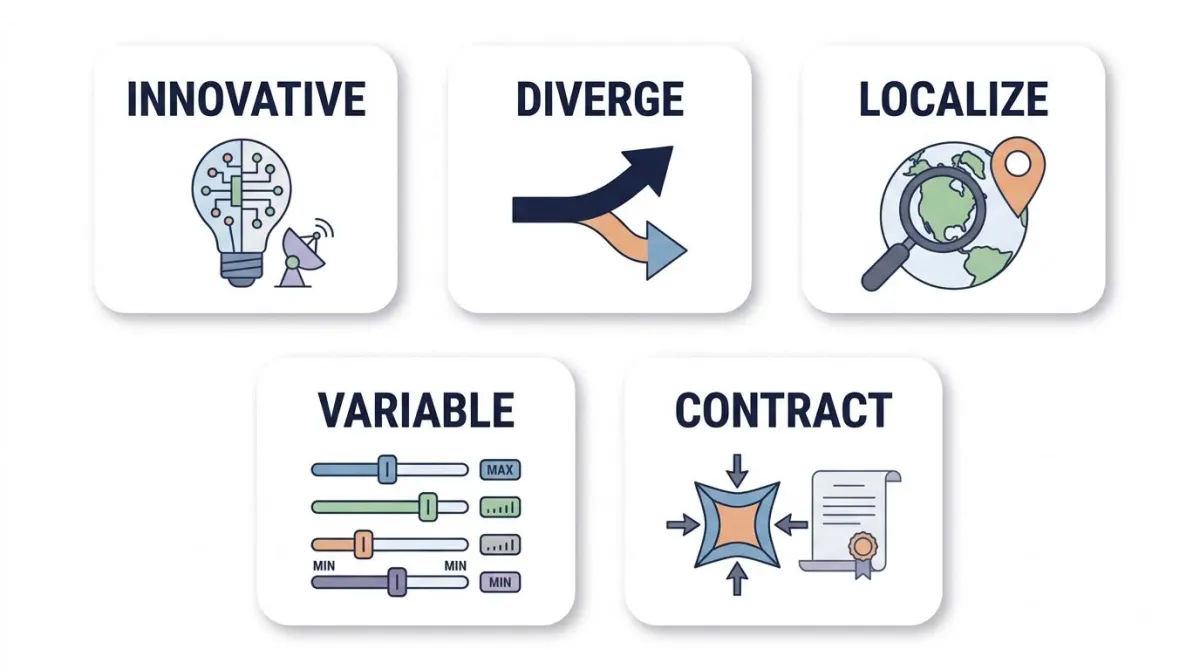
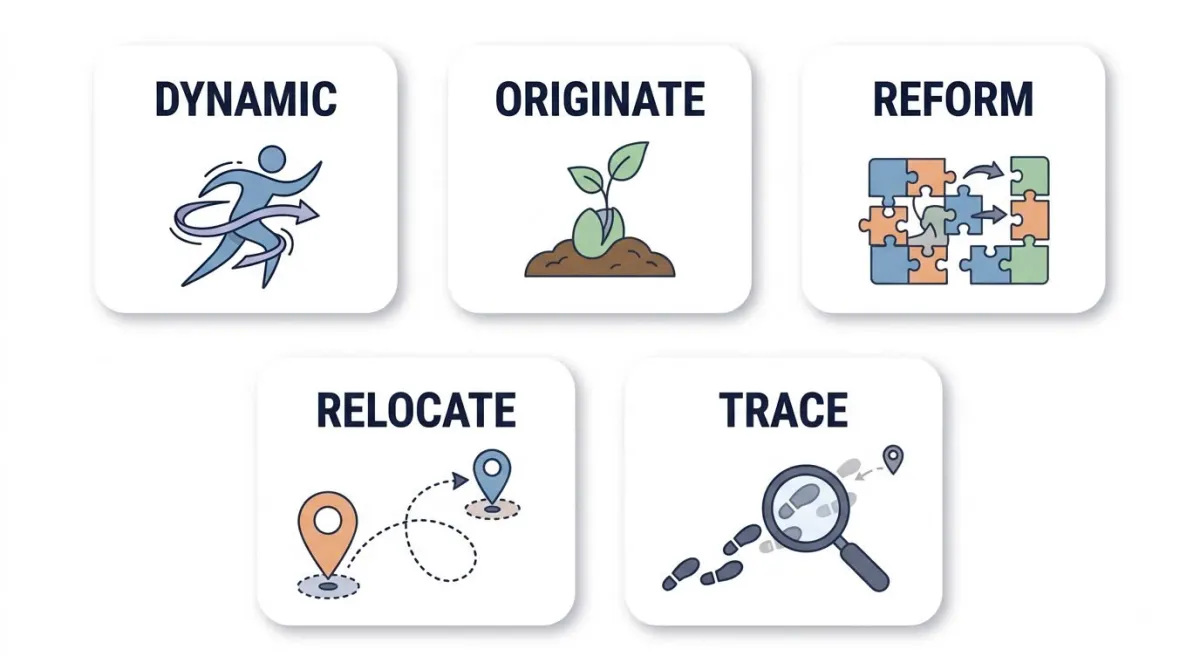
Xem thêm: Kinh nghiệm học và thi SAT hiệu quả cho người mới bắt đầu
Bài tập vận dụng
Sau đây là một số bài tập giúp người học luyện tập các từ vựng thuộc chủ đề Change & Transformations (Unit 4).
Exercise 1: Matching vocabulary & Word families to definitions
Match each word or word family form in Column A (1–10) with its correct definition in Column B (A–J).
1. Dynamic | A. to identify the source, development, or history of something by following evidence backward | |
2. Originate | B. involving new ideas, methods, or technologies that differ significantly from established approaches | |
3. Reform | C. a factor or quantity that can change and whose value may affect an outcome | |
4. Relocate | D. to move a person, organization, activity, or facility to a different place | |
5. Trace | E. to become smaller, narrower, or more limited; or to make something smaller | |
6. Innovative | F. to begin or develop from a particular source, place, or situation | |
7. Diverge | G. characterized by continuous change, activity, or interaction rather than remaining fixed | |
8. Localize | H. to adapt something so that it is appropriate for the conditions, language, or culture of a particular place | |
9. Variable | I. to change or improve an established system, institution, or practice rather than completely replace it | |
10.Contract | J. to develop in different directions or become increasingly different from one another |
Key: 1. G | 2. F | 3. I | 4. D | 5. A | 6. B | 7. J | 8. H | 9. C | 10. E
Exercise 2: Word Family Table
Complete the table by writing the correct noun (person/thing), verb, adjective, or adverb form of each target word. If no common form exists, write "—"
No. | Noun (Person/Thing) | Verb | Adjective | Adverb |
1 | __________ | __________ | dynamic | __________ |
2 | __________ | originate | __________ | __________ |
3 | __________ | __________ | reformed | __________ |
4 | __________ | relocate | __________ | __________ |
5 | __________ | trace | __________ | __________ |
6 | __________ | innovate | innovative | __________ |
7 | __________ | __________ | divergent | __________ |
8 | __________ | localize | __________ | __________ |
9 | __________ | vary | variable | __________ |
10 | __________ | contract | __________ | __________ |
Key:
No. | Noun (Person/Thing) | Verb | Adjective | Adverb |
1 | dynamics | — | dynamic | dynamically |
2 | origin / originator | originate | original | originally |
3 | reform / reformation / reformer | reform | reformed/ reforming | — |
4 | relocation | relocate | relocated | — |
5 | trace / tracing / tracer/ traceability | trace | traceable/ untraceable/ tracing/ traced | traceably |
6 | innovation / innovator | innovate | innovative | innovatively |
7 | divergence | diverge | divergent | — |
8 | localization/ locality | localize | localized/ local | locally |
9 | variation / variability/ variant | vary | variable/ invariable | variably |
10 | contract / contraction / contractor | contract | contractual | contractually |
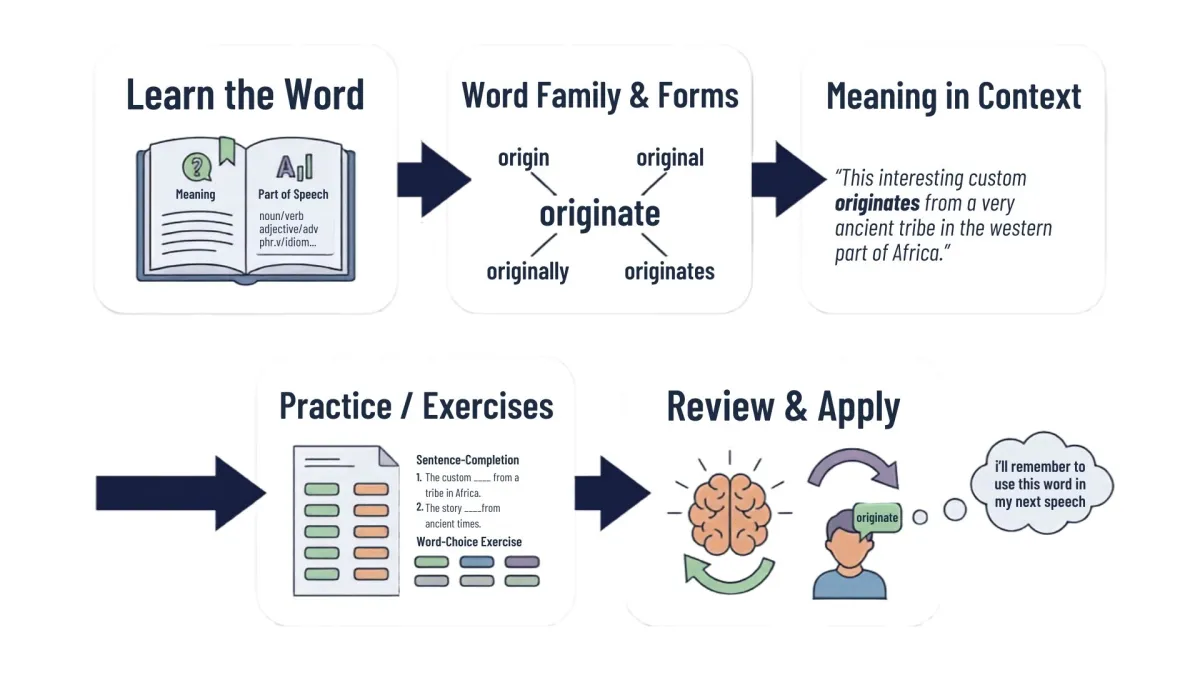
Exercise 3: Matching sentence halves
Match the first half of each sentence in Column A with its logically matching second half in Column B to complete the sentence.
1. Because the technology sector is highly dynamic, ... | A. ...so that it could operate more effectively in the cultural and linguistic context of the target market. | |
2. Archaeologists were able to trace the origin of the settlement ... | B. ...from a small community near the country's northern border. | |
3. The two researchers’ interpretations began to diverge… | C. ...which made it difficult to determine whether the observed effect was caused by temperature alone. | |
4. Rather than replacing the entire education system, the government decided to initiate a reform, ... | D. ...to a region where electricity and labor costs were substantially lower. | |
5. Due to increased financial pressure, the manufacturer decided to relocate its production facility ... | E. ...from archaeological evidence dating back more than three thousand years. | |
6. The researchers introduced several control variables, ... | F. ...upgrading the standard for educational facilities and renewing the textbook line-up. | |
7. The company developed an innovative AI chatbot... | G. ...the skills that employers require can change considerably over relatively short periods. | |
8. Historical evidence suggests that the custom originated ... | H. ...that is trained largely on localized data in Vietnam - something we have never seen before. | |
9. The researchers attempted to localize the software ... | I. ...and eventually became noticeably shorter than its original length. | |
10. As the temperature decreased, the metal began to contract, ... | J. ... as they analyzed the evidence from different theoretical perspectives. |
Key:
1–G (A dynamic sector experiences constant change, which explains why required skills change over short periods.)
2–E (Tracing the origin of a settlement refers to finding where or when it began, such as evidence dating back 3,000 years.)
3–J (For opinions to diverge means they split or move in different directions, which happens when using different theoretical perspectives.)
4–F (To reform a system means to improve it by updating and renewing its existing components.)
5–D (To relocate a facility means to move it to a different location, such as a region with lower costs.)
6–C (Setting control variables keeps non-target factors steady to ensure the observed effect comes strictly from the main variable.)
7–H (An innovative solution refers to a novel, groundbreaking development—like an AI chatbot trained on localized data—that hasn't been seen before.)
8–B (To originate means to begin or start in a specific place, such as a small community near a border.)
9–A (To localize software means to adapt it to fit the cultural and linguistic context of a specific target market.)
10–I (To contract physically means to shrink or become smaller, causing the metal to become shorter than its original length.)
Exercise 4: Word choice
For each sentence, choose the word that fits the context more precisely. Both choices may seem possible at first, so pay attention to the exact meaning and collocation.
1. The researchers wanted to determine whether the decline in bee populations was caused by a single environmental factor or by several interacting [ variables / fluctuations ].
2. Driven by rising operating costs, the firm decided to [ relocate from / dissipate ] its expensive city center offices to a lower-cost region.
3. Rather than creating custom solutions for each country, the multinational firm preferred to [ standardize / localize ] its operational processes across all global branches.
4. The engineering team created an [ innovative / intermittent ] design that significantly reduced the weight of the aircraft component without compromising strength.
5. The historian attempted to [ trace / diverge ] the origins of the ancient manuscript back to a small monastery in western Europe.
6. The administration announced plans to implement major structural [ reforms / variations ] to increase the transparency of the financial system.
7. The software was originally built for a Western audience, so the developers had to [ localize / originate ] the text and interface for Asian markets.
8. Because market conditions are so unpredictably [ dynamic / contractual ], tech companies must continually adapt their business strategies to stay solvent.
9. Anthropologists believe that the traditional harvesting ritual may have [ originated / contracted ] as part of a solar celebration thousands of years ago.
10. When exposed to extreme cold, the metal alloy began to [ contract / diverge ], causing a slight decrease in the overall size of the frame.
Key:
1. variables (Context refers to multiple interacting factors in a study; "fluctuations" refers to the movement or shifts themselves, not the causal elements.)
2. relocate from (Context refers to moving away from a specific location; "dissipate" means to scatter or disappear.)
3. standardize (Context describes making processes uniform globally rather than adapting them locally; "localize" means adapting for a specific area.)
4. innovative (Context refers to an advanced, novel design; "intermittent" means occurring at irregular intervals.)
5. trace (Context refers to tracking the origin or history of something back in time; "diverge" means to split or separate.)
6. reforms (Context refers to structural changes made to improve a system; "variations" refers to slight differences between things.)
7. localize (Context refers to adapting software features for a regional target market; "originate" means to begin or creation point.)
8. dynamic (Context describes a market that is constantly changing and fluid; "contractual" relates strictly to legal agreements.)
9. originated (Context refers to where or how a cultural tradition first began; "contracted" means shrank or tightened.)
10. contract (Context refers to a physical material shrinking due to temperature drop; "diverge" means to branch off or split.)
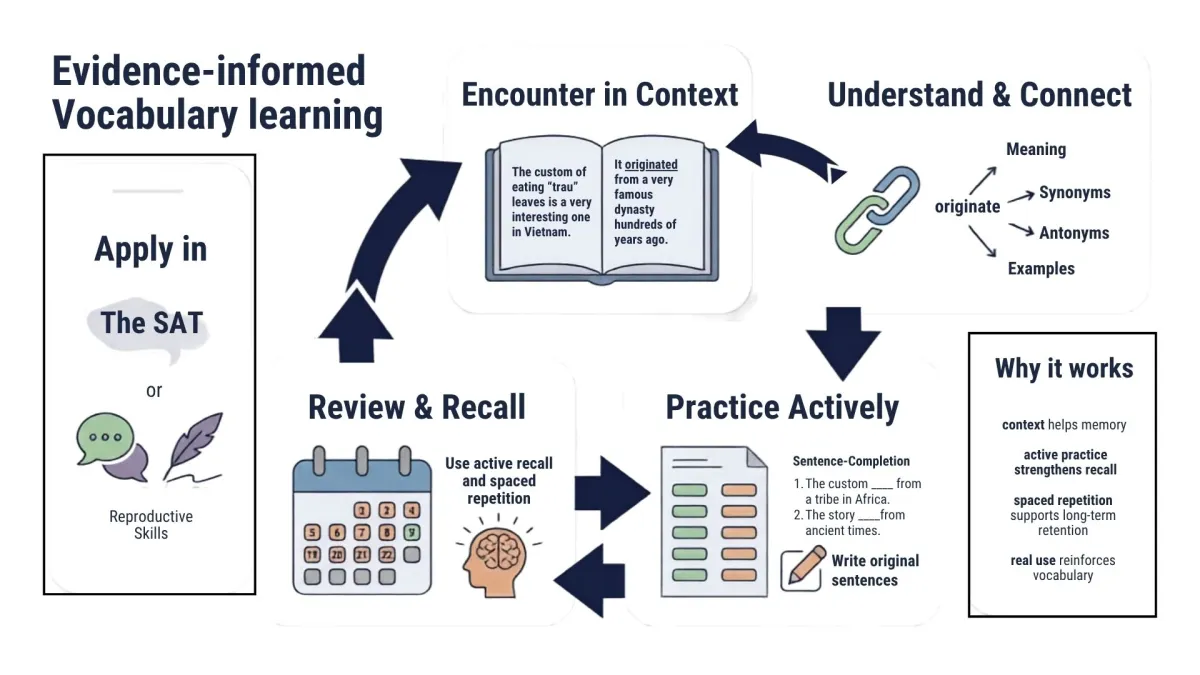
Gợi ý phương pháp học từ vựng hiệu quả
Để tiếp thu từ vựng một cách hiệu quả, người học cần xác định rõ mục tiêu học tập cũng như khả năng học tập của bản thân. Để hỗ trợ người học ôn luyện từ vựng hiệu quả, tác giả bài viết gợi ý phương pháp tự đánh giá để người học tự chọn hướng ôn tập phù hợp.
Xem thêm: Những phương pháp học từ vựng tiếng Anh hiệu quả
Để biết bản thân phù hợp với kiểu học từ vựng nào, người học cần đánh giá theo các tiêu chí sau: mục tiêu học tập, số lượng từ cần học, năng lực đầu vào, thời gian và mức độ cam kết.
Bản thân tác giả cho rằng cách học từ hiệu quả chính là học qua ngữ cảnh và học có lặp lại. Để đạt được hai điều này, người học cần thấy được cách dùng từ trong ngữ cảnh cụ thể, sau đó tìm cách để sử dụng từ trong các ngữ cảnh tương tự (đọc, viết, nói) để nắm rõ mục đích sử dụng từ. Người học cũng không nên chỉ học một lần mà cần phải nhắc lại và củng cố từ vựng.
Người học nên ôn lại từ mới mỗi 2-3 ngày để bù đắp cho phần trí nhớ ngắn hạn bị hao hụt. Nếu từ vựng được nhắc lại nhiều lần, kiến thức về từ sẽ được khắc sâu vào “kho từ vựng” của người học.
Xem thêm: Ưu và nhược điểm của việc học tập trung vào mục tiêu
Như vậy, bài viết SAT Vocab đã cung cấp cho người học một số từ vựng học thuật về chủ đề Change & Transformations, cùng một số bài tập luyện tập cơ bản để hỗ trợ người học ôn luyện. Việc học tập và ôn luyện cho kỳ thi Digital SAT không hề đơn giản và cần nhiều thời gian và nỗ lực. Hy vọng bài viết có thể hỗ trợ người học trong hành trình luyện tập và thi cử của bản thân.
Để xây dựng lộ trình học bài bản và đạt kết quả tốt nhất, học viên có thể tham khảo khóa học luyện thi SAT tại ZIM ngay hôm nay.
SAT® is a trademark registered by the College Board, which is not affiliated with, and does not endorse, this website.
- SAT Vocab Handbook - Từ vựng SAT theo chủ đề
- SAT® Vocab Handbook Unit 1: Từ vựng chủ đề Growth, Decline & Quantity
- SAT® Vocab Handbook Unit 3: Từ vựng chủ đề Change & Transformation
- SAT® Vocab Handbook Unit 4: Từ vựng chủ đề Growth, Decline & Quantity
- SAT® Vocab Handbook Unit 3: Từ vựng chủ đề Truth, Evidence & Proof
- SAT® Vocab Handbook Unit 2: Từ vựng chủ đề Truth, Evidence & Proof
- SAT® Vocab Handbook Unit 2: Từ vựng chủ đề Growth, Decline & Quantity
- SAT® Vocab Handbook Unit 5: Từ vựng chủ đề Knowledge, Learning & Thinking
- SAT® Vocab Handbook Unit 5: Từ vựng chủ đề Change & Transformation
- SAT® Vocab Handbook Unit 4: Từ vựng chủ đề Change & Transformation
- SAT® Vocab Handbook Unit 3: Từ vựng chủ đề Growth, Decline & Quantity
Tham vấn chuyên môn
Học là hành trình tích lũy kiến thức lâu dài và bền bỉ. Điều quan trọng là tìm thấy động lực và niềm vui từ việc học. Phương pháp giảng dạy tâm đắc: Lấy người học làm trung tâm, đi từ nhận diện vấn đề đến định hướng người học tìm hiểu và tự giải quyết vấn đề.
Nguồn tham khảo
1
“Digital SAT Suite of Assessments Technical Manual.” College Board , Accessed 14 August 2026.
2
“SAT Suite Question Bank..” College Board , https://satsuitequestionbank.collegeboard.org. Accessed 14 August 2026.
3
“The Official Digital SAT Study Guide.” College Board , Accessed 14 August 2026.
Bình luận - Hỏi đáp