IELTS Reading Concepts and Vocabulary Unit 13: Historical Events
Unit 13: Sự kiện Lịch sử tập trung vào các sự kiện quan trọng như Chiến tranh Nga-Ba Tư, Hiệp ước Turkmenchay và Chiến tranh Bán đảo với Napoleon. Người học sẽ khám phá các xung đột, hiệp ước và di sản lịch sử. Đơn vị này cung cấp từ vựng quan trọng để hiểu các đoạn văn IELTS Reading về sự kiện lịch sử, nhấn mạnh tác động của các sự kiện này đến các quốc gia và xã hội qua thời gian.
Về concept, chiến tranh Nga-Ba Tư và Hiệp ước Turkmenchay năm 1828 đã thay đổi biên giới Ba Tư, để lại di sản căng thẳng ở Nam Caucasus, cho thấy tầm quan trọng của các hiệp ước lịch sử. Chiến tranh Bán đảo đã đánh dấu sự suy tàn của Napoleon, với chiến thắng tại Vitoria năm 1813.
Unit này cũng đã cung cấp các từ vựng quan trong về lịch sử.
Sự kiện Lịch sử là những khoảnh khắc quan trọng trong quá khứ định hình thế giới chúng ta đang sống ngày nay, tập trung vào các cuộc chiến tranh, hiệp ước và cách mạng. Chúng bao gồm những thay đổi trong các quốc gia, xung đột và việc tạo ra những di sản lâu dài, ảnh hưởng đến xã hội qua thời gian. Đơn vị này sẽ giới thiệu cho bạn các từ vựng chính liên quan đến Sự kiện Lịch sử, điều này rất quan trọng để hiểu các đoạn văn IELTS Reading về chủ đề này. Hãy cùng khám phá các sự kiện lịch sử quan trọng!
Historical Events are significant moments in the past that shape the world we live in today, focusing on wars, treaties, and revolutions. They involve changes in nations, conflicts, and the creation of lasting legacies. This unit will introduce you to key vocabulary related to Historical Events, which is essential for understanding IELTS Reading passages on this topic.
Sự kiện Lịch sử là những khoảnh khắc quan trọng trong quá khứ định hình thế giới chúng ta đang sống ngày nay, tập trung vào các cuộc chiến tranh, hiệp ước và cách mạng. Chúng bao gồm những thay đổi trong các quốc gia, xung đột và việc tạo ra những di sản lâu dài. Bài học này sẽ giới thiệu cho bạn các từ vựng chính liên quan đến Sự kiện Lịch sử, điều này rất quan trọng để hiểu các đoạn văn IELTS Reading về chủ đề này.
Before You Read
Check (✓) your answers to these questions about Historical Events:
historical event
Have you ever visited a place where a famous historical event happened?
Yes
No
Do you like learning about wars or treaties from the past?
Yes
No
What might a treaty do after a war?
A. Start a new war
B. Bring peace
C. Build a school
D. Create a game
Which of these might tell us about a historical event?
A. A new movie
B. An old document
C. A fashion magazine
D. A cooking recipe
What is one reason people build monuments?
A. To sell them
B. To remember an event
C. To use them as homes
D. To grow plants
Part A. Reading
The Russo-Persian War and the Treaty of Turkmenchay
The Russo-Persian War
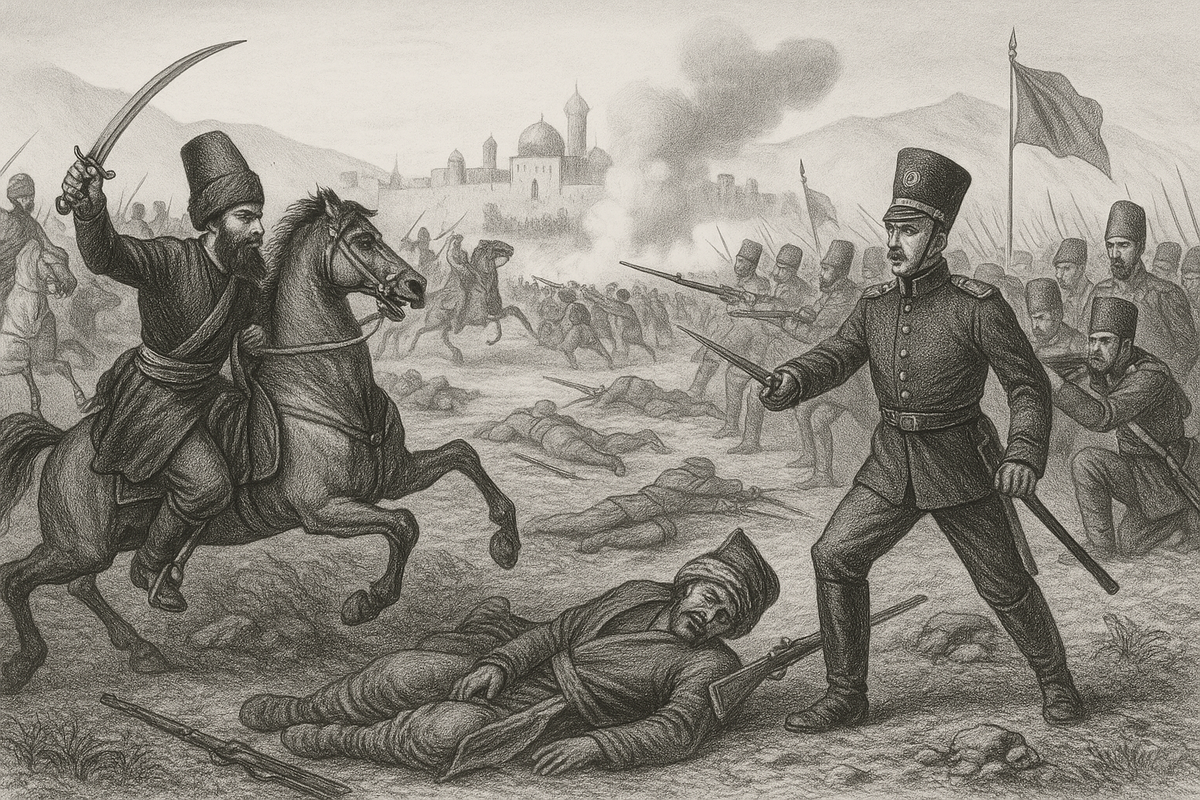
In 1826, a major war broke out between the Russian Empire and Qajar Persia, known as the Russo-Persian Conflict. This event took place in an era of tension after the Treaty of Gulistan in 1813, which had already caused fights over land in the South Caucasus. Persia, under Crown Prince Abbas Mirza, wanted to take back territories lost to Russia. They believed Russia was weak after a failed revolt called the Decembrist revolt. At first, Persia succeeded, capturing the city of Ganja and other areas, showing their determination to change the balance of power.
However, the war soon turned in Russia’s favor. General Ivan Paskevich led Russian soldiers to push back the Persian army, marking a significant change in the conflict. Through careful talks and military strength, Russia won key battles, such as the Battle of Ganja and the capture of Yerevan in 1827. By 1828, Russian soldiers reached Tabriz, Persia’s capital, forcing Persia to seek peace. Historical sources, like military letters, and evidence from the time, found in archives, show how Russia’s strategy led to victory. These records help us understand this important moment in history.
The treaty that ended the war, called the Treaty of Turkmenchay, was signed in 1828. It became a milestone in history, reshaping the borders of the nation of Persia. Persia had to give up large areas, including modern-day Armenia, Nakhchivan, and parts of Azerbaijan, to Russia. The document also forced Persia to pay a huge sum of money, aiming to suppress future conflicts. This treaty left Persia weaker, as recorded in historical archives, and many Persians felt ashamed by the loss of land and power.
The Treaty of Turkmenchay had a lasting impact on the region. It ended Persia’s reign over much of the Caucasus, creating a legacy of tension. Some monuments were built to remember the war, reflecting its importance. The treaty influenced new traditions of fighting back in Persia, as people sought to reclaim their pride. Although the treaty aimed for peace, it set the stage for future disputes. Its effects are still studied today, showing how historical events shape our world.
Exercise 1: Nối từ vựng với định nghĩa của nó. Viết ký hiệu A-H bên cạnh các từ vựng.
Words:
Definitions:
war
treaty
conflict
nation
peace
revolution
document
milestone
A. A written paper or record that gives information or proof. B. A country with its own government and people. C. A time when there is no fighting or war. D. A big fight or disagreement, often between groups or countries. E. An important event or achievement in history. F. A big change or uprising, often to change a government. G. A written agreement between countries to end a fight. H. A large fight between armies, often lasting a long time.
Exercise 2: Đọc đoạn văn về một sự kiện lịch sử dưới đây và chọn từ vựng thích hợp A, B, C, hoặc D được cho để điền vào chỗ trống.
The American Revolution was a significant (1) __________ in history. It began as a (2) __________ between the American colonies and Britain over taxes and rights. In 1776, the colonies declared independence, marking a new (3) __________ for the region. Leaders used (4) __________ to negotiate with other countries, like France, for support. The (5) __________ of the revolution was the creation of a new (6) __________, the United States. The war ended with a (7) __________ called the Treaty of Paris in 1783, which brought (8) __________ to the region.
a) change b) milestone c) tradition d) document
a) peace b) war c) conflict d) treaty
a) era b) nation c) reign d) monument
a) evidence b) diplomacy c) source d) legacy
a) impact b) archive c) revolution d) suppress
a) treaty b) nation c) conflict d) peace
a) war b) treaty c) milestone d) change
a) peace b) conflict c) era d) diplomacy
Exercise 3: Đọc bài văn sau để làm bài tập 3A và bài tập 3B bên dưới.
The Peninsular War and Napoleon’s Struggle
The Peninsular War was a major conflict that began in 1808, during Napoleon’s reign as leader of France. Napoleon wanted to suppress Spain and Portugal, two nations in the Iberian Peninsula, because they refused to follow his trade rules. He sent his army to invade, starting a long war that lasted until 1814. The French faced strong opposition from local people, who formed small fighting groups called guerrillas. These groups used surprise attacks to weaken Napoleon’s forces, creating a significant impact on the war’s outcome.
The Spanish and Portuguese, supported by Britain, fought back bravely. Britain sent soldiers under Arthur Wellesley, later known as the Duke of Wellington, to help. Together, they achieved a triumph at the Battle of Vitoria in 1813, a turning point that weakened Napoleon’s control. This campaign showed how teamwork between nations could defeat a powerful enemy. Historical documents, such as letters and maps, provide evidence of these events and are stored in archives today.
In 1814, the war ended with the Treaty of Paris, bringing peace to the region. Napoleon was forced to leave Spain and Portugal, marking a milestone in his downfall. The Peninsular War left a legacy of resistance in Spain, where people built monuments to honor their heroes. It also influenced traditions of independence in the region, as both nations rebuilt their identity. The war had a wider impact, weakening Napoleon’s empire and contributing to his final defeat in 1815. Historians use sources like diaries to study this era of change, showing how one war can shape the future of many nations.
Exercise 3A: Đọc bài văn về Peninsular War. Đối với mỗi từ được gạch chân, đoán nghĩa của từ vựng dựa trên ngữ cảnh của bài đọc.
Opposition from local people means: a) Support for the enemy b) Fighting against someone c) Building new cities d) Writing letters
Guerrillas in the war were: a) Large armies b) Small groups using surprise attacks c) Government leaders d) Peace negotiators
Triumph at the Battle of Vitoria refers to: a) A big victory b) A long journey c) A peace agreement d) A new law
Campaign in this context means: a) A political election b) A series of battles c) A school project d) A trade agreement
Downfall of Napoleon means: a) His rise to power b) His final defeat c) His new strategy d) His travel plans
Exercise 3B: Hoàn thiện sơ đồ dưới đây dựa vào thông tin từ bài đọc. Sử dụng KHÔNG QUÁ 3 TỪ từ bài đọc để điền vào chỗ trống.
The Peninsular War (1808–1814)
Napoleon invades Spain and Portugal
→ Local people form 1. ________ to fight back
→ Britain sends soldiers led by the 2. ________
→ A major 3. ________ happens at the Battle of Vitoria
→ The war ends with the 4. ________ in 1814
→ Napoleon faces his 5. ________
→ Spain builds 6. ________ to honor heroes
→ The war weakens Napoleon’s 7. ________
Exercise 4: Đọc lại bài đọc đầu tiên ở phần A. The Russo-Persian War and the Treaty of Turkmenchay. Chọn đáp án đúng nhất (A, B, C, hoặc D) cho mỗi câu hỏi.
What is a synonym for "conflict" as used in the passage? A) Agreement B) Fight C) Peace D) Treaty
What is a synonym for "milestone" in the context of the passage? A) Problem B) Event C) Failure D) Tradition
In the sentence "They believed Russia was weak after a failed revolt," what does "they" refer to? A) The Russian Empire B) Qajar Persia C) The South Caucasus D) General Ivan Paskevich
In the phrase "historical sources, like military letters," what does "historical sources" refer to? A) Modern books B) Old records C) Future predictions D) Personal opinions
Why did Persia start the war against Russia? A) To sign a new treaty B) To take back lost territories C) To build monuments D) To improve their army
What did the Treaty of Turkmenchay force Persia to do? A) Build new cities B) Pay Russia a large sum C) Join the Russian Empire D) Start another war
How do archives help us understand the war? A) They provide food recipes B) They store historical records C) They show future events D) They teach new languages
Which statement below is TRUE according to the passage? A) The Treaty of Turkmenchay brought lasting peace to the region. B) Russia lost the war against Persia. C) The war ended in 1828 with a treaty.
Part D. Key and Explanation
Exercise 1: Matching Definitions
war - H (A large fight between armies, often lasting a long time.) - chiến tranh
treaty - G (A written agreement between countries to end a fight.) - hiệp ước
conflict - D (A big fight or disagreement, often between groups or countries.) - xung đột
nation - B (A country with its own government and people.) - quốc gia
peace - C (A time when there is no fighting or war.) - hòa bình
revolution - F (A big change or uprising, often to change a government.) - cách mạng
document - A (A written paper or record that gives information or proof.) - tài liệu
milestone - E (An important event or achievement in history.) - cột mốc
Exercise 2: Gapped Short Paragraph - Cloze Test
milestone (cột mốc)
conflict (xung đột)
era (kỷ nguyên)
diplomacy (ngoại giao)
impact (tác động)
nation (quốc gia)
treaty (hiệp ước)
peace (hòa bình)
Exercise 3A: Guessing the Meaning of New Vocabulary
opposition - b) Fighting against someone (Sự phản kháng)
guerrillas - b) Small groups using surprise attacks (Du kích)
triumph - a) A big victory (Chiến thắng)
campaign - b) A series of battles (Chiến dịch)
downfall - b) His final defeat (Sự sụp đổ)
Exercise 3B: Flow Chart Completion
Local people form ________ to fight back →
Key: guerrillas
Vietnamese Explanation: Đáp án đúng là "guerrillas" (du kích), vì đoạn văn đề cập đến việc người dân địa phương thành lập các nhóm du kích để chống lại quân Pháp. Các lựa chọn khác như "armies" (quân đội lớn) hoặc "leaders" (lãnh đạo) không phù hợp vì không được nhắc đến trong ngữ cảnh này.
Britain sends soldiers led by ________ →
Key: the Duke of Wellington
Vietnamese Explanation: Đáp án đúng là "the Duke of Wellington" (Công tước Wellington), vì đoạn văn nói rằng Anh gửi binh lính dưới sự lãnh đạo của Arthur Wellesley, người sau này được gọi là Công tước Wellington. Các lựa chọn khác như "Napoleon" hoặc "local leaders" không đúng vì họ không lãnh đạo quân Anh.
A major ________ happens at the Battle of Vitoria →
Key: triumph
Vietnamese Explanation: Đáp án đúng là "triumph" (chiến thắng), vì đoạn văn mô tả rằng liên minh Tây Ban Nha, Bồ Đào Nha và Anh đã giành chiến thắng lớn tại trận Vitoria. Các lựa chọn khác như "defeat" (thất bại) hoặc "treaty" (hiệp ước) không phù hợp vì không phản ánh kết quả trận đánh.
The war ends with the ________ in 1814 →
Key: Treaty of Paris
Vietnamese Explanation: Đáp án đúng là "Treaty of Paris" (Hiệp ước Paris), vì đoạn văn nói rằng cuộc chiến kết thúc vào năm 1814 với Hiệp ước Paris. Các lựa chọn khác như "Battle of Vitoria" (trận đánh) hoặc "Napoleon’s invasion" (cuộc xâm lược của Napoleon) không phải là sự kiện kết thúc chiến tranh.
Napoleon faces his ________ →
Key: downfall
Vietnamese Explanation: Đáp án đúng là "downfall" (sự sụp đổ), vì đoạn văn nói rằng cuộc chiến đánh dấu sự sụp đổ của Napoleon, dẫn đến việc ông phải rời Tây Ban Nha và Bồ Đào Nha. Các lựa chọn như "victory" (chiến thắng) hoặc "rise" (sự nổi lên) không đúng vì không phản ánh kết quả của chiến tranh đối với Napoleon.
Spain builds ________ to honor heroes →
Key: monuments
Vietnamese Explanation: Đáp án đúng là "monuments" (đài tưởng niệm), vì đoạn văn đề cập rằng người Tây Ban Nha xây dựng các đài tưởng niệm để tôn vinh các anh hùng của họ. Các lựa chọn khác như "schools" (trường học) hoặc "bridges" (cầu) không được nhắc đến trong ngữ cảnh này.
The war weakens Napoleon’s ________ →
Key: empire
Vietnamese Explanation: Đáp án đúng là "empire" (đế chế), vì đoạn văn nói rằng cuộc chiến làm suy yếu đế chế của Napoleon, góp phần vào thất bại cuối cùng của ông vào năm 1815. Các lựa chọn khác như "army" (quân đội) hoặc "country" (quốc gia) không phù hợp vì không phản ánh quy mô ảnh hưởng đến quyền lực của Napoleon.
Exercise 4: Comprehension Questions Based on Part A
What is a synonym for "conflict" as used in the passage?
Key: B) Fight
Vietnamese Explanation: Đáp án đúng là "Fight" (cuộc chiến đấu), vì "conflict" trong đoạn văn đề cập đến cuộc chiến giữa Nga và Ba Tư, có nghĩa là một cuộc đấu tranh hoặc chiến đấu. "Agreement" (sự đồng ý) và "Peace" (hòa bình) là những ý nghĩa trái ngược, còn "Treaty" (hiệp ước) là kết quả của xung đột, không phải từ đồng nghĩa.
What is a synonym for "milestone" in the context of the passage?
Key: B) Event
Vietnamese Explanation: Đáp án đúng là "Event" (sự kiện), vì "milestone" trong đoạn văn ám chỉ Hiệp ước Turkmenchay là một sự kiện quan trọng trong lịch sử. "Problem" (vấn đề) và "Failure" (thất bại) mang nghĩa tiêu cực, không phù hợp, còn "Tradition" (truyền thống) không liên quan đến ý nghĩa của một sự kiện quan trọng.
In the sentence "They believed Russia was weak after a failed revolt," what does "they" refer to?
Key: B) Qajar Persia
Vietnamese Explanation: Đáp án đúng là "Qajar Persia" (Ba Tư Qajar), vì trong câu "They believed Russia was weak," "they" ám chỉ Ba Tư Qajar, những người nghĩ rằng Nga yếu sau cuộc nổi dậy Decembrist thất bại. "The Russian Empire" (Đế quốc Nga) là đối tượng được nhắc đến, không phải chủ thể tin tưởng. "The South Caucasus" (Nam Caucasus) và "General Ivan Paskevich" không phải là chủ ngữ của câu này.
In the phrase "historical sources, like military letters," what does "historical sources" refer to?
Key: B) Old records
Vietnamese Explanation: Đáp án đúng là "Old records" (hồ sơ cũ), vì "historical sources" như thư quân sự là các tài liệu cũ từ quá khứ. "Modern books" (sách hiện đại) và "Future predictions" (dự đoán tương lai) không phải là nguồn lịch sử, còn "Personal opinions" (ý kiến cá nhân) không được đề cập trong đoạn văn.
Why did Persia start the war against Russia?
Key: B) To take back lost territories
Vietnamese Explanation: Đáp án đúng là "To take back lost territories" (để giành lại lãnh thổ đã mất), vì đoạn văn nói rằng Ba Tư muốn lấy lại các vùng đất đã mất trước đó cho Nga. "To sign a new treaty" (ký hiệp ước mới) và "To build monuments" (xây đài tưởng niệm) không phải lý do khởi chiến, còn "To improve their army" (cải thiện quân đội) không được nhắc đến.
What did the Treaty of Turkmenchay force Persia to do?
Key: B) Pay Russia a large sum
Vietnamese Explanation: Đáp án đúng là "Pay Russia a large sum" (trả cho Nga một khoản tiền lớn), vì đoạn văn đề cập rằng hiệp ước buộc Ba Tư phải trả một khoản tiền lớn cho Nga. "Build new cities" (xây thành phố mới) và "Join the Russian Empire" (gia nhập Đế quốc Nga) không được đề cập, còn "Start another war" (bắt đầu một cuộc chiến khác) là ngược lại với mục tiêu của hiệp ước.
How do archives help us understand the war?
Key: B) They store historical records
Vietnamese Explanation: Đáp án đúng là "They store historical records" (chúng lưu trữ hồ sơ lịch sử), vì đoạn văn nói rằng các kho lưu trữ chứa bằng chứng như thư quân sự, giúp chúng ta hiểu về cuộc chiến. "They provide food recipes" (cung cấp công thức nấu ăn) và "They teach new languages" (dạy ngôn ngữ mới) không liên quan, còn "They show future events" (hiển thị sự kiện tương lai) không đúng với vai trò của kho lưu trữ.
Which statement below is TRUE according to the passage?
Key: C) The war ended in 1828 with a treaty.
Vietnamese Explanation: Đáp án đúng là "The war ended in 1828 with a treaty" (cuộc chiến kết thúc năm 1828 với một hiệp ước), vì đoạn văn nói rằng Hiệp ước Turkmenchay được ký năm 1828, kết thúc cuộc chiến. "The Treaty of Turkmenchay brought lasting peace" (Hiệp ước mang lại hòa bình lâu dài) là sai vì đoạn văn nói rằng nó dẫn đến các tranh chấp sau này. "Russia lost the war" (Nga thua cuộc chiến) và "Persia kept all its territories" (Ba Tư giữ tất cả lãnh thổ) là sai vì Nga thắng và Ba Tư mất lãnh thổ.
Unit 13 đã mang đến cái nhìn sâu sắc về Sự kiện Lịch sử, từ Chiến tranh Nga-Ba Tư và Hiệp ước Turkmenchay đến Chiến tranh Bán đảo với Napoleon. Bạn đã học các từ vựng quan trọng như xung đột, hiệp ước và di sản, giúp hiểu rõ hơn về tác động của các sự kiện lịch sử. Đồng thời, đơn vị nhấn mạnh vai trò của các nguồn lịch sử trong việc nghiên cứu quá khứ. Những kiến thức này sẽ hỗ trợ bạn đọc hiểu các đoạn văn IELTS về lịch sử một cách hiệu quả.
Triết lý giáo dục: "Không ai bị bỏ lại phía sau" (Leave no one behind). Mọi học viên đều cần có cơ hội học tập và phát triển phù hợp với mức độ tiếp thu và tốc độ học tập riêng của mình.







Bình luận - Hỏi đáp