

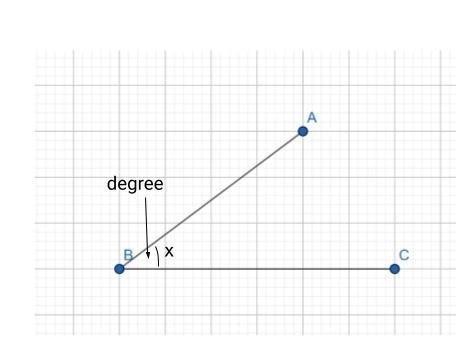
Degree được định nghĩa là độ, một đơn vị đo góc trong hình học, sử dụng nhiều trong SAT Math.
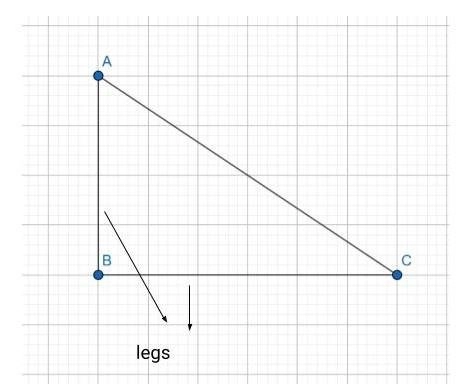
Legs trong hình học được hiểu là các cạnh góc vuông của một tam giác vuông
Essential Vocab for SAT® Math - Geometry and Trigonometry | Unit 27: Degree + Leg
Bài viết giới thiệu về định nghĩa 2 từ degree và leg trong phạm trù hình học của SAT Math cùng các bài tập ứng dụng từ vựng
Key takeaways
Trong Unit 27 của sách Essential Vocabulary for SAT Math - Geometry and Trigonometry, người học sẽ tìm hiểu về định nghĩa của 2 từ degree và leg trong hình học, qua đó ứng dụng từ vựng vào các dạng bài tập khác nhau.
Xem lại phần trước: Essential Vocabulary for SAT Math - Geometry and Trigonometry - Unit 26: right angle + associated angle
Degree (noun): độ
Nghĩa thông dụng: bằng cấp
Định nghĩa
Trong toán học, degree (kí hiệu là °) được hiểu là độ, là đơn vị đo thông dụng được dùng để xác định kích thước của một góc, dùng trong đo một góc phẳng. Đơn vị đo độ được dựa trên 1 vòng quay của hình tròn, với số đo tổng là 360 độ.
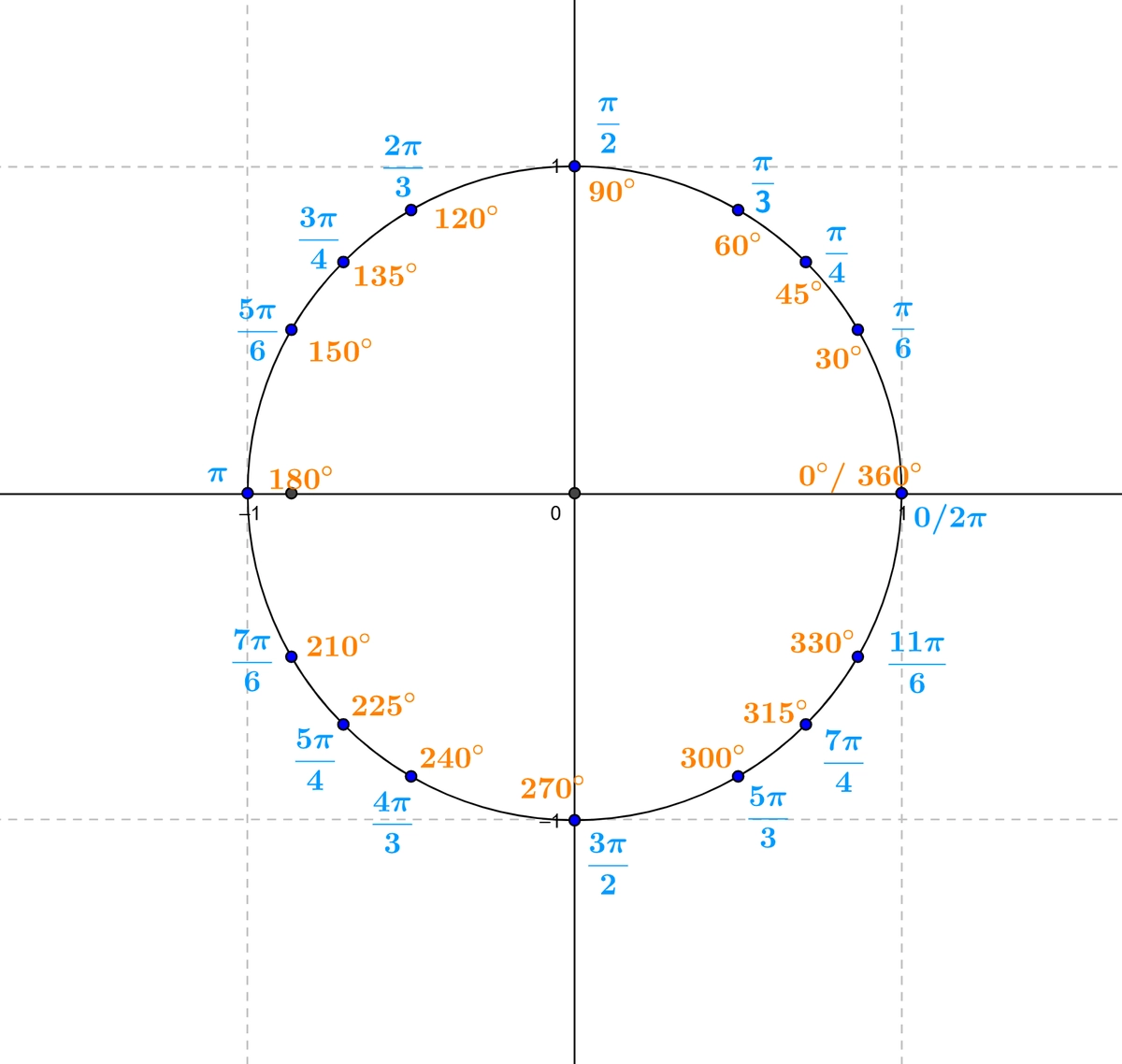
Góc 1 độ có thể được hiểu là 1/360 của một vòng quay hoàn chỉnh. Tương tự như thế, với số đo x độ sẽ tương đương với x/360 của một vòng quay.
Ngoài ra, degree được dùng để nói vê nhiệt độ của một số đơn vị như Celcius và Fahrenheit, được viết dưới dạng °C và °F.
Khái niệm liên quan
Radian (rad): Đơn vị đo chuẩn của góc trong hệ đơn vị chuẩn, với 1 vòng tròn tương đương với 2π rad.
Quy đổi tương đương từ độ sang radian:

Leg (noun): cạnh góc vuông
Nghĩa thông dụng: chân
Từ đồng nghĩa: cathetus
Định nghĩa
Trong toán học, leg được hiểu là cạnh góc vuông trong tam giác vuông, là 2 cạnh kề của góc vuông trong tam giác đó.
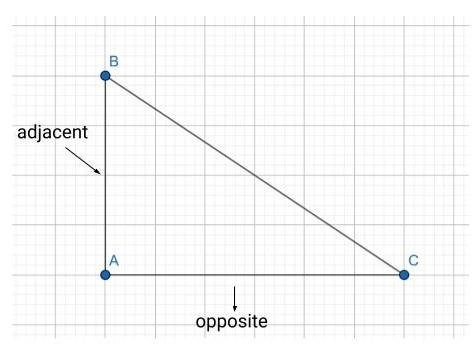
Phụ thuộc vào vị trí của góc đang được xét trong tam giác, một cạnh góc vuông có thể được xác định là đối (opposite) hoặc kề (adjacent). Đồng thời, dựa trên quy ước cạnh đối/kề và độ dài của các cạnh khác nhau, các legs sẽ tạo thành các cặp tỷ lệ khác nhau được gọi là tỷ số lượng giác (trigonometric ratio).
Trong hình dưới đây, xét góc B của tam giác ABC vuông tại A: Cạnh kề góc B sẽ là cạnh BA, trong khi cạnh đối là cạnh AC.
Trong trường hợp đặc biệt khi 2 cạnh góc vuông bằng nhau, tam giác đó trở thành một tam giác vuông cân.
Khái niệm liên quan
Trigonometric ratio: là các tỷ lệ giữa các cạnh của một tam giác vuông, liên quan đến một góc nhọn α trong tam giác đó. Trong đó có 4 tỷ số cơ bản như sau:
Sin (sine): là tỷ số giữa cạnh đối diện góc α và cạnh huyền.
Cos (cosine): là tỷ số giữa cạnh kề góc α và cạnh huyền.
Tan (tangent): là tỷ số giữa cạnh đối diện và cạnh kề.
Cot (cotangent): là tỷ số giữa cạnh kề và cạnh đối.
Công thức
Xét tam giác ABC vuông tại A , ta có thể tính được các cạnh góc vuông thông qua định lý Pytago:
\[AB^{^2}+AC^{^2}=BC^{^2}\]Ta có thể tính được cạnh góc vuông như sau:
\[AB=\sqrt{BC^{^2}-AC^{^2}}\]Xem thêm: Cách làm dạng bài Geometry and Trigonometry trong SAT Math
Kiểm tra từ vựng - degree
Which of the following best defines the term degree in geometry?
A. A unit used to measure the length of a line segment.
B. A unit used to measure the size of an angle, where a full circle is 360 degrees.
C. A mathematical term for the number of sides in a polygon.
D. A unit used to measure the area of a geometric figure.
Kiểm tra từ vựng - legs
Exercise 1: Which of the following best defines the term leg in geometry?
A. A side of any triangle that is opposite the largest angle.
B. A side of a triangle that is always equal in length to the hypotenuse.
C. One of the two sides that form the right angle in a right triangle.
D. A line segment that connects the midpoints of two sides of a triangle.
Exercise 2: Fill in the blanks with one of the following words: adjacent, opposite, legs
1. In a right triangle, the two sides that form the right angle are called the _________.
2. The side across from the angle in question is known as the _________ side.
3. The side next to the angle (but not the hypotenuse) is called the _________ side.
Bài toán thực tế - degree
Exercise 1: Person A is standing in a hallway and wants to see around a corner using a small mirror placed on the wall. She shines a flashlight toward the mirror at an angle of 40° from the normal (a line perpendicular to the mirror). She wants to know where the reflected light will go, given that the angle of incidence is equal to the angle of reflection.
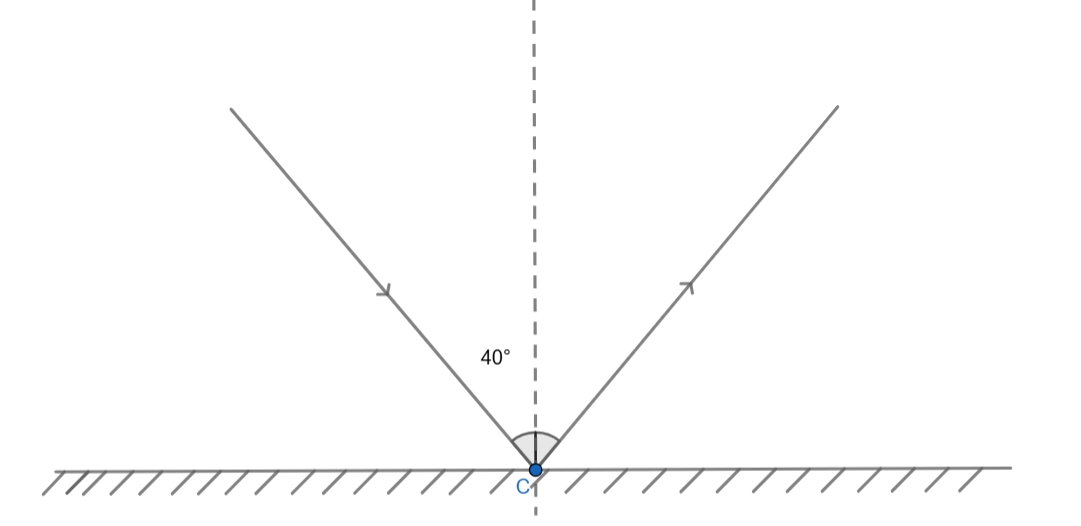
Determine the angle of reflection. What is the total angle between the incident ray and the reflected ray?
If the angle of incidence increases to 50°, what will be the new angle of reflection and the total angle between the two rays?
Exercise 2: A city planner is designing a wheelchair ramp for a new public building. The ramp needs to rise from the ground level to an entrance door that is 1.2 meters above the ground. The ramp must comply with safety regulations that require the incline angle to be no steeper than 12 degrees.
Calculate the angle of elevation of the ramp if it is 6 meters long and rises 1.2 meters. Does the ramp meet the safety regulation of an angle no steeper than 12°?
If the city planner wants to design a ramp that rises 1.2 meters and has a length of 7 meters, what would be the angle of elevation?
Bài toán thực tế - leg
Exercise 1: A drone was observed flying from a rooftop to a point on the ground. Investigators model the flight path as a right triangle, where the horizontal leg from the building to the landing point is 15 meters, and the vertical leg from the rooftop to the ground is 9 meters.
What is the angle of descent of the drone relative to the ground? Express your answer in degrees, rounded to the nearest whole number.
Calculate the length of the drone’s flight path. If the drone’s battery allows it to fly a maximum of 20 meters in a straight line, would it have been able to complete the flight path? Round the number to the nearest tenth.
Suppose the drone had descended at a 45° angle instead, while still dropping the same vertical distance of 9 meters. How far from the building would it have landed in that case? Round the number to the nearest tenth.
Exercise 2: A forensic scientist is reconstructing a shooting scene. The bullet entered and exited a wall, and its path can be modeled as a right triangle ABC in the picture below. The horizontal leg of the triangle is 10 inches. The vertical leg is 12.8 inches.
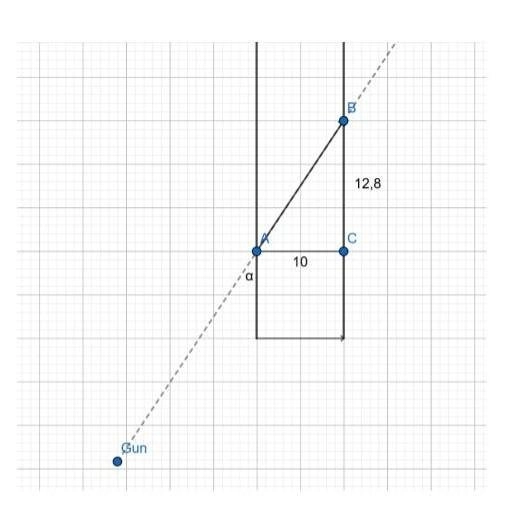
Calculate the measure of the shooting angle α. Round your answer to the nearest whole number.
Suppose the forensic team wants to simulate the bullet’s path using a laser beam. If the laser must follow the same angle as the bullet, what is the minimum length of the laser beam needed to span the diagonal path through the wall?
Đáp án - degree
Exercise 1: 1. 40°, 80°; 2. 50°, 100°
Exercise 2: 1. 11.54°, Yes; 2. 9.87°.
Đáp án - leg
Exercise 1: C
Exercise 2: legs, opposite, adjacent.
Exercise 1: 1. 31°; 2. 17.5m (It would have been able to complete the flight path); 3. 9m.
Exercise 2: 1. 38°; 2. 16.24 inches.
Kết luận
Unit trên đã tổng kết lại đến người học về định nghĩa của 2 từ degree và leg khi sử dụng trong SAT Math. Người học hãy ôn luyện tại nhà thông qua các dạng bài tập khác nhau.
Với định hướng học thông minh, tài liệu Think in SAT Digital Math và chương trình luyện thi SAT tại ZIM được thiết kế nhằm giúp học sinh phát triển tư duy theo chiều sâu, nắm chắc bản chất khái niệm, đồng thời luyện tập qua các ngữ cảnh sát thực tế. Qua đó, người học không chỉ làm tốt bài thi mà còn hình thành kỹ năng tư duy toán học bền vững.
SAT® is a trademark registered by the College Board, which is not affiliated with, and does not endorse, this website.
- Essential Vocabulary for SAT Math - Geometry and Trigonometry
- Essential Vocab for SAT® Math - Geometry and Trigonometry | Unit 18: Equilateral triangle + Perimeter
- Essential Vocab for SAT® Math - Geometry and Trigonometry | Unit 12: Cone + Inscribe
- Essential Vocab for SAT® Math - Geometry and Trigonometry | Unit 11: Trapezoid + Cube
- Essential Vocab for SAT® Math - Geometry and Trigonometry | Unit 7: Area + Prism
- Essential Vocab for SAT® Math - Geometry and Trigonometry | Unit 26: Right angle + Associated angle
- Essential Vocab for SAT® Math - Geometry and Trigonometry | Unit 10: Cylinder + Similar
- Essential Vocab for SAT® Math - Geometry and Trigonometry | Unit 1: Measure + Length
- Essential Vocab for SAT® Math - Geometry and Trigonometry | Unit 16: Arc + Congruent
- Essential Vocab for SAT® Math - Geometry and Trigonometry | Unit 9: Sphere + Altitude
- Essential Vocab for SAT® Math - Geometry and Trigonometry | Unit 14: Perpendicular + Adjacent angles
Tham vấn chuyên môn
Học là hành trình tích lũy kiến thức lâu dài và bền bỉ. Điều quan trọng là tìm thấy động lực và niềm vui từ việc học. Phương pháp giảng dạy tâm đắc: Lấy người học làm trung tâm, đi từ nhận diện vấn đề đến định hướng người học tìm hiểu và tự giải quyết vấn đề.
Bình luận - Hỏi đáp