

Perpendicular là hai đường thẳng cắt nhau tại góc vuông 90°, thường gặp trong tam giác vuông, định lý Pythagoras, và biểu thức đường thẳng có slope âm nghịch đảo.
Adjacent angles là hai góc nằm cạnh nhau, có chung đỉnh và cạnh, không chồng lấn. Khái niệm này giúp xác định mối quan hệ giữa các góc trong sơ đồ hoặc bài toán hình học.
Essential Vocab for SAT® Math - Geometry and Trigonometry | Unit 14: Perpendicular + Adjacent angles
Bài học làm rõ hai khái niệm thường gặp trong SAT Math là perpendicular và adjacent angles, thuộc nhóm kiến thức Geometry và Trigonometry.
Key takeaways
Trong hình học, đặc biệt là phần Geometry của SAT Math, perpendicular và adjacent angles là hai khái niệm quen thuộc. Việc nắm chắc chúng lại là chìa khóa để xử lý hiệu quả các bài toán về góc, tam giác vuông và các biểu thức liên quan đến đường thẳng trong hệ trục tọa độ. Thông qua bài học hôm nay, người đọc sẽ có thể nhận diện đúng các mối quan hệ giữa góc, từ đó chinh phục được các bài toán Digital SAT một cách trơn tru hơn.
Xem lại phần trước: Essential Vocabulary for SAT Math - Geometry and Trigonometry - Unit 13: rectangle + parallel
Perpendicular (adjective): vuông góc
Định nghĩa
Trong hình học, perpendicular (vuông góc) là hai đường thẳng giao nhau tại một góc 90°. Góc này còn được gọi là right angle (góc vuông). Khi hai đường thẳng vuông góc, ta ký hiệu: AB ⊥ CD, nghĩa là đường thẳng AB vuông góc với CD.
Tính chất cần nhớ
Hai đường vuông góc luôn cắt nhau tại một điểm.
Góc tạo bởi hai đường vuông góc luôn bằng 90°.
Trong toán SAT, người học sẽ thường gặp khái niệm perpendicular khi làm việc với các bài toán liên quan đến
Đường thẳng có slope âm nghịch đảo.
Tính các góc trong tam giác vuông sử dụng Sin, Cos, Tan, Cotan.
Áp dụng định lý Pythagoras để tìm độ dài cạnh.
Làm việc với góc vuông trong biểu đồ tọa độ.
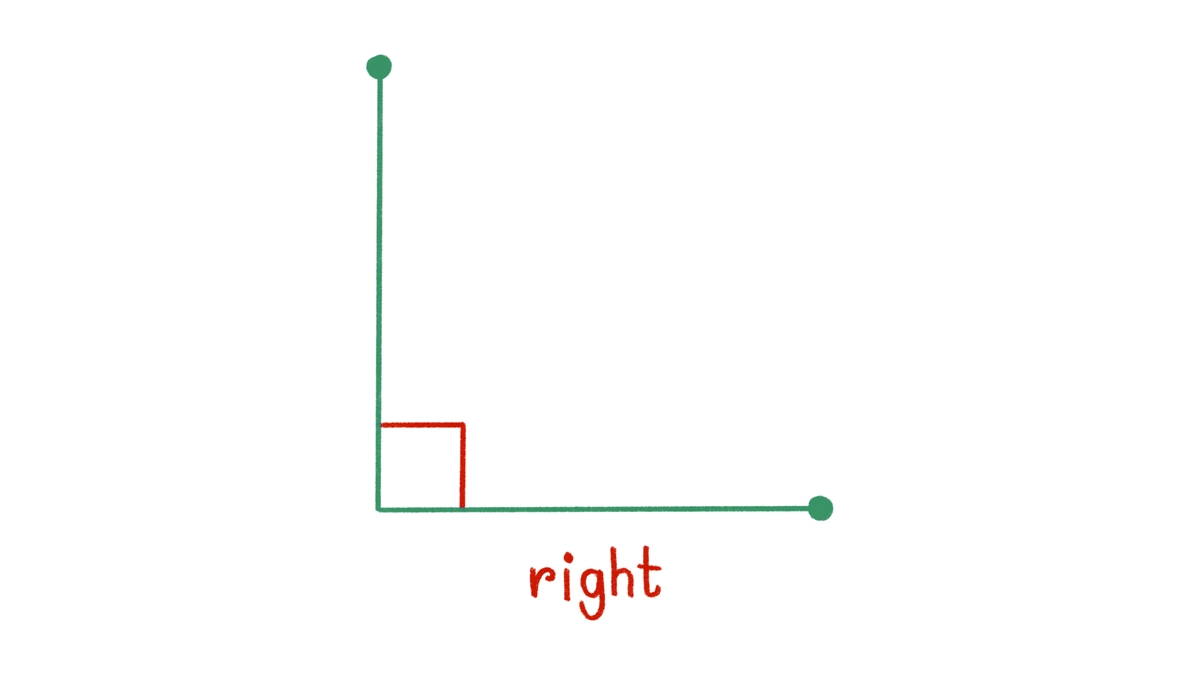
Hình minh họa
Xem thêm: Cách làm dạng bài Geometry and Trigonometry trong SAT Math
Adjacent angles (noun): góc kề nhau
Định nghĩa
Thuật ngữ "adjacent angles" (góc kề nhau) dùng để chỉ hai góc nằm cạnh nhau, cùng xuất phát từ một đỉnh chung và chia sẻ một cạnh chung. Tuy nhiên, phần còn lại của mỗi góc không trùng nhau và không chồng lấn.
Như vậy Adjacent angles (góc kề nhau) có 3 đặc điểm chính sau:
Cùng chung đỉnh (common vertex).
Cùng chung một cạnh (common arm/ side).
Không chồng lên nhau.
Trong hình học, adjacent angles thường xuất hiện khi hai tia xuất phát từ một điểm chia mặt phẳng thành hai phần liền kề, mỗi phần là một góc. Đây là một trong những mối quan hệ góc cơ bản và quan trọng trong các bài toán dựng hình và chứng minh.
Một số lưu ý thú vị về góc kề nhau:
Hai góc kề nhau luôn có một đỉnh chung và một cạnh chung, nhưng phần còn lại không trùng nhau.
Chúng có thể tạo thành một góc bù (180°) hoặc góc phụ (90°) nếu tổng số đo hai góc tương ứng bằng 180° hoặc 90°. Người đọc sẽ được tìm hiểu hai định nghĩa này ở những bài sau.
Không phải mọi cặp góc đứng gần nhau đều là góc kề nhau, nếu chúng chồng lên hoặc không chung đỉnh, thì không thoả định nghĩa.
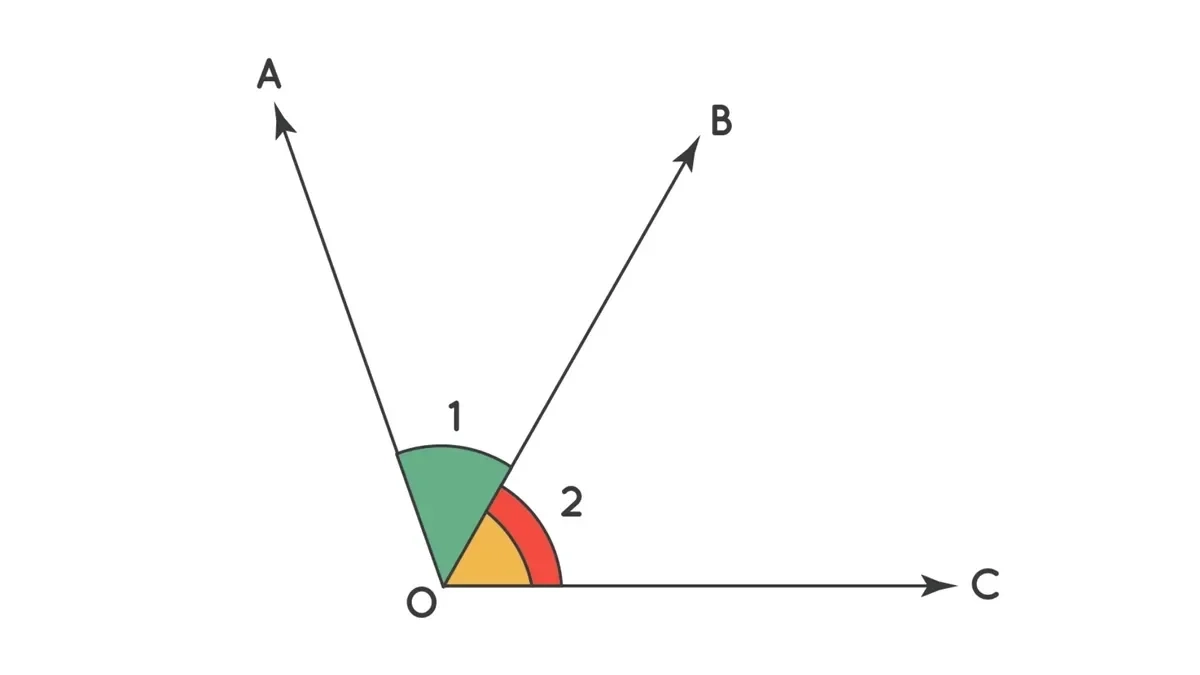
Hai góc kề nhau
Kiểm tra từ vựng - perpendicular
Exercise 1: Matching terms with their definition
Term | Definition |
1. Perpendicular | A. An angle that measures exactly 90° |
2. Right angle | B. Lines that intersect at 90° |
3. Intersect | C. To meet or cross each other |
4. Acute angle | D. An angle less than 90° |
Exercise 2: Write "Yes" if the two objects are perpendicular to each other. Write "No" if they are not.
The Leaning Tower of Pisa tilts 4 degrees compared to the ground.
→ ______A student holds a pencil at a 60° angle to the notebook while writing. Is the pencil perpendicular to the notebook?
→ ______The corner of a rectangular whiteboard forms a right angle. Are the two sides forming this angle perpendicular to each other?
→ ______A flagpole standing straight up on flat ground. Is the flagpole perpendicular to the ground?
→ ______The hands of a clock show 3:00. Are the minute and hour hands perpendicular at this time?
→ ______
Bài toán thực tế - Perpendicular
Exercise 1: A carpenter installs a shelf, ensuring it is perpendicular to the wall.
Questions:
What is the angle in degrees between the shelf and the wall?
A right-angled support brace has two sides forming the right angle that are 30 cm and 40 cm long. What is the length of the third side (the hypotenuse)?
Exercise 2: A 10-meter ladder leans against a vertical wall. The wall is perpendicular to the ground. The base of the ladder is 6 meters from the wall.
Questions:
What geometric shape is formed by the ladder, the wall, and the ground?
How high up the wall does the top of the ladder reach in meters?
Exercise 3: In the coordinate plane, point A is located at (2, 3), and point B is located at (6, 7). Line segment AB is extended. Point C lies somewhere such that line segment AC is perpendicular to AB and has the same length as AB. Find one possible set of coordinates of point C.
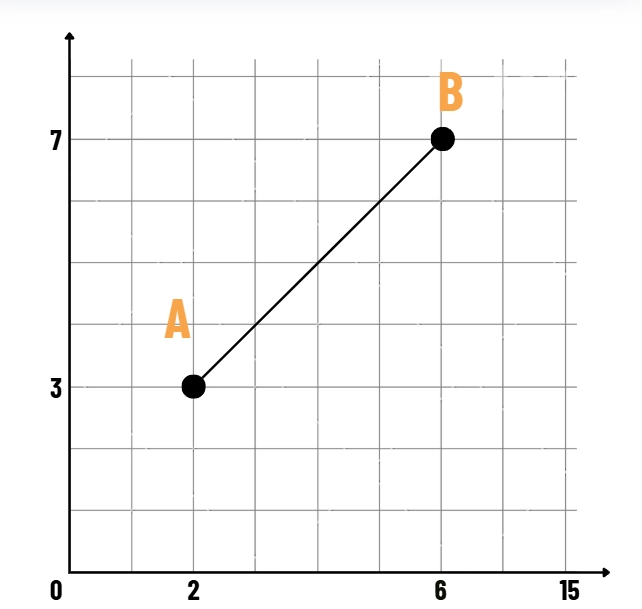
Kiểm tra từ vựng - Adjacent angles
Exercise 1: Write Yes if the pair of angles is adjacent. Write No if they are not. Write Not Given if the situation is not clear to give a conclusion.
Two angles share a common vertex and a common side, and they don’t overlap.
→ _____
Angles ∠ABC and ∠CBD have a common ray BC and share a vertex B.
→ _____
Angles formed by opposite rays (like vertical angles)
→ _____
Angles ∠1 and ∠2 sit side by side and do not overlap.
→ _____
Two angles are on different planes but have the same measure.
→ _____
Exercise 2: Fill in the blank with one of these words: adjacent, overlap, vertex, arm, side
Adjacent angles must have a common __________, a point where their sides meet.
They share a common __________ and do not __________.
The non-common __________ of each angle lie on opposite sides.
If two angles lie next to each other without overlapping, they are __________ angles.
Bài toán thực tế - Adjacent angles
Exercise 1:
A straight line is divided into three adjacent angles by two rays:
Angle 1 = 45°,
Angle 2 = x°,
Angle 3 = 75°
If all three are adjacent and lie on the same straight line, what is the value of x?
Exercise 2: At exactly 3:00, the minute and hour hands of a clock form a right angle. If a third hand (second hand) is pointing directly between them, how many adjacent angles are formed, and what is their relationship?
Exercise 3: Imagine a pizza that has been cut exactly in half, forming a straight line (180 degrees) across the center. You then make one more cut from the center to the edge, dividing one of the halves into two unequal slices. These two new slices form adjacent angles.
Question: If the smaller slice has an angle of 60 degrees, what is the angle of the larger slice next to it?
Đáp án - Perpendicular
Exercise 1
B
A
C
D
Exercise 2
No (the tower is tilted; its vertical axis doesn’t form a 90° angle with the ground.)
No (Perpendicular means 90°, but 60° is not a right angle)
Yes
Yes
Yes
Exercise 1
90 degrees
Calculate the length using the Pythagorean theorem:
\[\sqrt{30^2+40^2}=\sqrt{900+1600}=\sqrt{2500}=50\operatorname{\mathrm{cm}}\]Exercise 2
A right triangle: The ladder, wall, and ground form the three sides, with a 90-degree angle between the wall and ground.
8 meters: The height is a leg of the right-angled triangle. We use the Pythagorean theorem, solving for the unknown side.
Exercise 3
AB = (6–2, 7–3) = (4, 4)
Vector perpendicular to AB = (−4, 4) or (4, −4)
Length of AB = √(4² + 4²) = √32
One possible vector: (−4, 4)
Coordinates of C = A + (−4, 4) = (2 − 4, 3 + 4) = (−2, 7)
Answer: C = (−2, 7)
Đáp án - Adjacent angles
Exercise 1
Yes
NG (we are not sure whether A lies on BD or not)
No
NG (we are not sure whether they have the same vertex)
No
Exercise 2
vertex
arm, overlap
side
adjacent
Exercise 1:
45° + x + 75° = 180° → x = 60°.
Exercise 2
2 adjacent angles
They all share a common vertex (clock center) and common sides (clock hands).
Their sum is 90°, so the two adjacent angles are complementary angles (angles that add up to 90 degrees).
Exercise 3:
The two angles are adjacent, and together they form a straight line, which is always 180 degrees. Therefore, you subtract the known angle from 180 to find the unknown angle: 180° - 60° = 120°.
Việc thành thạo perpendicular và adjacent angles không chỉ giúp củng cố kiến thức hình học nền tảng mà còn hỗ trợ người học xử lý nhanh các bài toán góc, tọa độ và tam giác trong SAT Math. Hi vọng bài viết hôm nay sẽ là bước đệm quan trọng để người đọc tự tin chinh phục các dạng bài Geometry & Trigonometry với độ chính xác và tốc độ cao hơn.
Tham khảo chương trình luyện thi SAT cam kết đầu ra tại ZIM Academy để được hướng dẫn chuyên sâu và bứt phá điểm số.
SAT® is a trademark registered by the College Board, which is not affiliated with, and does not endorse, this website.
- Essential Vocabulary for SAT Math - Geometry and Trigonometry
- Essential Vocab for SAT® Math - Geometry and Trigonometry | Unit 18: Equilateral triangle + Perimeter
- Essential Vocab for SAT® Math - Geometry and Trigonometry | Unit 12: Cone + Inscribe
- Essential Vocab for SAT® Math - Geometry and Trigonometry | Unit 11: Trapezoid + Cube
- Essential Vocab for SAT® Math - Geometry and Trigonometry | Unit 7: Area + Prism
- Essential Vocab for SAT® Math - Geometry and Trigonometry | Unit 26: Right angle + Associated angle
- Essential Vocab for SAT® Math - Geometry and Trigonometry | Unit 10: Cylinder + Similar
- Essential Vocab for SAT® Math - Geometry and Trigonometry | Unit 1: Measure + Length
- Essential Vocab for SAT® Math - Geometry and Trigonometry | Unit 16: Arc + Congruent
- Essential Vocab for SAT® Math - Geometry and Trigonometry | Unit 9: Sphere + Altitude
- Essential Vocab for SAT® Math - Geometry and Trigonometry | Unit 14: Perpendicular + Adjacent angles
Tham vấn chuyên môn
Học là hành trình tích lũy kiến thức lâu dài và bền bỉ. Điều quan trọng là tìm thấy động lực và niềm vui từ việc học. Phương pháp giảng dạy tâm đắc: Lấy người học làm trung tâm, đi từ nhận diện vấn đề đến định hướng người học tìm hiểu và tự giải quyết vấn đề.
Bình luận - Hỏi đáp