


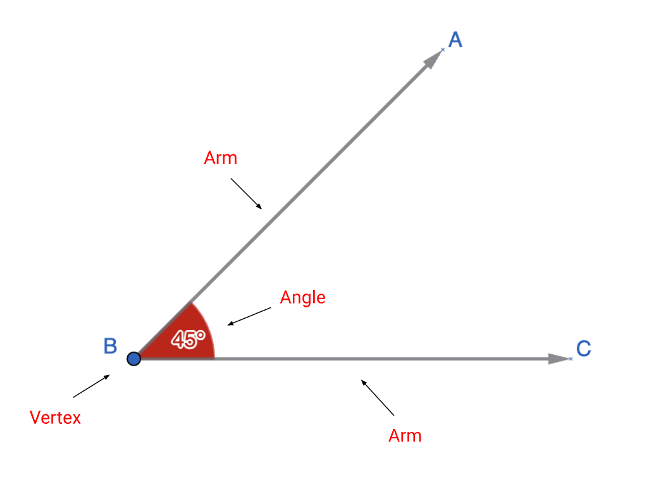
Angle (góc) được tạo thành khi hai tia gặp nhau tại điểm đầu của chúng
Square (hình vuông) là một tứ giác đều có:
4 cạnh bằng nhau,
4 góc vuông (90°),
2 đường chéo bằng nhau, cắt nhau tại trung điểm, và vuông góc với nhau.
Essential Vocab for SAT® Math - Geometry and Trigonometry | Unit 5: Angle + Square
Bài viết này giúp người học củng cố vốn từ vựng hiểu và sử dụng đúng các khái niệm toán học cơ bản như góc (angle) và hình vuông (square) thông qua định nghĩa, bài tập từ vựng và các bài toán thực tế sinh động, gần gũi.
Key takeaways
Việc hiểu và sử dụng đúng các khái niệm toán học cơ bản như góc (angle) và hình vuông (square) đóng vai trò quan trọng trong việc xây dựng nền tảng hình học vững chắc. Không chỉ xuất hiện trong sách vở, những khái niệm này còn được áp dụng rất nhiều trong cuộc sống hằng ngày – từ việc trang trí căn phòng, thiết kế bảng hiệu cho đến đo đạc diện tích và xây dựng công trình. Bài viết này giúp người học củng cố vốn từ vựng toán học thông qua định nghĩa, bài tập từ vựng và các bài toán thực tế sinh động, gần gũi.
Xem lại phần trước: Essential Vocabulary for SAT Math - Geometry and Trigonometry - Unit 4: identical + respectively
Angle (noun): góc
Định nghĩa
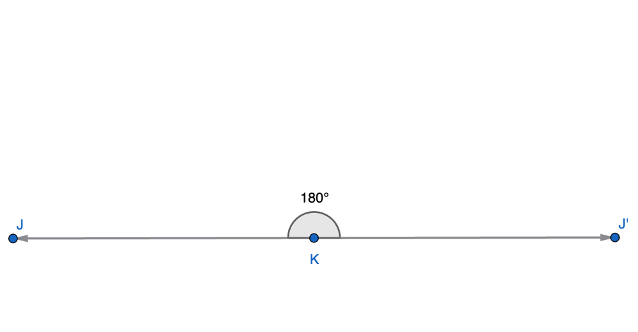
Trong hình học, angle (góc) được tạo thành khi hai tia gặp nhau tại điểm đầu của chúng. Những tia này được gọi là cạnh hoặc cánh tay của góc. Có hai bộ phận chính liên quan đến một góc – các cạnh (arms) và đỉnh (vertex/vertices.)
Các góc phổ biến
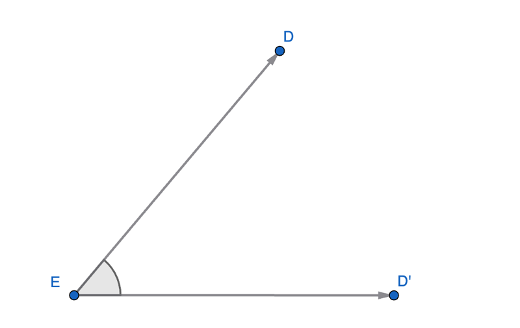
Acute angle – góc nhọn: là góc có độ lớn lớn hơn 0°và bé hơn 90°.
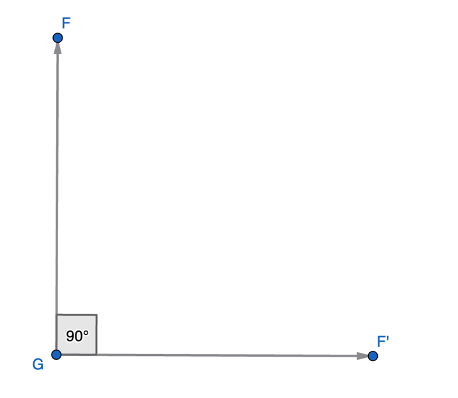
Right angle – góc vuông: là góc có độ lớn bằng 90°.
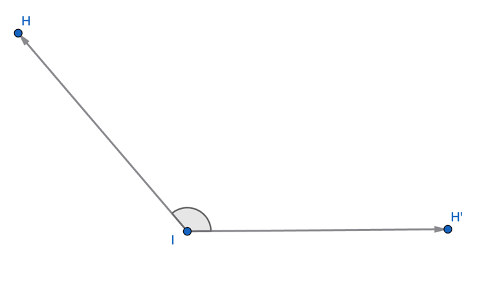
Obtuse angle – góc tù: là góc có độ lớn lớn hơn 90 và bé hơn 180°.
Straight angle – góc bẹt: là góc có độ lớn bằng 180°.
Xem thêm: Cách làm dạng bài Geometry and Trigonometry trong SAT Math
Square (noun): hình vuông
Định nghĩa
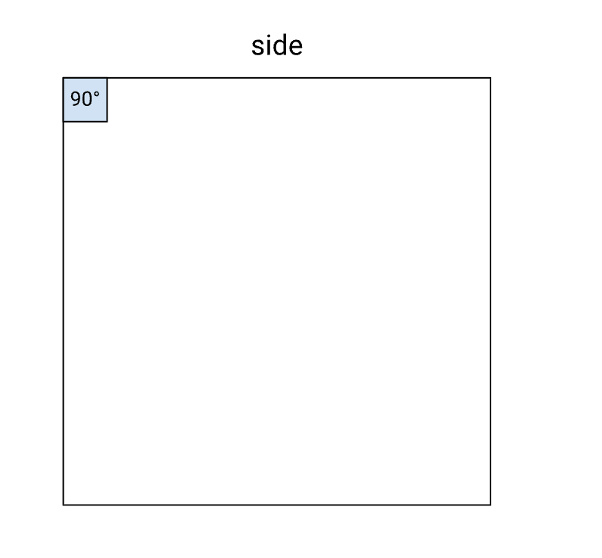
Trong hình học, square (hình vuông) là một tứ giác đều có:
4 cạnh bằng nhau.
4 góc vuông (90°).
2 đường chéo bằng nhau, cắt nhau tại trung điểm, và vuông góc với nhau.
Công thức
1. Chu vi hình vuông (Perimeter): P = 4 × cạnh
2. Diện tích hình vuông (Area): A = cạnh²
3. Độ dài đường chéo (Diagonal): d = cạnh\(\sqrt2\)
Ví dụ: Một hình vuông có cạnh là 5 cm. Tính chu vi, diện tích, và độ dài đường chéo của hình vuông đó.
Chu vi hình vuông: P = 4 × 5 = 20 cm.
Diện tích hình vuông: A = 5² = 25 cm².
Độ dài đường chéo: d = 5\(\sqrt2\) cm.
Kiểm tra từ vựng – angle
Exercise 1: Which sentence uses angle as a mathematical term?
A. He found a new angle to approach the problem.
B. The angle between the two lines is 90 degrees.
C. She looked at the situation from a different angle.
D. The photographer tried to capture the best angle.
Exercise 2: Fill in the blank with one of these words: angle, arm, side, straight.
A square has four equal ________.
A ________ is formed when two rays meet at one point.
Each ray in an angle is called an ________.
A ________ angle measures exactly 180 degrees.
Kiểm tra từ vựng – square
Exercise 1: Which sentence uses square as a geometric term?
A. She stood in the town square and watched the show.
B. Please square the value of 6 to find the result.
C. The square has four equal sides and four right angles.
D. He tried to square his opinion with the facts.
Exercise 2: Fill in the blank with one of these words: square, side, area, perimeter.
A ________ is a shape with four equal sides and four right angles.
The ________ of a square is found by multiplying one side by itself.
The ________ is the total length around the square.
Each ________ of a square is the same length.
Bài toán thực tế – angle
Exercise 1: In triangle ABC, angle A = 50°, angle B = 65°.
What is the measure of angle C?
Is triangle ABC an acute triangle or not?
Exercise 2: A designer creates a triangular window with angles of 90°, 30°, and 60°.
Which angle is the smallest?
Which angle is the right angle?
Exercise 3: A spinning chair rotates 270° before stopping.
Is 270° greater than a straight angle and less than a full circle?
How many more degrees does it need to complete a full 360° turn?
Exercise 4: A triangular sign board has the following two angles: Angle A = 40°, Angle B = 55°.
What is the measure of angle C?
Classify angle C as acute, right, or obtuse.
Exercise 5: A triangular “Yield” road sign has angles measuring 70° and 55°.
What is the missing angle?
Is this triangle acute, right, or obtuse?
Exercise 6: A security camera is installed to cover an angle of 120°.
What type of angle is this?
How many more degrees would the camera need to turn to cover a straight angle (180°)?
Bài toán thực tế – square
Exercise 1: Lan is covering a square floor with tiles. Each side of the floor is 4 meters.
What is the area of the floor?
What is the perimeter?
Exercise 2: A square photo frame has a diagonal of 20 cm.
What is the length of one side?
What is the area of the frame?
Exercise 3: A square garden has an area of 49 m².
What is the length of one side?
What is the length of the diagonal?
Exercise 4: Tom is designing a square playground with a perimeter of 80 meters.
What is the length of one side?
What is the total area of the playground?
Exercise 5: Hoa is cutting carpet tiles into perfect squares for a room. Each square tile has a side length of 0.5 meters.
What is the area of one tile?
If the room is 4m × 4m, how many tiles do you need?
Exercise 6: Minh is creating a square wall art piece. Each side of the frame is 0.6 meters long.
What is the area of the frame?
If Minh wants to add a string border all around the frame, how much string will he need?
Đáp án – angle
Exercise 1: B
Exercise 2:
1. sides
2. angle
3. arm
4. straight
Exercise 1:
1. 65°
2. acute triangle
Exercise 2:
1. 30°
2. 90°
Exercise 3:
1. Yes
2. 90°
Exercise 4:
1. 85°
2. acute angle
Exercise 5:
1. 55°
2. acute triangle
Exercise 6:
1. obtuse angle
1. 60°
Đáp án – quare
Exercise 1: C
Exercise 2:
1. square
2. area
3. perimeter
4. side
Exercise 1:
1. 16 m²
2. 16 m
Exercise 2:
1. 14.14 cm
2. 200 cm²
Exercise 3:
1. 7 m
2. 9.8994 m
Exercise 4:
1. 20 m
2. 400 m²
Exercise 5:
1. 0.25 m²
2. 64 tiles
Exercise 6:
1. 0.36 m²
1. 2.4 m of string
Tác giả: Lê Cát Gia Linh
Thông qua việc luyện tập với các bài tập về góc và hình vuông, người học không chỉ nắm vững lý thuyết mà còn phát triển kỹ năng vận dụng toán học vào đời sống. Những khái niệm tưởng chừng đơn giản này chính là nền tảng cho tư duy logic, khả năng quan sát không gian và giải quyết vấn đề.
Tham khảo chương trình luyện thi SAT cam kết đầu ra tại ZIM Academy để được hướng dẫn chuyên sâu và bứt phá điểm số.
SAT® is a trademark registered by the College Board, which is not affiliated with, and does not endorse, this website.
- Essential Vocabulary for SAT Math - Geometry and Trigonometry
- Essential Vocab for SAT® Math - Geometry and Trigonometry | Unit 18: Equilateral triangle + Perimeter
- Essential Vocab for SAT® Math - Geometry and Trigonometry | Unit 12: Cone + Inscribe
- Essential Vocab for SAT® Math - Geometry and Trigonometry | Unit 11: Trapezoid + Cube
- Essential Vocab for SAT® Math - Geometry and Trigonometry | Unit 7: Area + Prism
- Essential Vocab for SAT® Math - Geometry and Trigonometry | Unit 26: Right angle + Associated angle
- Essential Vocab for SAT® Math - Geometry and Trigonometry | Unit 10: Cylinder + Similar
- Essential Vocab for SAT® Math - Geometry and Trigonometry | Unit 1: Measure + Length
- Essential Vocab for SAT® Math - Geometry and Trigonometry | Unit 16: Arc + Congruent
- Essential Vocab for SAT® Math - Geometry and Trigonometry | Unit 9: Sphere + Altitude
- Essential Vocab for SAT® Math - Geometry and Trigonometry | Unit 14: Perpendicular + Adjacent angles
Tham vấn chuyên môn
Học là hành trình tích lũy kiến thức lâu dài và bền bỉ. Điều quan trọng là tìm thấy động lực và niềm vui từ việc học. Phương pháp giảng dạy tâm đắc: Lấy người học làm trung tâm, đi từ nhận diện vấn đề đến định hướng người học tìm hiểu và tự giải quyết vấn đề.
Bình luận - Hỏi đáp