

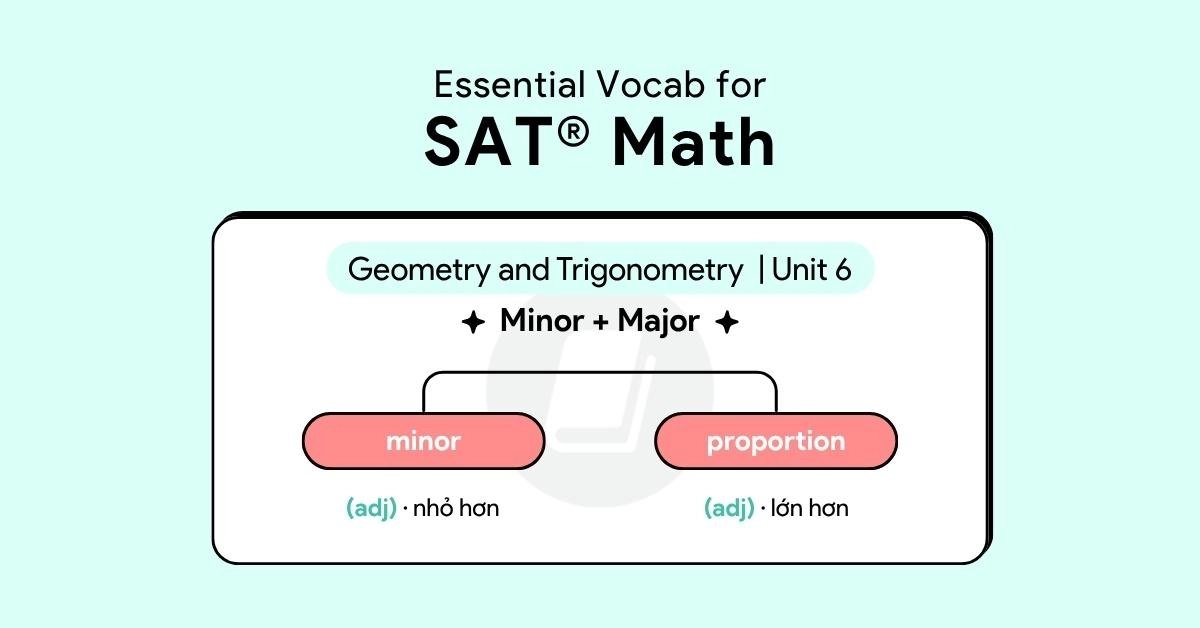
Nắm rõ hai từ vựng quan trọng trong SAT Math Advanced:
Minor (nhỏ hơn)
Major (lớn hơn)
Key takeaways
Nắm rõ hai từ vựng quan trọng trong SAT Math Advanced:
Minor (nhỏ hơn)
Major (lớn hơn)
Việc nắm vững các thuật ngữ trong toán học đóng vai trò thiết yếu trong việc phân tích và giải quyết các bài toán một cách chính xác và hiệu quả. Bài viết này sẽ tập trung làm rõ ý nghĩa cũng như cách sử dụng hai thuật ngữ quan trọng là minor và major trong các ngữ cảnh phổ biến.
Xem lại phần trước: Essential Vocabulary for SAT Math - Geometry and Trigonometry - Unit 5: angle + square
từ đồng nghĩa: smaller
Trong hình học và lượng giác, minor (nhỏ hơn) được sử dụng để mô tả phần nhỏ hơn của một hình hoặc góc khi có sự phân chia. Thuật ngữ này thường xuất hiện trong bối cảnh của các cung tròn, góc, trục ellipse.
Trong bài thi SAT, minor thường xuất hiện trong các câu hỏi về đường tròn và các phép đo góc.
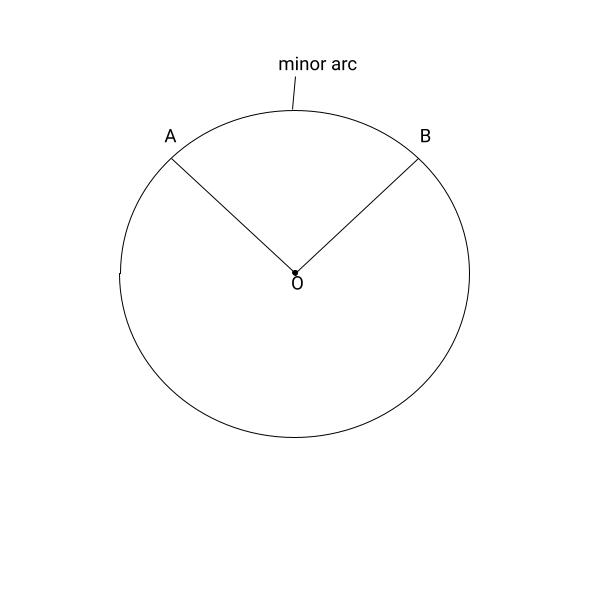
Minor Arc (Cung Nhỏ): Trên đường tròn với hai điểm A và B, minor arc (cung nhỏ) là cung ngắn hơn nối hai điểm này, có số đo góc ở tâm nhỏ hơn 180°, trong khi major arc tương ứng sẽ có số đo lớn hơn 180°. Ví dụ, nếu cung AB có số đo 120°, thì đây là minor arc, còn cung còn lại sẽ có số đo 240° (360° - 120°) và được gọi là major arc.
Minor Axis (Trục Nhỏ): Trong ellipse, minor axis (trục nhỏ) là đoạn thẳng ngắn nhất đi qua tâm và vuông góc với major axis (trục lớn). Độ dài của minor axis được ký hiệu là 2b, trong đó b là bán trục nhỏ (semi-minor axis). Minor axis chia ellipse thành hai nửa đối xứng và xác định chiều rộng nhỏ nhất của hình ellipse.
Xem thêm: Cách làm dạng bài Geometry and Trigonometry trong SAT Math
từ đồng nghĩa: greater
Trong hình học và lượng giác, major (lớn hơn) được sử dụng để mô tả phần lớn hơn của một hình hoặc góc khi có sự phân chia. Thuật ngữ này thường đi đối lập với minor và xuất hiện trong các bối cảnh tương tự.
Trong bài thi SAT, major thường xuất hiện trong các câu hỏi về đường tròn và đo lường góc.
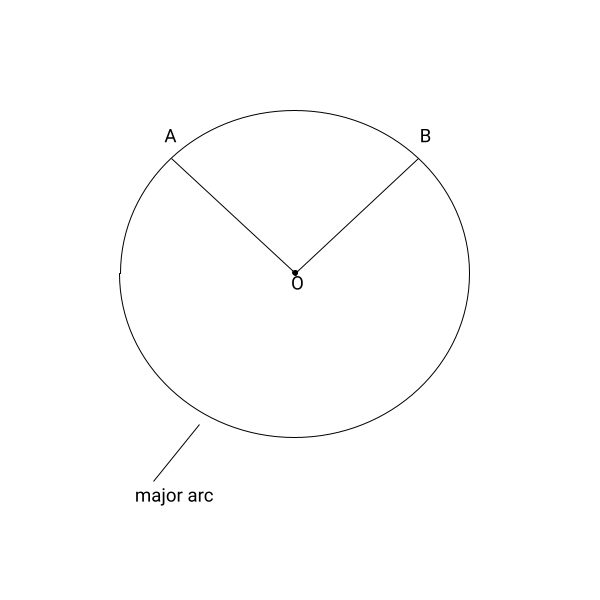
Major Arc (Cung Lớn): Trên đường tròn với hai điểm A và B, major arc (cung lớn) là cung dài hơn nối hai điểm này, có số đo góc ở tâm lớn hơn 180° nhưng nhỏ hơn 360°. Tổng số đo của major arc và minor arc tương ứng luôn bằng 360°. Ví dụ, nếu minor arc AB có số đo 120°, thì major arc AB sẽ có số đo 240° (360° - 120°).
Major Axis (Trục Lớn): Trong ellipse, major axis (trục lớn) là đoạn thẳng dài nhất đi qua tâm và hai tiêu điểm của ellipse.
Fill in the blanks with one of these words: minor, perpendicular, axis, segment, semicircle.
In a circle, two diameters that cross each other at right angles are __________ to each other.
When a chord is drawn across a circle to divide it into two distinct regions of different sizes, the smaller portion that contains less than half of the circle's total area is mathematically referred to as the minor __________, which is always complemented by a larger counterpart.
Any curved path along the circumference of a circle that measures less than 180 degrees and therefore covers less than half of the circle's total boundary is classified as a __________ arc, representing the shorter of two possible paths between any two points on the circle.
In geometric constructions involving circles, any straight line that passes through the center of the circle and extends to both sides of the circumference is called an __________, serving as a line of symmetry that divides the circle into two equal halves.
A __________ represents exactly half of a complete circle, creating an arc that measures precisely 180 degrees and divides the circular shape into two identical parts of equal area and circumference length.
Fill in the blanks with one of these words: major, diameter, segment, circumference, vertex.
In a circle, the longest straight line that can be drawn through the center is called the __________, connecting two points on the opposite sides of the circle and representing the maximum distance across the circular shape.
When a chord divides a circle into two unequal regions, the larger portion that encompasses more than half of the circle's total area and contains the center of the circle is known as the __________ segment, which always has greater area than its smaller counterpart.
The total distance around the edge of a circle is called the __________, which represents the complete boundary that encloses the circular area and can be calculated using the formula involving pi and the radius.
In geometry, a line __________ is a portion of a line that is bounded by two distinct endpoints, having a definite length and serving as one of the fundamental building blocks in geometric constructions.
In coordinate geometry, the __________ of a parabola represents the turning point where the curve changes direction, and it serves as a crucial reference point for determining the parabola's axis of symmetry and overall shape characteristics.
Exercise 1: A circular park has a radius of 10 meters. The walking path goes all around the park. Two benches, bench A and bench B, are placed on the path so that the angle at the center between them is 60 degrees.
Given that the circumference C of a circle is calculated by the formula: C = 2πr, where r is the radius of the circle and π ≈ 3.14.
What is the total distance around the park if you walk once along the path?
How long is the minor path between bench A and bench B?
Exercise 2: A circular fountain has a radius of 8 meters. Two decorative lights are placed on the edge, creating an arc that measures 120°.
Is this a minor arc or a major arc?
What is the measure of the other arc?
Exercise 1: A cargo ship sails along two circular routes across the ocean. Each circular route surrounds a different island. The ship can choose between a large circle with radius 150 kilometers around the main island and a smaller circle with radius 120 kilometers around a smaller island. The larger circle is called the major circle of the route.
What is the radius of the major circle?
How much longer is the radius of the major circle compared to the minor circle?
Exercise 2: A park has two circular playgrounds - a large one with radius 25 meters and a small one with radius 15 meters. The minor circle refers to the smaller circular playground.
What is the radius of the minor circle of the playground?
If fences are built around both circular playgrounds, what is the total length of both fences combined? (Use π ≈ 3.14)
Đáp án - minor
perpendicular
segment
minor
axis
semicircle
Exercise 1:
62.8 meters
10.47 meters
Exercise 2:
Minor arc (120° < 180°).
240° (360° - 120° = 240°)
Đáp án - major
diameter
major
circumference
segment
vertex
Exercise 1:
150 kilometers
30 kilometers
Exercise 2:
15 meters.
251.2 meters
Tác giả: Lê Quỳnh Anh
Việc nắm vững các khái niệm như minor và major không chỉ giúp người học sử dụng chính xác trong các biểu thức học thuật, mà còn hỗ trợ phân tích các bài toán thực tế một cách hiệu quả. Qua những ví dụ minh họa và các bài tập thực hành, người đọc có thể luyện tập và củng cố kiến thức để ứng dụng vào việc giải quyết các vấn đề thực tiễn một cách dễ dàng hơn.
Tham khảo chương trình luyện thi SAT cam kết đầu ra tại ZIM Academy để được hướng dẫn chuyên sâu và bứt phá điểm số.
SAT® is a trademark registered by the College Board, which is not affiliated with, and does not endorse, this website.
Nguồn tham khảo
“minor.” Cambridge Dictionary, https://dictionary.cambridge.org/vi/dictionary/english/minor. Accessed 8 July 2025.
“major.” Cambridge Dictionary, https://dictionary.cambridge.org/vi/dictionary/english/major. Accessed 8 July 2025.
Đánh giá
Gửi đánh giá
Bình luận - Hỏi đáp